Two-Headed Turtles: Causes, Famous Cases & Why They’re So Rare
This post was created with help from AI tools and carefully reviewed by a human (Muntaseer Rahman). For more on how we use AI on this site, check out our Editorial Policy.
The first time I saw a two-headed turtle, I honestly thought it was a Photoshop prank. Then I watched a video of one crawling around a vet’s desk, both heads munching on lettuce like two toddlers fighting over the last french fry, and my brain short-circuited.
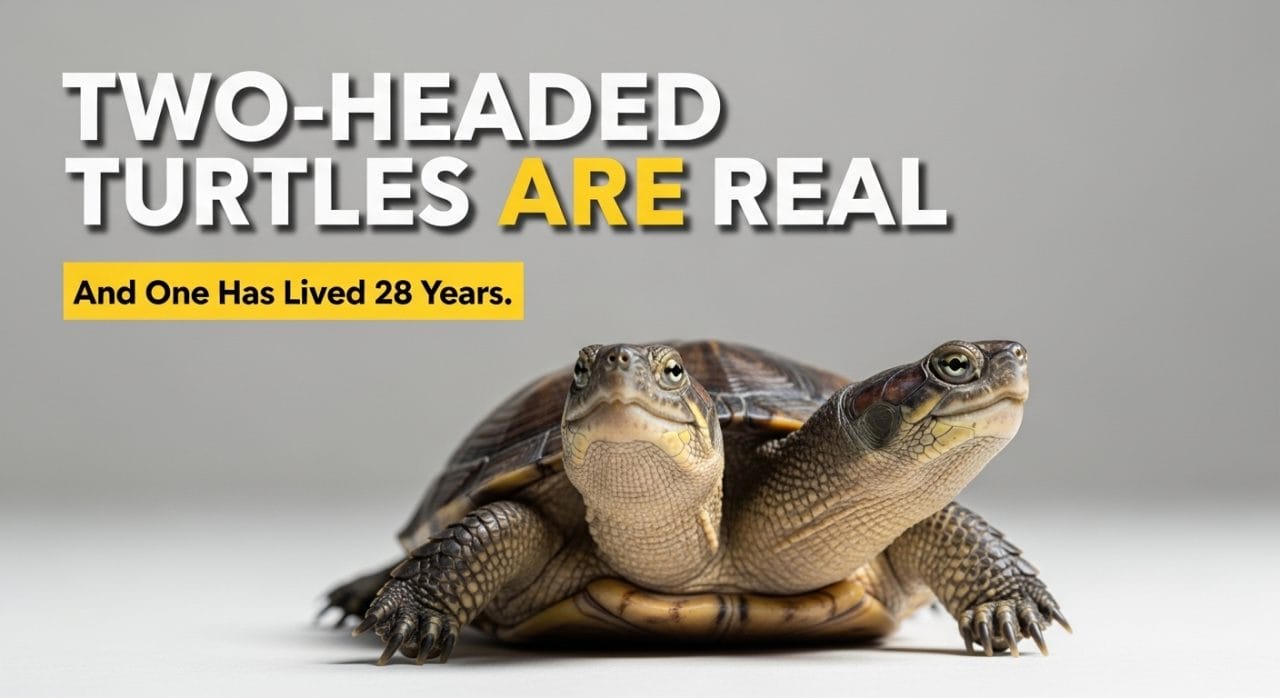
Turns out two-headed turtles are 100% real. The condition is called bicephaly (sometimes polycephaly if you’re feeling fancy), and while it’s wildly rare, it shows up in everything from sea turtles to box turtles to tortoises. Let’s get into what causes it, which ones have made headlines, and why most of them don’t last long in the wild.
What Exactly Is a Two-Headed Turtle?
A two-headed turtle is a turtle born with two fully or partially formed heads sharing one body. Scientists call it bicephaly when there are exactly two heads, and polycephaly when there’s more than one (three is possible but we’re talking absurdly rare).
Inside that shell, things get wild. Some have two separate brains, two necks, two esophagi, and even two stomachs. Others share most of their internal organs. It just depends on how far the split went during embryo development.
The two heads often act independently, too. One might want to swim left, the other wants to head right. Feeding time can look like a slow-motion wrestling match.
Why Are Some Turtles Born With Two Heads?
Bicephaly happens during embryonic development, usually in the first few days after the egg is laid. Here’s what can cause it:
1. Incomplete Twin Splitting
This is the big one. When a turtle embryo starts to split into identical twins but the split stops halfway, you end up with two heads sharing a body. It’s the same mechanism that produces conjoined twins in humans.
2. Genetic Mutations
Random mutations can mess with the genes that control cell division and body symmetry. Most mutations are harmless — but some cause the neural tube (the early spinal cord) to bifurcate and form two heads instead of one.
3. Incubation Temperature
Turtles are ectothermic, which is just a fancy way of saying their body temperature matches their environment. Eggs incubated at abnormal temperatures (too hot, too cold, or wildly fluctuating) are more likely to produce deformities, including bicephaly.
4. Environmental Pollution
Chemical exposure is a real concern. Pollutants like heavy metals, pesticides, and endocrine disruptors can interfere with embryo development. Coastal pollution is one reason researchers think we’re seeing more two-headed sea turtle hatchlings in recent decades.
5. Inbreeding
Small, isolated turtle populations sometimes run out of fresh genetics. When relatives breed, recessive mutations surface more often — and bicephaly is one of them.
6. Just… Bad Luck
Sometimes it happens for no identifiable reason. Developmental biology is messy, and occasionally an embryo just does its own thing.
This Hilarious Turtle Book Might Know Your Pet Better Than You Do

Let’s be real—most turtle care guides feel like reading a textbook written by a sleep-deprived zookeeper.
This one’s not that.
Told from the snarky point of view of a grumpy, judgmental turtle, 21 Turtle Truths You’ll Never Read in a Care Guide is packed with sarcasm, sass, and surprisingly useful insights.
And hey—you don’t have to commit to the whole thing just yet.
Grab 2 free truths from the ebook and get a taste of what your turtle really thinks about your setup, your food choices, and that weird plastic palm tree.
It’s funny, it’s honest, and if you’ve ever owned a turtle who glares at you like you’re the problem—you’ll feel seen.
How Rare Are Two-Headed Turtles?
Really, really rare. There’s no hard global number because most cases die in the egg and nobody counts them, but biologists estimate bicephaly occurs in less than 1 in 10,000 turtle hatchlings, possibly closer to 1 in 100,000 for some species.
What we see in news stories is the tiny fraction that survive past hatching. Most don’t.
Famous Two-Headed Turtles You Should Know
Over the years, a handful of two-headed turtles have become minor celebrities. Here are the ones worth knowing.
Janus — The World Record Holder
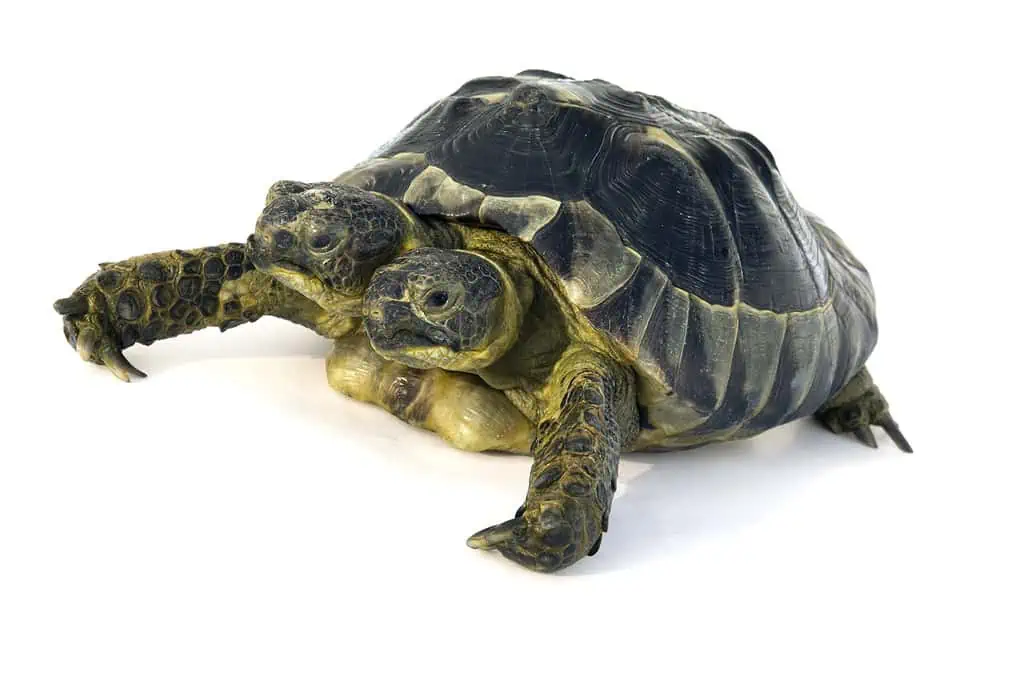
Born in 1997 at the Natural History Museum of Geneva, Janus is a Greek tortoise and the oldest known two-headed tortoise alive. He celebrated his 25th birthday in September 2022 with an actual party, and as of 2026, he’s 28+ years old and still going strong.
Janus has two hearts, two pairs of lungs, two stomachs, and two very distinct personalities (one head is reportedly more curious, the other more cautious). He gets organic salads, daily massages, warm baths, and regular walks. Basically he lives better than most of us.
Fun fact: he’s gotten so big he can no longer fully tuck both heads inside his shell. He’s named after the Roman god with two faces.
Mary-Kate and Ashley — The Massachusetts Terrapin (2021)
In September 2021, a diamondback terrapin hatched at a protected nesting site in Barnstable, Massachusetts with two independently controlled heads and six legs (each head controls its own three). Staff at the Birdsey Cape Wildlife Center named them after the Olsen twins.
X-rays showed two separate gastrointestinal tracts and a partially fused spine. They were thriving when last reported — eating well, swimming, and gaining weight. The center’s CEO said it was the first bicephalic turtle they’d ever seen.
Thelma and Louise — The San Antonio Zoo Sliders (2013)
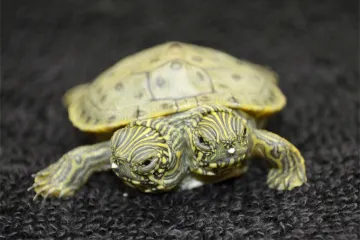
A pair of two-headed red-eared sliders born in June 2013 and displayed at the San Antonio Zoo. Named after the famous movie duo, they drew huge crowds and became a pop culture moment.
South Carolina Loggerhead Hatchling (2021)
In September 2021, volunteers doing nest inventory at Edisto Beach State Park found a two-headed loggerhead sea turtle hatchling. Park staff said it was the first they’d ever seen after years of monitoring. It was released into the ocean, though survival odds for wild two-headed hatchlings are brutal.
Maldives Green Turtle Embryos (2021 & 2025)
The Olive Ridley Project has documented multiple two-headed green sea turtle embryos during nest monitoring in the Maldives. One was found in Baa Atoll in 2021 with severe deformities including lordosis (curved spine). Another polycephalic embryo turned up in October 2025. Neither survived.
Historical Cases
Two-headed reptiles pop up in old records going back to ancient China and Greece, often treated as omens. A two-headed choristoderan (a fossil reptile) was found in Early Cretaceous rocks in China — over 120 million years old — making it the oldest known polycephalic vertebrate in the fossil record.
Daily Life With Two Heads
Being a two-headed turtle is genuinely hard. Here’s why.
Coordination Is a Nightmare
Each head has its own brain, its own eyes, and often its own opinion. When the two heads disagree about direction, the turtle can literally walk in circles or get stuck.
Some two-headed turtles eventually “learn” to cooperate. Others never quite figure it out.
Feeding Fights
Both heads want to eat. Both heads have different preferences. Caretakers usually feed them separately — one head at a time — to make sure both get nutrition and don’t fight over scraps.
Health Problems Are the Norm
Two-headed turtles are significantly more prone to:
- Spinal deformities
- Respiratory issues (especially if they share a trachea)
- Digestive problems (two mouths, one gut can be chaos)
- Shell abnormalities
- Immune weakness
They need way more vet care than a regular turtle. And even with top-tier care, most don’t live past a few months to a few years. Shell deformities show up in many forms — our turtle shell patterns guide explains what healthy vs. unhealthy shells actually look like.
Wild vs. Captivity — The Harsh Math
In the wild, two-headed hatchlings almost never make it. A turtle that can’t swim straight, can’t coordinate, and can’t hide efficiently gets eaten fast. Predators like crabs, fish, and birds pick them off within days.
In captivity with dedicated care, survival rates jump dramatically. That’s why nearly every long-lived two-headed turtle you’ve heard of lives in a zoo, museum, or wildlife center.
What Does the Science Actually Say?
Researchers keep finding and studying two-headed turtle cases to figure out what’s going wrong in development. Some recent highlights:
- A 2024 study in the Journal of Experimental Zoology documented a bicephalic green turtle hatchling, adding to a growing body of research on congenital malformations in sea turtles.
- A 2017 paper on a two-headed green sea turtle hatchling from Samandağ Beach, Turkey showed the spinal column split near the tail and organs like the esophagus, lungs, and heart were fully duplicated.
- A 2021 Maldives study raised concerns that climate change and coastal pollution may be increasing bicephaly rates in sea turtle nests.
- A Cretaceous-era fossil from China’s Yixian Formation proved this condition has been happening in reptiles for at least 120 million years.
The current scientific consensus: bicephaly is mostly a random developmental glitch, but environmental stressors (heat, pollution, inbreeding) tilt the odds.
Conservation and Care — Should We Even Keep Them Alive?
This is where it gets ethically messy. Two-headed turtles are basically guaranteed to suffer more than regular turtles. Some conservationists argue we shouldn’t artificially extend their lives. Others point out that studying them teaches us about embryonic development, climate-linked deformities, and genetic diversity.
Most wildlife centers that care for bicephalic turtles do it for three reasons:
- Research value — each case adds to our understanding of reptile development.
- Public education — they’re powerful ambassadors for conservation talks.
- Ethical care — since the turtle exists, they believe it deserves decent life quality.
Good captive care for a two-headed turtle usually involves separate feeding stations, vet monitoring every few weeks, a temperature-controlled habitat, and protection from stress.
Two-Headed Turtle FAQ
Are two-headed turtles real or fake?
Totally real. Bicephaly is a documented condition in reptiles, mammals, fish, and even snakes. The rarity makes it feel fake, but there’s solid scientific literature and living examples (like Janus) to prove it.
How long do two-headed turtles live?
Most die within weeks or months. Some captive ones live a few years. The record holder, Janus, is 28+ years old — but he’s a massive outlier. In the wild, the lifespan is usually days.
Are two-headed turtles the same as conjoined twins?
Pretty much, yes. Bicephaly is the reptile equivalent of partially conjoined twins in humans — two embryos that started to separate but stopped halfway.
Can a two-headed turtle be bought as a pet?
Technically yes in some jurisdictions, and they occasionally sell for thousands of dollars. But they’re fragile, need expert vet care, and many countries restrict the trade. Honestly, unless you’re a licensed reptile rehabber with deep pockets, you should leave them to zoos and wildlife centers.
Which turtle species get bicephaly most often?
Bicephaly has been documented in red-eared sliders, diamondback terrapins, Greek tortoises, loggerhead sea turtles, green sea turtles, box turtles, and African-spurred tortoises. It seems to happen across most species — sea turtles just get more attention because of nesting monitoring programs. For the full family tree these species belong to, see our turtle taxonomy guide.
Do two-headed turtles have two brains?
Usually yes. Each head typically has its own brain, its own eyes, and its own nervous system wiring down to the point where the spine merges. That’s why the two heads often act independently.
Do the two heads get along?
Sometimes! Janus’s two heads reportedly coexist fine. But many bicephalic turtles have documented “fights” — one head trying to bite the other, or both pulling in opposite directions. It really depends on the individual turtle.
The Weird Takeaway
Two-headed turtles are a reminder that biology is messier than any textbook makes it sound. Every time a two-headed hatchling shows up on a beach or in a nest, it tells us something about how genes, temperature, and pollution all tangle together to shape what comes out of an egg.
They’re also just genuinely cool. Rare, weird, hard-to-explain, and often heartbreaking — but proof that nature occasionally rolls the dice and lands somewhere unexpected.
If you ever spot one in the wild (extremely unlikely, but hey), don’t pick it up — call your local wildlife agency. These animals need expert handling from minute one, and a well-meaning tourist is one of the fastest ways to accidentally hurt them.
Want more weird turtle stuff? Stick around — we go deep on everything from albino turtles to ancient turtle fossils.

About Author
Muntaseer Rahman started keeping pet turtles back in 2013. He also owns the largest Turtle & Tortoise Facebook community in Bangladesh. These days he is mostly active on Facebook.