18 Aquatic Turtle Habitat Setups, Matched To Your Species And Space
This post was created with help from AI tools and carefully reviewed by a human (Muntaseer Rahman). For more on how we use AI on this site, check out our Editorial Policy.
When I first got my turtle, I thought a tank, some water, and a basking rock would be enough.
Spoiler: it wasn’t.
If your aquatic turtle tank feels like it’s missing something, these 18 tank ideas and habitat setups will give you a clear plan. You’ll find everything from beginner starter tanks to outdoor stock tank ponds, planted aquascapes, and floating island builds, each with steps to recreate it.
Skim the quick-reference table to find the setup that fits your water turtle, your space, and your skill level, then jump to the full build below. For the dry half of the build, our 26 DIY turtle basking area ideas pair with any tank here.
Quick Reference: Which Aquatic Turtle Tank Setup Fits You
| Setup | Best For | Tank / Water Size | Difficulty |
|---|---|---|---|
| 1. Above-Tank Basking Loft | Sliders, cooters that bask a lot | 75+ gal | Hard |
| 2. Riverbank Aquascape | Active swimmers, planted-tank fans | 55+ gal | Medium |
| 3. Simple Starter Tank | First-time owners, hatchlings | 40+ gal | Easy |
| 4. Twin-Level Mansion | Space-saving multi-zone keepers | 75+ gal | Hard |
| 5. Half-Water Habitat | Semi-aquatic species, beginners | 40+ gal | Easy |
| 6. Budget Basking Tank | Tight budgets, single small turtle | 40+ gal | Easy |
| 7. Driftwood Zen Tank | Minimalist, low-stress setups | 55+ gal | Medium |
| 8. Outdoor Stock Tank Pond | Outdoor keepers with yard space | 100+ gal | Medium |
| 9. Paludarium Moss Wall | Display tanks, mud/musk turtles | 40+ gal | Hard |
| 10. Deep Water Swimmer | Painted, map turtles, cooters | 75+ gal | Medium |
| 11. Rock Canyon Habitat | Turtles that love caves and hides | 55+ gal | Medium |
| 12. Blackwater Biotope | Natural-look, jungle-stream species | 55+ gal | Medium |
| 13. Indoor Turtle Table | Mud, musk, small species | 4 ft+ frame | Medium |
| 14. Split-Theme Dual Zone | Display builds, beach + planted fans | 75+ gal | Hard |
| 15. Floating Island | Open-water swimmers, enrichment | 55+ gal | Medium |
| 16. Small Space Nano Tank | Musk, mud, small species | 20-40 gal | Easy |
| 17. Turtle + Fish Community Tank | Experienced keepers | 75+ gal | Hard |
| 18. Bookshelf / Corner Tank | Apartments, tight spaces | 20-40 gal | Medium |
The Equipment Every Aquatic Turtle Tank Needs (But Photos Don’t Show)
These setups look amazing, but the structure changes while the core equipment stays the same. Get this right once and every idea below will work.
The habitat is the fun part, but water quality is what keeps an aquatic turtle healthy, so it helps to log your water tests and filter cleanings in a turtle care app and catch trouble before it shows on the turtle.
- Filtration: A canister filter (my pick: Penn-Plax Cascade) rated for 2 to 3x your tank volume (Fluval FX4 for 55 to 75 gal, FX6 for 100+ gal). Skip internal and HOB filters, they’re too weak for turtle waste.
- UVB (my pick: Zoo Med ReptiSun 10.0) lighting: A proper fixture like the ReptiSun 10.0 T5 HO or Arcadia D3 12%, mounted 10 to 12 inches above the basking spot. Replace every 6 to 12 months. Generic “basking bulbs (my pick: Zoo Med PowerSun)” do not provide UVB.
- Basking heat lamp (my pick: heat lamp): A separate 75 to 100W bulb creating an 88 to 92°F basking surface for digestion. This is a different fixture from your UVB.
- Water heater: Turtles spend 80 to 90% of their time in the water. Hold 75 to 80°F year-round at 2.5 to 5 watts per gallon, and shield it so your turtle can’t crack the glass.
- Water treatment: Seachem Prime to remove chlorine and chloramine, plus an API test kit for ammonia, nitrite, nitrate, and pH while the tank cycles (4 to 6 weeks).
- Proper nutrition: A quality pellet like Mazuri or Zoo Med, a calcium supplement (my pick: Rep-Cal Calcium with D3) with D3, and varied greens.
For exact product picks and sizing, see our Complete Turtle Owner Essentials guide. A beautiful habitat without this gear is just an expensive decoration around a sick turtle.
This Hilarious Turtle Book Might Know Your Pet Better Than You Do

Let’s be real—most turtle care guides feel like reading a textbook written by a sleep-deprived zookeeper.
This one’s not that.
Told from the snarky point of view of a grumpy, judgmental turtle, 21 Turtle Truths You’ll Never Read in a Care Guide is packed with sarcasm, sass, and surprisingly useful insights.
And hey—you don’t have to commit to the whole thing just yet.
Grab 2 free truths from the ebook and get a taste of what your turtle really thinks about your setup, your food choices, and that weird plastic palm tree.
It’s funny, it’s honest, and if you’ve ever owned a turtle who glares at you like you’re the problem—you’ll feel seen.
18 Aquatic Turtle Tank Ideas
1. Indoor Turtle Paradise With Above-Tank Basking Loft
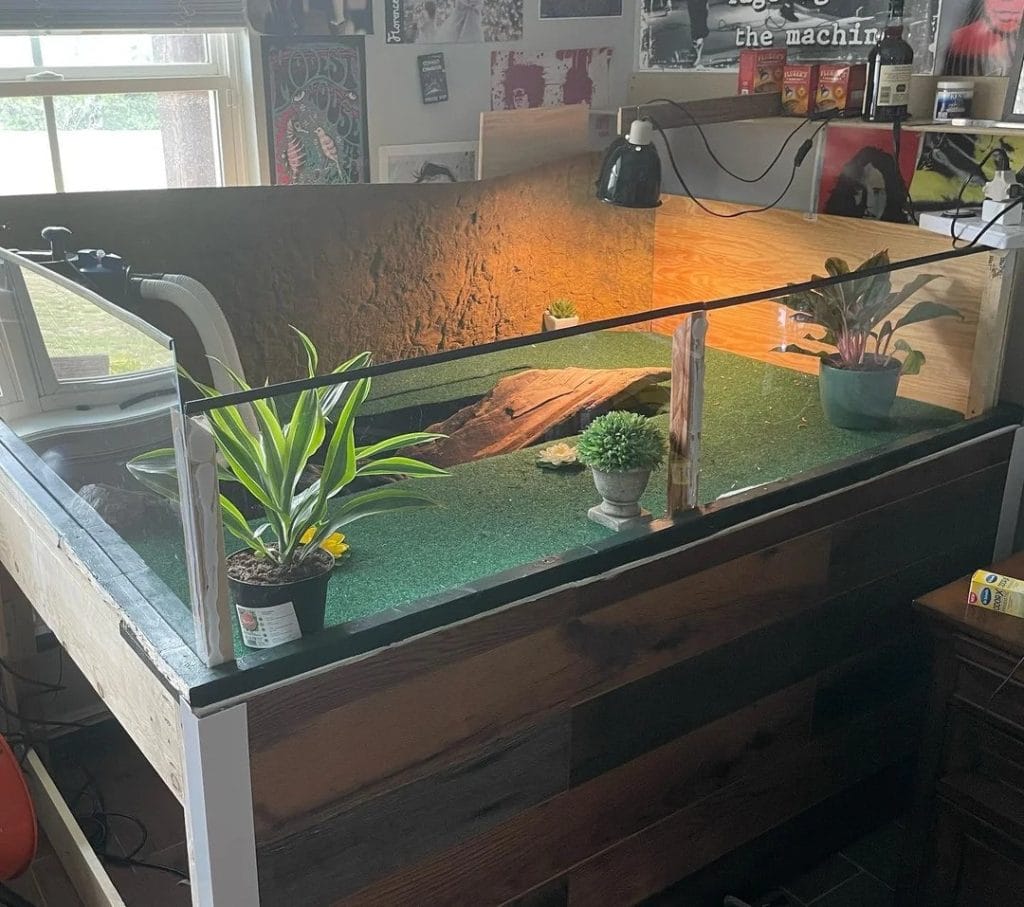
This setup stands out for its large, raised basking area that sits above the tank. It has warm UV lighting, artificial turf for grip, and decorative plants to create a cozy dry zone.
To make this: build a wooden or glass extension on top of your tank, add a ramp for your turtle to climb, and mount a basking lamp overhead. Use fake plants to avoid mess and rot.
Best for: Heavy baskers like sliders and cooters in a 75+ gallon tank. The loft frees up full swimming depth below, but the wooden frame needs sealing against constant splash.
2. Natural Riverbank Aquascape
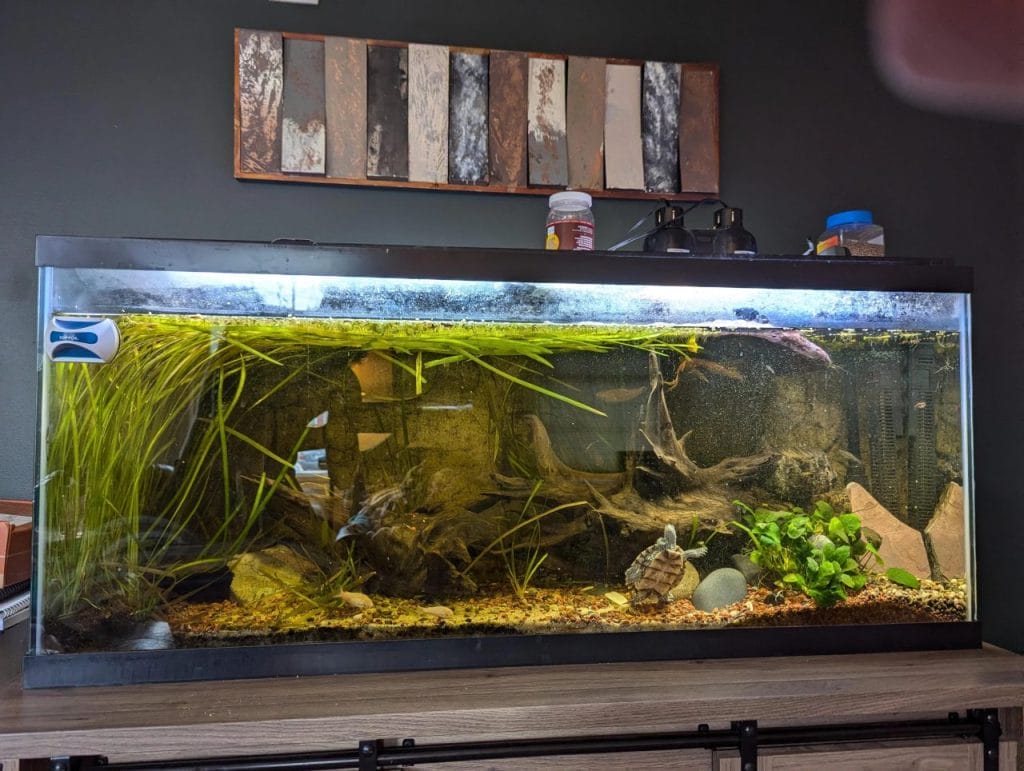
This one mimics a natural river scene with driftwood, live plants, and dark substrate. It’s heavily planted and filtered, great for turtles that love to swim and explore.
To recreate it: use a canister filter, add smooth river rocks, lots of plants like Vallisneria, and place driftwood for hiding spots. Keep water deep and clean.
Best for: Active swimmers and planted-tank fans. Pick turtle-tough plants (Vallisneria, Anubias, Java fern); most softer species get shredded or eaten.
3. Simple and Clean Starter Habitat
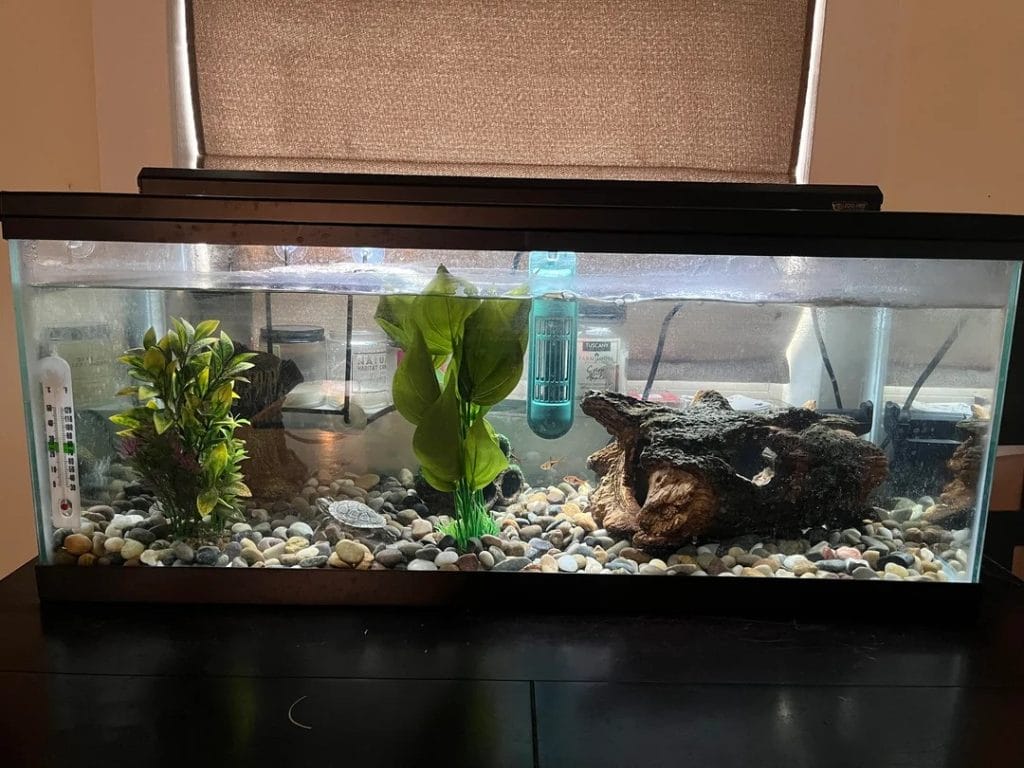
This setup is perfect for beginners. It uses a shallow layout with plastic plants, smooth gravel, and a clear basking platform (my pick: floating basking platform). Easy to clean and maintain.
To make this: get a basic tank, use large smooth gravel (avoid small pebbles to prevent choking), add fake plants, and install a heater and basking light.
Best for: First-time owners and hatchlings. Just be specific with gear, “a heater and basking light” isn’t enough. You need a UVB fixture plus a separate heat lamp, not one combo bulb.
4. Twin-Level Turtle Mansion
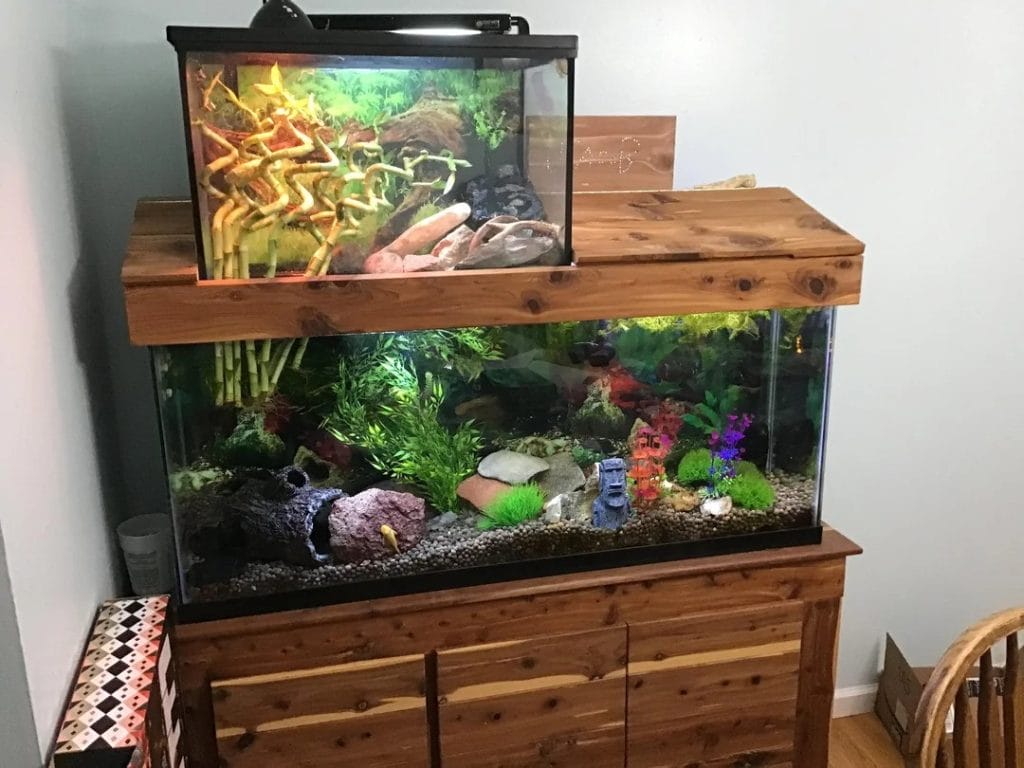
This one’s a clever stack: a small land tank sits right on top of a large aquatic tank. It saves space while giving your turtle both dry and wet zones.
To make it: use a strong wooden stand to hold the upper tank, connect both levels with a ramp or tunnel, and add lighting on top for the basking area.
Best for: Keepers short on floor space who still want big swimming volume. The catch is weight, a full upper tank is heavy, so the stand and ramp must be rock solid.
5. Classic Half-Water Habitat with Background Illusion
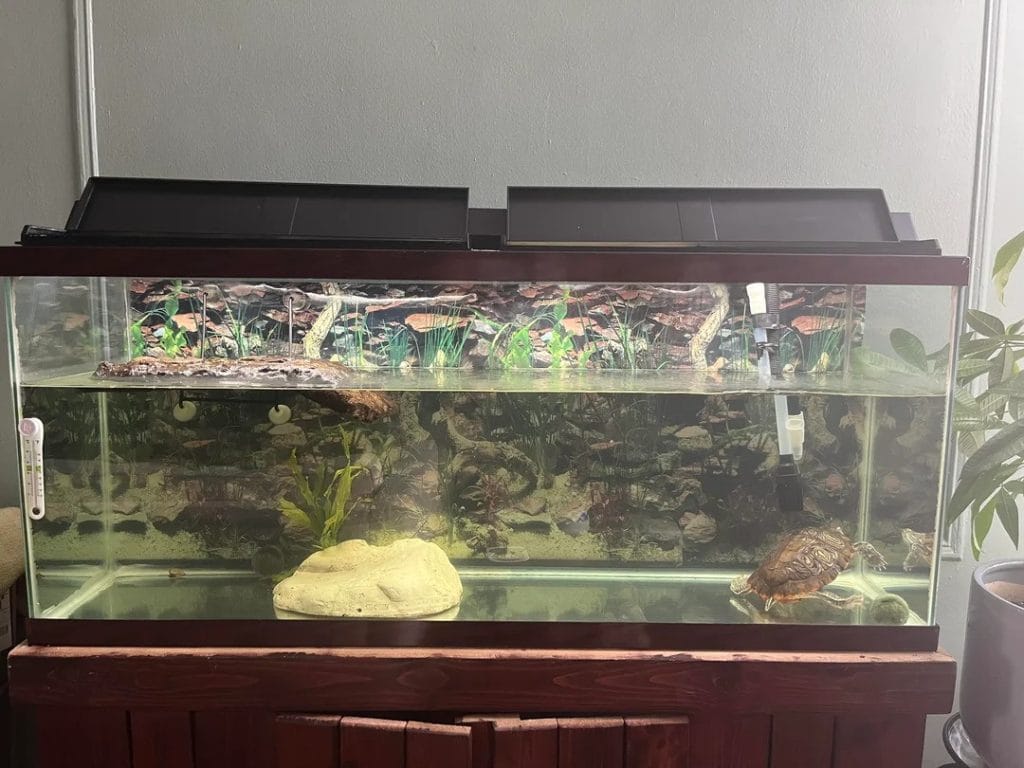
This setup uses half-filled water to leave enough room for basking. The photo backdrop makes it feel like a forest stream.
You can recreate this with a shallow water level, floating or suction-cup platforms, and a printed tank background for depth. Keep the water heater low and safe.
Best for: Semi-aquatic species and beginners who want an easy, low-water setup. Make sure the basking platform is fully dry and the water still covers your turtle’s shell height for swimming.
6. Budget Basking Beauty
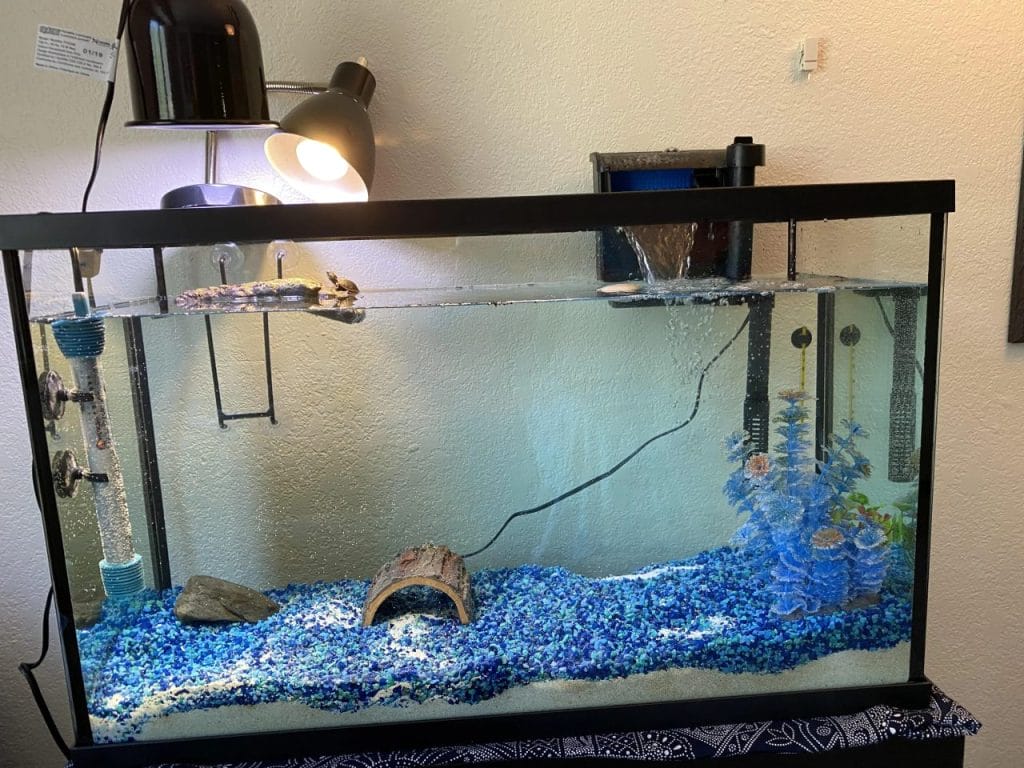
This tank keeps it simple with a hang-on basking dock and bright overhead lamp. The blue gravel adds a splash of color.
To make this: get a floating turtle dock, use a proper UVB fixture overhead, and use colored gravel for easy cleaning and visibility. If the tank itself is the expensive part, our 21 budget DIY turtle tank builds cover the bin, recycled and foam-board routes with a cost breakdown for each.
Best for: Tight budgets and a single small turtle. Budget should never mean a random desk lamp, you still need a real UVB fixture (ReptiSun 10.0 T5 HO) plus a separate heat lamp.
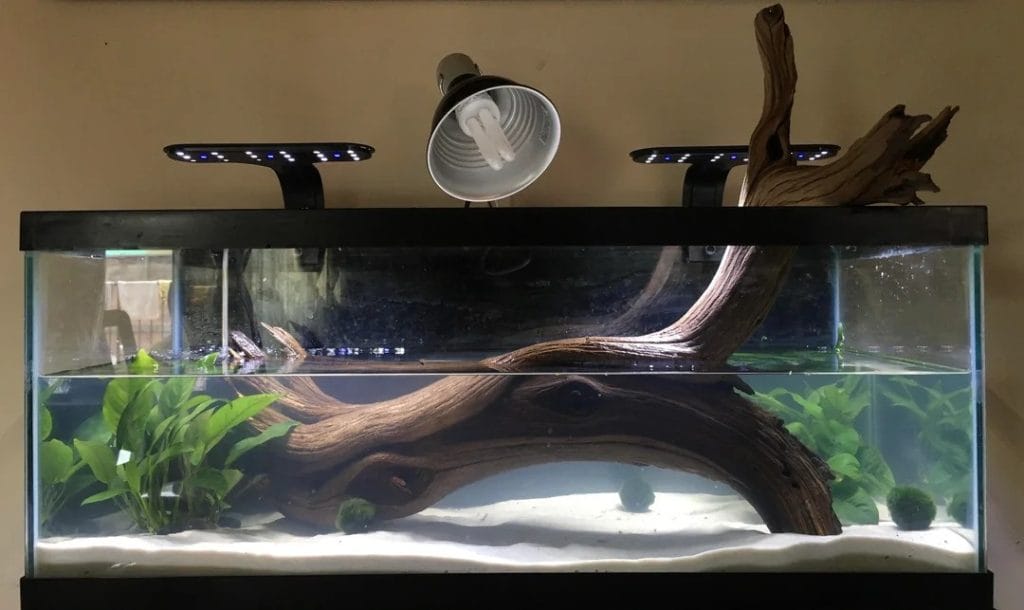
7. Natural Driftwood Zen Tank
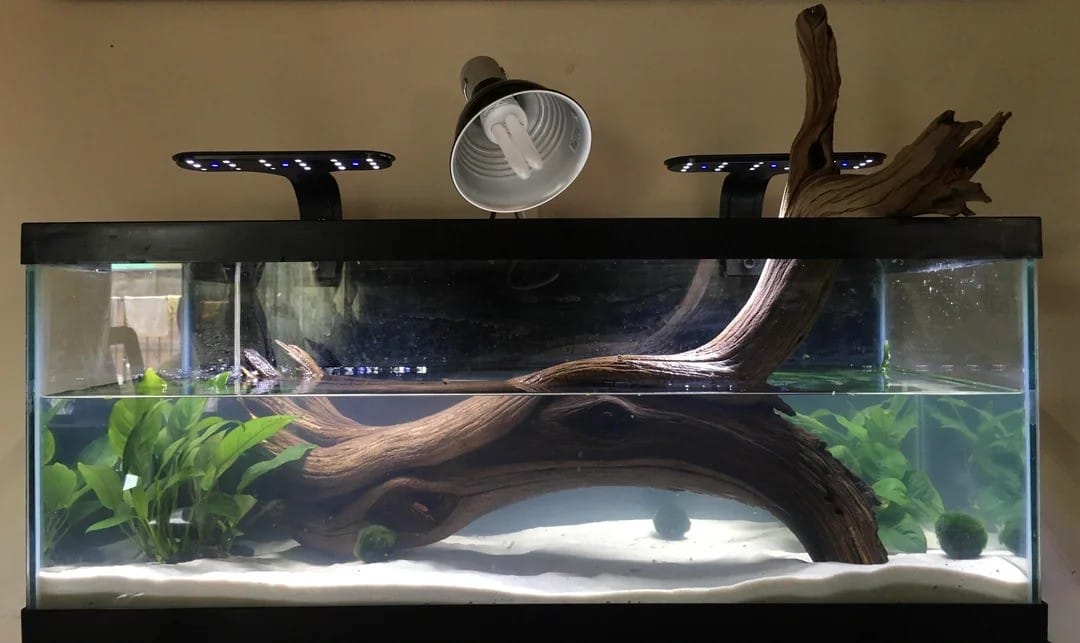
Minimalist and peaceful, this setup focuses on white sand, live plants, and large driftwood. It’s low-stress and easy on the eyes.
Set it up by choosing white substrate, adding live plants like Anubias, and placing one or two large pieces of driftwood. Use soft lighting to keep it calm.
Best for: Minimalist keepers who want a calm, display-quality look. Soak new driftwood first so it sinks and releases tannins before it goes in the tank.
8. Outdoor Stock Tank Pond
If you’ve got the space (and the weather), a stock tank pond is one of the best upgrades you can give your turtle.
This setup uses a large Rubbermaid or galvanized stock tank placed outdoors, on a patio, deck, or backyard. Add emergent plants like water lettuce or water hyacinth around the edges, stack flat slate pieces for a natural basking spot, and let natural sunlight handle the UVB.
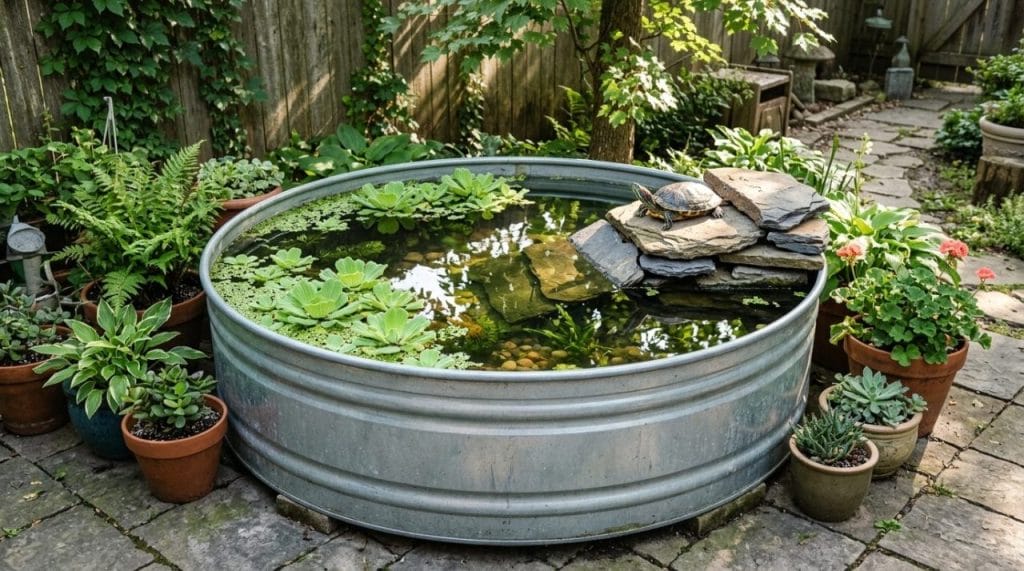
To make this: pick a 100+ gallon stock tank, place it where it gets a mix of sun and shade throughout the day, add a pond filter or canister filter, and build up one side with flagstone for basking access. A mesh cover is essential to keep out predators like raccoons and birds.
Best for: Outdoor keepers with yard space. Sunlight covers UVB, but you still need filtration (outdoor water fouls fast) and shade, since full sun all day overheats the water.
9. Paludarium-Style Moss Wall Habitat
This one blurs the line between aquarium and terrarium, and it looks absolutely stunning.
A paludarium setup features a lush, dripping moss and plant wall covering the back of the tank. The bottom has shallow water for swimming, while one side has a built-up land area with soil, moss, and small plants. It gives the whole thing a tropical rainforest vibe.
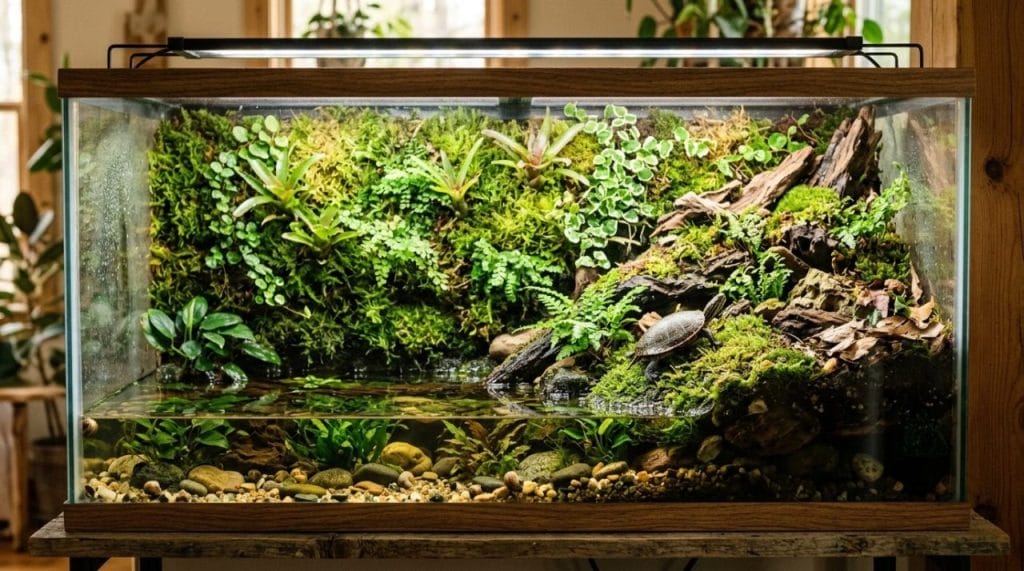
To recreate it: use expanding foam or egg crate to build a background structure, cover it with coco fiber and live moss (like Java moss or Christmas moss), and add a small pump to circulate water down the wall. Keep the water level lower than a standard setup, around 6 to 8 inches, and create a sloped land area on one side with rocks and substrate.
Best for: Display tanks and shallow-water species like mud and musk turtles. The moss wall is pure aesthetics, so don’t let it distract from filtration and UVB.
10. Deep Water Swimmer’s Paradise
Not every turtle likes lounging on a dock. Some are built to swim, and this setup gives them the space to do it.
This habitat maxes out water depth with a tall, fully filled tank optimized for strong swimmers like painted turtles, map turtles, or cooters. The bottom stays clean and minimal, maybe some smooth river rocks or bare bottom for easy cleaning. Floating plants like duckweed or frogbit drift on the surface, and a top-mounted basking dock keeps the dry area out of the way.
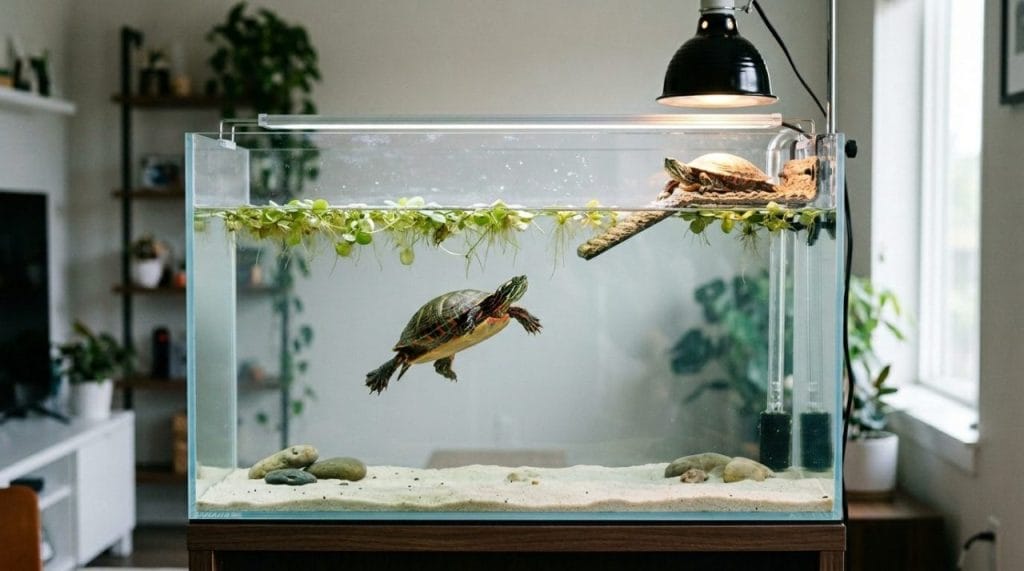
To build this: use the tallest tank you can find (or a 75+ gallon standard), fill it nearly to the top, add a clip-on or suction-cup basking platform near the surface, and scatter floating plants for cover. Skip the heavy decorations on the bottom, this tank is about swimming room.
Best for: Painted turtles, map turtles, and cooters. Deep water means more volume to filter, so size your canister filter to the full tank and expect a longer cycle.
11. Rock Canyon Habitat
Rugged, dramatic, and surprisingly functional, this setup turns your tank into a mini canyon landscape.
Stacked slate and flagstone create canyon walls, tunnels, and caves inside the tank. Sandy substrate covers the bottom. The overall look feels like a desert river gorge, all hard edges, layered stone, and earthy tones. Turtles love squeezing through the gaps and hiding in the caves.
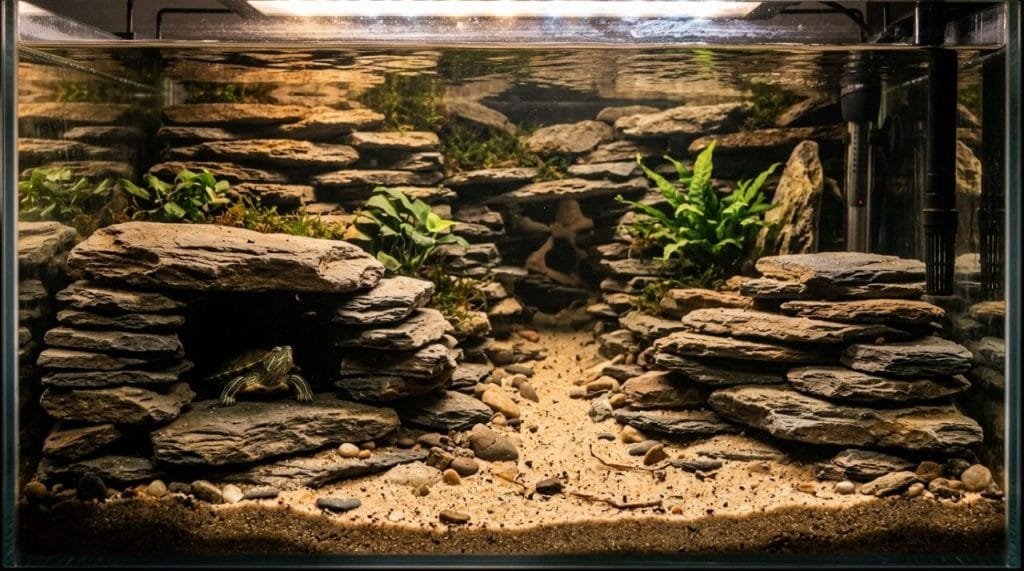
To build this: use aquarium-safe silicone to secure flat slate or flagstone pieces into stable stacks. Create at least one tunnel and one cave for hiding spots. Use fine sand as substrate (avoid sharp-edged gravel). Leave enough open water in the center for swimming. The top of the tallest rock stack doubles as the basking area.
Best for: Turtles that love caves and hides. Silicone every stack securely, a falling slab can crack the glass or injure your turtle.
12. Blackwater Biotope Tank
If you want a setup that looks nothing like anyone else’s, this is it.
A blackwater biotope mimics the tannin-rich, slow-moving jungle streams where many turtle species actually live in the wild. The water has a natural amber or tea-colored tint from Indian almond leaves or driftwood tannins. Dark substrate, dim lighting, and scattered leaf litter on the bottom complete the moody, natural look.
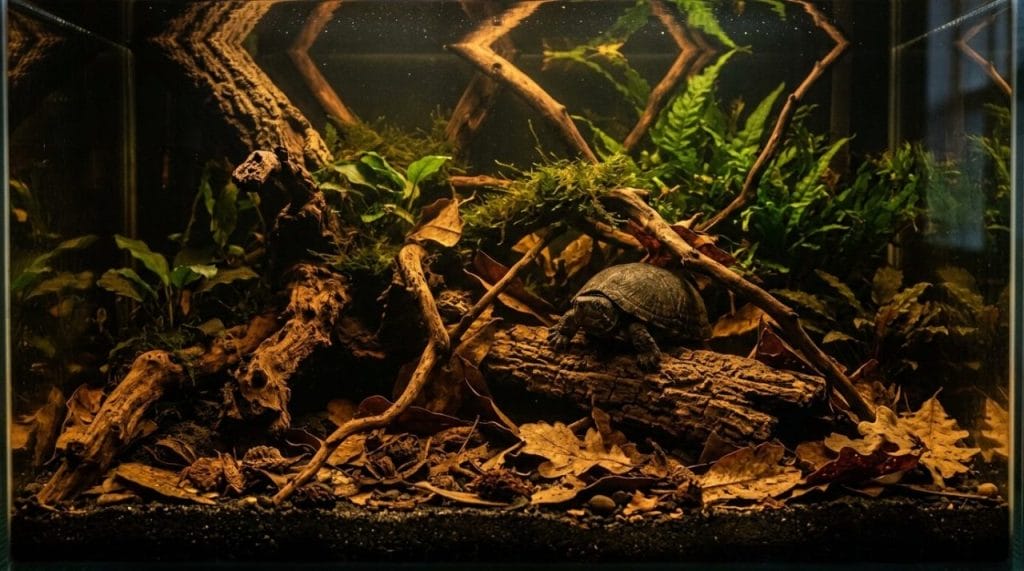
To make this: use a dark sand or soil substrate, add several pieces of driftwood (mopani or Malaysian), toss in dried Indian almond leaves (also called Catappa leaves), and keep the lighting low. The tannins will naturally tint the water over time. Skip the bright gravel and plastic plants, this setup is all about the natural, dark aesthetic.
Best for: Natural-look fans and jungle-stream species. Tinted water hides ammonia and dirt, so lean harder on regular API kit testing here.
13. Indoor Turtle Table (Shallow Pond Style)
Think of this as a tortoise table (my pick: Aivituvin Wooden Tortoise Habitat), but with a swimming section built in.
A turtle table is a large, shallow, open-top enclosure (usually wood-framed with a pond liner (my pick: 10x15 FT 20 Mil HDPE pond liner) inside) that works like an indoor pond. One end has a deeper water area for swimming, while the other end slopes up into a dry land section with substrate, rocks, and a basking lamp overhead. It’s especially great for mud turtles, musk turtles, and smaller species that don’t need deep water.
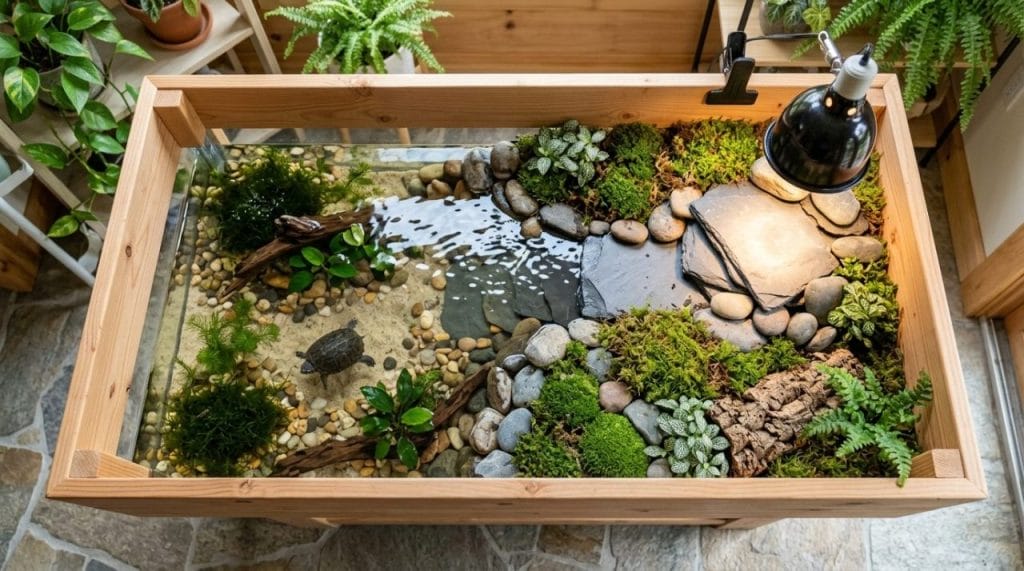
To build this: construct or buy a large shallow wooden frame (at least 4 feet long), line it with a pond liner, and divide it into a water zone and a land zone using stacked rocks or a silicone-sealed divider. Slope the land side gently so your turtle can walk in and out of the water easily.
Best for: Mud, musk, and small species. The open top evaporates fast, so top up water often and a sponge or small canister filter handles the shallow volume.
14. Split-Theme Dual Zone Tank
Half beach, half jungle, this setup splits your tank into two visually distinct zones and it’s ridiculously Pinterest-friendly.
One side of the tank features a sandy shoreline with warm overhead lighting, smooth pebbles, and a gentle slope into the water. The other side goes full planted aquascape, deep water, lush green plants, driftwood, and dim, filtered light. The contrast between the two halves makes the whole tank pop.
To recreate this: use a piece of flat slate or acrylic as a subtle divider to keep the sand from migrating into the planted side. Build up one end with fine sand and smooth river stones to create the beach slope. On the opposite end, plant Anubias, Java fern, or Vallisneria around pieces of driftwood. Position your basking lamp over the sandy side and keep the planted side slightly shaded.
Best for: Display builds and keepers who want beach and planted looks in one tank. Mount UVB spanning the full tank length, not just the basking side.
15. Floating Island Habitat
This one looks like something out of a nature documentary, a lush planted island floating in the middle of a crystal-clear tank.
Instead of a boring plastic dock, this setup uses a DIY floating platform covered in live or artificial plants, moss, and small rocks. The island sits in the center of the tank, surrounded by open water on all sides. Your turtle climbs up from underneath to bask. The water beneath is kept clean and minimal, bare bottom or fine sand.
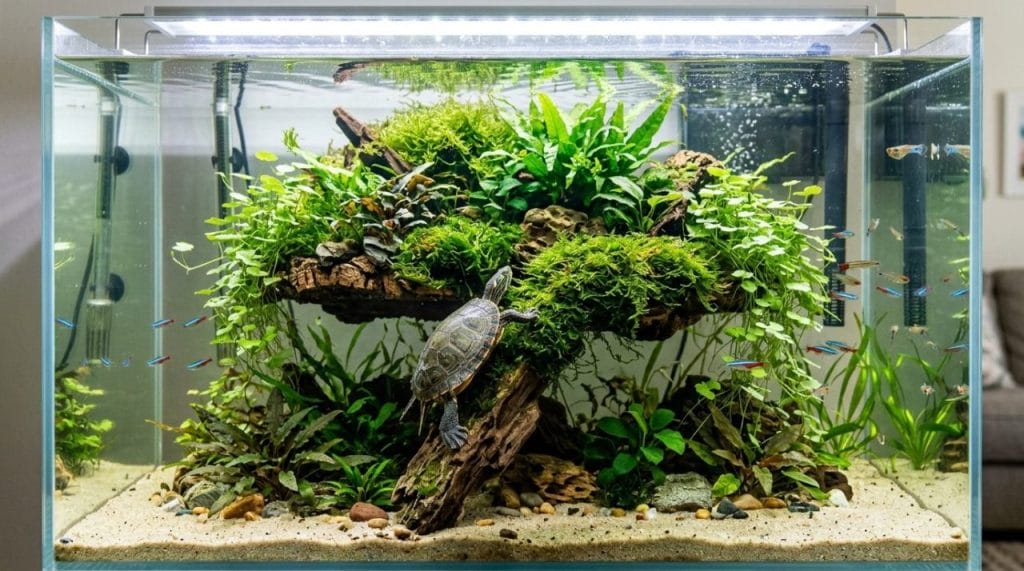
To build it: create a floating platform using egg crate or a foam base wrapped in coco fiber mesh. Attach Pothos or artificial trailing plants so they drape over the edges and into the water. Anchor the island loosely so it doesn’t drift into the glass. Position your basking lamp directly above the island.
Best for: Open-water swimmers and enrichment-focused setups. Test that the platform supports your turtle’s weight without flipping before you trust it.
16. Small Space Nano Turtle Tank
For musk, mud, and other small species, you don’t need a giant tank, you need a smart small one. This setup keeps a tidy footprint with a low water level, one or two hides, and a compact basking spot.

To make this: use a 20 to 40 gallon long tank (wide beats tall), add a sponge or small canister filter, a suction-cup or floating dock, and fine sand with a couple of smooth caves. Keep the water shallow, roughly 1.5 to 2x the turtle’s shell length for shallow-water species.
Best for: Musk, mud, and other small turtles, or anyone short on space. Small doesn’t mean low-maintenance, shallow water fouls faster, so test and change it more often.
17. Turtle and Fish Community Tank
A turtle sharing a tank with fish looks incredible, but only some combinations actually survive. The trick is fast, larger fish plus a tank big enough that they can stay out of reach.
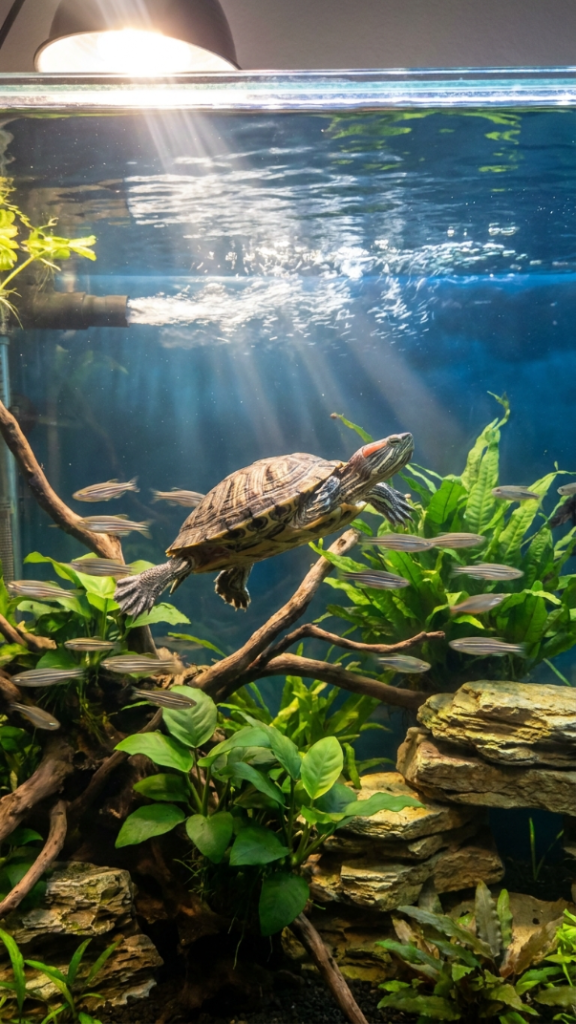
To make this: start with a large, heavily filtered tank (75+ gallons), add sturdy fast-moving fish, and pack in hiding spots and tough plants for cover. Keep the basking area and equipment identical to a turtle-only tank.
Best for: Experienced keepers who want a community look. Most small or slow fish will get eaten, so treat any survivors as a bonus, not a guarantee.
18. Space-Saving Bookshelf or Corner Tank
When floor space is tight, a corner tank or one built into furniture turns a turtle setup into part of the room. The aquatic footprint stays modest while the design blends into a shelf, stand, or corner.
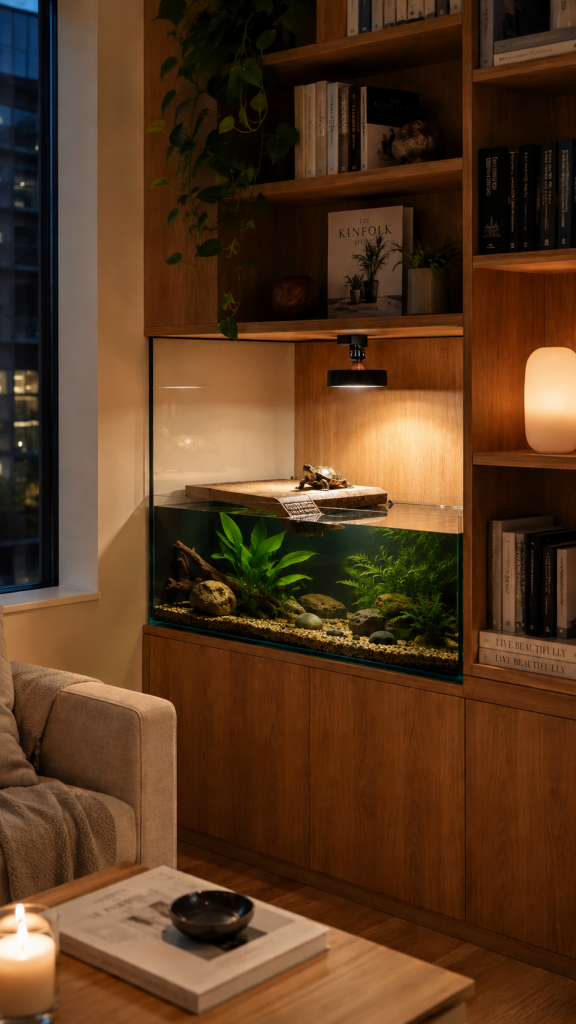
To make this: choose a corner or low-profile tank that fits the spot, set it on furniture rated for the full water weight, and route filtration and cords neatly behind or below. Keep the basking platform and lights easy to reach for cleaning and bulb changes.
Best for: Apartments and shared rooms where a standard rectangular tank won’t fit. Confirm the furniture can hold the loaded weight, water is far heavier than people expect.
Aquatic Turtle Tank FAQs
How big should an aquatic turtle tank be?
The rule of thumb is 10 gallons of water per inch of shell length, so a single adult slider needs 75 to 100 gallons. Hatchlings can start smaller (around 40 gallons), but they grow fast, so buying big early saves money.
Do aquatic turtles need deep water?
Most do. Strong swimmers like painted, map, and cooter turtles thrive in deep water at least as deep as their shell is long, while mud and musk turtles prefer shallower setups. Always pair deep water with an easy way to reach the surface and a dry basking spot.
What’s the easiest aquatic turtle tank setup for beginners?
A simple starter tank (idea 3) or half-water habitat (idea 5) is the easiest. Use a large tank, smooth gravel or bare bottom, a floating basking dock, a canister filter, and separate UVB and heat lamps. Skip live plants and complex hardscape until you’re comfortable.
Do planted aquascape tanks work with turtles?
They can, but only with turtle-tough plants like Anubias, Java fern, and Vallisneria anchored to driftwood or rock. Many turtles eat or uproot softer plants, so expect some trial and error and keep filtration strong to handle the extra organic load.
Can aquatic turtles live in an outdoor tank or pond?
Yes, if your climate suits the species. An outdoor stock tank pond (idea 8) gives natural sunlight for UVB and tons of swimming room. You still need filtration, a predator-proof mesh cover, and shade so the water doesn’t overheat in full sun.

About Author
Muntaseer Rahman started keeping pet turtles back in 2013. He also owns the largest Turtle & Tortoise Facebook community in Bangladesh. These days he is mostly active on Facebook.