Kemp’s Ridley Sea Turtle: Facts, Habitat, and Conservation

This post was created with help from AI tools and carefully reviewed by a human (Muntaseer Rahman). For more on how we use AI on this site, check out our Editorial Policy.
In 1947, a Mexican businessman named Andrés Herrera climbed into his small airplane and flew low over a beach in Tamaulipas, Mexico.
What he filmed that day left scientists speechless for decades.
Tens of thousands of sea turtles — all at once — storming a single beach to nest in a synchronized frenzy nobody had ever documented before.
That film became the Kemp’s ridley’s origin story.
And its near-death story.
Because by the 1980s, that same beach had fewer than 200 nesting females left.
This is the tale of the world’s most endangered sea turtle — and the humans who refused to let it disappear.
Quick Facts Summary
| Fact | Detail |
|---|---|
| Scientific Name | Lepidochelys kempii |
| Conservation Status | Critically Endangered (IUCN) |
| Global Population | ~24,000 nests/year (2017 peak) |
| Shell Length | 58–70 cm |
| Weight | 36–50 kg (80–110 lbs) |
| Lifespan | 30–50 years |
| Time to Maturity | 10–15 years |
| Unique Behavior | Only sea turtle that nests during the day |
| Primary Nesting Site | Tamaulipas, Mexico (95% of global nesting) |
| Primary Threat | Fishing bycatch |
| Named For | Richard M. Kemp, Key West fisherman |
Track A Real Sea Turtle With Each Bracelet!


Learn Name
You get to learn your sea turtle’s name, size, age. Also a picture!
Enjoy Stories
Enjoy the story of your sea turtle, where it came from, where is it going?
Follow Me
You get to follow the sea turtle’s journey on an interactive tracking map!
Click Here & Use Coupon Code: THETURTLEHUB20 For A 20% Discount!
What Makes the Kemp’s Ridley Special
The Kemp’s ridley holds two records nobody really wants.
Smallest sea turtle in the world. Most endangered sea turtle in the world.
Both at the same time. In one very anxious little package.
It’s listed as Critically Endangered by the IUCN — the highest threat category before “extinct in the wild.”
And unlike most endangered species, we actually have a film showing what its population looked like before it crashed. That 1947 footage is basically its before-and-after photo, and the comparison is painful.
The Name
The species is named after Richard M. Kemp, a fisherman from Key West, Florida, who sent a specimen to scientists at Harvard in 1906 for identification.
The “ridley” part? Nobody knows. Same mystery as the olive ridley.
One old theory: fishermen called it a “heartbreak turtle” because it died so easily after being flipped on its back. Another name it carried for years: the “bastard turtle.”
Neither name is exactly a great start in life.
Quick Size Check
| Feature | Measurement |
|---|---|
| Shell Length | 58–70 cm (about 2 feet) |
| Adult Weight | 36–50 kg (80–110 lbs) |
| Shell Shape | Nearly circular — almost as wide as it is long |
| Hatchling Size | About 3.8 cm (1.5 inches) |
| Hatchling Weight | ~14 grams (half an ounce) |
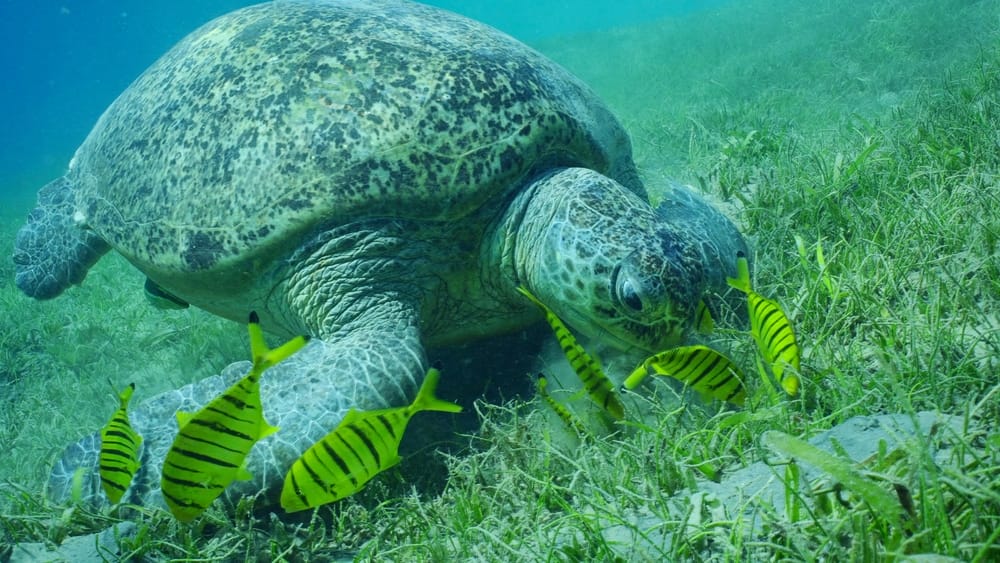
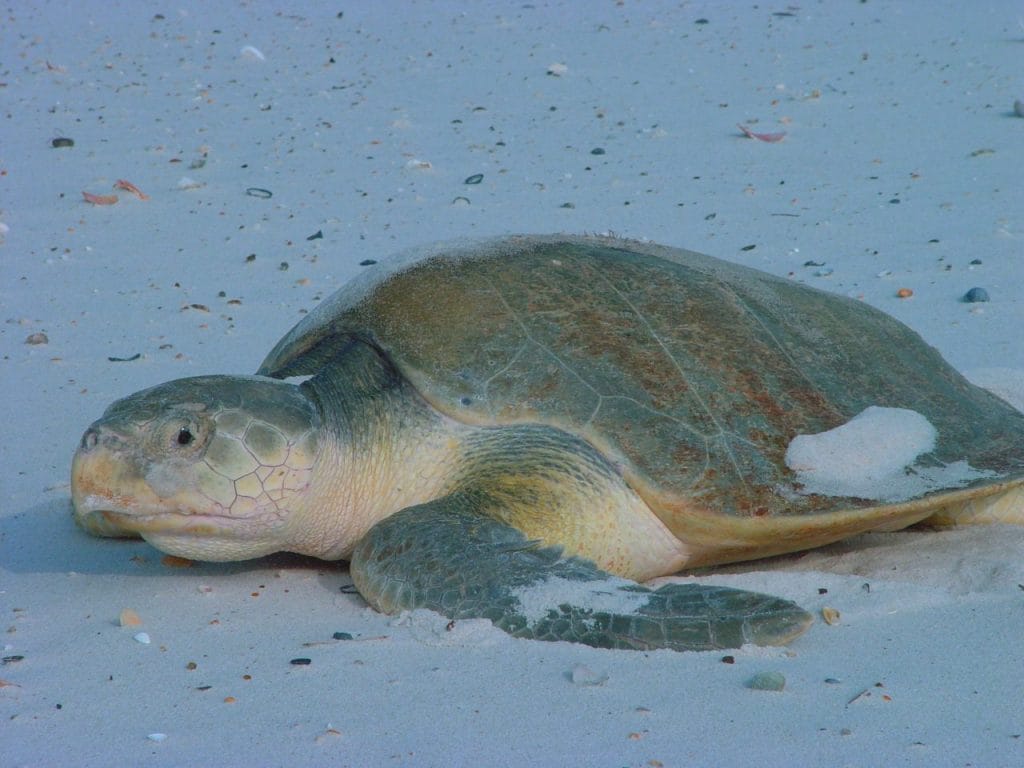
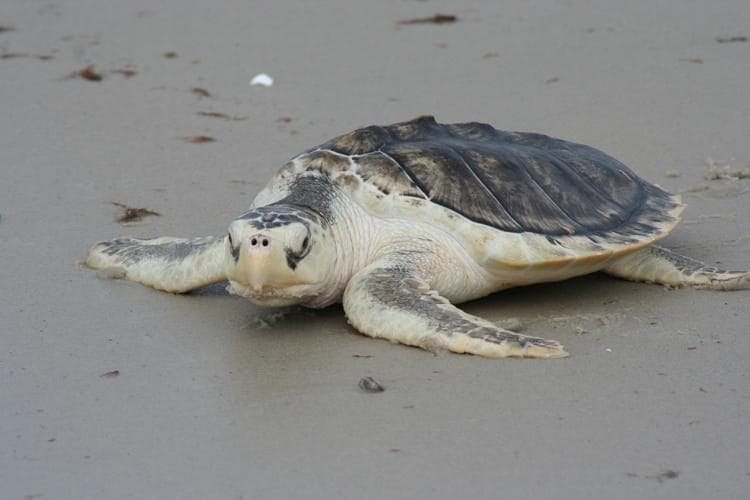
Adults are grayish-green on top with a pale yellow underside.
Hatchlings are almost entirely dark purple-black — which is about the most dramatic glow-up in the sea turtle world, going from tiny dark blobs to gray-green adults.
This Hilarious Turtle Book Might Know Your Pet Better Than You Do

Let’s be real—most turtle care guides feel like reading a textbook written by a sleep-deprived zookeeper.
This one’s not that.
Told from the snarky point of view of a grumpy, judgmental turtle, 21 Turtle Truths You’ll Never Read in a Care Guide is packed with sarcasm, sass, and surprisingly useful insights.
And hey—you don’t have to commit to the whole thing just yet.
Grab 2 free truths from the ebook and get a taste of what your turtle really thinks about your setup, your food choices, and that weird plastic palm tree.
It’s funny, it’s honest, and if you’ve ever owned a turtle who glares at you like you’re the problem—you’ll feel seen.
Where Do Kemp’s Ridleys Live?
This is where it gets both impressive and terrifying.
Kemp’s ridleys are almost entirely a Gulf of Mexico species.
Unlike other sea turtles that range across multiple oceans, nearly all Kemp’s ridley nesting happens on one stretch of coastline in Tamaulipas, Mexico — specifically three beaches: Rancho Nuevo, Tepehuajes, and Barra del Tordo.
95% of all worldwide Kemp’s ridley nesting happens in Tamaulipas.
Think about how fragile that is. One oil spill, one major hurricane, one sustained poaching operation on that one stretch of coast — and you’ve potentially wiped out the bulk of the entire global population.
(The Deepwater Horizon oil spill in 2010 made this exact scenario very real. More on that later.)
Where the Juveniles Go
Young Kemp’s ridleys are more adventurous than the adults.
Carried by the Gulf Stream, juveniles have been found up and down the US East Coast as far north as Nova Scotia — and occasionally in the waters off Ireland, the UK, Spain, and even the Azores.
A juvenile named “Boeier” was found tangled in fishing nets off the coast of the Netherlands in 2023, was rehabilitated at Rotterdam Zoo, and was released back into the Gulf of Mexico from a Galveston beach in November 2024.
That turtle drifted over 3,000 miles from home.
Major Nesting Sites
| Location | Significance |
|---|---|
| Rancho Nuevo, Tamaulipas, Mexico | Primary nesting site; ~95% of global nesting |
| Tepehuajes & Barra del Tordo, Mexico | Secondary sites in Tamaulipas |
| Padre Island, Texas, USA | Only consistent US nesting site |
| Occasional nesting in NC, SC, GA, FL | Very small numbers |
Snuggle a Plush. Track a Turtle.
🧸 + 🌊 = 🐢 A toy that connects you to real sea turtles in the wild.


Meet Your Turtle
Scan the tag to meet your real sea turtle. Learn its name, species, and see a real photo!
Follow the Journey
Watch your turtle swim across the ocean using the 3D tracking map. It’s like a sea adventure in your pocket.
Support Wildlife
Every plush supports turtle conservation efforts through the Sea Turtle Conservancy.
Click Here & Use Coupon Code: THETURTLEHUB20 For A 20% Discount! (Your hug helps a turtle.)
The Arribada: Turtles With a Schedule
Like their olive ridley cousins, Kemp’s ridleys do the arribada.
But Kemp’s have a twist that no other sea turtle species does.
They nest during the day.
Every other sea turtle sneaks up the beach under cover of darkness.
Kemp’s ridleys just show up in broad daylight, in full view of everything and everyone, completely unbothered.
Scientists aren’t entirely sure why. The leading theory is that daytime nesting helped their ancestors avoid nocturnal predators — a strategy that made total sense before humans with flashlights and trucks showed up to steal eggs.
The 1947 Film
The Herrera film from 1947 documented what scientists now estimate was 26,000 to 40,000 nests in a single arribada — representing a total nesting season of 121,000 to 181,000 nests.
That number is the benchmark. The before photo.
By 1985, the same beach had 702 nests total for the entire year.
A drop of 99.4% in under four decades.
To be clear: that wasn’t climate change, predators, or bad luck. That was humans collecting truckloads of eggs and selling them in towns across Texas and Mexico, combined with turtles drowning in shrimp nets.
The Recovery
Conservation started in the 1960s and intensified through the 1990s.
By 2017, Kemp’s ridley nesting had recovered to about 24,000 nests — a massive improvement from 702, but still only about 13–20% of 1947 levels.
In 2025, Texas alone set a new record: 449 nests confirmed on the Texas coast, breaking the previous Texas record of 353 set in 2017.
The recovery is real. It’s just slower than anyone hoped.
What Do Kemp’s Ridleys Eat?
They’re not complicated eaters.
Kemp’s ridleys are primarily crab specialists — specifically swimming crabs, which make up the bulk of their diet.
Their full menu includes:
- Swimming crabs (favorite)
- Spider crabs
- Shrimp
- Snails and clams
- Jellyfish
- Sea urchins
- Fish and squid
Those powerful jaws — built for crushing — make short work of hard-shelled prey. Compared to other species, their sea turtle diet is heavily skewed toward crustaceans.
They forage mostly in shallow water, rarely venturing deeper than 160 feet (49 meters), which keeps them uncomfortably close to the bottom-trawling grounds of shrimp fisheries.
That overlap is not a coincidence. It’s the root of their biggest problem.
Reproduction and Life Cycle
Growing Up
Kemp’s ridleys reach sexual maturity at around 10–15 years old — the fastest of any sea turtle species.
That’s important for conservation, because a faster maturing turtle can theoretically rebuild its population faster than, say, a loggerhead that takes 30 years.
The problem is that even with a 10-year maturity window, the population still hasn’t bounced all the way back after 50+ years of conservation efforts.
That tells you how bad the damage was.
Nesting Facts
| Fact | Detail |
|---|---|
| Nesting Season | April to August (peak May–July) |
| Nesting Time | Daytime — unique among sea turtles |
| Eggs Per Clutch | ~100 eggs |
| Clutches Per Season | 2–3 per female |
| Incubation Period | 50–70 days |
| Nesting Frequency | Every 1–3 years |
| Navigation Method | Magnetic field memory |
Females return to the beach where they hatched — 95% of them to that same narrow stretch of Tamaulipas coastline — year after year.
The Survival Problem
Around 1 in 1,000 hatchlings makes it to adulthood.
The odds haven’t improved much because while conservation has protected eggs on nesting beaches, the ocean is still full of shrimp trawls, plastic bags, and boat propellers.
Every hatchling that survives the gauntlet of ghost crabs, birds, and fish on the way to the ocean still has years of open-water hazards ahead.
How Long Do Kemp’s Ridleys Live?
The honest answer is: scientists aren’t completely sure.
Best estimates put their lifespan at 30 to 50 years.
Given how close they came to extinction, the older individuals in the wild right now are basically walking conservation history — turtles that were alive during the crash and made it through.
Conservation Status: The Complicated Truth
The IUCN Status
Critically Endangered — the highest threat category before “extinct in the wild.”
This is the only sea turtle species listed at this level.
Under the US Endangered Species Act, they’ve been Endangered since 1970 — the first year the Act even existed.
The Good News
The population has genuinely recovered from its 1985 low.
702 nests in 1985 → ~24,000 nests in 2017 is a 34-fold increase. That’s not nothing. That’s conservation working.
The 2025 Texas nesting season broke records. Bi-national protection efforts between the US and Mexico have been sustained for over 50 years — longer than almost any international wildlife conservation partnership.
The Bad News
Despite decades of work, nesting numbers have plateaued since around 2010–2012 and fluctuated rather than continuing their upward climb.
Some research published in 2023 predicted no significant increase in Kemp’s ridley nesting through 2048 — which is a sobering forecast for a species still critically endangered.
The Pacific once had millions of olive ridleys. Kemp’s ridleys have always been a Gulf species with a narrow range. There’s no massive hidden population waiting to rebound. What you see is basically what there is.
The Biggest Threats
1. Fishing Bycatch
Same story as every sea turtle. But worse for Kemp’s ridleys because their feeding grounds overlap almost perfectly with Gulf shrimp trawling areas.
They get caught in trawl nets, longlines, gillnets, crab traps, and dredges.
Because they breathe air, entanglement = drowning.
Turtle Excluder Devices (TEDs) have been mandatory in US shrimp trawls since 1987 and have saved enormous numbers of turtles. Mexican waters have seen slower adoption of the same gear requirements.
2. Oil Spills
The Deepwater Horizon disaster in 2010 hit Kemp’s ridleys especially hard.
156 sea turtle deaths were documented directly from the spill. Most were Kemp’s ridleys.
Over 450 oiled turtles were rescued, cleaned, and released — again, mostly Kemp’s ridleys, because this is their home water.
Scientists even airlifted eggs away from contaminated beaches to incubate them safely elsewhere.
The species has only one home. An oil spill in the Gulf of Mexico isn’t a regional problem for Kemp’s ridleys — it’s an existential one.
3. Climate Change and Cold-Stunning
Here’s the climate twist specific to Kemp’s ridleys.
As ocean temperatures warm, juvenile turtles are spending more time in northern Atlantic waters — staying longer into the fall before migrating south.
When a cold snap hits suddenly, they get cold-stunned: their metabolism crashes and they wash up on beaches, unable to move, essentially in a coma.
Cape Cod, Massachusetts has become ground zero for this phenomenon.
In the 1980s, about 10 Kemp’s ridleys were recovered there annually.
By 2024, that number was 684 cold-stunned turtles in a single season.
Mass Audubon’s Wellfleet Bay Wildlife Sanctuary runs annual rescue operations, combing beaches after every high tide during late fall. The New England Aquarium handles triage. Turtles are stabilized and shipped to rehabilitation facilities across the US.
It’s a massive, sustained operation — and the numbers keep growing.
4. Plastic and Pollution
Kemp’s ridleys mistake floating plastic for jellyfish and food.
Ingested plastic causes intestinal blockages, malnutrition, and slow death.
Given their restricted Gulf habitat, plastic pollution concentrated by Gulf currents poses a particular threat.
5. Coastal Development
Nesting beaches in both Mexico and Texas face ongoing pressure from development.
Beach lighting disorients hatchlings. Armored shorelines reduce available nesting habitat. Increased human presence during nesting season disrupts females trying to come ashore.
Conservation Wins Worth Celebrating
The Bi-National Recovery Program
The US-Mexico partnership to save Kemp’s ridleys is one of the longest-running international wildlife conservation efforts in history.
It started in the 1960s when Mexico sent biologists to survey Tamaulipas beaches. The US joined formally in the 1970s. For over 50 years, two countries have coordinated beach patrols, egg protection, nest monitoring, and fisheries management for a single species.
It worked — at least partly. The fact that there are any Kemp’s ridleys left is largely because of this partnership.
The Head-Starting Program
Starting in the 1970s, conservationists tried an aggressive experiment: taking Kemp’s ridley eggs, hatching them in controlled conditions, raising the hatchlings in captivity until they were large enough to have a better survival chance, then releasing them.
The idea was to give them a head start past the most dangerous years.
Results were mixed — many “head-started” turtles released in Texas didn’t return to nest there as adults — but the program contributed to rebuilding the population during the critical early recovery period.
TED Regulations
Turtle Excluder Devices changed the math on bycatch mortality.
A simple metal grid in a shrimp trawl net. Turtles hit the bars and escape through a flap. Shrimp pass through.
Mandatory in US waters since 1987. The single most effective policy intervention in Kemp’s ridley conservation history.
Cape Cod Rescue Operations
What started as a small volunteer effort has become a sophisticated annual rescue system.
Every fall, Mass Audubon, the New England Aquarium, and dozens of partner organizations mobilize to rescue cold-stunned turtles from Cape Cod beaches.
Hundreds of turtles a year are saved, rehabilitated, and returned to the Gulf.
In 2020, a rescue operation was so complicated it required the Tennessee Aquarium to provide emergency overnight shelter mid-transfer. These operations now involve aquariums, government agencies, and volunteers spanning multiple states.
How You Can Help
Choose Gulf-friendly seafood
Look for shrimp caught with TEDs and from fisheries with verified turtle-safe practices. Wild American shrimp from certified sources is generally a safer bet than imported shrimp from regions with no TED requirements.
Support Cape Cod rescue organizations
Mass Audubon’s Wellfleet Bay Wildlife Sanctuary and the New England Aquarium run the cold-stunning rescue operations that save hundreds of Kemp’s ridleys every year.
Reduce plastic use
Every piece of plastic that doesn’t reach the Gulf is one less hazard for a turtle that’s already fighting hard enough.
Report stranded turtles
If you find a cold-stunned or injured sea turtle, call your local wildlife rescue authority immediately. Don’t try to warm them up yourself — the process needs to be gradual and supervised.
Support conservation organizations
Support those organizations that are working in the Gulf — groups like the Sea Turtle Conservancy, Padre Island National Seashore’s turtle program, and Grupo Tortuguero in Mexico do the on-the-ground work that keeps this species alive.
Final Thoughts
Andrés Herrera’s 1947 film showed us what we had.
The 1985 nest count of 702 showed us what we almost lost.
The 2025 Texas record of 449 nests on a single state’s beaches shows us that conservation can work — even when the damage seems irreversible.
But Kemp’s ridleys still don’t have a safety net.
One population. One region. One stretch of Mexican coastline where 95% of the species shows up to reproduce.
A bad oil spill, a sustained poaching operation, or a decade of bad weather at Rancho Nuevo could undo fifty years of work.
The Kemp’s ridley has survived everything thrown at it so far — part of a 260-million-year lineage of turtles that outlived the dinosaurs.
The 1947 film is proof it was once thriving.
The question is whether we’re patient enough — and careful enough — to give it the chance to get back there.

About Author
Muntaseer Rahman started keeping pet turtles back in 2013. He also owns the largest Turtle & Tortoise Facebook community in Bangladesh. These days he is mostly active on Facebook.