Olive Ridley Sea Turtle Facts: Size, Diet, Lifespan & More

This post was created with help from AI tools and carefully reviewed by a human (Muntaseer Rahman). For more on how we use AI on this site, check out our Editorial Policy.
Imagine a beach at night.
The tide rolls in. The moon is low. And then — out of nowhere — the ocean starts moving.
Not water. Turtles.
Thousands of them. Tens of thousands. All arriving at the exact same time, hauling themselves up the sand to lay their eggs in a synchronized frenzy that scientists still can’t fully explain.
That’s the olive ridley sea turtle.
The most common sea turtle on the planet — and somehow, one of the most mysterious.
Quick Facts Summary
| Fact | Detail |
|---|---|
| Scientific Name | Lepidochelys olivacea |
| Conservation Status | Vulnerable (IUCN) |
| Population | ~800,000 nesting females globally |
| Shell Length | 60–70 cm |
| Weight | Up to 50 kg (110 lbs) |
| Lifespan | Unknown, likely several decades |
| Time to Maturity | ~14–15 years |
| Unique Behavior | Arribada mass nesting |
| Primary Threat | Fishing bycatch |
| Named For | Olive-green shell color |
Track A Real Sea Turtle With Each Bracelet!


Learn Name
You get to learn your sea turtle’s name, size, age. Also a picture!
Enjoy Stories
Enjoy the story of your sea turtle, where it came from, where is it going?
Follow Me
You get to follow the sea turtle’s journey on an interactive tracking map!
Click Here & Use Coupon Code: THETURTLEHUB20 For A 20% Discount!
What Makes the Olive Ridley Special
Here’s the thing about olive ridleys.
They’re the most abundant sea turtle in the world, with an estimated 800,000 nesting females worldwide.
You’d think being the most common automatically means “not at risk.”
You’d be wrong.
They’re listed as Vulnerable on the IUCN Red List — because almost all of them nest on just a handful of beaches. Wipe out one beach, and you don’t lose a local turtle population. You lose a massive chunk of the entire species.
That’s a brutal design flaw nature didn’t exactly anticipate humans would exploit.
The Name
The name is pretty straightforward — unlike some animals that are named after random explorers or Latin tongue-twisters.
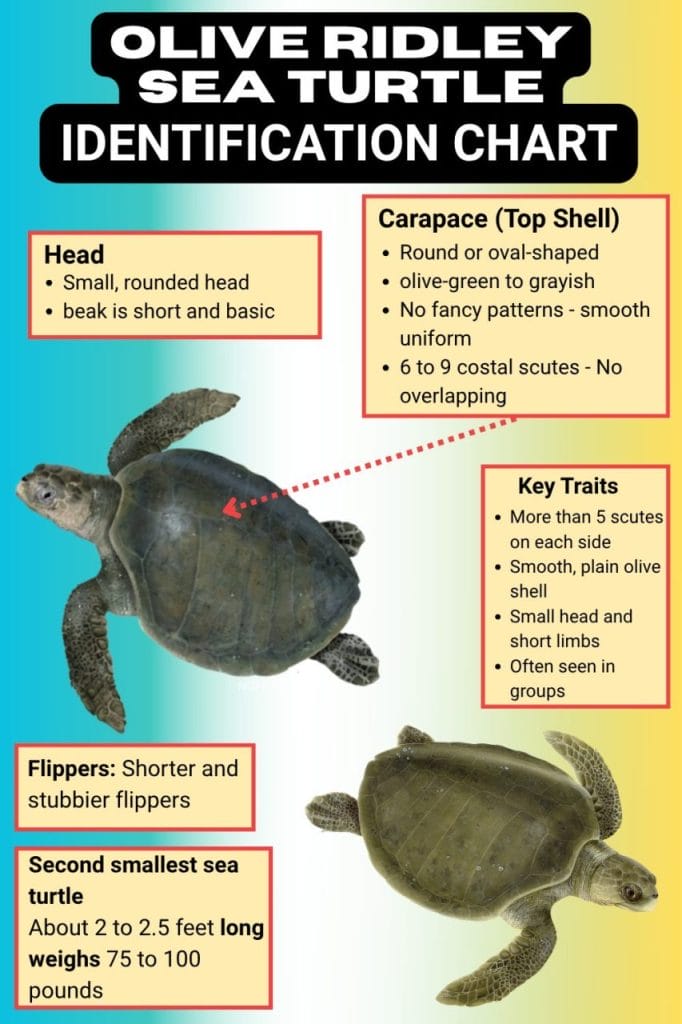
The olive ridley gets its name from its olive-green heart-shaped shell.
Simple. Honest. Refreshing.
The “ridley” part is murkier. Nobody actually knows where it comes from. Some think it’s derived from the word “riddle” — which feels weirdly appropriate given how much about this species still confuses scientists.

Quick Size Check
They’re small by sea turtle standards. Like, noticeably small.
| Feature | Measurement |
|---|---|
| Shell Length | 60–70 cm (about 2 feet) |
| Adult Weight | Up to 45–50 kg (100 lbs) |
| Hatchling Length | 37–50 mm (about 1.5 inches) |
| Hatchling Weight | 12–23 grams |
For comparison, a loggerhead can weigh over 300 pounds.
The olive ridley is basically the compact sedan of the sea turtle world. Not flashy. Gets the job done. Surprisingly tough.
This Hilarious Turtle Book Might Know Your Pet Better Than You Do

Let’s be real—most turtle care guides feel like reading a textbook written by a sleep-deprived zookeeper.
This one’s not that.
Told from the snarky point of view of a grumpy, judgmental turtle, 21 Turtle Truths You’ll Never Read in a Care Guide is packed with sarcasm, sass, and surprisingly useful insights.
And hey—you don’t have to commit to the whole thing just yet.
Grab 2 free truths from the ebook and get a taste of what your turtle really thinks about your setup, your food choices, and that weird plastic palm tree.
It’s funny, it’s honest, and if you’ve ever owned a turtle who glares at you like you’re the problem—you’ll feel seen.
Where Do Olive Ridleys Live?
These turtles are everywhere.
And when I say everywhere, I mean every warm ocean on the planet — the Pacific, Indian, and Atlantic. They’ve been spotted as far north as Oregon in the eastern Pacific and as far as the Isle of Anglesey in Wales (a lost female showed up there in 2016, which is as far from home as it gets).
Major Nesting Hotspots
| Location | Notes |
|---|---|
| Odisha, India (Gahirmatha & Rushikulya) | World’s largest nesting sites |
| Ostional & Nancite, Costa Rica | ~600,000 nesting olive ridleys between two beaches |
| La Escobilla, Mexico | ~450,000 nesting females |
| Gabon, West Africa | Eastern Atlantic’s largest population |
| Brazil & French Guiana | Growing non-arribada nesting population |
Costa Rica and India basically carry the species on their backs.
Snuggle a Plush. Track a Turtle.
🧸 + 🌊 = 🐢 A toy that connects you to real sea turtles in the wild.


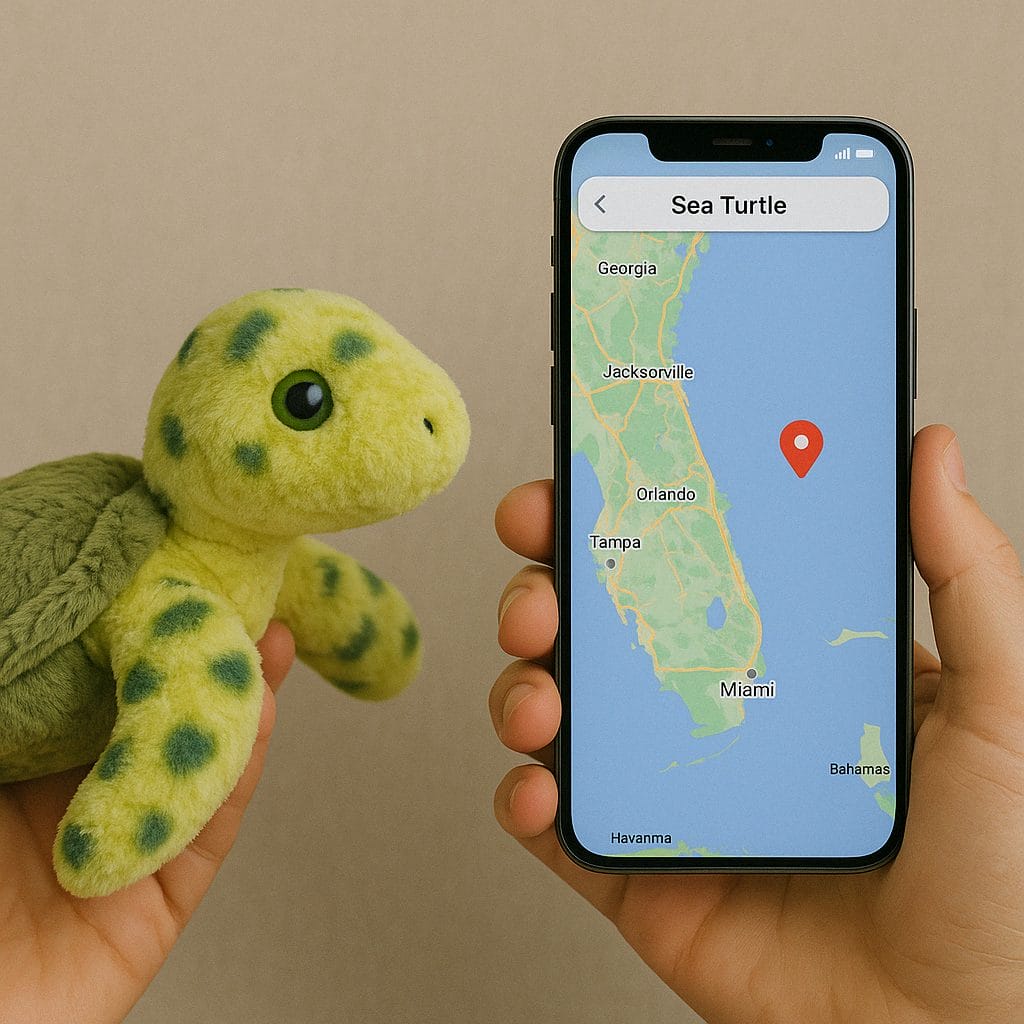
Meet Your Turtle
Scan the tag to meet your real sea turtle. Learn its name, species, and see a real photo!
Follow the Journey
Watch your turtle swim across the ocean using the 3D tracking map. It’s like a sea adventure in your pocket.
Support Wildlife
Every plush supports turtle conservation efforts through the Sea Turtle Conservancy.
Click Here & Use Coupon Code: THETURTLEHUB20 For A 20% Discount! (Your hug helps a turtle.)
The Arribada: Nature’s Wildest Party
Okay, this is the part everyone comes for.
The arribada.
The word is Spanish for “arrival” — and it refers to the olive ridley’s signature move: showing up by the hundreds of thousands, all at once, to nest on the same beach over a span of just 3 to 7 days.
It’s the biggest synchronized nesting event of any animal on Earth.
No other sea turtle does this at this scale. Only olive ridleys and their close cousin, the Kemp’s ridley.
The Numbers Are Insane
In March 2025, hundreds of thousands of olive ridleys stormed Rushikulya beach in Odisha, India.
The 2024–25 season broke all records: 1.51 million turtles nested across Gahirmatha and Rushikulya combined — surpassing every previous count on record.
That’s not a typo.
1.51 million turtles on two beaches.
Nobody Knows Why They Do It
Here’s the maddening part — scientists still don’t know exactly what triggers an arribada.
The leading theories: offshore winds, lunar cycles, female pheromones in the water.
Maybe all three. Maybe none. Maybe the turtles just collectively decided it was time and didn’t bother explaining it to us.
The nesting density gets so high that females literally dig up previously laid eggs while digging their own nests.
It’s chaotic. It’s destructive. It somehow works.
The Safety-in-Numbers Theory
The best guess scientists have is that this is a survival strategy.
If you nest alone, predators pick off your eggs one by one.
But if half a million of your friends show up on the same beach at the same time, predators get absolutely overwhelmed.
Nobody can eat 50 million eggs in a week.
The sheer number of nests is the protection.
What Do Olive Ridleys Eat?
Olive ridleys are not picky.
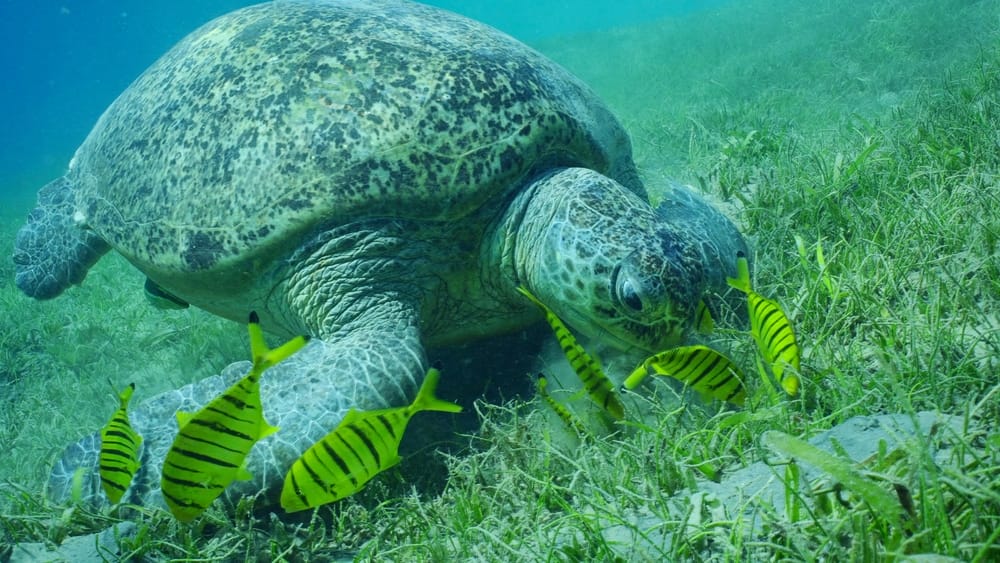
They’re omnivores, which basically means they eat whatever they can find at the bottom of the ocean — unlike the almost entirely herbivorous green sea turtle.
Their menu includes:
- Crabs and other crustaceans (favorites)
- Shrimp
- Jellyfish
- Snails and mollusks
- Algae
- Tunicates
- Fish eggs
They can forage down to about 150 meters (500 feet) deep, which is impressive for an animal that has to come up for air.
During breeding seasons, research published in 2024 confirmed that arrribada olive ridleys actually continue feeding even while at the nesting grounds — which was previously thought to be unlikely. These turtles do not take breaks.
Reproduction and Life Cycle
Growing Up Fast (By Turtle Standards)
Olive ridleys reach sexual maturity at around 14–15 years old.
That’s fast compared to loggerheads, which take nearly three decades.
Still not exactly a quick turnaround by any measure, but for a sea turtle, 14 years is practically a teenager.
Nesting Facts
| Fact | Detail |
|---|---|
| Nesting Season | Varies by region; often October–April |
| Eggs Per Clutch | Around 100–110 eggs |
| Incubation Period | Approximately 45–65 days |
| Nests Per Season | 1–2 clutches per female |
| How They Navigate Back | Magnetic field memory + smell |
Females return to the same beach where they hatched — sometimes after traveling thousands of miles across the ocean.
And the thing about olive ridleys is that some of them do this solo, sneaking up on a quiet beach alone in the dark. Others show up with 500,000 of their closest friends.
Same species. Two completely different approaches to parenting.
The 1-in-1,000 Problem
Only about 1 in 1,000 hatchlings survives to adulthood.
From the moment a nest is laid, it faces jackals, crabs, dogs, birds, and humans who treat the eggs as food.
Once hatchlings hit the water, fish and seabirds are waiting.
And then there’s the modern stuff — fishing nets, plastic bags, boat strikes, climate change.
The odds are genuinely terrible.
How Long Do Olive Ridleys Live?
Nobody knows exactly.
Like other sea turtles, they likely live for several decades, but pinning down a precise lifespan is hard when your research subject is a wild ocean animal.
What we do know: they’ve been around as a species for millions of years.
They survived whatever killed the dinosaurs.
They just need us to stop accidentally drowning them in shrimp nets.
Conservation Status: The Complicated Truth
The Good News
Global sea turtle numbers are trending upward.
A 2024 analysis found that across monitoring sites worldwide, population increases were six times more common than decreases.
India’s Odisha beaches are a massive success story — nest counts at Rushikulya have jumped from 25,000–50,000 per season in the early 2000s to over 150,000 in recent decades, with some seasons exceeding 400,000 nests.
Conservation genuinely works.
The Bad News
Despite being the most abundant sea turtle, olive ridleys have declined over 30% in just one generation.
Some populations are in serious trouble. Suriname’s arribada population has dropped by more than 90% since 1967.
The Pacific once had an estimated 10 million olive ridleys. Today, most of the surviving mass nesting populations are concentrated on a tiny handful of beaches.
The IUCN Status
Vulnerable globally. Endangered for Mexico’s Pacific coast populations.
Appendix I of CITES — meaning international trade in olive ridleys or their parts is banned.
The Biggest Threats
1. Fishing Bycatch
This is the #1 killer.
Olive ridleys get tangled in trawl nets, longlines, and gillnets. Because they breathe air, getting stuck underwater means drowning.
Shrimp trawling is especially brutal. The trawl nets scoop up everything on the seafloor — including turtles that had no interest in getting caught.
Turtle Excluder Devices (TEDs) have helped in US waters since 1987, saving an estimated hundreds of thousands of turtles. But TEDs aren’t mandatory in most of the world.
2. Egg Poaching
In many regions, olive ridley eggs are eaten as food or sold.
It’s not abstract. People show up at the nesting beach, dig up the eggs, and take them.
Some beaches have seen local populations reduced to near zero because of it.
3. Coastal Development
Hotels, seawalls, and beach lighting make nesting harder.
Artificial lights disorient hatchlings — they’re supposed to crawl toward the bright horizon of the ocean, but beach lights look brighter.
The result: hatchlings crawling toward parking lots instead of the sea.
4. Climate Change
Same sex-ratio problem as other sea turtles.
Sand temperature determines sex. Too warm = almost all females.
Rising sand temperatures from climate change are skewing populations heavily female, which is a long-term reproductive problem for a species that needs males.
5. Plastic Pollution
Olive ridleys mistake floating plastic for jellyfish.
11 million metric tons of plastic enter the ocean every year. By 2040, that number is projected to hit 29 million.
Every piece of plastic that ends up in the ocean is a potential meal for a turtle that doesn’t know better.
Conservation Wins Worth Celebrating
Odisha’s Turnaround
India’s Odisha state has become a global model for sea turtle conservation.
The 2024–25 record of 1.51 million nesting turtles across two beaches didn’t happen by accident — it took decades of coordinated effort between forest departments, the coast guard, fisheries departments, and local communities.
Fishing closures during nesting season, beach patrols, and strict enforcement all contributed.
Community-Based Protection
Across India, fishermen-turned-conservationists are making a real difference.
In Velas, Maharashtra, a local activist convinced the village council to ban seaside construction. On beaches in Kerala, local fishermen now protect nests that would otherwise be poached.
The turtle that nested on a beach in Mangaluru in 2025 — the first nesting there in nearly two decades — is a sign that protected areas are actually working.
The TED Revolution
Turtle Excluder Devices may be the single most effective sea turtle conservation tool ever invented.
A simple metal grid in a shrimp trawl net. Turtles hit the bars and get funneled out through an escape hatch. Shrimp pass through.
It took political will and some fishing industry pushback to get them mandated in US waters — but they’ve saved hundreds of thousands of turtles since 1987.
How You Can Help
- Choose sustainable seafood. Look for fisheries that use turtle-safe gear and have TEDs in their nets. Certifications like MSC help here.
- Cut your plastic use. Every plastic bag that doesn’t reach the ocean is one less fake jellyfish.
- Support beach-based conservation. Organizations like the Olive Ridley Project and Sea Turtle Conservancy fund the hard work of nest monitoring, bycatch reduction, and community outreach.
- If you’re near a nesting beach at night, kill your lights. Seriously. It matters more than people realize.
- Report stranded turtles. Don’t touch or move them yourself. Call your local wildlife rescue authority and let the professionals handle it.
Final Thoughts
Olive ridleys have been doing the arribada for millions of years.
Half a million turtles showing up on the same beach on the same night, guided by nothing but magnetic fields and instinct, to lay eggs in the dark while the world sleeps.
It’s one of the most jaw-dropping things nature does.
The 2024–25 season in Odisha broke all records. That’s proof that when humans actually get out of the way — or better yet, actively protect what’s left — these turtles can recover.
But they’re still classified as Vulnerable.
They still face fishing nets, plastic bags, poachers, and a warming planet.
The question isn’t whether olive ridleys can survive.
They’ve survived everything for millions of years.
The question is whether they’ll survive us.

About Author
Muntaseer Rahman started keeping pet turtles back in 2013. He also owns the largest Turtle & Tortoise Facebook community in Bangladesh. These days he is mostly active on Facebook.