Sea Turtle Facts That Will Make You Rethink Everything You Know About the Ocean
This post was created with help from AI tools and carefully reviewed by a human (Muntaseer Rahman). For more on how we use AI on this site, check out our Editorial Policy.
Look, I thought I knew a thing or two about sea turtles. Cute, slow, eats jellyfish. Done.
Then I actually started digging into what these animals can do, and honestly? I felt dumb for ever underestimating them.
They Were Here Before the Dinosaurs Died (And They’re Still Here)
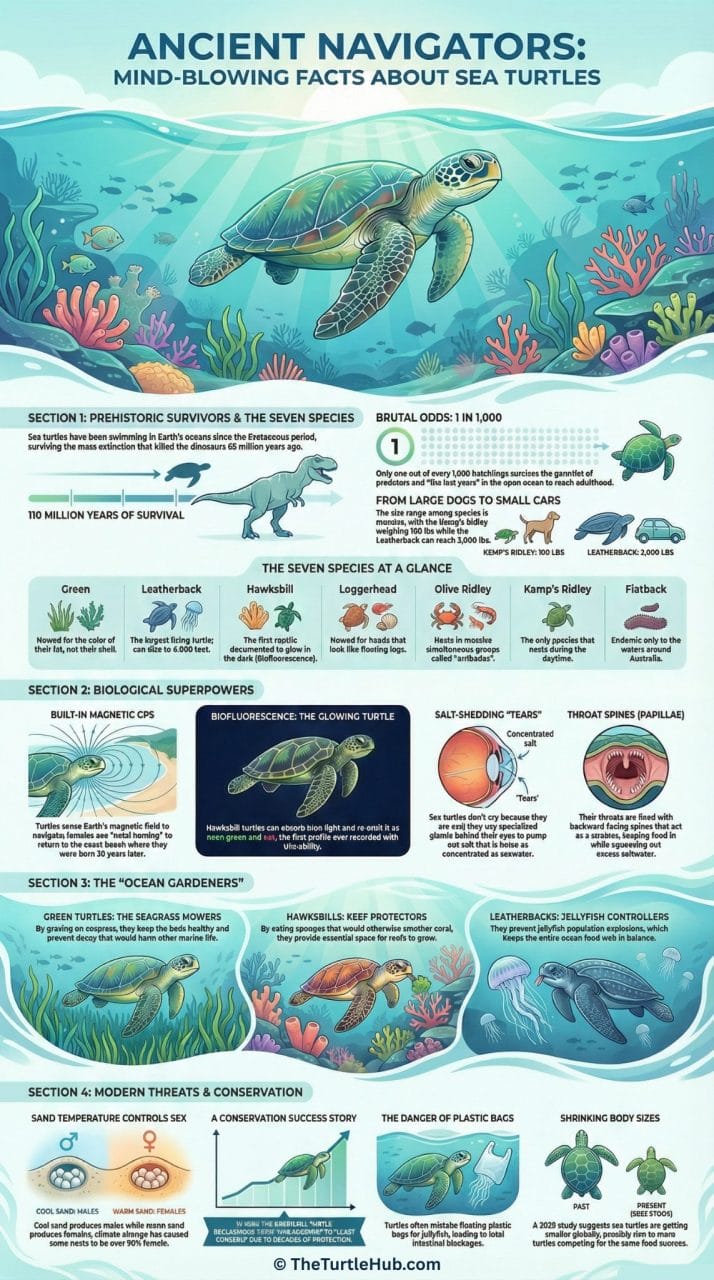
Sea turtles have been swimming in Earth’s oceans for over 110 million years.
Let that sink in. They watched the dinosaurs go extinct 65 million years ago and basically shrugged it off. Whatever killed the T. rex didn’t even faze them.
We cover even more about their ancient origins and 14 other remarkable traits in our complete turtle facts guide.
Track A Real Sea Turtle With Each Bracelet!


Learn Name
You get to learn your sea turtle’s name, size, age. Also a picture!
Enjoy Stories
Enjoy the story of your sea turtle, where it came from, where is it going?
Follow Me
You get to follow the sea turtle’s journey on an interactive tracking map!
Click Here & Use Coupon Code: THETURTLEHUB20 For A 20% Discount!
There Are 7 Species (And They’re All Wildly Different)
Not all sea turtles are the same. Not even close.
Here’s a quick breakdown so you can stop lumping them all together:
| Species | Size | Favorite Food | Cool Trait |
|---|---|---|---|
| Green | Up to 5 ft, 650 lbs | Seagrass and algae | Named for the green color of their fat, not their shell |
| Leatherback | Up to 7 ft, 2,000 lbs | Jellyfish | Largest living turtle on the planet |
| Hawksbill | Up to 3 ft, 280 lbs | Sponges | Can glow in the dark (seriously, keep reading) |
| Loggerhead | Up to 4 ft, 500 lbs | Crabs and shellfish | Named because sailors mistook their heads for floating logs |
| Olive Ridley | Up to 2.5 ft, 100 lbs | Crabs, shrimp, algae | Nests in massive groups called “arribadas” |
| Kemp’s Ridley | Up to 2.5 ft, 100 lbs | Crabs | The only sea turtle that nests during the day |
| Flatback | Up to 3.5 ft, 200 lbs | Sea cucumbers, jellyfish | Found only in Australian waters |
The size difference alone is wild. A Kemp’s ridley weighs about 100 pounds. A leatherback can tip the scales at 2,000 pounds. That’s the difference between a large dog and a small car.
In March 2026, a three-limbed Kemp’s ridley sea turtle named Amelie was released back into the Atlantic Ocean in Juno Beach, Florida, fitted with a satellite tracking device.
She lost her right forelimb to a shark attack but was rehabilitated at the Loggerhead Marinelife Center.
An ultrasound confirmed she’s developing eggs, making her journey even more worth tracking. She’s actually the fourth amputee sea turtle being tracked by the center, including one named Pyari who has already traveled nearly 700 miles since her release in January.
For a deeper dive into what each species represents across world cultures, see our guide on what sea turtles symbolize in different civilizations.
This Hilarious Turtle Book Might Know Your Pet Better Than You Do

Let’s be real—most turtle care guides feel like reading a textbook written by a sleep-deprived zookeeper.
This one’s not that.
Told from the snarky point of view of a grumpy, judgmental turtle, 21 Turtle Truths You’ll Never Read in a Care Guide is packed with sarcasm, sass, and surprisingly useful insights.
And hey—you don’t have to commit to the whole thing just yet.
Grab 2 free truths from the ebook and get a taste of what your turtle really thinks about your setup, your food choices, and that weird plastic palm tree.
It’s funny, it’s honest, and if you’ve ever owned a turtle who glares at you like you’re the problem—you’ll feel seen.
They Have a Built-In GPS (And It’s Better Than Yours)
Here’s where things get insane.
Sea turtles can detect Earth’s magnetic field. They use it like a map and compass combined, sensing both the intensity and the angle of the field to figure out exactly where they are in the ocean.
They Remember Where They Were Born
When a baby sea turtle hatches and crawls to the sea, it memorizes the magnetic signature of its birth beach.
Then, 20 to 30 years later, the female swims back to that exact same beach to lay her own eggs. This is called “natal homing” and scientists are still trying to fully understand how it works.
Think about that. You probably can’t remember where you parked your car this morning. These turtles remember a specific strip of sand from three decades ago.
The Longest Migration on Record
A single female leatherback was tracked swimming nearly 13,000 miles over 647 days, from Indonesia all the way to the west coast of the United States.
That’s more than 20 miles a day, every single day, for almost two years. No GPS. No rest stops. Just magnetic field vibes.
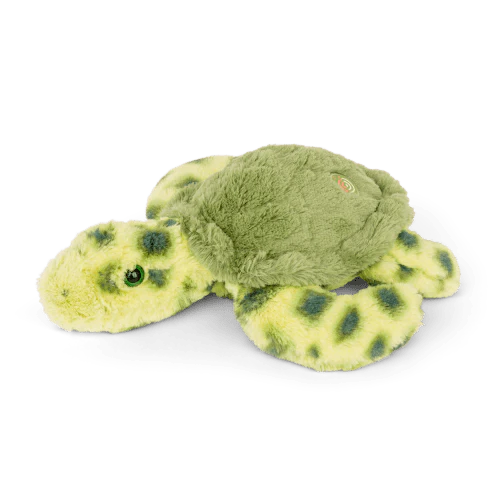
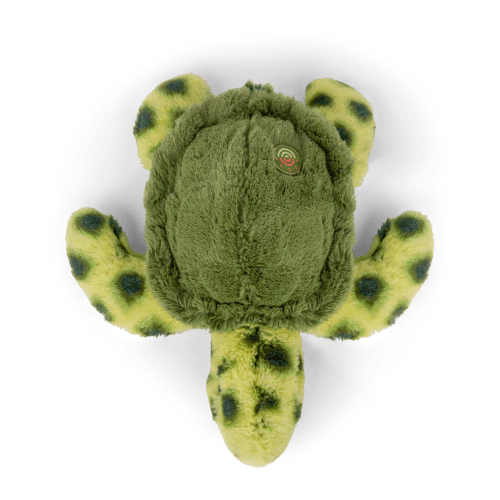
Snuggle a Plush. Track a Turtle.
🧸 + 🌊 = 🐢 A toy that connects you to real sea turtles in the wild.
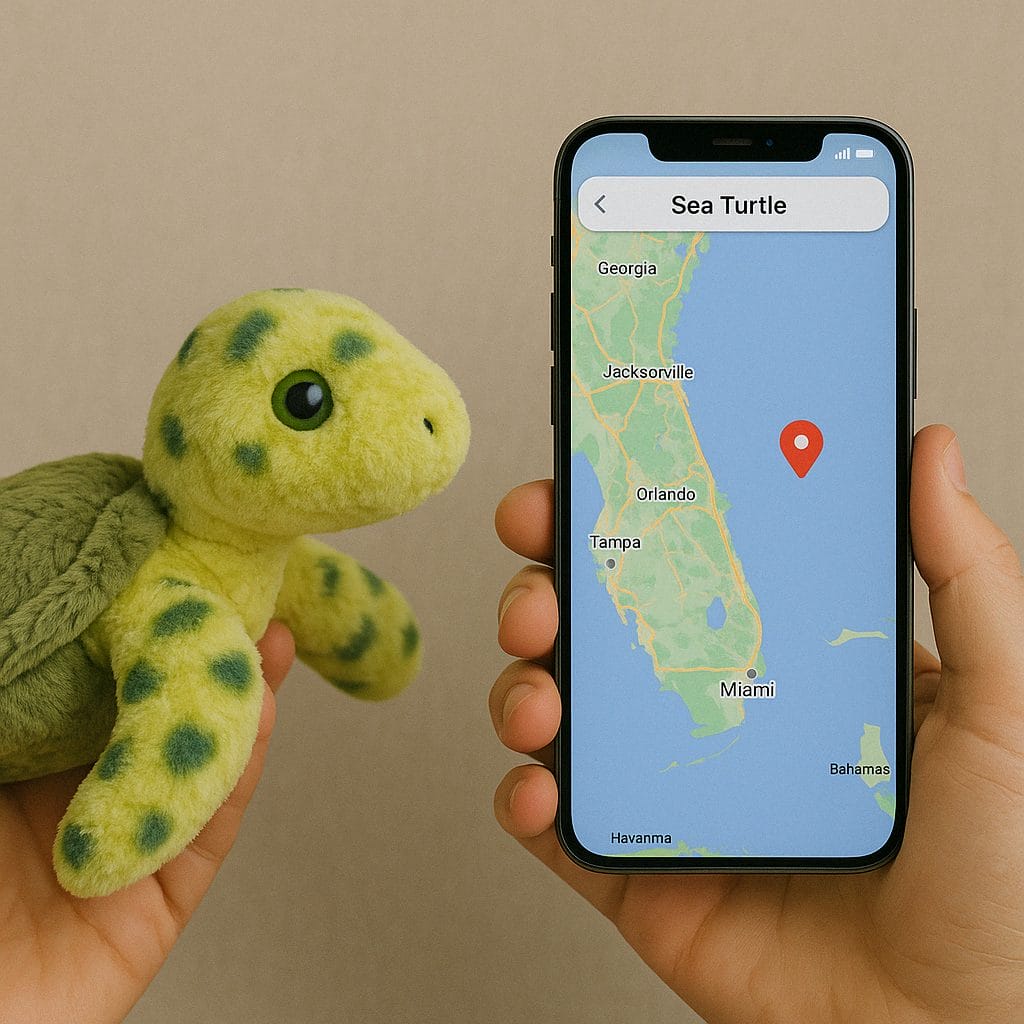
Meet Your Turtle
Scan the tag to meet your real sea turtle. Learn its name, species, and see a real photo!
Follow the Journey
Watch your turtle swim across the ocean using the 3D tracking map. It’s like a sea adventure in your pocket.
Support Wildlife
Every plush supports turtle conservation efforts through the Sea Turtle Conservancy.
Click Here & Use Coupon Code: THETURTLEHUB20 For A 20% Discount! (Your hug helps a turtle.)
They Cry (But Not Because They’re Sad)
If you’ve ever seen a sea turtle nesting on a beach and thought she looked like she was weeping, you’re not imagining things.
But she’s not emotional. She’s flushing salt out of her body.
Here’s How It Works
Sea turtles swallow a ton of saltwater when they eat. Their kidneys can’t handle all that salt on their own, so they evolved special glands behind their eyes that pump out a super-concentrated salt solution.
These glands produce tears that are twice as salty as seawater.
The tears also keep their eyes moist and protected from sand during nesting, which can take hours. So yeah, those “tears” are actually a brilliantly designed survival tool.
Their Shells Are Basically Biological Time Capsules
A 2026 study published in Marine Biology revealed that the hard plates on a sea turtle’s shell, called scutes, grow continuously throughout their lives and preserve chemical signals from the ocean.
By slicing these plates into ultra-thin layers and analyzing them, scientists can reconstruct where a turtle has been foraging, what it was eating, and even detect past environmental stress events like red tides and major seaweed blooms. It’s basically sea turtle forensics.
One Species Can Literally Glow in the Dark
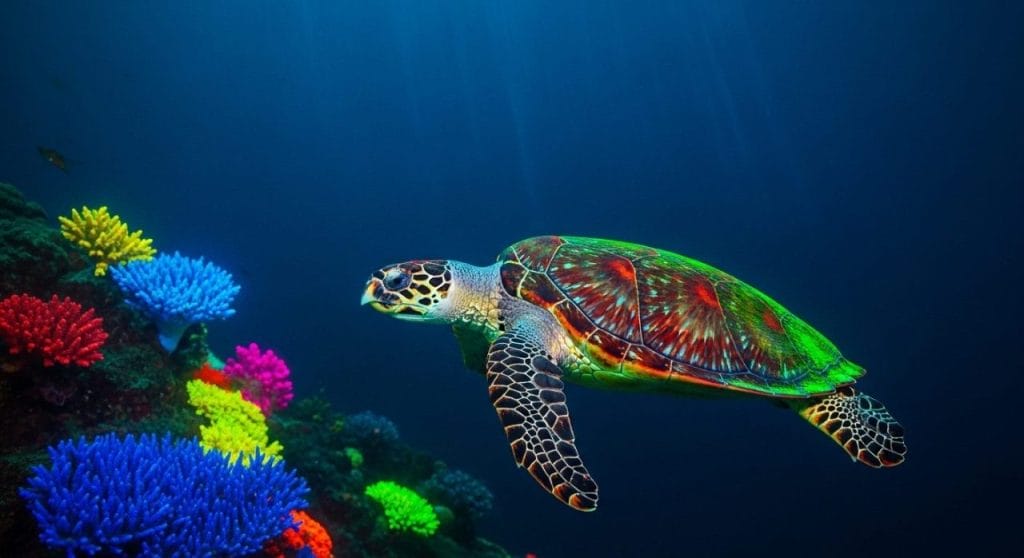
In 2015, scientists were diving at night near the Solomon Islands filming biofluorescent corals when a hawksbill sea turtle swam right in front of their camera.
It was glowing neon green and red.
First Biofluorescent Reptile Ever Recorded
This was the first time any reptile had been documented exhibiting biofluorescence, which is the ability to absorb blue light and re-emit it as a different color.
Corals do it. Over 200 species of fish do it. Sharks do it. But nobody expected a turtle to pull it off.
Scientists still aren’t totally sure why hawksbills glow. The leading theories are communication with other turtles, camouflage against glowing coral reefs, or something we haven’t figured out yet.
The Temperature of Sand Decides If a Baby Turtle Is Male or Female
Sea turtles don’t have sex chromosomes like humans do.
Instead, the temperature inside the nest determines whether hatchlings develop as male or female. Cooler sand produces males. Warmer sand produces females.
And Climate Change Is Messing This Up Badly
In some parts of Florida and Australia, rising temperatures mean that more than 90% of hatchlings are now female.
If sand temperatures keep climbing, we could eventually end up with populations that are almost entirely female. That’s not sustainable.
Only 1 in 1,000 Hatchlings Makes It to Adulthood
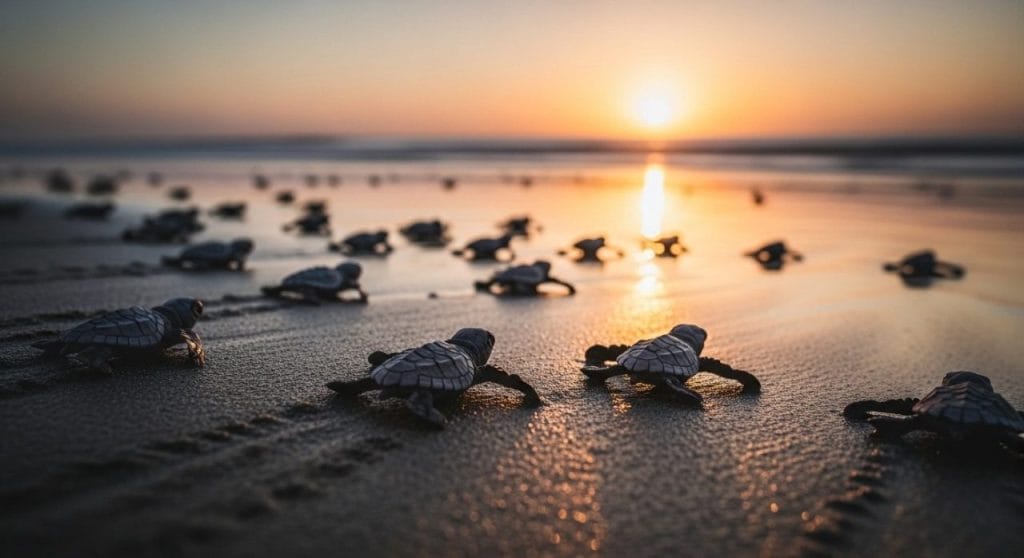
A female sea turtle lays around 100 to 125 eggs per nest and may create multiple nests in a season.
But statistically, only about 1 out of every 1,000 eggs will produce a turtle that survives to become an adult.
The odds are brutal from the very start. Hatchlings have to dodge birds, crabs, dogs, fish, and sharks just to reach open water. Then they spend years in the open ocean during what scientists actually call “the lost years” because we barely know what happens to them during that time.
The ones that do make it? They can live 70 to 80 years or more. A green turtle named Myrtle at the New England Aquarium is estimated to be around 90 years old.
They Can Hold Their Breath for Up to 7 Hours
When resting or sleeping, sea turtles slow their heart rate down so much that it can drop to as low as one beat every nine minutes.
This lets them stay underwater for hours without surfacing to breathe. During active swimming, they typically come up for air every 4 to 5 minutes.
They Can Dive Deeper Than Most Marine Mammals
Leatherback sea turtles hold the record with dives reaching nearly 4,000 feet below the surface.
That’s deeper than most whales and dolphins can go. For context, the average scuba diver goes to about 60 feet.
Their Throats Are Lined with Backward-Facing Spines
Sea turtles, especially leatherbacks, have their esophagus lined with hard, pointed structures called papillae.
These spines point backward toward the stomach so that when a turtle swallows a jellyfish (which is mostly water), the muscles of the throat can squeeze out the extra seawater while the spines keep the food from sliding back out.
It’s basically a built-in strainer. And it’s one of the reasons they’re so effective at eating jellyfish, which are about 95% water.
They Can’t Hide in Their Shells (Unlike Their Land Cousins)
Here’s something most people get wrong: sea turtles cannot retract their head or flippers into their shell.
Their shells are flatter and more streamlined for swimming, and their limbs have evolved into paddle-shaped flippers. Great for speed. Not so great for hiding.
This makes them more vulnerable to predators like tiger sharks, but once they reach full adult size, very few animals in the ocean can mess with them.
They’re Basically Ocean Gardeners
Sea turtles aren’t just floating around looking pretty. They play a huge role in keeping ocean ecosystems healthy.
Green Turtles Mow the Seagrass
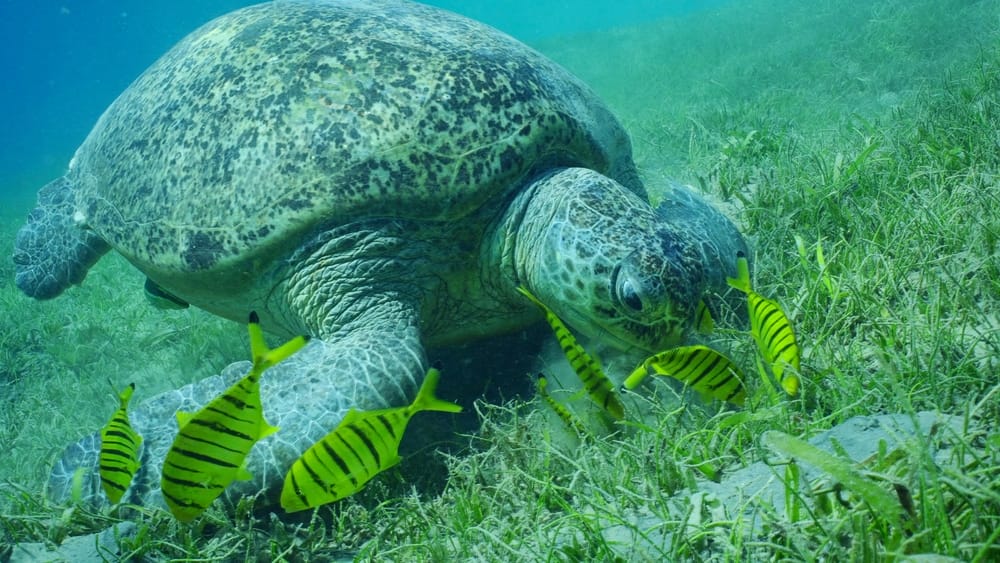
Green sea turtles graze on seagrass beds, which keeps the grass short and healthy. Without turtles trimming it, seagrass beds get overgrown and start to decay, which messes up the habitat for tons of other marine species.
Hawksbills Keep Coral Reefs Alive
Hawksbill turtles eat sponges off coral reefs. If sponges take over, they can smother the coral. By removing sponges, hawksbills give coral space to grow.
These ecological roles are part of why nearly every major civilization revered sea turtles — our article on sea turtle symbolism across cultures explains how their real-life behaviors inspired myths from Hawaii to ancient Mesopotamia.
Leatherbacks Control Jellyfish Populations
Without leatherbacks eating massive amounts of jellyfish, jellyfish populations could explode and throw entire food webs out of balance.
The Good News: They’re Actually Making a Comeback
Here’s a rare piece of genuinely good news.
A major 2024 review published in Nature Reviews Biodiversity found that most sea turtle populations worldwide are increasing. In fact, significant population increases were six times more common than decreases.
And in 2025, the green sea turtle was officially reclassified from “Endangered” to “Least Concern” on the IUCN Red List. That’s a massive deal for a species that’s been listed as endangered since 1982.
Conservation efforts like protected nesting beaches, turtle excluder devices in fishing nets, and reduced artificial lighting near shores are actually working.
And the momentum keeps building.
In March 2026, the U.S. Senate passed the Sea Turtle Rescue Assistance and Rehabilitation Act, which creates a federal grant program authorizing $5 million annually through 2030 to fund sea turtle rescue, rehabilitation, and research across the country.
Until now, most rescue efforts have been volunteer-led and severely underfunded.
But They’re Not Out of Danger Yet
Six of the seven species are still listed as threatened or endangered in U.S. waters.
The Biggest Threats Right Now
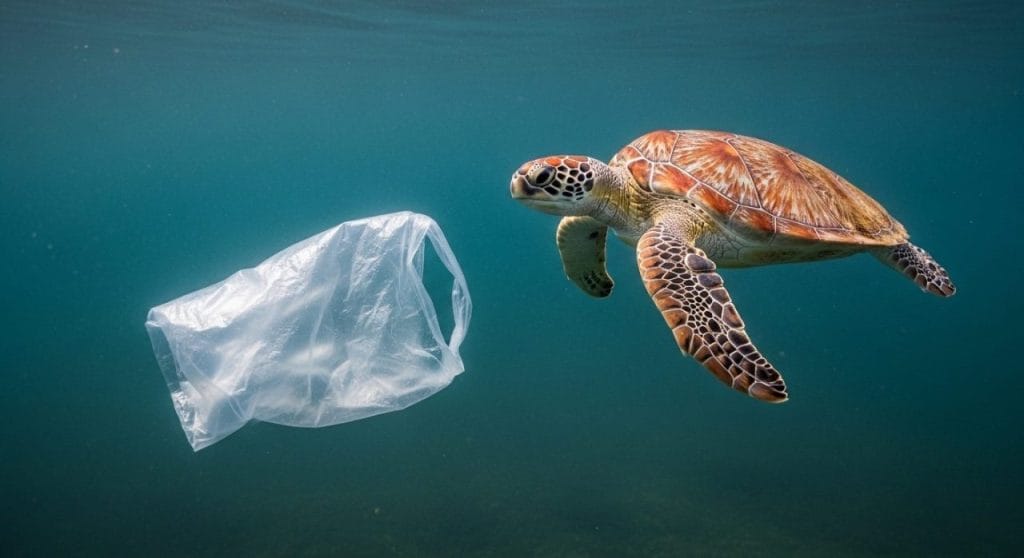
- Plastic pollution: Turtles mistake plastic bags for jellyfish. Once eaten, plastic can block their intestines and kill them.
- Fishing bycatch: Thousands of sea turtles die every year after getting tangled in commercial fishing nets.
- Climate change: Rising temperatures are skewing sex ratios, flooding nests, and reducing food availability.
- Habitat loss: Coastal development destroys nesting beaches and degrades coral reefs.
- Shrinking body size: A 2025 study found that sea turtles are getting physically smaller worldwide. At 27 of 31 nesting sites studied, mean body size is decreasing. While this is partly linked to conservation success bringing more smaller first-time nesters into expanding populations, declining ocean productivity and increased competition for food may also play a role.
A 2026 study from Queen Mary University of London also found that in Cabo Verde, loggerhead turtles are nesting earlier but breeding less frequently, with the gap between breeding seasons growing from about 2 years to 4 years over the past 17 years.
What You Can Actually Do
You don’t need to be a marine biologist to help.
Pick up trash on the beach, especially plastic bags. If you see a nesting turtle at night, keep your distance and turn off any lights. Support fisheries that use turtle-safe gear. Skip the souvenirs made from turtle shell.
And if nothing else, just tell someone about what you learned today. Most people have no idea that these animals can detect magnetic fields, glow in the dark, or cry salt tears that are twice as concentrated as the ocean itself.
Sea turtles survived an asteroid that wiped out the dinosaurs. It would be pretty embarrassing if they couldn’t survive us.

About Author
Muntaseer Rahman started keeping pet turtles back in 2013. He also owns the largest Turtle & Tortoise Facebook community in Bangladesh. These days he is mostly active on Facebook.