What Does A Sea Turtle Symbolize? [In Different Cultures]
This post was created with help from AI tools and carefully reviewed by a human (Muntaseer Rahman). For more on how we use AI on this site, check out our Editorial Policy.
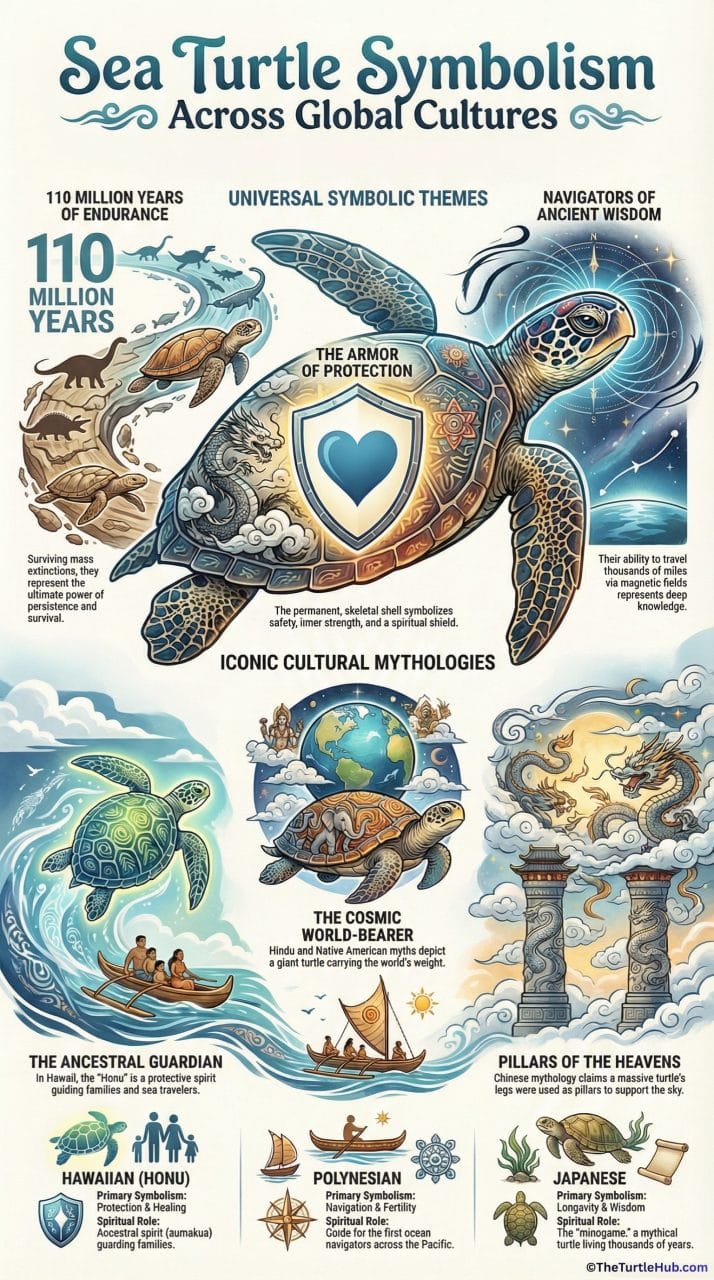
Sea turtles have been cruising through the world’s oceans for over 110 million years.
That’s not a typo. These animals watched the dinosaurs go extinct and kept swimming.
So it makes sense that pretty much every major culture on the planet looked at sea turtles and thought, “Yeah, that thing means something.”
And they were right.
From Hindu gods to Hawaiian spirits to ancient Greek coins, sea turtles have shown up in mythology, religion, and folklore more than almost any other animal. They symbolize everything from the creation of the world to good luck to the literal foundation the earth sits on.
Let’s break down what sea turtles actually mean, culture by culture and symbol by symbol.
What Do Sea Turtles Symbolize?
Before we get into specific cultures, there are some universal themes that keep showing up everywhere sea turtles appear in human history.
These aren’t random. They all connect back to what sea turtles actually do in real life.
Longevity
This one’s obvious.
Sea turtles can live 50 to 80 years or more. A green turtle named Myrtle at the New England Aquarium is estimated to be around 90.
When you watch something outlive everyone and everything around it for decades, you start associating it with long life. Every culture did this.
For more on turtle lifespans and the record-holding 188-year-old tortoise named Jonathan, check out our 15 fascinating turtle facts.
Patience and Perseverance
Sea turtles look slow on land. People see that and think lazy.
They’re not lazy. They just don’t rush.
In the water, sea turtles are fast, efficient swimmers. They cross entire oceans without GPS, without rest stops, without complaining. One leatherback was tracked swimming nearly 13,000 miles over 647 days.
That’s not laziness. That’s patience on a level most of us can’t even imagine.
Endurance
A baby sea turtle’s first day alive is basically a horror movie.
It hatches, digs out of the sand, and sprints toward the ocean while birds, crabs, and every other predator on the beach tries to eat it. Only about 1 in 1,000 hatchlings survives to adulthood.
The ones that make it? They can live for decades. That kind of survival rate makes them a perfect symbol of endurance, and cultures everywhere picked up on it.
We break down the full survival gauntlet — from predators on the beach to “the lost years” in open ocean — in our sea turtle facts deep dive.
Wisdom
Sea turtles navigate thousands of miles using Earth’s magnetic field. They remember the exact beach where they were born and return to it 20 to 30 years later to lay their own eggs.
You probably can’t remember where you parked your car this morning.
When ancient people saw turtles showing up at the same beach generation after generation, they assumed these animals knew something the rest of us didn’t. That’s wisdom.
Protection
The shell is the obvious one here.
Sea turtles carry their armor everywhere they go. It’s part of their skeleton. You can’t take it off. It’s not a house they retreat into (unlike land turtles, sea turtles actually can’t retract into their shells), but it’s still a permanent shield.
Cultures all over the world saw that shell and thought: protection, strength, safety.
Peace
Sea turtles don’t pick fights.
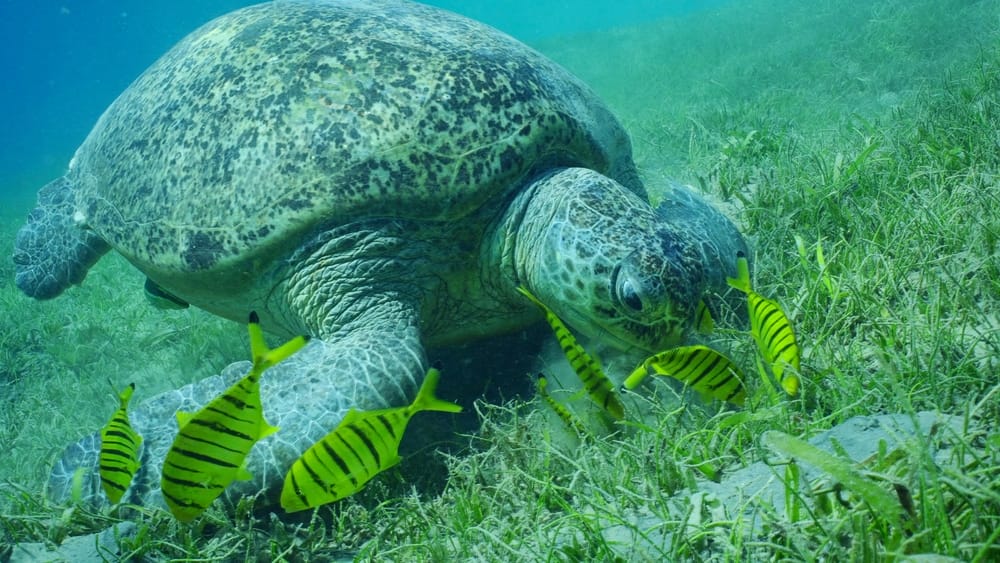
They eat jellyfish and seagrass. They mind their own business. When a predator shows up, they swim away instead of fighting back.
They’re one of the most peaceful large animals in the ocean, and that calm energy made them symbols of tranquility in dozens of cultures.
Good Luck and Fertility
Female sea turtles lay 80 to 120 eggs per nest and may create multiple nests in a single season. That’s a lot of babies.
Ancient sailors believed that spotting a sea turtle during a voyage meant good fortune ahead. And in many coastal cultures, turtles became symbols of fertility and abundance because of the sheer number of eggs they produce.
Track A Real Sea Turtle With Each Bracelet!


Learn Name
You get to learn your sea turtle’s name, size, age. Also a picture!
Enjoy Stories
Enjoy the story of your sea turtle, where it came from, where is it going?
Follow Me
You get to follow the sea turtle’s journey on an interactive tracking map!
Click Here & Use Coupon Code: THETURTLEHUB20 For A 20% Discount!
Sea Turtle Symbolism In Different Cultures
Here’s where things get really interesting.
Almost every major civilization had something to say about sea turtles. Some of these stories are beautiful. Some are wild. And a few are kind of dark.
Hindu Mythology
In Hindu mythology, the turtle isn’t just a symbol. It’s literally holding the universe together.
During the churning of the cosmic ocean (called the Samudra Manthan), Lord Vishnu took the form of a giant turtle called Kurma to support Mount Mandara on his back. The mountain was being used as a churning rod, and without the turtle holding it steady, the whole operation would have collapsed.
There’s also the concept of Akupara, the cosmic turtle that carries the world on its back. In this version, the earth rests on four elephants, and those elephants stand on a giant turtle.
So in Hinduism, turtles don’t just represent stability. They ARE the stability. The entire world depends on them.
Native American Culture
Native Americans have one of the most powerful turtle creation myths in the world.
According to several tribes, including the Haudenosaunee (Iroquois) and Anishinaabe, a Great Turtle volunteered to carry the world on its back after a flood covered the earth. A small animal dove to the bottom of the water, brought up mud, and spread it across the turtle’s shell. That mud became the land.
This is why North America is called “Turtle Island” in many Native American traditions.
Beyond the creation myth, Native Americans associate sea turtles with:
| Symbol | Meaning |
|---|---|
| Mother Earth | The turtle carries and sustains life |
| Fertility | Turtles produce many offspring |
| Protection | Shells were used to hold medicine for babies |
| Health | The turtle represents physical and spiritual wellness |
| Good luck | Encountering a turtle is a positive sign |
The turtle shell also has spiritual healing significance. Some tribes used turtle shells to dispense medicine, especially for protecting newborns.
Chinese Culture
China gave turtles a seriously elevated status.
The turtle is one of the Four Sacred Animals (along with the dragon, phoenix, and qilin). Specifically, the Black Turtle (Xuanwu) guards the north and symbolizes endurance, strength, and longevity.
The Chinese also noticed something interesting about turtle anatomy. The domed upper shell looks like the sky, and the flat lower shell looks like the earth. They saw the turtle as a living model of the universe.
And then there’s the creation myth.
According to Chinese mythology, the water god Gong Gong damaged Mount Buzhou, which held up the heavens. The creator goddess Nuwa cut off the legs of a massive sea turtle named Ao and used them as pillars to support the sky.
Chinese people also used turtle shells for divination. They’d heat the shells until they cracked, then read the crack patterns to predict the future. Some of the oldest Chinese writing ever discovered was found on these oracle bones, many of which were turtle shells.
In feng shui, placing a turtle statue in your home is believed to bring good fortune, health, and family harmony.
Japanese Culture
The Japanese took turtle symbolism and turned it into art.
In Japanese mythology, sea turtles are sacred creatures associated with Konpira, the god of sailors and seafaring. Turtles represent safe passage, longevity, and wisdom.
The most famous mythical turtle in Japanese culture is the minogame, a turtle that has supposedly lived for thousands of years. It’s often depicted with a long, flowing tail that’s actually just seaweed and algae accumulated on its shell over centuries.
The minogame appears constantly in Japanese art, pottery, and literature as a symbol of extreme longevity and deep wisdom.
There’s also the story of Urashima Taro, a fisherman who saved a turtle and was taken to an underwater palace as a reward. It’s one of the most famous folktales in Japan and reinforces the idea that treating turtles well brings blessings.
Hawaiian Culture
Hawaii might be the place where sea turtles are most deeply woven into everyday life.
The green sea turtle is called Honu in Hawaiian, and it’s considered sacred.
Honu aren’t just animals. They’re aumakua, which are ancestral spirits that watch over and protect families. Many Hawaiians believe that deceased ancestors return as sea turtles to guide and guard their loved ones.
Here’s what Honu symbolizes in Hawaiian culture:
| Symbol | Meaning |
|---|---|
| Protection | Spiritual guardian of families |
| Navigation | Guides travelers and the lost |
| Good luck | Sighting a Honu brings blessings |
| Wisdom | Represents the knowledge of elders (kupuna) |
| Connection | Bridge between land, sea, and the spirit world |
| Healing | Seeing one after loss or illness signals recovery |
There’s also the legend of Kauila, a mythical turtle goddess who could transform into a human girl to watch over children playing on the shores of Punalu’u on the Big Island.
Harming a Honu is considered deeply disrespectful in Hawaiian culture. Even today, it’s illegal to touch or disturb green sea turtles in Hawaii.
Polynesian Culture
The broader Polynesian world shares Hawaii’s deep reverence for turtles, but adds its own layers.
In Polynesian tradition, the sea turtle is one of the most important animals in tattooing. Turtle shell patterns are among the most common and meaningful designs in Polynesian tattoo art.
A turtle tattoo in Polynesian culture can represent:
- Navigation and safe voyages
- Fertility and family
- Longevity and health
- Protection from danger
- Prosperity (turtle shells were used to craft fish hooks and tattoo needles)
According to Polynesian legend, the turtle guided the first navigators across the Pacific Ocean, showing them currents, stars, and shorelines before navigational instruments existed.
Polynesian people also believed that turtles could travel between the earthly world and the world of the gods. After death, turtles were thought to guide souls to their final resting place.
That’s why seeing a sea turtle during a voyage was never just a cool nature moment. It was a sign that you were on the right path and the gods were watching over you.
Ancient Greek and Roman Culture
The Greeks and Romans had a complicated relationship with turtles.
On one hand, the tortoise was a symbol of fertility and an attribute of Aphrodite (Venus in Roman mythology). Statues of Aphrodite sometimes show her with her foot resting on a tortoise.
On the other hand, there’s the story of the nymph Chelone.
When Zeus and Hera got married, all creatures were invited to the celebration. Chelone refused to leave her house. She basically said, “There’s no place like home” and stayed put.
Zeus didn’t take that well. He (or Hermes, depending on the version) turned Chelone into a tortoise and made her carry her house on her back forever as punishment.
The word “Chelonian”, the scientific term for turtles, comes directly from her name.
The tortoise was also the symbol of the ancient Greek city of Aegina. Their coins featured images of tortoises.
And here’s a fun one: according to myth, Hermes invented the lyre by finding a dead tortoise, hollowing out its shell, and stringing it with animal gut. Apollo loved it so much that the lyre became his signature instrument.
Then there’s the dark side. The bandit Sciron would force travelers to wash his feet at the edge of a cliff, then kick them into the sea where a giant sea turtle would devour them. Theseus eventually defeated Sciron by kicking him off the same cliff.
So in Greek mythology, turtles could be symbols of beauty, music, and fertility, or they could be monsters lurking at the bottom of a cliff. It depended on the story.
Ancient Egyptian Culture
Egypt is the one place where turtles got a genuinely bad reputation.
Early on, turtles were actually considered protective. During the pre-dynastic and Old Kingdom periods, turtle amulets were used to ward off evil and protect health. Turtle-shaped palettes, vases, and magical objects were common.
But things changed.
As Egyptian religion evolved, turtles became associated with Set (also spelled Seth), the god of chaos, storms, and disorder. Set was the enemy of Ra, the sun god.
Since turtles were aquatic creatures connected to the dark waters of the underworld, they got lumped in with Set’s forces of chaos. From the 19th Dynasty onward, turtles were increasingly viewed as evil beings and enemies of the sun.
Kings and nobles began ritually spearing turtles as a symbolic act of defeating chaos. Eating turtle meat, which had been common in earlier periods, became considered an “abomination of Ra.”
That said, it wasn’t all negative. The frog-headed goddess Heqet, associated with fertility and childbirth, was sometimes depicted alongside turtles. And turtle parts were used in Egyptian medicine, including a formula where turtle brain was used as a treatment for eye problems.
So Egypt gives us one of the few cultures where turtle symbolism was mostly negative, at least in the later periods.
Ancient Mesopotamian Culture
Mesopotamia gives us one of the oldest and wildest turtle stories in recorded history.
The turtle was associated with Enki, the god of water, wisdom, creation, and mischief. Turtles appear as symbols of Enki on kudurrus, which were stone boundary markers used to claim land under divine protection.
The best story comes from the Myth of Ninurta and the Turtle.
Ninurta, the god of rain and war, recovered a powerful tablet that controlled fate. Instead of returning it, he decided to keep the power for himself.
Enki wasn’t having it. He created a giant turtle and released it behind Ninurta. The turtle bit Ninurta’s ankle. While they fought, the turtle dug a deep pit with its claws, and both Ninurta and the turtle fell in.
Enki then stood at the edge of the pit and basically trash-talked the trapped god.
It’s one of the earliest recorded stories of a turtle being used as a weapon, and it reinforces the turtle’s association with cunning, strength, and divine trickery.
Celtic Culture
In Celtic mythology, sea turtles are shape-shifters.
They were believed to transform into humans or other animals to help and protect people from danger. Celtic myths treat turtles as guardians that move between forms and worlds.
Seeing a sea turtle on the seashore was considered a good omen in Celtic tradition, a sign that protective forces were nearby.
Celtic symbolism also connects turtles to longevity, protection, and the connection between the physical and spiritual worlds, similar to Hawaiian and Polynesian beliefs.
Christianity
Sea turtles show up in Christian symbolism, but the meaning depends on who you ask.
On the positive side, turtles represent patience, endurance, and wisdom. Their slow, steady nature aligns with Christian values of perseverance through hardship.
In some interpretations, the turtle symbolizes the journey of the soul. Its movement between land and water represents the transition between earthly life and the afterlife.
But there’s a darker side too.
Some Christian traditions view the turtle’s shell as representing the burden of sin. The weight the turtle carries on its back symbolizes the weight that sinners must bear.
In certain medieval European interpretations, turtles were associated with sloth and lust, two of the seven deadly sins. The idea was that the turtle’s slow movement and tendency to hide in its shell represented laziness and withdrawal from God.
So in Christianity, turtles are a bit of a coin flip. Wise and patient, or lazy and sinful. It really depends on the era and the theologian.
This Hilarious Turtle Book Might Know Your Pet Better Than You Do

Let’s be real—most turtle care guides feel like reading a textbook written by a sleep-deprived zookeeper.
This one’s not that.
Told from the snarky point of view of a grumpy, judgmental turtle, 21 Turtle Truths You’ll Never Read in a Care Guide is packed with sarcasm, sass, and surprisingly useful insights.
And hey—you don’t have to commit to the whole thing just yet.
Grab 2 free truths from the ebook and get a taste of what your turtle really thinks about your setup, your food choices, and that weird plastic palm tree.
It’s funny, it’s honest, and if you’ve ever owned a turtle who glares at you like you’re the problem—you’ll feel seen.
Sea Turtle Symbolism in Modern Culture
Today, sea turtles have taken on a new symbolic role: environmental conservation.
Because six of the seven sea turtle species are still listed as threatened or endangered, the sea turtle has become one of the most recognizable symbols of ocean conservation worldwide.
Organizations, governments, and communities use sea turtle imagery to promote beach cleanups, anti-plastic campaigns, marine protected areas, and sustainable fishing.
In a way, the symbolism has come full circle. Ancient cultures saw sea turtles as protectors of the world. Modern culture sees protecting sea turtles as one of our most important responsibilities.
The green sea turtle was officially reclassified from Endangered to Least Concern on the IUCN Red List in October 2025, proving that when humans actually commit to protecting these animals, it works.
But the other species still need help. And the turtle’s symbolic meaning, endurance, patience, wisdom, and protection, is exactly what the conservation effort requires.
Our sea turtle facts article covers the latest conservation wins and ongoing threats in detail, including the 2026 Sea Turtle Rescue Act and the emerging concern over shrinking body sizes worldwide.
Snuggle a Plush. Track a Turtle.
🧸 + 🌊 = 🐢 A toy that connects you to real sea turtles in the wild.

Meet Your Turtle
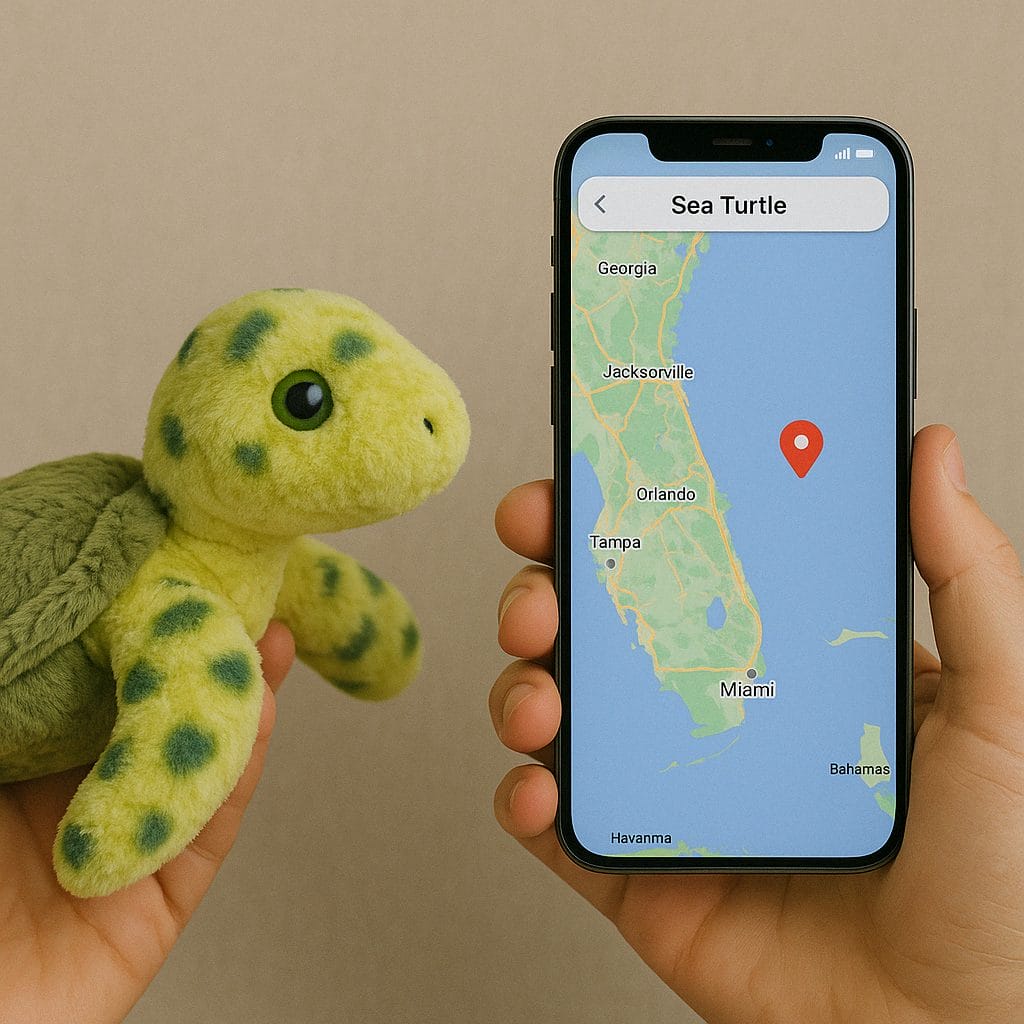
Scan the tag to meet your real sea turtle. Learn its name, species, and see a real photo!
Follow the Journey
Watch your turtle swim across the ocean using the 3D tracking map. It’s like a sea adventure in your pocket.
Support Wildlife
Every plush supports turtle conservation efforts through the Sea Turtle Conservancy.
Click Here & Use Coupon Code: THETURTLEHUB20 For A 20% Discount! (Your hug helps a turtle.)
Before You Go
Sea turtles have meant something to humans for as long as humans have been telling stories.
They’ve been gods, guardians, weapons, musical instruments, navigation guides, and symbols of everything from cosmic creation to fertility to the punishment of lazy nymphs.
110 million years of existence will do that.
If there’s one thing every culture agrees on, it’s this: sea turtles are not just animals. They carry weight, literally and symbolically, that very few other creatures on Earth can match.

About Author
Muntaseer Rahman started keeping pet turtles back in 2013. He also owns the largest Turtle & Tortoise Facebook community in Bangladesh. These days he is mostly active on Facebook.