15 Genius Outdoor Tortoise Enclosure Ideas You Can Build in a Weekend
This post was created with help from AI tools and carefully reviewed by a human (Muntaseer Rahman). For more on how we use AI on this site, check out our Editorial Policy.
Ever catch your tortoise staring longingly at the great outdoors? I know the feeling.
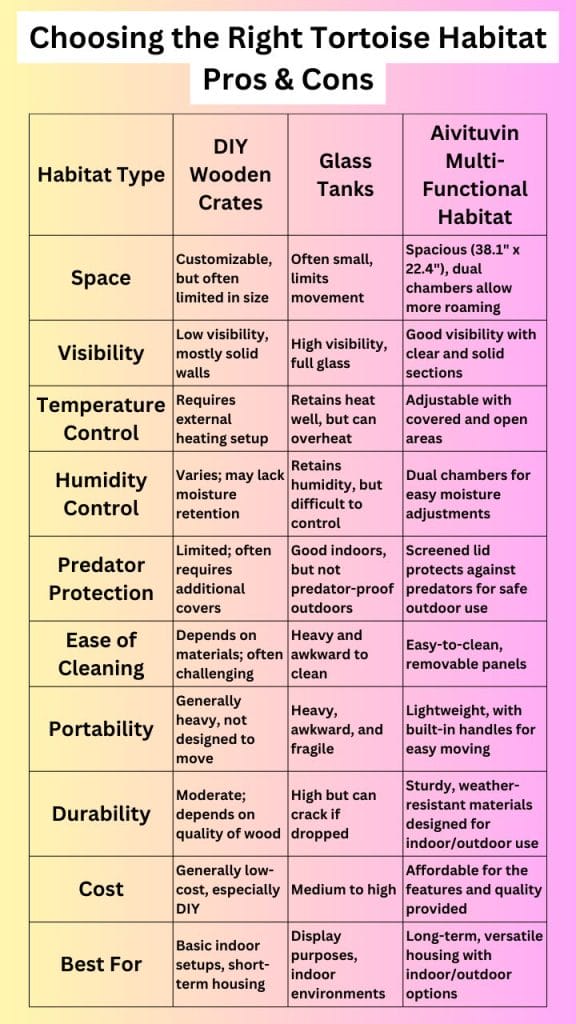
After realizing my little guy needed more space and fresh air, I dove into designing the perfect outdoor tortoise enclosure (my pick: Aivituvin Wooden Tortoise Habitat).
Turns out, creating a tortoise-friendly backyard haven is easier (and quicker) than you’d think.
In just one weekend, you can transform your outdoor space into a tortoise paradise — here are 15 outdoor tortoise enclosure ideas grouped by the kind of setup you actually need, from weekend DIY builds to sulcata burrows to cold-climate greenhouses.
DIY Outdoor Tortoise Enclosure Ideas
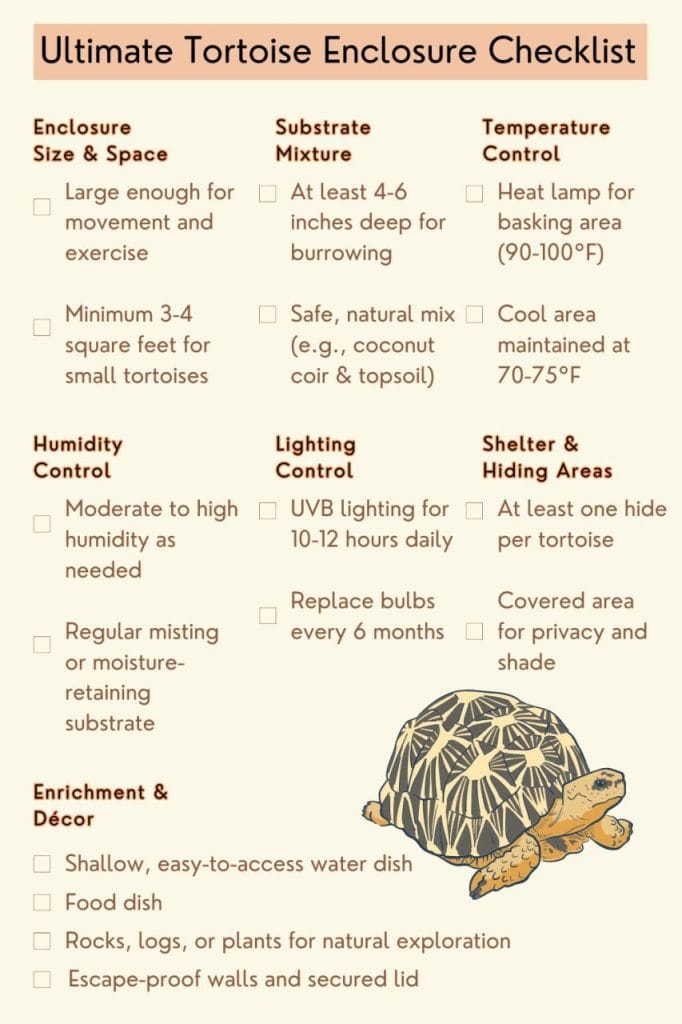
Looking for DIY outdoor tortoise enclosure ideas you can build without being a carpenter? These setups use basic wood framing, hardware cloth, and materials from any home improvement store — no fancy tools required. Each one is a weekend project that beats overpriced pet-store pens on both space and cost.
1. Predator-Proof Tortoise Box With Built-In Hide
What makes it special:
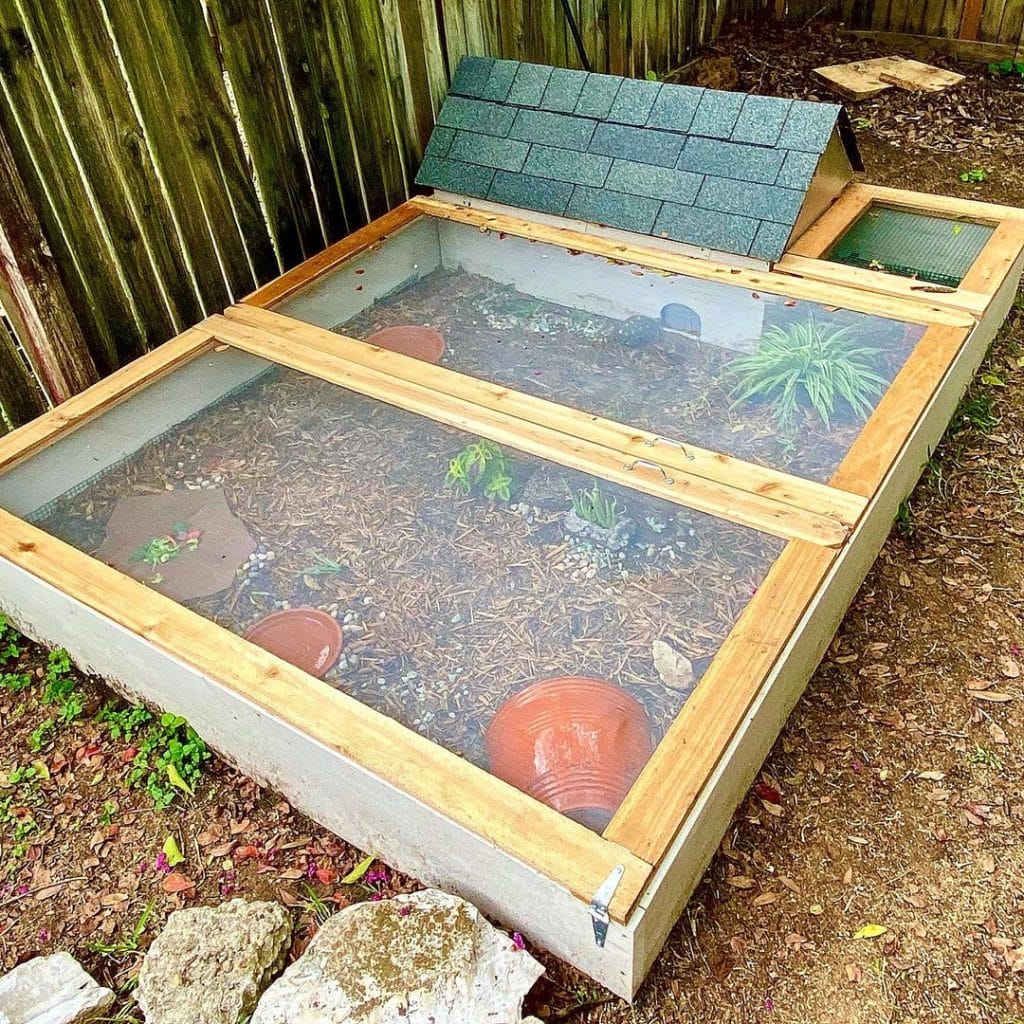
This setup is fully enclosed with a mesh top that keeps predators out while letting sunlight in. It includes a raised hide house with a shingle roof, giving your tortoise a cozy, rain-resistant shelter. The interior has mulch, edible plants, and clay pots for shade or play.
How to copy it:
- Build a deep wooden frame with solid walls
- Add a secure wire mesh lid with hinges
- Include a weatherproof hide with a small entrance
- Use mulch for substrate and add potted plants
- Keep the enclosure near a wall or fence for wind protection
Good elements shown: This setup has mesh for predator protection and a weatherproof hide. But a “cozy, rain-resistant shelter” also needs HEAT — even on cool summer nights, tortoises need warmth.
Add a ceramic heat emitter (recommended: CHE bulbs and fittings) or radiant heat panel (recommended: wall-mount panels) inside that hide, controlled by a thermostat (recommended: dimming and pulse units). Without heat, your tortoise retreats to the shelter and gets cold anyway.
See heated shelter setup.
2. Rustic Garden-Style Pen with Chicken Wire Cover
What makes it special:
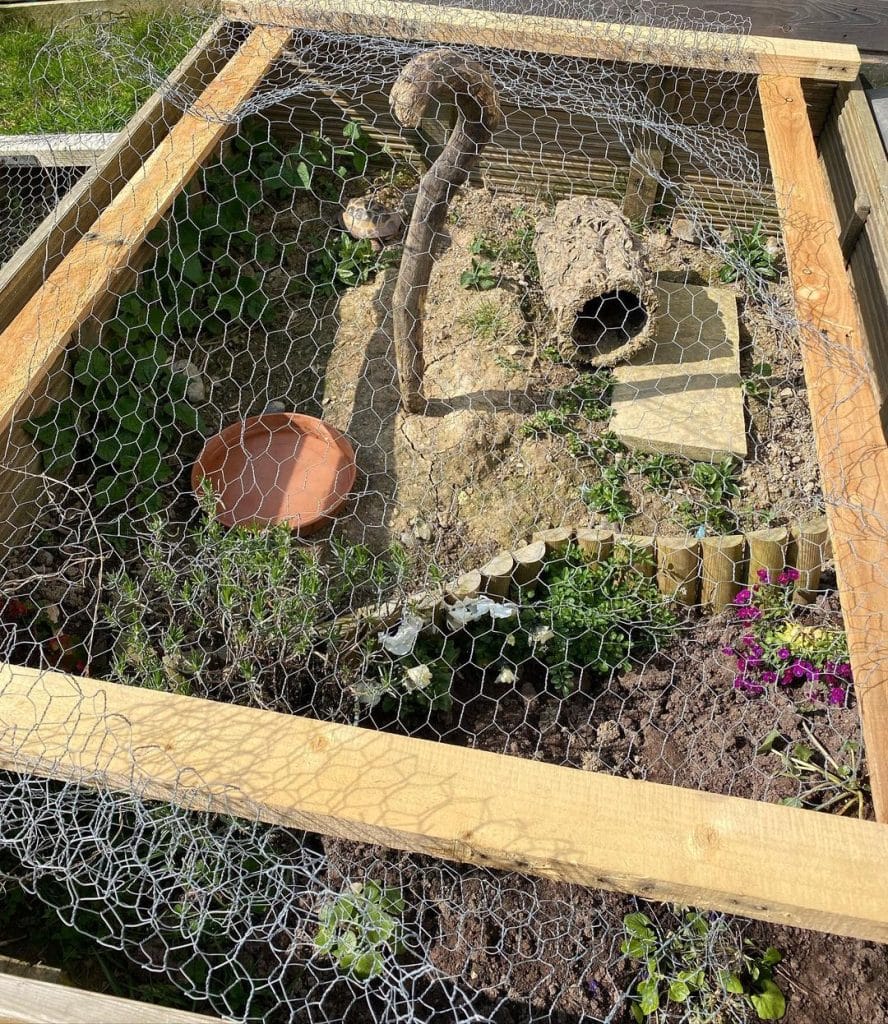
This DIY outdoor tortoise enclosure looks like a slice of a natural garden. It uses chicken wire to keep the tortoise in, a clay water dish, a log tunnel, and natural plants scattered across a raised soil bed. It’s simple, cheap, and tort-friendly.
How to copy it:
- Make a shallow wooden frame
- Cover the top with chicken wire for basic protection
- Use dirt and grass as the base
- Add safe garden plants and a log for hiding
- Keep it low-cost by using yard scraps and repurposed items
Predator protection warning: “Chicken wire to keep predators out” is mentioned, but standard chicken wire has gaps large enough for raccoon paws to reach through. Hardware cloth (1/2 inch mesh) is genuinely predator-proof.
This setup also shows no heated shelter — essential even in summer for cool nights and overcast days. Budget option: add a simple wooden hide box with a ceramic heat emitter.
See how to build a tortoise habitat on a budget.
3. Rustic Cottage-Style Tortoise Corner
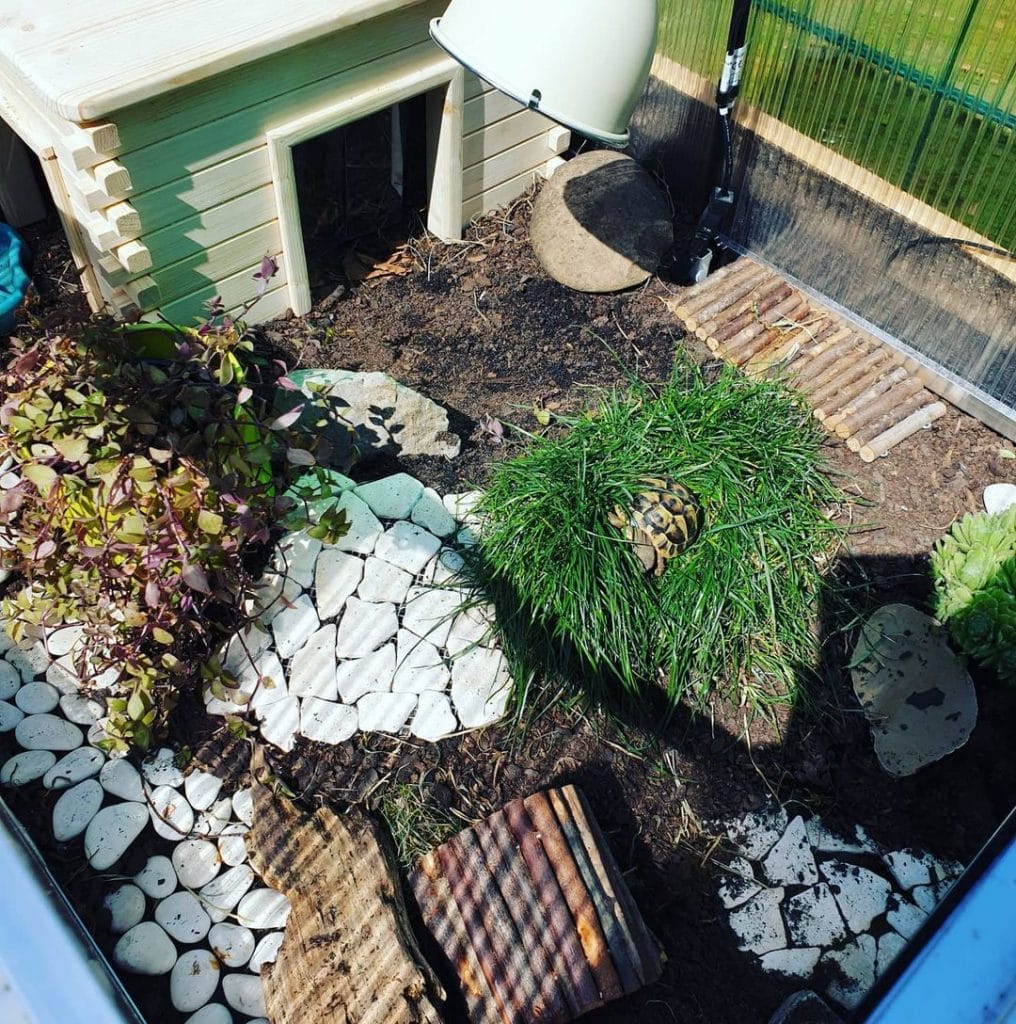
What makes it special:
This cozy DIY pen is packed with texture — flat stone paths, clumps of grass, bark hideouts, and a wooden log house. There’s a heat lamp (my pick: heat lamp) overhead and full sunlight access. The layout encourages the tortoise to move between zones naturally.
How to copy it:
- Use logs or wood panels to build a small house
- Place river stones and broken tiles to create winding paths
- Add natural grass mounds and small bushes
- Hang a lamp overhead if the space is shaded
- Mix rustic materials for a functional backyard tortoise habitat
4. Portable Cage-Style Outdoor Pen With Full Enrichment
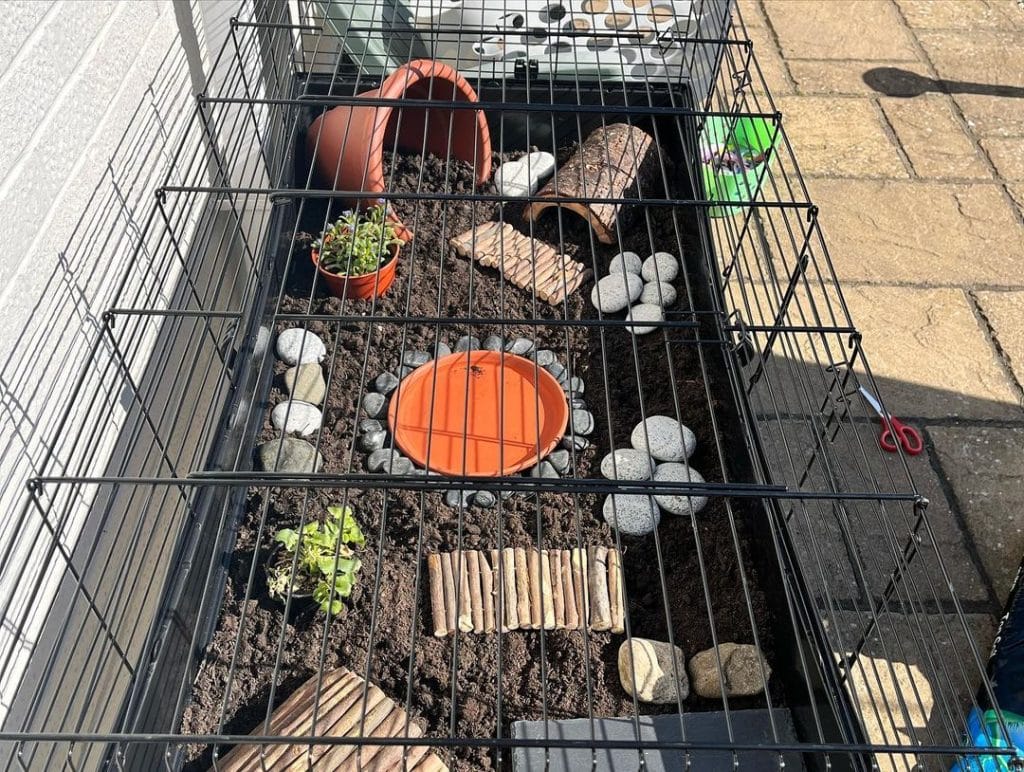
What makes it special:
This setup uses a metal crate as a movable outdoor tortoise pen. It has everything — potted plants, logs, hideouts, smooth rocks, and a large shallow water dish. The ground is real soil, giving your tortoise a natural feel with full sun exposure.
How to copy it:
- Repurpose a large dog crate or metal pet cage
- Fill the bottom with organic soil
- Add flat stones, driftwood, and mini logs for climbing
- Place potted edible greens and a shallow water dish in the middle
- Great for temporary outdoor time or small spaces
Portable setup use case: This works great for temporary outdoor time but isn’t a permanent solution. No heated shelter, limited space, and metal crates conduct cold fast.
Use this for supervised daytime enrichment, then return your tortoise to a properly equipped enclosure. For permanent outdoor setups, you need heated shelter, predator protection, and temperature monitoring.
The full tortoise gear list covers what a permanent outdoor setup actually needs.
5. Small Botanical Enclosure With Edible Plants
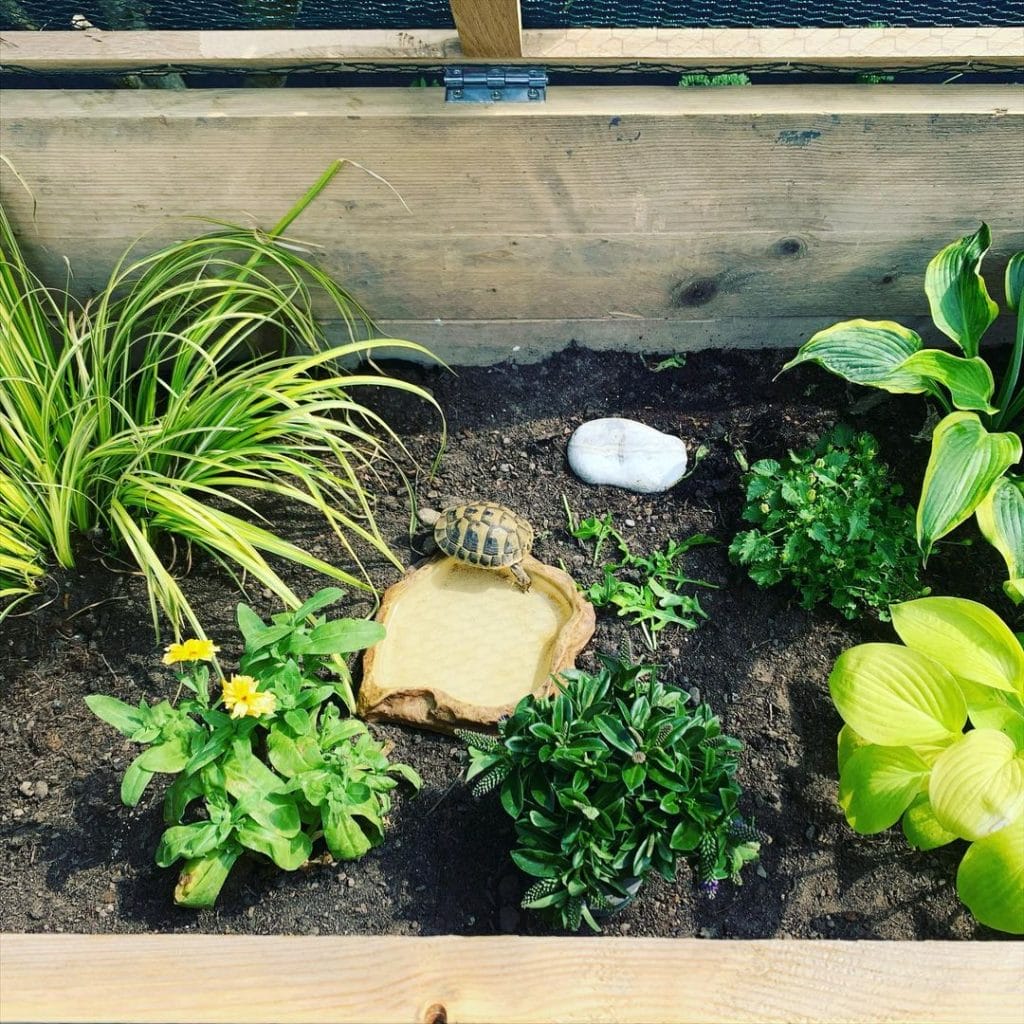
What makes it special:
This habitat is like a little garden buffet. It’s packed with tort-safe plants and herbs, giving both cover and grazing options. The natural water dish is shallow and easy to reach, and the raised wooden walls keep things tidy and protected.
How to copy it:
- Build a small raised box from wood planks
- Fill with soil and plant a mix of edible greens and decorative foliage
- Use a flat stone or resin dish for water
- Place a few natural rocks for basking or climbing
- Works well for young tortoises or limited yard space
Large Outdoor Tortoise Habitat Ideas
If your adult sulcata, leopard, redfoot, or Hermann’s has outgrown every “large” enclosure you’ve tried, you need a real large outdoor tortoise habitat — not another oversized box. These setups prioritize open ground, shade zones, raised planters for grazing, and genuine room to roam.
6. Natural Outdoor Habitat With Trees and Raised Bed
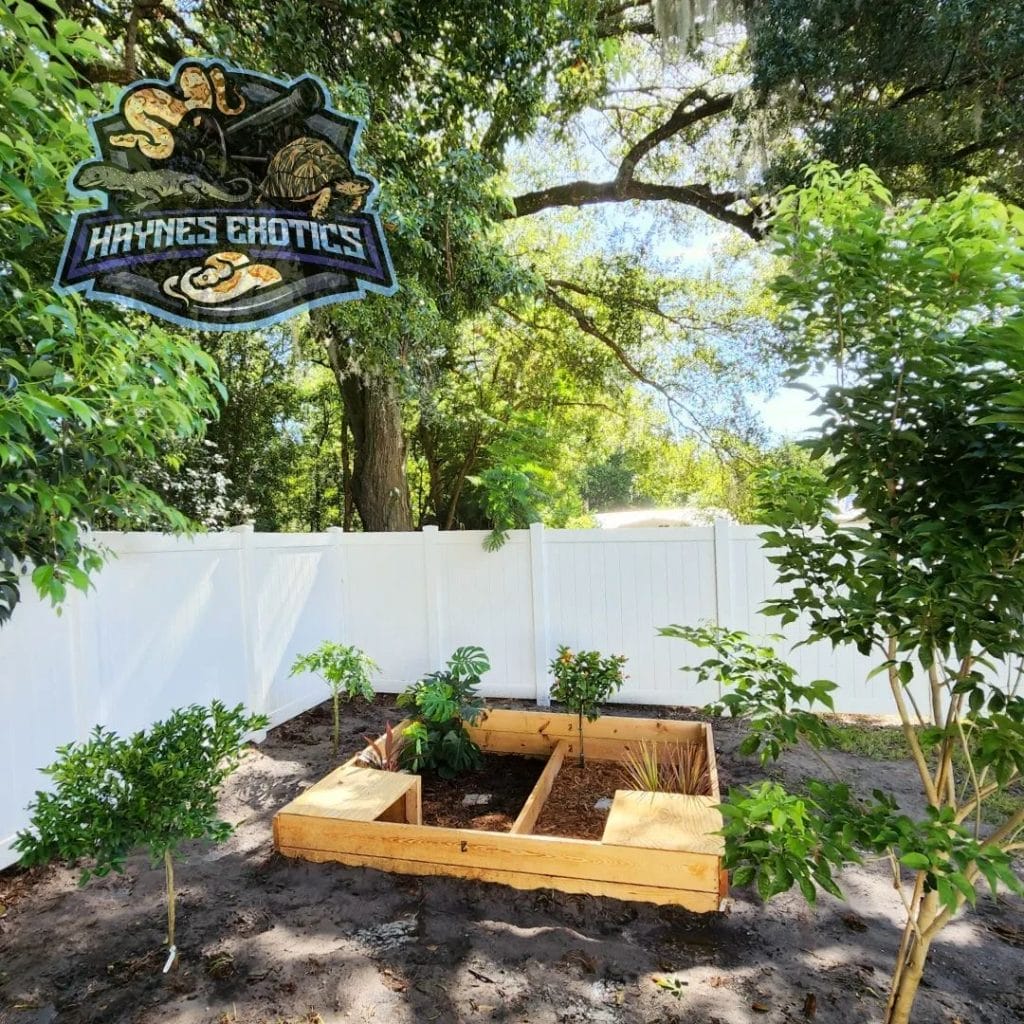
What makes it special:
This large outdoor tortoise habitat blends with the yard and uses natural trees and raised planters for shade and privacy. The large space and open sky give the tortoise plenty of room to roam. There’s enough foliage to create natural hiding spots without needing complex shelters.
How to copy it:
- Set up a fenced area with partial shade (like under big trees)
- Add raised wooden planters filled with edible tort-safe plants
- Create small dirt mounds and open pathways for exploration
- Use soft soil or a sand-loam mix as the base
- Make sure the fencing is deep enough to stop digging escapes
7. Long Narrow Walkway-Style Outdoor Run
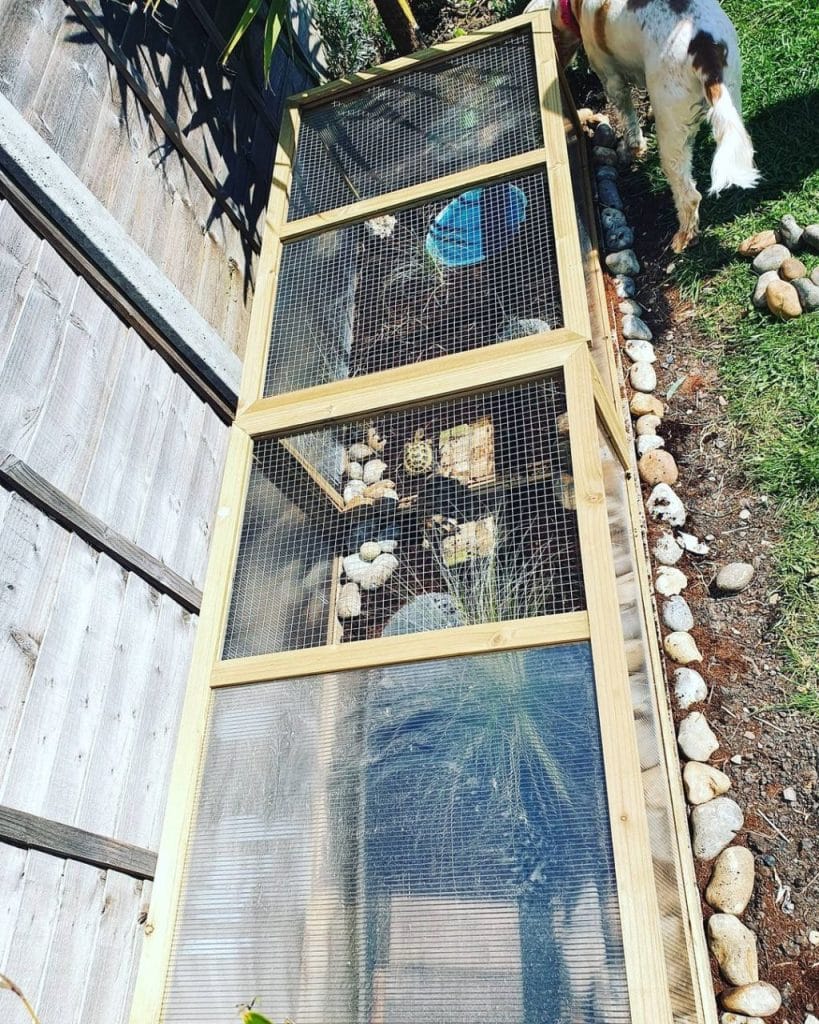
What makes it special:
This setup runs along a fence, using vertical space wisely. It’s fully enclosed with fine mesh to protect from predators, and a clear roof section lets sunlight in. Rocks, plants, and shade zones are spaced throughout to encourage movement.
How to copy it:
- Build a long wooden frame with mesh on all sides
- Use clear plastic on part of the top to allow sun in
- Add stones and plant pockets along the path
- Place it against a fence or wall to save yard space
- Great for active tortoises who love to walk and explore
8. Open Garden Enclosure with Tunnel and Planters
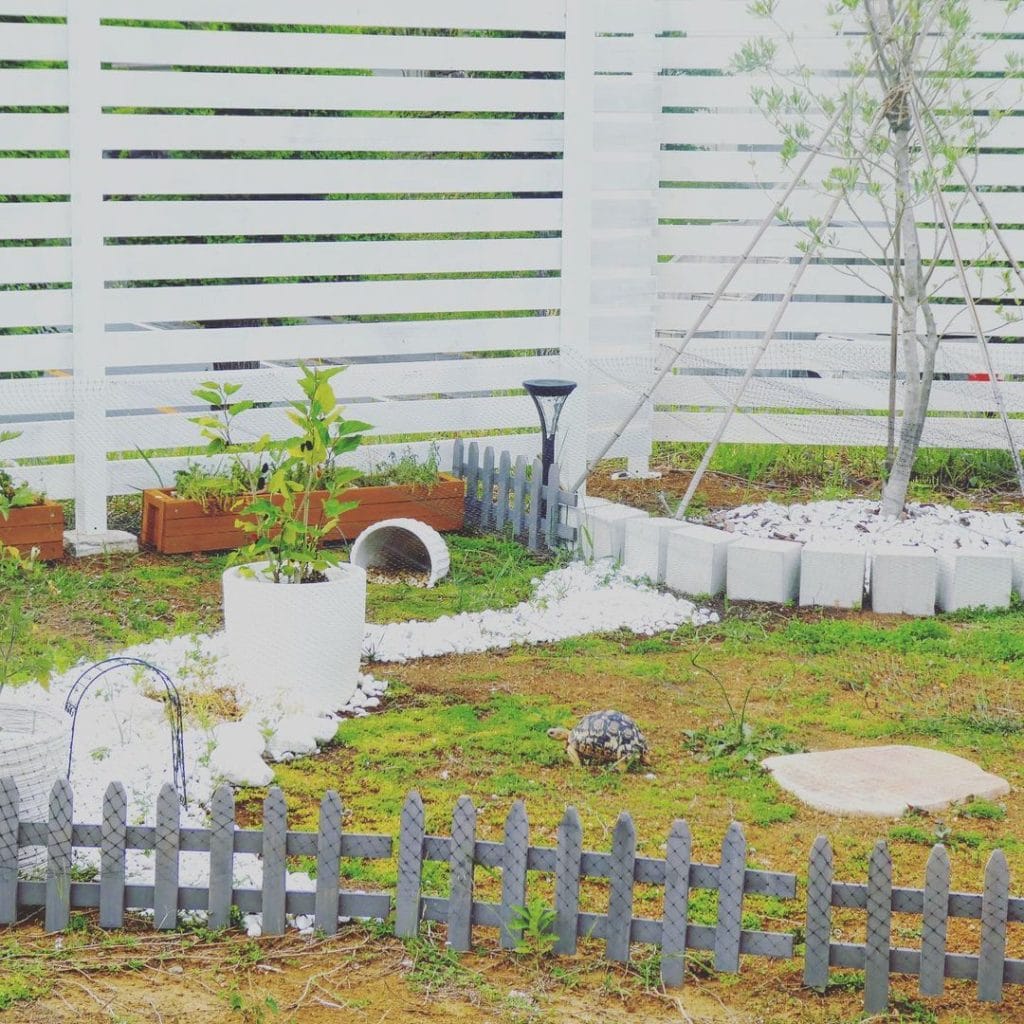
What makes it special:
This large tortoise enclosure blends right into a backyard garden with a natural, open look. There’s a buried tunnel hide made from a white pipe, a gravel walking path, and raised beds along the back wall. The white picket fence and mesh overlay keep things safe while still looking clean.
How to copy it:
- Use garden fencing to section off an area
- Bury a plastic or clay pipe as a hide tunnel
- Lay a curved gravel path for easy walking
- Place small trees or bushes in pots to create shady zones
- Add a low mesh cover if you have predators nearby
9. Simple Plant-Filled Enclosure for Grazing and Shade
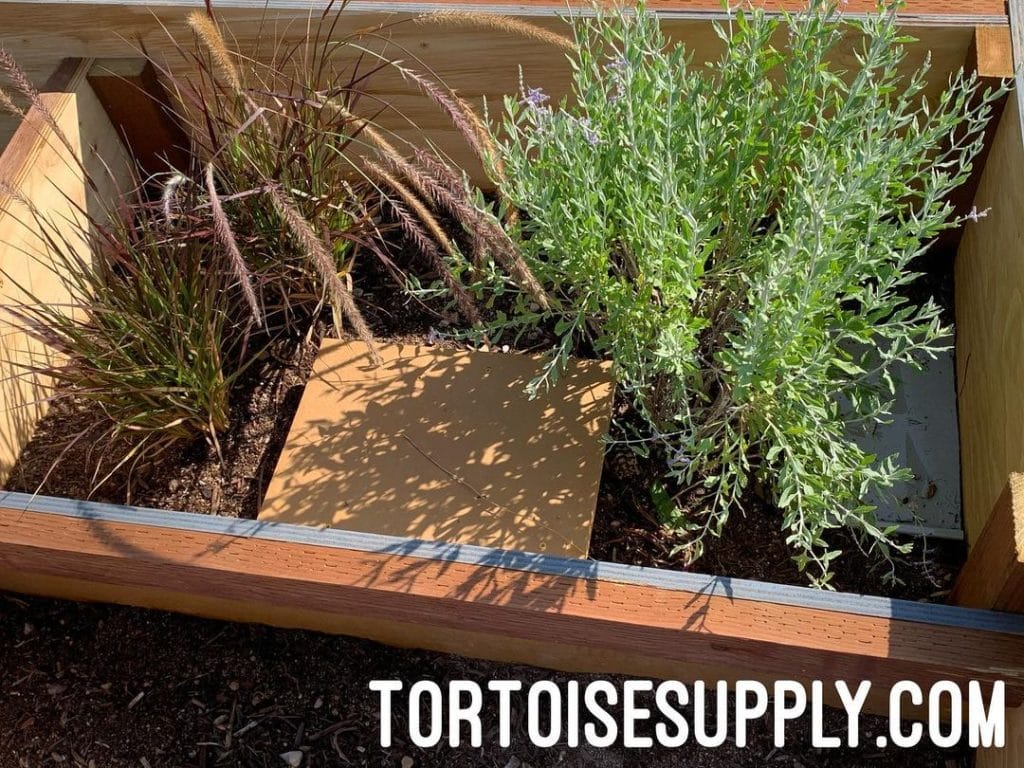
What makes it special:
This outdoor tortoise enclosure focuses on dense planting with edible grass and shrubs. It also includes a warm basking tile that helps with digestion and shell health. Everything is packed into a raised box that’s easy to manage.
How to copy it:
- Build a small wooden frame enclosure
- Fill one half with tortoise-safe grass and broad-leaf plants
- Leave space for a flat basking tile in full sun
- Keep the layout simple and dense to encourage grazing
- This works great as a section inside a bigger outdoor pen
This Hilarious Turtle Book Might Know Your Pet Better Than You Do

Let’s be real—most turtle care guides feel like reading a textbook written by a sleep-deprived zookeeper.
This one’s not that.
Told from the snarky point of view of a grumpy, judgmental turtle, 21 Turtle Truths You’ll Never Read in a Care Guide is packed with sarcasm, sass, and surprisingly useful insights.
And hey—you don’t have to commit to the whole thing just yet.
Grab 2 free truths from the ebook and get a taste of what your turtle really thinks about your setup, your food choices, and that weird plastic palm tree.
It’s funny, it’s honest, and if you’ve ever owned a turtle who glares at you like you’re the problem—you’ll feel seen.
Sulcata and Desert Tortoise Outdoor Habitat Ideas
Sulcata and desert tortoise owners face different challenges than other species. Sulcatas are aggressive burrowers from the Sahel, and desert tortoises (Gopherus) evolved for arid Southwestern terrain. These sulcata tortoise habitat outdoor and desert tortoise habitat outdoor ideas account for burrowing behavior, dry climate needs, and the rocky grassland aesthetic that matches their natural environment.
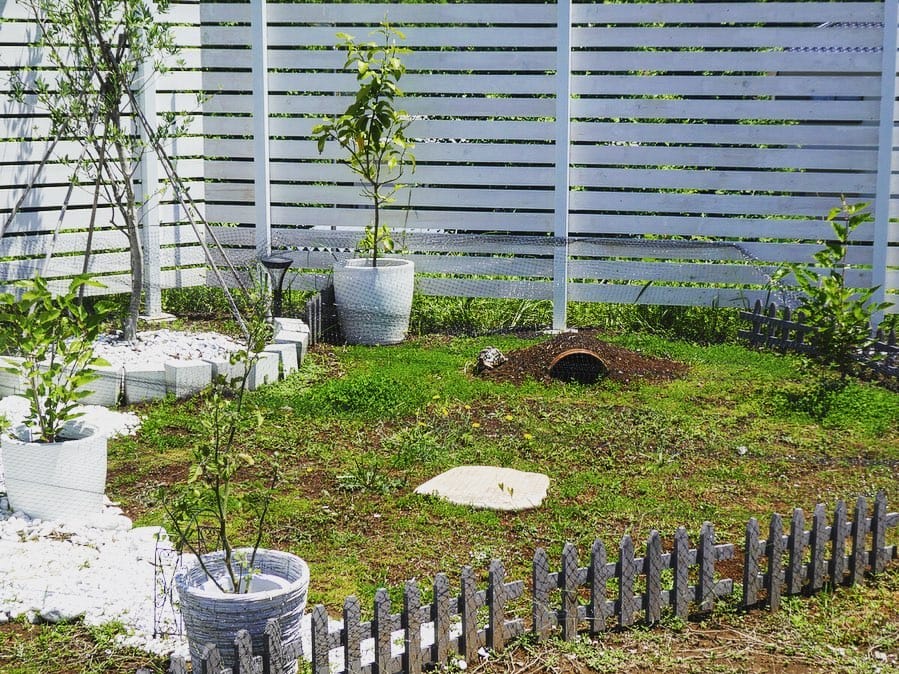
10. Garden-Style Outdoor Setup with Burrow Hide (Great for Sulcatas)
What makes it special:
This sulcata-friendly outdoor habitat mimics a natural meadow with plenty of grass and open space. The hide is made from a simple clay tunnel covered in soil for insulation — a built-in burrow that satisfies the sulcata’s hardwired digging instinct. It also uses decorative potted plants and a small fence to keep the area organized.
How to copy it:
- Use a corner of your garden with natural sunlight
- Bury a curved clay pipe and mound soil over it for a burrow
- Plant clover or grass as ground cover
- Add small bushes or potted plants for shade
- Use a short fence to keep the tortoise inside without blocking the view
Natural burrow warning: A curved clay pipe covered in soil creates a cool, insulated hide — which is fine for escaping midday heat but dangerous for cold nights.
Natural burrows don’t generate heat. Your sulcata needs a HEATED shelter option in addition to cool hiding spots. The buried pipe is great enrichment, but add a separate heated house.
A buried pipe stays cool by design, so pair it with a proper heated shelter running on a thermostat.
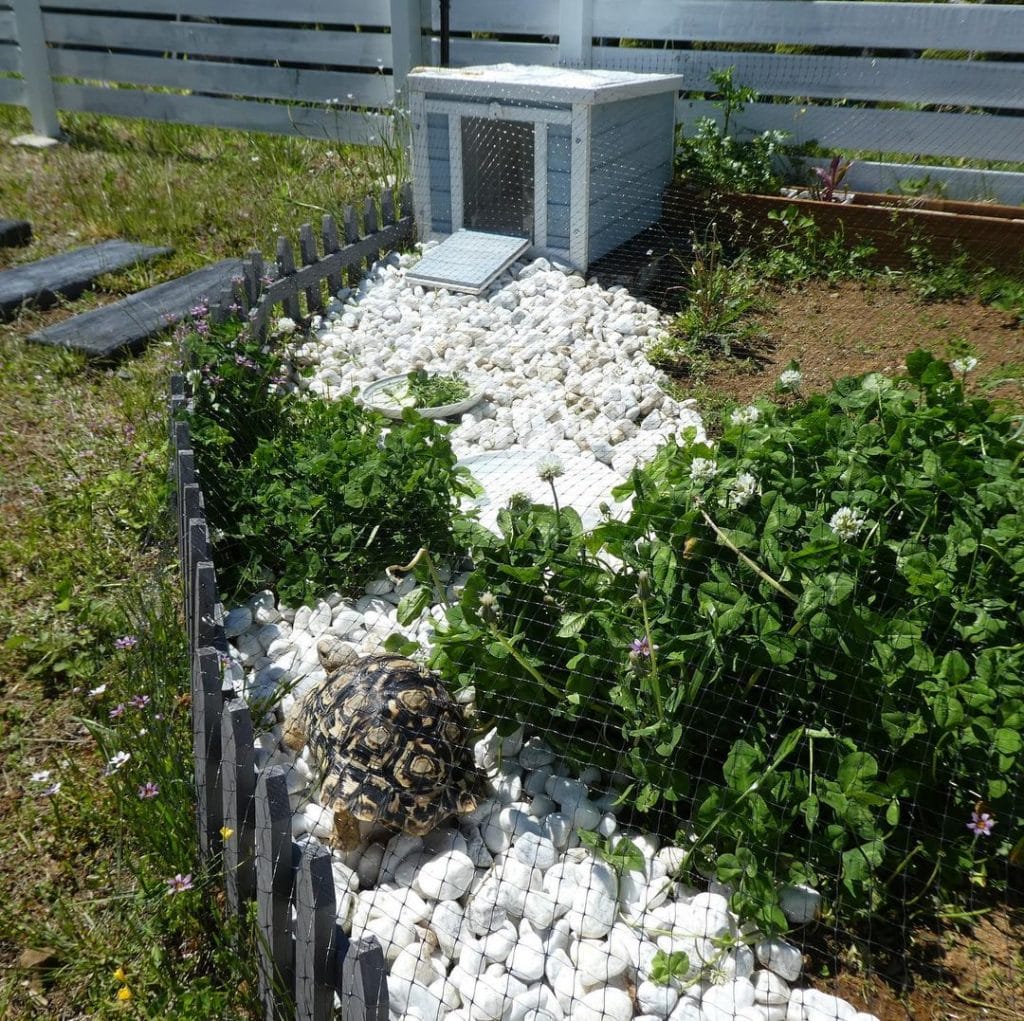
11. Sectioned Habitat with White Stones and Green Zones (Desert Tortoise Style)
What makes it special:
This desert tortoise outdoor habitat has a clear visual layout that matches arid terrain: a basking zone with white river stones, a feeding zone near the house, and a lush grazing zone with tall plants. The fencing is low and enclosed with mesh to prevent escape. It’s clean, pretty, and functional — especially for Gopherus species that evolved in rocky, open desert.
How to copy it:
- Lay down white river stones in the basking and walking areas
- Use a small raised wooden house as the shelter
- Plant edible clover or weeds in a designated patch
- Fence the whole setup with low garden pickets and a mesh overlay
- Create a walkway from the hide to the food dish with clear zones for different activities
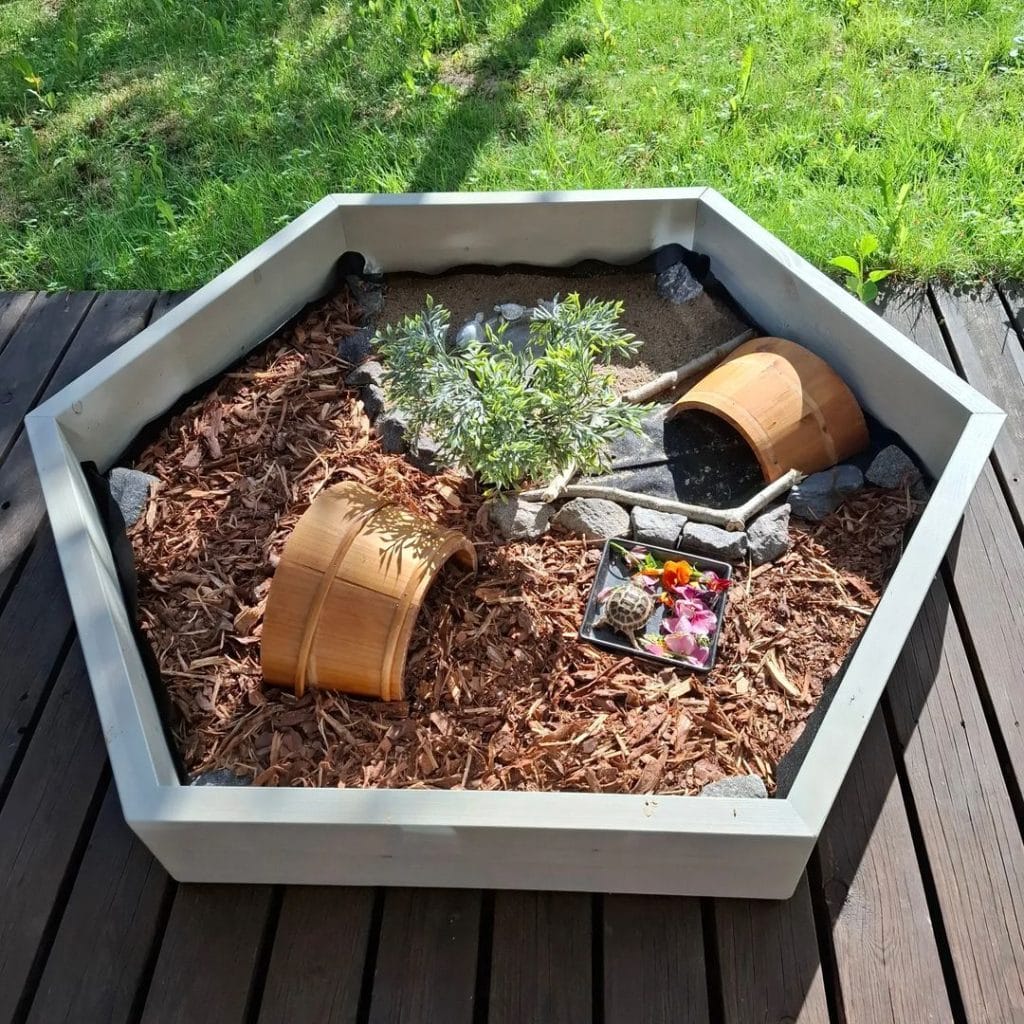
12. Aesthetic Hexagon Pen With Bark, Sand, and Flower Feeder
What makes it special:
This hexagonal outdoor tortoise pen is both functional and beautiful. Two log-style hides, a mini tree for shade, and a flower feeding tray for color and enrichment. The mix of bark mulch, sand, and stones creates texture and contrast — the sand zone is especially useful for desert and sulcata tortoises that prefer a drier substrate.
How to copy it:
- Build a six-sided frame with wood boards
- Divide the space into bark mulch, sand, and rock areas
- Place overturned pots or wooden arches as hides
- Add a feeding tray with edible flowers and greens
- Keep a small plant or shrub in the center for natural cover
What Makes a Sulcata Enclosure Different From Every Other Tortoise Pen
Most outdoor tortoise enclosure guides quietly assume a Hermann’s or a Russian tortoise. Something that tops out around 8 inches and 3 pounds.
A sulcata is the third largest tortoise on earth. An adult reaches 24 to 36 inches and 70 to 150 pounds, and it arrives at that size with a bulldozer’s attitude toward anything in its way.
That single fact rewrites every spec in a normal enclosure build. Here is what actually changes.
| Spec | Typical small tortoise | Adult sulcata |
|---|---|---|
| Minimum footprint | 6 x 8 ft | 8 x 16 ft absolute floor, 200+ sq ft preferred |
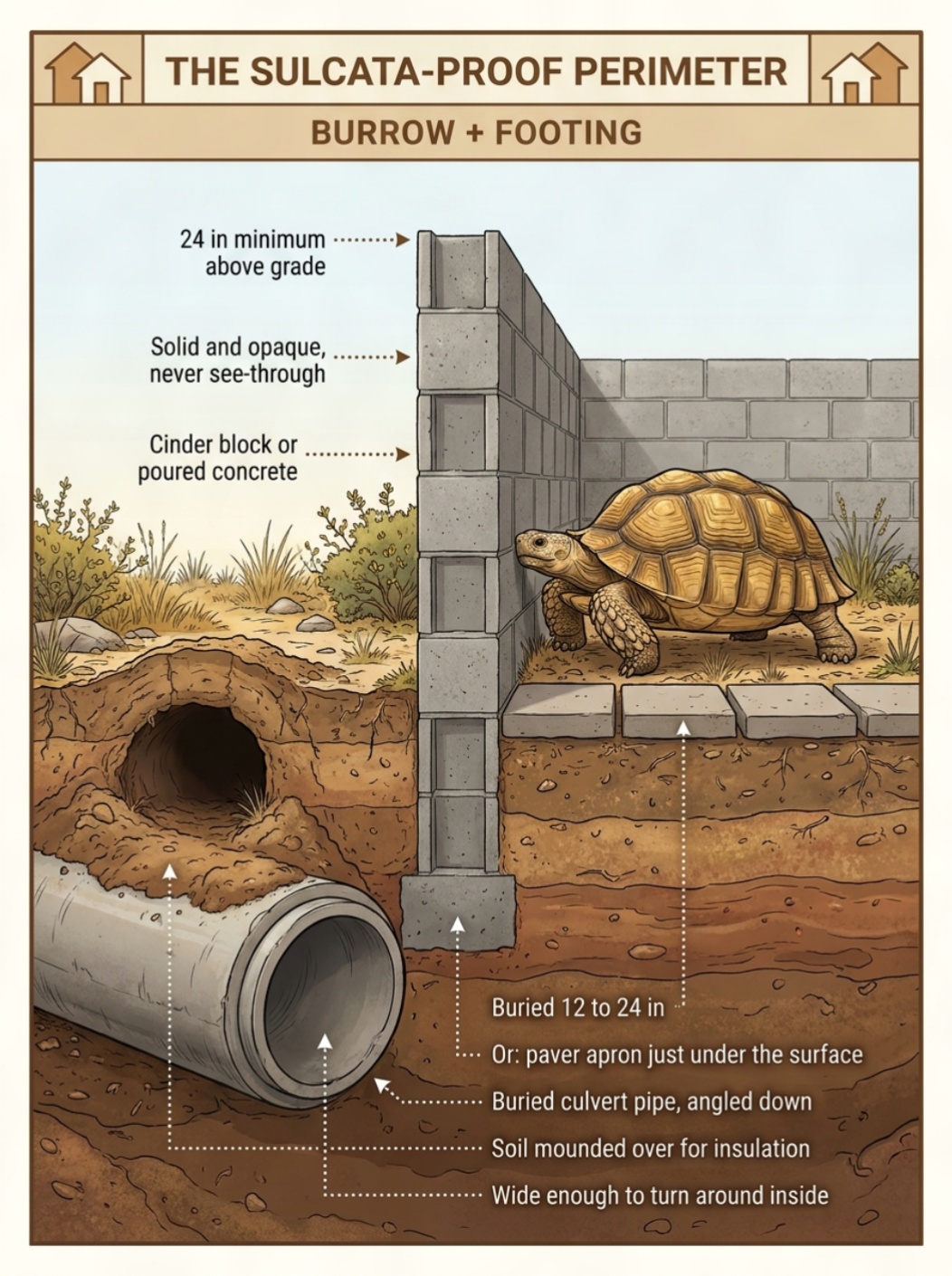
| Wall height above grade | 12 to 16 in | 24 in minimum, solid and opaque |
| Wall foundation | Buried 6 in | Buried 12 to 24 in, or a paver apron |
| Wall material | Wood planks | Cinder block, concrete, or doubled timber |
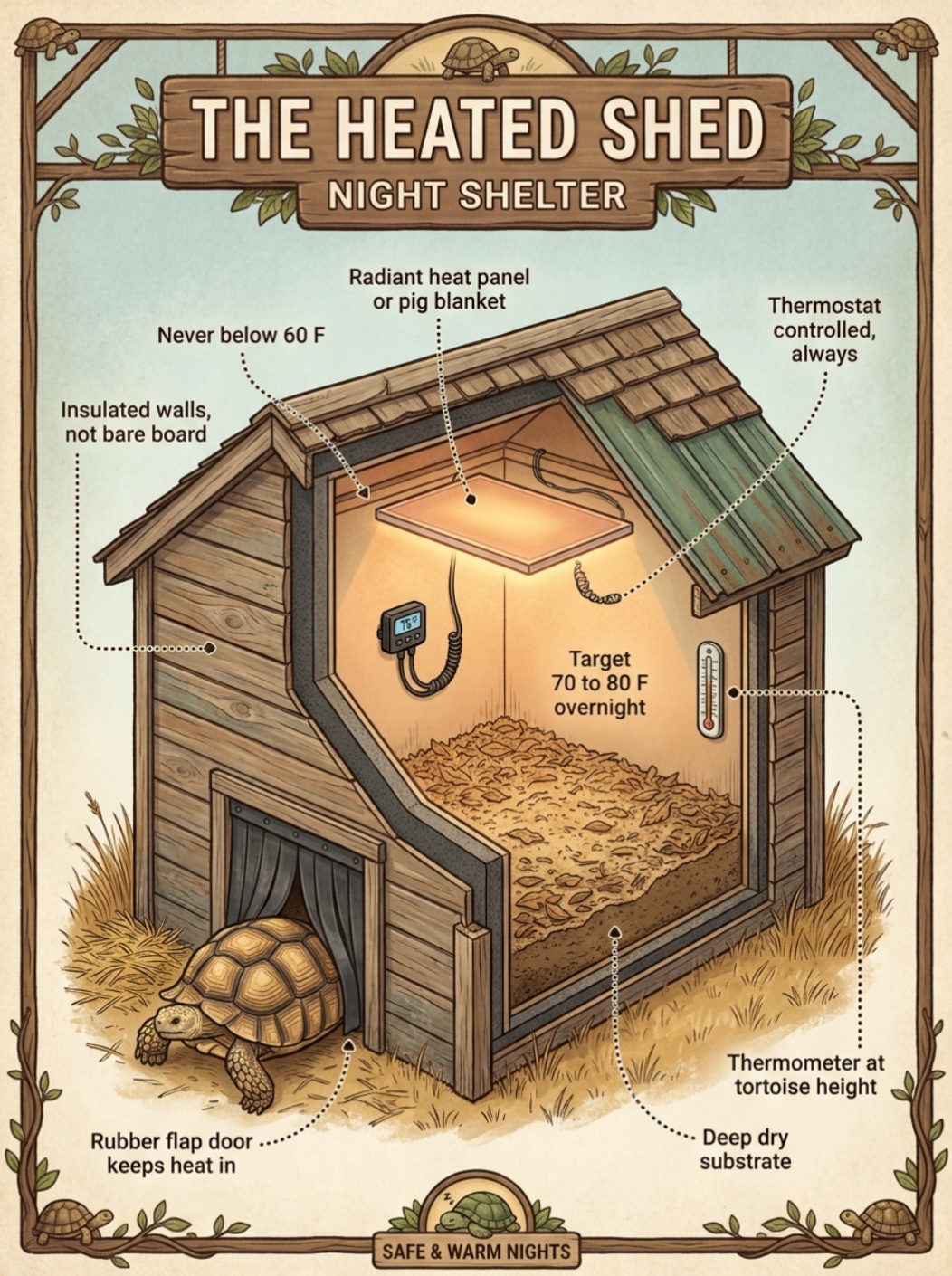
| Shelter | Insulated hide box | Heated shed with thermostat, walk-in scale |
| Night temperature floor | Species dependent | Never below 60°F, target 70 to 80°F inside |
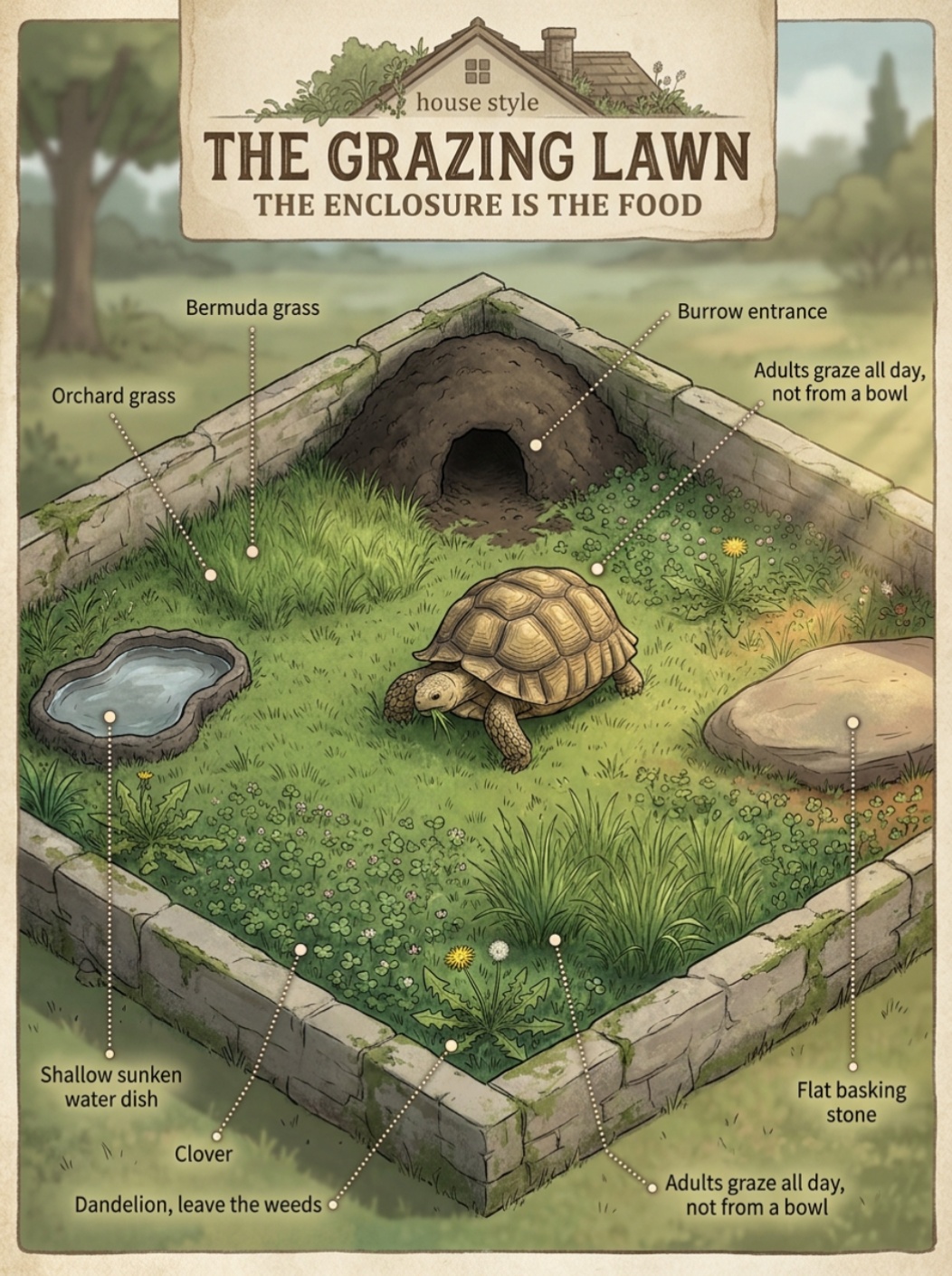
| Food source | Daily salad | Grazing lawn, the enclosure is the food |
Solve the Burrow Before It Solves Itself
Wild sulcatas dig burrows up to 10 feet deep and 30 feet long. That instinct does not switch off because you built a nice pen.
If you do not give your sulcata a burrow, it will make one, usually starting at the base of whichever wall you were most confident about.
The fix is to build the burrow yourself and make it the most appealing spot in the enclosure. Bury a length of concrete or heavy plastic culvert pipe at a shallow downward angle, wide enough that an adult can turn around inside, and mound soil over the top for insulation.
Then handle the perimeter separately. Either sink the wall 12 to 24 inches below grade, or lay a horizontal apron of pavers or hardware cloth along the inside base so digging hits a solid floor about a foot in. The apron is cheaper and usually works better, because a sulcata that meets resistance early tends to give up and go dig where you wanted it to.
Build Walls for a 100-Pound Animal, Not a Fence
Sulcatas are not climbers. They are pushers. A grown one leans into an obstacle and simply keeps walking, and thin wood panels or garden fencing eventually give.
Cinder block, poured concrete, or doubled 2x lumber on sunk posts is the standard for adults. Chicken wire and picket fencing belong on hatchling and juvenile pens only.
Keep the walls opaque, too. A sulcata that can see through a barrier treats it as a route rather than a boundary and will work at it for weeks.
If you want the actual construction sequence rather than the specs, we walk through it in how to build a sulcata tortoise house.
The Heated Shed Is Not Optional
Here is the point where a lot of otherwise good sulcata setups go wrong. Sulcatas do not hibernate. They are a hot, dry grassland species, and a cold sulcata does not sleep through it, it gets sick.
An unheated hide, a buried pipe, or an insulated box only holds ambient temperature. None of them make heat. Once nights drop below 60°F you need an actual heat source.
Most keepers outside the warmest zones end up converting a small shed or large dog house: insulated walls, a rubber flap doorway the tortoise can push through, a radiant heat panel or pig blanket on a thermostat, and a thermometer you actually check. Target 70 to 80°F inside overnight.
Design the Enclosure as a Grazing Lawn
This is the difference that most enclosure guides skip entirely. A redfoot gets a salad bowl. An adult sulcata should be eating its enclosure.
Sulcatas are grazers built for high fiber and low protein, and the healthiest ones spend their day cropping grass rather than waiting at a dish. Plant the floor with Bermuda grass, orchard grass, clover, and dandelion, and let broadleaf weeds come up rather than pulling them.
Practically, that means sizing the enclosure for grazing pressure as well as walking room. A pen big enough to hold a sulcata is often still too small to feed one, which is a large part of why the 8 by 16 foot minimum is a floor rather than a target. Supplement with grass hay whenever the lawn cannot keep up.
For the full plant list, see safe plants for sulcata tortoises, and check anything questionable against the toxic plants for tortoises guide before it goes in the ground.
Perfect Wooden Tortoise House For Outdoor & Indoor!
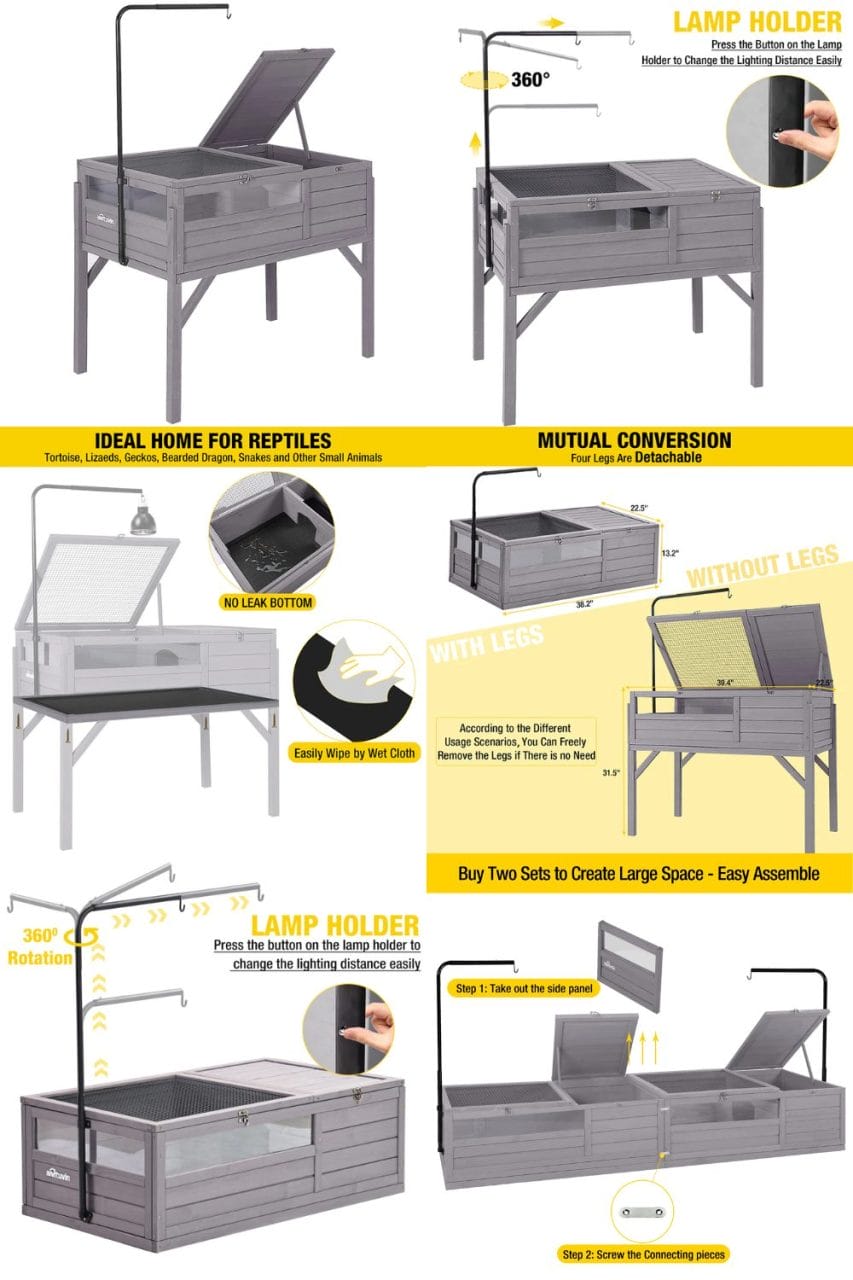
This tortoise house isn’t cheap — but that’s because it’s not your average wooden box.
Built with durable wood, a waterproof liner, and smart design features like a sunbathing area and a hideout zone, the Aivituvin Large Wooden Habitat is made to last.
It’s perfect for tortoises or box turtles, indoors or out. And yep, it even has detachable legs.
If you’re serious about giving your tortoise a safe, comfy home without building one from scratch, this is the one.
👉 Grab the Aivituvin Tortoise House here — it’s currently $10 off.
Indoor-Outdoor Hybrid Tortoise Setups
Not every climate allows a tortoise to live outside full-time. Plenty of keepers use hybrid setups where the tortoise moves between a controlled indoor space and an outdoor tortoise pen whenever the weather allows. These layouts make the transition smooth for the tortoise and simple for you.
13. Personalized Wooden Hide Box for Indoor-Outdoor Use
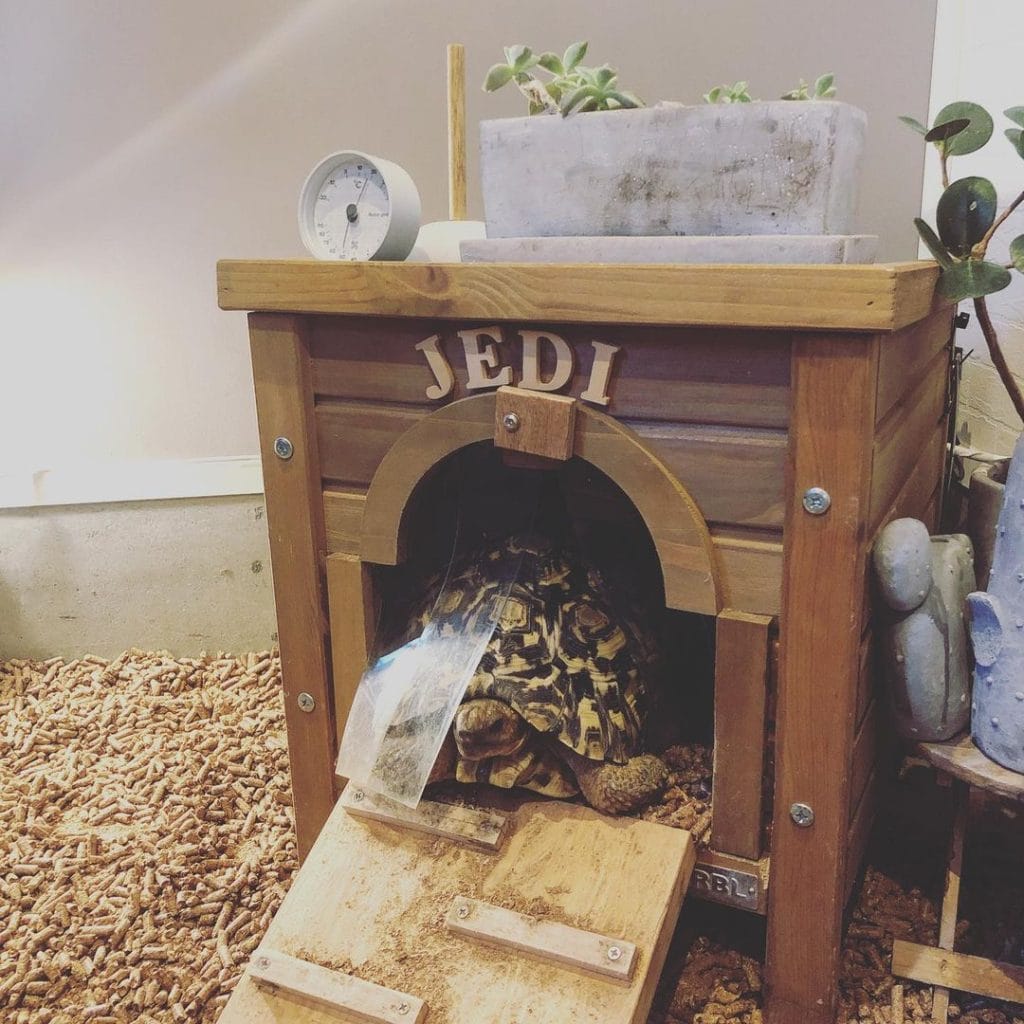
What makes it special:
This cozy hide is built like a mini cabin, with the tortoise’s name (JEDI) proudly displayed. It has a ramp, a clear door flap for insulation, and a thermometer on top to monitor the temperature. Works well as a warm retreat for indoor or outdoor use.
How to copy it:
- Use wood panels to build a box with a sloped roof
- Add a name plaque to make it personal
- Install a plastic flap to keep warmth inside
- Add a ramp with grip strips
- Place a thermometer on top to monitor heat levels
- Use it indoors or connect it to an outdoor pen for hybrid setups
Excellent detail — thermometer shown: This setup correctly includes temperature monitoring. The plastic flap for insulation is smart but not enough alone — you need active heating inside.
A ceramic heat emitter or radiant heat panel plus a thermostat turns this from a “shelter” into a “heated retreat.” This design works well as a hybrid indoor-outdoor setup.
Check the panel wattage against the size of the box before you buy, because an oversized emitter in a small hide swings the temperature hard.
14. Indoor Tortoise Corner with Smart Layout
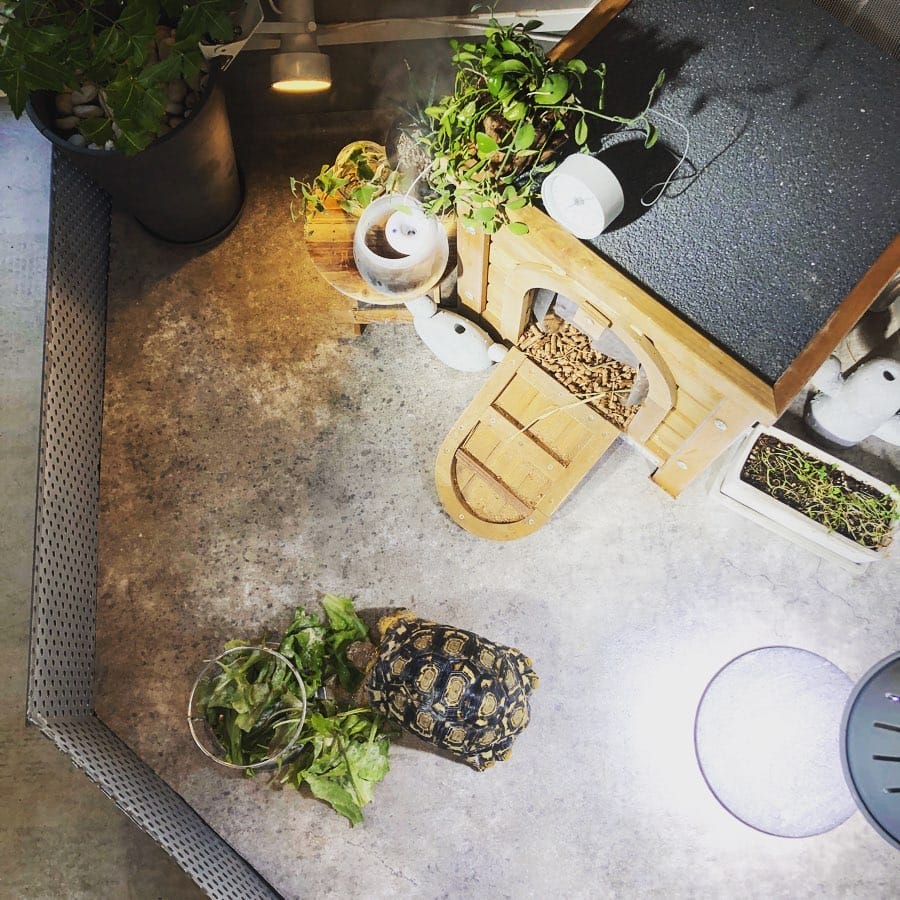
What makes it special:
This indoor pen makes smart use of vertical space. The hide box has plants on top, and a food bowl is placed under a spotlight. The setup uses flat flooring with loose pellets for digging and insulation near the hide ramp. There’s also a humidifier and heating light nearby.
How to copy it:
- Build or buy a flat tortoise hide and place it in a corner
- Use concrete or smooth tile flooring with easy-to-clean texture
- Set up a heat lamp and humidifier above the hide
- Add edible greens and safe plants in pots
- Keep the layout clean, with one zone for basking and another for feeding
Good equipment integration shown: This indoor setup correctly shows heat lamp and humidifier — the equipment outdoor enclosures often skip. Note the heat lamp placement over the hide entrance creates a warm zone the tortoise can access.
This is what your outdoor shelter should replicate: designated heat source, controlled temperature, monitoring.
For the gear side of that, see our temperature and humidity monitoring picks.
Walk-In Greenhouse Tortoise Enclosure
A walk-in greenhouse tortoise enclosure solves the cold-climate problem. Solar heat gets trapped under glass, UVB (my pick: Zoo Med ReptiSun 10.0) and supplemental heating cover cloudy days, and a door lets your tortoise roam the yard when the weather allows. This is the top pick for keepers in the UK, Pacific Northwest, Minnesota, or anywhere with long cool shoulder seasons.
15. Walk-In Tortoise Greenhouse Setup
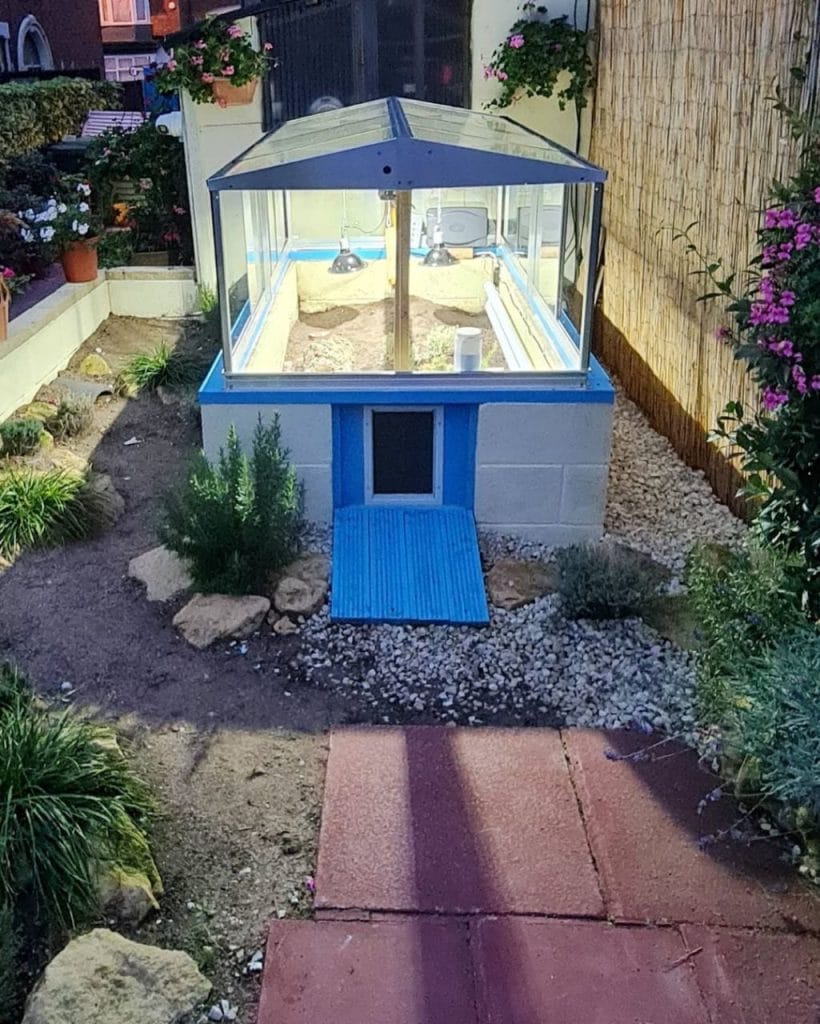
What makes it special:
This greenhouse tortoise enclosure is a hybrid between a greenhouse and a tortoise palace. It’s raised with a glass top to trap heat and light, making it great for colder climates. The tortoise can exit via a door and roam the landscaped yard. Inside, there are heating lamps and plenty of room to walk.
How to copy it:
- Build a raised box foundation and place a greenhouse top
- Set up UVB and heat lamps inside
- Install a ramp for outdoor access
- Surround the area with plants, gravel, and soft soil
- Ideal for climates with cool nights or rainy seasons
Best practice shown: This greenhouse setup correctly uses heating lamps and UVB inside — understanding that even with a glass top trapping heat, you need backup heating for cold or cloudy days.
The raised design and ramp access is excellent. Key additions: thermostat control for heating, temperature monitoring (greenhouses can OVERHEAT dangerously on sunny days), and ventilation.
A greenhouse swings hot fast on a sunny day, so a thermostat-controlled heat source and a max-min thermometer both earn their place here.
Frequently Asked Questions
How big should an outdoor tortoise enclosure be?
A general rule is at least 10 times the length of your tortoise in both directions, but adult sulcatas, leopards, and Aldabras need dramatically more — think minimum 8×16 feet for a full-grown sulcata, with bigger being better. Smaller species like Hermann’s or Russian tortoises do well in 6×8 foot enclosures as adults. When in doubt, go larger than the minimum.
How big does a sulcata tortoise enclosure need to be?
Treat 8 by 16 feet as the absolute floor for a single adult, and 200 square feet or more as the realistic target. The reason the minimum is so often criticized is that a sulcata grazes: a pen large enough to hold the animal is frequently still too small to feed it, so you end up hauling in hay year round. Hatchlings and juveniles do fine in far less space, but plan the adult footprint before you buy, because a sulcata reaches 70 to 150 pounds and rehoming one is genuinely difficult.
Can I keep a sulcata tortoise outdoors year-round?
In warm climates (USDA zones 9–11 — think Florida, southern Texas, southern California, Arizona), yes, with a heated shelter for cold nights. Outside those zones, sulcatas need to come inside or into a heated greenhouse when nighttime temperatures drop below 60°F. A sulcata tortoise habitat outdoor always needs a deep burrow or heated hide, because this species will dig regardless — better to build one in than have them tunnel under your fence.
What’s different about a desert tortoise outdoor habitat?
Desert tortoises (Gopherus) come from arid grassland and rocky desert, not tropical forest. A proper desert tortoise habitat outdoor uses dry substrate like decomposed granite or sandy soil, low-growing native plants (prickly pear, mallow, desert grasses), rocky basking zones, and a burrow for heat escape. Skip the lush ferns and humid plantings most generic outdoor enclosure guides recommend — they’re wrong for this species.
Can you really build a DIY outdoor tortoise enclosure in a weekend?
Yes — the simpler builds in this guide (predator-proof box, rustic garden pen, small botanical enclosure) are genuinely weekend projects if you have basic tools and a drill. Larger habitats with custom shelters take longer. The trick is starting with a pre-built or repurposed base (pallets, dog crates, raised garden beds) instead of milling everything from scratch.
Do outdoor tortoise enclosures need a heated shelter?
Almost always, yes. Even in warm climates, nighttime temperatures drop below safe levels during cool seasons, and tortoises can’t thermoregulate if their shelter is just an insulated box. A ceramic heat emitter or radiant heat panel paired with a thermostat inside the hide is the standard setup. Exceptions are rare — only full-time tropical climates with reliably warm nights.
How do I predator-proof an outdoor tortoise pen?
Use hardware cloth with 1/2 inch mesh (not chicken wire — raccoon paws reach right through chicken wire) on all exposed sides including the top. Bury the mesh at least 12 inches deep around the perimeter to block digging predators. Add a secure latched lid or roof, and position the enclosure away from places where predators hide (woodpiles, dense shrubs). Predator-proofing and weatherproofing are non-negotiable for any permanent outdoor tortoise enclosure.
Is a greenhouse tortoise enclosure worth it for cold climates?
If you live somewhere with long cool shoulder seasons or short summers, a walk-in greenhouse tortoise enclosure extends your tortoise’s outdoor time by months. It handles rain, cool nights, and overcast days that would otherwise force indoor-only keeping. The main risk is overheating on sunny days, so you need ventilation and temperature monitoring. For keepers in the UK, Pacific Northwest, Canada, or the northern US, it’s often the difference between outdoor access and permanent indoor life.
Your Next Weekend Project
Whatever your climate, species, or budget, there’s an outdoor tortoise enclosure idea above that fits. Sulcata owners get a proper burrow, desert tortoise keepers get an arid-aesthetic setup, cold-climate owners get a greenhouse, and DIY builders get a weekend project. Pick the one that matches your yard and your tortoise, and your little roamer will thank you with years of healthier, happier outdoor time.
Once the enclosure is built, the daily routine is what keeps your tortoise healthy, so log feeding, soaking, weight, and vet visits in a tortoise care app and let it remind you what is due.

About Author
Muntaseer Rahman started keeping pet turtles back in 2013. He also owns the largest Turtle & Tortoise Facebook community in Bangladesh. These days he is mostly active on Facebook.