How Do Red Eared Sliders Mate? Courtship, Season & Eggs Explained
This post was created with help from AI tools and carefully reviewed by a human (Muntaseer Rahman). For more on how we use AI on this site, check out our Editorial Policy.
You walk past the tank and stop dead.
One of your red eared sliders is parked right in front of the other, arms stretched out, claws buzzing like he is trying to hypnotize her.
It looks weird. A little aggressive. Honestly, a little funny.
That, my friend, is a slider trying to seal the deal. And there is a lot more going on under the water than it looks.
Here is the short version, then we will break down every strange part of it.
How Does a Red Eared Slider Mate?
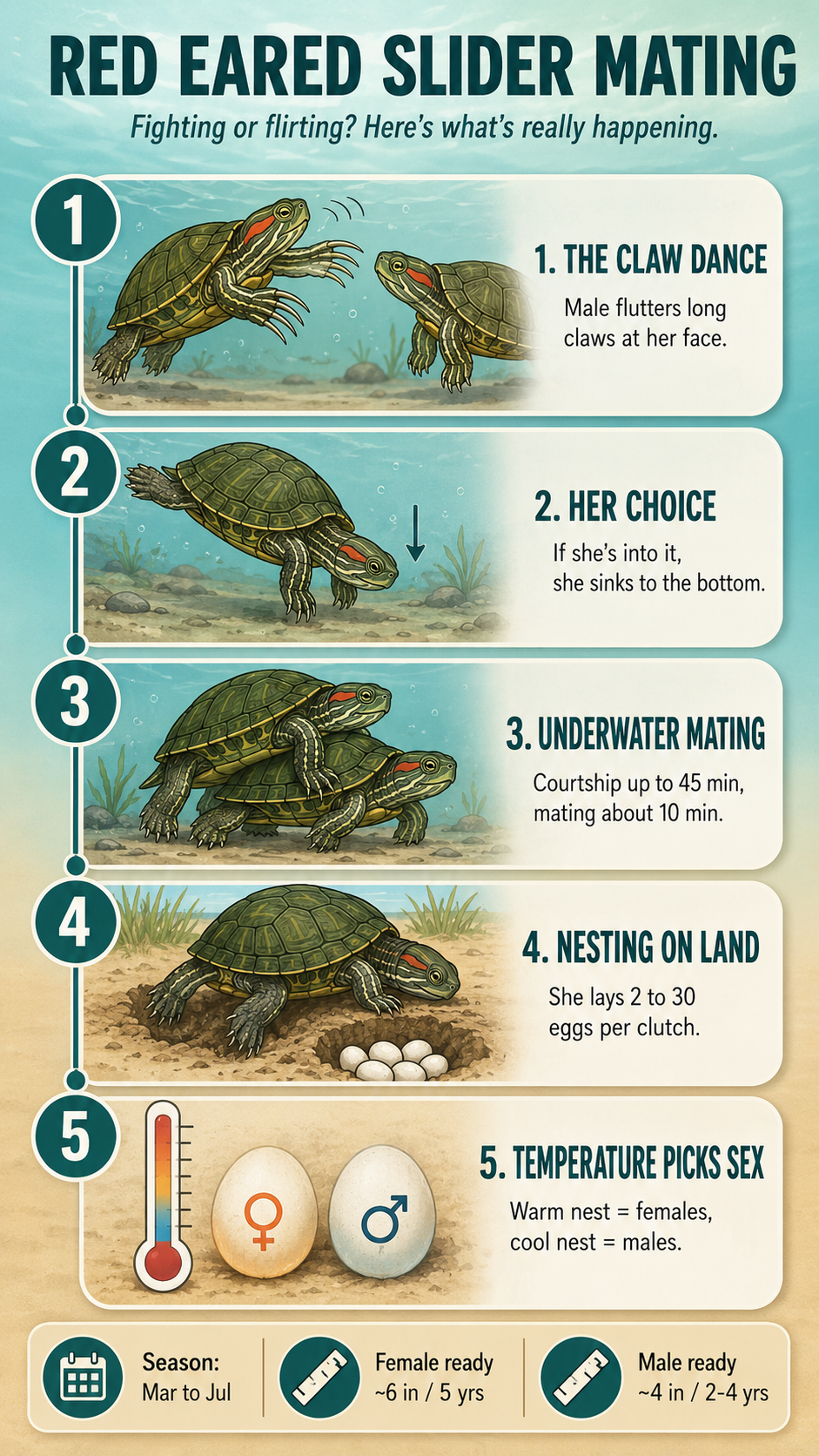
During mating season, the male red eared slider swims face-to-face with the female and rapidly flutters his long front claws against her head. This is courtship. If she is receptive, she sinks to the bottom and the male mounts her shell from behind to mate. The whole thing happens underwater.
Courtship can drag on for up to 45 minutes. The actual mating usually wraps up in about 10 minutes.
No, sliders cannot reproduce on their own. A female can absolutely lay eggs without a male around, but those eggs are infertile and will never hatch. Reproduction needs a male in the picture at some point.
The Claw-Fluttering Dance, Explained
This is the part everyone Googles, so let us actually decode it.
When a male is interested, he swims out in front of the female and gets close. Really close.
Then he brings his forelimbs forward and vibrates those long claws against and around her face.
Scientists think he is fanning pheromones toward her, basically chemical signals that say “pick me.”
The male’s claws are not long by accident. Mature males grow noticeably longer front claws than females, and this dance is exactly what they are for. If you have ever wondered about the difference, our guide on telling a male and female red eared slider apart breaks it down.
If she likes what she sees, she swims toward him and settles to the bottom of the tank or pond. Mating happens there.
Wait, Is That Mating or Fighting?
Here is the confusing part. The claw flutter is not always romance.
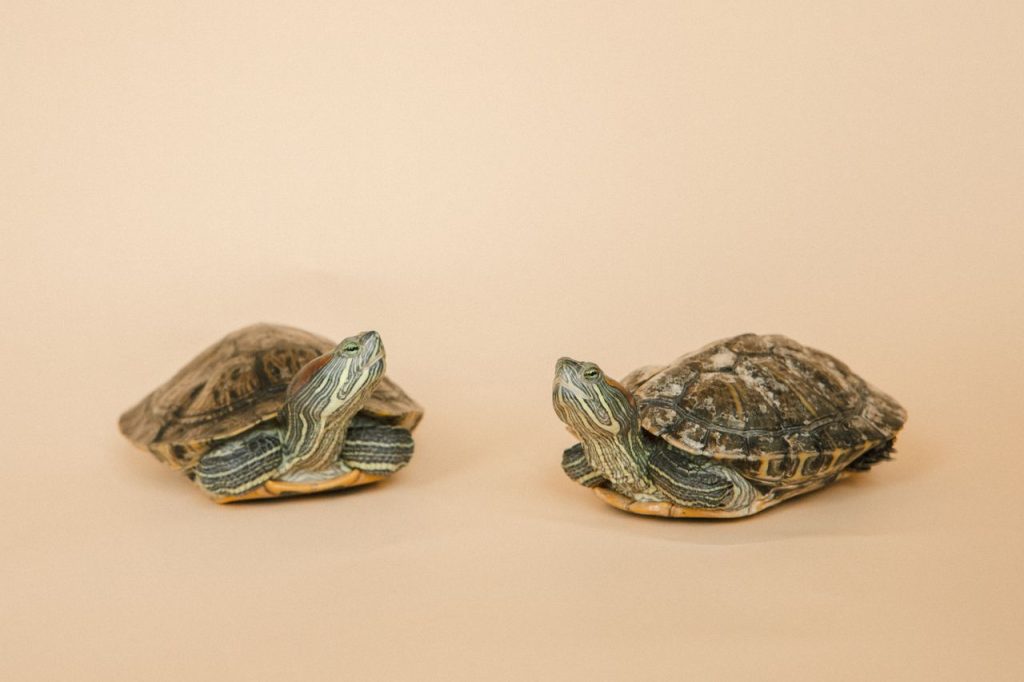
Red eared sliders use the exact same move to intimidate each other. Two males will flutter claws to size each other up before a scrap.
So if you see one slider doing the dance and the other one snapping, biting, or fleeing, that is not courtship. That is conflict.
We dug into this exact behavior in why red eared sliders shake their hands if you want the full picture.
The tell is the response. Receptive female sinks and stays. Annoyed turtle bites, chases, or bolts.
This Hilarious Turtle Book Might Know Your Pet Better Than You Do

Let’s be real—most turtle care guides feel like reading a textbook written by a sleep-deprived zookeeper.
This one’s not that.
Told from the snarky point of view of a grumpy, judgmental turtle, 21 Turtle Truths You’ll Never Read in a Care Guide is packed with sarcasm, sass, and surprisingly useful insights.
And hey—you don’t have to commit to the whole thing just yet.
Grab 2 free truths from the ebook and get a taste of what your turtle really thinks about your setup, your food choices, and that weird plastic palm tree.
It’s funny, it’s honest, and if you’ve ever owned a turtle who glares at you like you’re the problem—you’ll feel seen.
When Do Red Eared Sliders Mate?
Sliders are seasonal romantics.
In the wild, they breed most heavily in spring, roughly March through July, with a smaller bump in the fall.
Warmer days and longer light kick their hormones into gear. They usually go at it during daylight when the water is warm and they have had time to bask.
Indoor sliders kept at steady warm temperatures year-round can try to mate at odd times, since they never get the seasonal cues that tell wild turtles to slow down.
How Old and Big Before They Can Mate?
Age gets all the attention, but size matters more than age for sliders.
A turtle that is technically old enough but too small still will not breed. Here is the general guide.
| Males | Females | |
|---|---|---|
| Maturity by age | ~2 to 5 years | ~5 to 7 years |
| Maturity by size (shell) | carapace around 4 inches (10 cm) | carapace around 6 inches (15-17 cm) |
| Key signal | long front claws, long thick tail | broader body, shorter claws and tail |
Females take longer and need more body mass because they are the ones carrying and laying eggs. A female under about 6 inches usually is not ready, no matter how many birthdays she has had.
Not sure how old yours are? Counting shell rings gives you a rough ballpark at best, since rings form with growth spurts, not neatly once a year. Comparing your turtle against a red eared slider size chart is usually the more reliable read.
What Happens After Mating
Mating is just step one. The interesting stuff comes after.
Once fertilized, the female does not lay right away. She carries the eggs for a few weeks, basking more than usual to keep them developing.
When she is ready, she leaves the water and looks for soft, diggable ground. She digs a nest chamber with her back legs, drops the clutch, covers it, and walks away. No turtle parenting here.
A healthy female can lay 2 to 30 eggs per clutch, and she can produce up to 4 or 5 clutches in a single year, usually spaced a couple of weeks apart.
If you end up with eggs on your hands, our red eared slider egg care guide walks you through what to do next.
Why a Lone Female Can Still Lay Fertile Eggs
This one surprises a lot of owners.
Female sliders can store sperm inside their body for months, sometimes into the next season.
That means a female who mated last year can lay fertile eggs this year with no male anywhere near her. She can also store sperm from several males and mix it within one clutch.
So if you are scratching your head over fertile eggs from a “single” female, this is almost always the answer.
Temperature Decides if You Get Boys or Girls
Sliders do not have sex chromosomes the way we do. The temperature of the nest during incubation sets the sex of the babies.
- Cooler incubation tends to produce males.
- Warmer incubation tends to produce females.
The flip happens around a narrow window in the high 80s Fahrenheit. A few degrees in the nest is the difference between a clutch of brothers and a clutch of sisters.
Why Won’t My Red Eared Sliders Mate?
You set the mood and got nothing. It happens. Common reasons:
- She is not interested. Mating only starts if the female responds. She can simply turn the male down.
- He is too rough. An overly aggressive male can stress or hurt the female instead of courting her, and she shuts down.
- She is not ready yet. A female may need to hit that 6-inch size before she will engage, even past 5 years old.
- Wrong temperature. Water that is too cool kills the mood. Sliders want warmth and good basking before they breed.
- Not enough space or depth. Shallow or cramped water makes it hard for the male to mount.
Never force it. Crowding two stressed turtles together does more harm than good.
Should You Let Your Sliders Breed?
Honest answer for most pet owners: probably not.
Breeding sliders is a real commitment, not a fun weekend project. You need proper nesting substrate, an incubation setup, and a plan for the hatchlings.
There is also a legal wrinkle people get wrong. In the US, the FDA banned the sale and distribution of turtles with shells under 4 inches back in 1975, mainly because tiny turtles spread Salmonella, which hits young kids hardest.
To be clear, that rule targets selling small turtles, not simply owning the babies your own turtle produced. But it does mean you cannot legally offload a clutch of hatchlings, so you are responsible for every single one.
And those babies are fragile. Caring for baby red eared sliders is a different and more demanding job than caring for adults.
If you would rather not deal with any of that, you can simply keep a mating pair apart during breeding season or house males and females separately. That is the easiest, kindest call for most homes.
Final Thoughts
So that strange underwater claw show is not your turtle glitching out. It is one of the oldest routines in the reptile playbook.
Now you know what the flutter means, when it happens, what size your sliders need to be, and the quietly wild stuff that follows, from stored sperm to temperature-picked babies.
Whether you let them breed or keep them as a happy bachelor-and-bachelorette pair is entirely your call.
Just go in with eyes open, because once those eggs show up, the clock starts ticking.

About Author
Muntaseer Rahman started keeping pet turtles back in 2013. He also owns the largest Turtle & Tortoise Facebook community in Bangladesh. These days he is mostly active on Facebook.