Is My Painted Turtle Male or Female? 7 Ways To Tell The Difference
This post was created with help from AI tools and carefully reviewed by a human (Muntaseer Rahman). For more on how we use AI on this site, check out our Editorial Policy.
So you’ve got a painted turtle and you’re staring at it like “are you a Steve or a Stephanie?”
Trust me, you’re not alone. Figuring out if your painted turtle is male or female is like trying to solve a puzzle where half the pieces look identical. But here’s the thing – once you know what to look for, it’s actually pretty straightforward.
Let me walk you through this.
Quick Reference Table
Here’s everything in one spot so you don’t have to scroll back up:
| Feature | Male Painted Turtle | Female Painted Turtle |
|---|---|---|
| Front Claws | Long and thick (Wolverine vibes) | Short and stubby |
| Tail | Long, thick, wide at base | Short and thin |
| Shell Size | Small (6-8 inches when mature) | Large (8-12 inches when mature) |
| Plastron Shape | Concave (curved inward) | Flat |
| Cloaca Position | Far down the tail (near tip) | Close to body (near base) |
| Behavior | Territorial, aggressive, chases females | Peaceful, digs nests, lays eggs |
| Sexual Maturity | 3-5 years old | 6-10 years old |
Turtle Gender Identification Chart
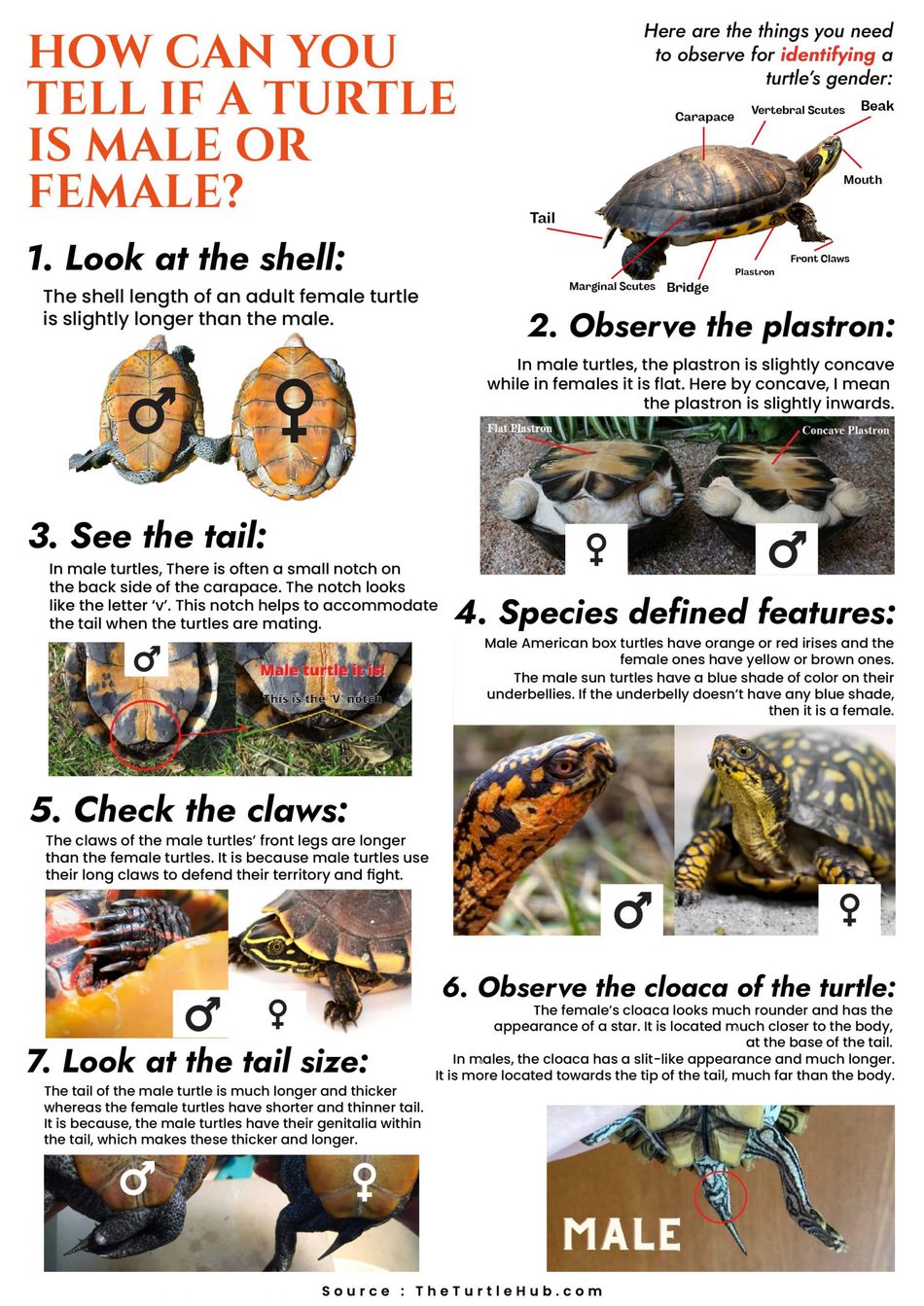
For a printable version of this amazing visual chart, click here!
This Hilarious Turtle Book Might Know Your Pet Better Than You Do

Let’s be real—most turtle care guides feel like reading a textbook written by a sleep-deprived zookeeper.
This one’s not that.
Told from the snarky point of view of a grumpy, judgmental turtle, 21 Turtle Truths You’ll Never Read in a Care Guide is packed with sarcasm, sass, and surprisingly useful insights.
And hey—you don’t have to commit to the whole thing just yet.
Grab 2 free truths from the ebook and get a taste of what your turtle really thinks about your setup, your food choices, and that weird plastic palm tree.
It’s funny, it’s honest, and if you’ve ever owned a turtle who glares at you like you’re the problem—you’ll feel seen.
Why Even Bother Finding Out?
Maybe you’re planning to breed turtles. Maybe you just want to give your turtle the right name (nobody wants to call their girl turtle “Bruce” for three years). Or maybe you’re trying to avoid World War III in your tank because male turtles can get weirdly territorial with each other.
Whatever your reason, knowing your turtle’s gender is actually useful information.
The Big Problem With Baby Turtles
Here’s the bad news first: if your turtle is tiny, you’re basically out of luck.
Baby painted turtles all look the same regardless of gender. The physical differences don’t really show up until they hit about 4 inches in shell length.
Males reach maturity around 3-5 years old, while females take their sweet time and don’t mature until 6-10 years old. So if you’ve got a hatchling, you’re gonna need patience.
But once they’re grown? Game on.
Check The Claws First (This One’s Super Obvious)
This is honestly the easiest way to tell, and once you see it, you can’t unsee it.
Male painted turtles have ridiculously long front claws. We’re talking Wolverine-level claws here.
Females have short, stubby claws that look normal.
Why do males have these crazy long claws? Two reasons that are both related to romance. First, they use them to grip onto the female’s shell during mating (romantic, right?). Second, during courtship, males do this weird fluttering thing in front of the female’s face with their claws.
Scientists call it “titillation” – basically the turtle version of waving at someone you think is cute.
So if your turtle’s front claws look like they could open letters, that’s a dude.
The Tail Tells All
Next up: tail inspection time.
Male painted turtles have long, thick tails that are wide at the base. This is because they store their reproductive organs inside their tails. (Yeah, turtle anatomy is wild.)
Female painted turtles have thin, short tails that are way less impressive.
One warning though: pet turtles sometimes get their tails nipped by tank mates who mistake them for food. So if the tail looks weird or shortened, that might be why. Don’t let a chomped tail fool you into thinking your male is a female.
Size Matters (When They’re Adults)
Once your turtles are fully grown, size becomes a dead giveaway.
Female painted turtles are significantly larger than males. We’re talking 8-12 inches in shell length for the ladies.
Males max out around 6-8 inches. They’re basically the hobbits of the painted turtle world.
Why are females bigger? They need the extra space for egg production. Carrying eggs requires real estate, and evolution gave them bigger shells to work with.
But remember – this only works if you’re comparing fully mature adults. A young male and young female will be similar sizes, so don’t jump to conclusions with juveniles.
Flip That Shell (Carefully!)
The plastron – that’s the bottom shell on your turtle – gives you another clue.
Male painted turtles have concave (curved inward) plastrons. This isn’t random design. That curve helps them mount the female during mating without sliding off. It’s like nature’s anti-slip technology.
Female painted turtles have flat plastrons because they don’t need that feature.
To check this, gently pick up your turtle (don’t drop it – shells aren’t designed for asphalt bouncing). You can usually feel the difference by sliding your hand under their belly. No need to flip them completely upside down like a pancake.
The Cloaca Location Test
Okay, this one requires you to get a bit personal with your turtle.
The cloaca is the opening where turtles do… well, everything. It’s a multi-purpose exit for waste and reproduction.
- In males, the cloaca is located far down the tail, almost near the tip. It’s way out there.
- In females, the cloaca is close to the body, almost tucked under the shell at the base of the tail.
This is actually one of the most reliable methods, but it requires getting pretty close to your turtle’s business end, which might make both of you uncomfortable.
Watch Their Behavior (Especially During Breeding Season)
If you’ve got multiple turtles, behavior can be a huge giveaway.
Males are basically the jocks of the turtle world. They’re territorial, aggressive with other males, and spend breeding season (late May to mid-July) chasing females around the tank like it’s speed dating.
Females are way more chill. They’re peaceful, tolerate other turtles better, and spend their energy digging and preparing nests rather than starting fights.
And here’s the ultimate confirmation: if your turtle lays eggs, congratulations, it’s a girl. Males don’t do that. Mystery solved.
Even if a female hasn’t mated, she might still lay infertile eggs from late May through mid-July, so egg-laying is the definitive proof.
The Temperature Thing (But Not What You Think)
You might have heard that temperature determines gender in painted turtles.
This is true, but it only applies during egg incubation – before the turtle hatches.
Eggs incubated at 71-78°F (22-27°C) produce males. Eggs incubated at 80.6-89.6°F (27-32°C) produce females. Temperatures in between can go either way.
But this is NOT a method for identifying gender in your living, breathing turtle. Once they’re born, temperature doesn’t tell you anything. This is only useful if you’re breeding turtles and want to control the gender ratio during incubation.
So ignore any advice that says “just check what temperature your turtle prefers” – that’s completely misleading.
Pro Tips For Gender Identification
1. Use multiple methods. Don’t rely on just one characteristic. Look at claws AND tail AND size together for the most accurate ID.
2. Wait until they’re mature. Trying to sex a baby turtle is an exercise in frustration. Wait until they’re at least 4 inches long.
3. Compare if you can. If you have multiple turtles, comparing them side-by-side makes the differences way more obvious.
4. Be gentle. When handling your turtle for inspection, support their body properly and don’t stress them out. Wash your hands before and after – turtles can carry salmonella.
5. Watch for nipped tails. In crowded tanks, turtles sometimes bite each other’s tails. Don’t let a damaged tail confuse you.
Once you’ve figured out if you’ve got a boy or girl turtle, make sure you’re providing the right care for your painted turtle. Check out our complete care guide to ensure your turtle lives a long, healthy life.
What If You Still Can’t Tell?
Look, sometimes even with all these methods, it’s tough to call.
If your turtle is young, the features might not be developed enough yet. If it’s been injured, some characteristics might be misleading. And sometimes you just need a second opinion.
If you’re really stuck, a reptile vet can usually tell you definitively. Some research facilities even use genetic testing, but that’s overkill unless you’re doing serious breeding work.
The Bottom Line
Determining your painted turtle’s gender isn’t rocket science, but it does require a bit of observation and patience.
The easiest tells are the front claws (males have crazy long ones) and the tail (males have thick, long tails while females have short, thin ones).
Once your turtle is fully grown, size becomes obvious – females are noticeably bigger.
And if you’re still not sure, just wait for breeding season and watch their behavior. Territorial aggression or egg-laying will give you your answer real quick.
Now you can confidently name your turtle without that nagging doubt that you might have gotten it wrong. You’re welcome.
Got questions or still confused about your specific turtle? Drop a comment below and let’s figure it out together!

About Author
Muntaseer Rahman started keeping pet turtles back in 2013. He also owns the largest Turtle & Tortoise Facebook community in Bangladesh. These days he is mostly active on Facebook.