Best Softshell Turtles For Pets (And Which Ones To Avoid)
This post was created with help from AI tools and carefully reviewed by a human (Muntaseer Rahman). For more on how we use AI on this site, check out our Editorial Policy.
Softshell turtles look like someone stepped on a regular turtle and flattened it into a pancake. Then gave it a snorkel nose.
They are weird, fast, aggressive, and honestly one of the coolest turtle species you can own. But here’s the thing — not every softshell turtle belongs in your living room.
There are over 25 species of softshell turtles in the world. Most of them either get way too big, are too rare, or are straight up not suited for captivity.
The ones that actually work as pets? You’re looking at these four:
- Florida softshell turtle
- Spiny softshell turtle
- Smooth softshell turtle
- Chinese softshell turtle
That’s it. That’s the realistic list.
Everything else is either endangered, the size of a coffee table, or only found in some temple pond in Southeast Asia. Let’s break down each species so you know exactly what you’re signing up for.

Florida Softshell Turtle
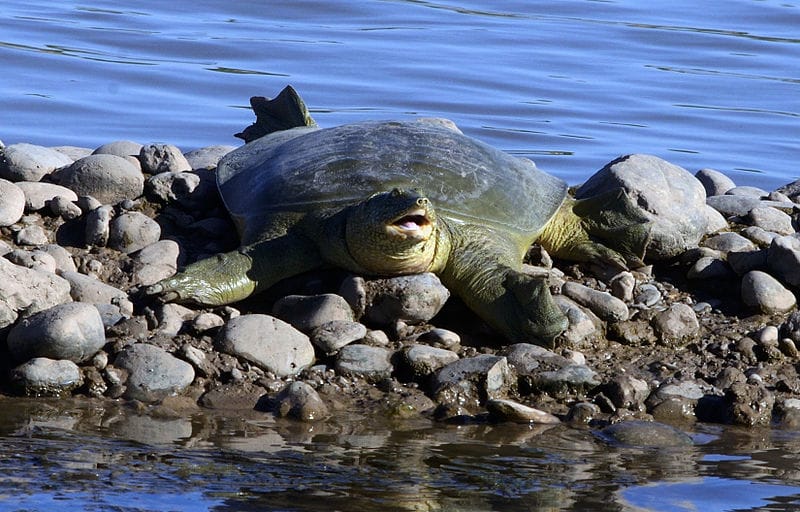
The Florida softshell turtle is the big dog of the North American softshell world.
These turtles are native to Florida (obviously), and also found in parts of Georgia, Alabama, South Carolina, and southern Texas. They hang out in ponds, lakes, streams, and marshes — basically any freshwater body with a muddy or sandy bottom.
How Big Do Florida Softshells Get?
Here’s where things get serious.
Males grow between 6 to 12 inches. Manageable. You can work with that.
Females? They can hit 24 to 29 inches. That’s not a pet turtle. That’s a dinner plate with an attitude.
This size difference between males and females is a huge deal when it comes to keeping them as pets. A male Florida softshell is a fun, manageable project. A female is a multi-year commitment that will need a pond-sized setup.
Tank Requirements
A baby Florida softshell can start in a 75-gallon tank. But don’t get comfortable with that.
Adults need a minimum of 100 gallons, and honestly, most experienced keepers recommend 400 to 600+ gallon stock tanks for full-grown specimens. These turtles are active swimmers and they need the room.
Stock tanks or large indoor ponds work way better than glass aquariums for this species.
Tank Setup Essentials
Your Florida softshell’s enclosure needs:
- Sand substrate — fine, washed river sand or play sand. No gravel. Their soft bellies get scratched and infected on rough surfaces.
- Water filter — and not a wimpy one. Go for a filter rated at double your tank’s capacity. These turtles are messy eaters.
- Water heater — keep the water around 70 to 80 degrees Fahrenheit.
- Basking dock (my pick: floating basking platform) — even though they rarely leave the water, they still need the option.
- UV/heat lamp (my pick: heat lamp) — basking spot should hit about 90 degrees Fahrenheit. UVB (my pick: Zoo Med ReptiSun 10.0) is essential for calcium absorption.
Water quality is the number one killer of softshell turtles in captivity. If you skip on filtration, your turtle will develop shell rot, fungal infections, and bacterial issues faster than you can say “water change.”
What Do Florida Softshells Eat?
Florida softshells are mostly carnivorous. Their wild diet includes fish, snails, crayfish, shrimp, insects, worms, and even the occasional small bird. Yes, bird.
In captivity, you can feed them:
- Turtle pellets (my pick: Mazuri Aquatic Turtle Diet) (Reptomin and similar brands)
- Feeder fish (guppies, minnows)
- Earthworms and nightcrawlers
- Shrimp
- Cuttlebones (my pick: natural cuttlefish bone) for calcium
- Occasional leafy greens at adult age
Always dust their food with calcium and vitamin D3 supplements. Metabolic bone disease is real and it’s ugly.
Temperament
Let me be blunt here. Florida softshells are the most aggressive species among all pet softshell turtles.
They will bite. They will scratch. And their neck can extend with scary speed — you won’t even see it coming.
Keeping them with other turtles or fish? That’s a gamble. Some keepers have managed it with mud turtles, painted turtles, and map turtles. But the general advice from experienced owners is to house them alone.
Difficulty Level
| Gender | Difficulty |
|---|---|
| Male | Intermediate |
| Female | Advanced |
If you’re new to turtles, skip the Florida softshell. Start with something simpler like a red-eared slider or a musk turtle. Come back to softshells once you’ve got some experience under your belt.

Spiny Softshell Turtle
The Spiny softshell is probably the most widely distributed softshell turtle in North America.
You’ll find them throughout the central and eastern United States, from the Great Lakes region down to the Gulf states. They live in rivers, ponds, lakes, and marshes — but they have a strong preference for rivers with moderate current and sandy bottoms.
There are actually seven recognized subspecies of spiny softshells, including the Texas spiny, Guadalupe spiny, and the black spiny (which is endemic to a single basin in Mexico). But in the pet trade, you’re mostly going to see the eastern and western spiny varieties.
How Big Do Spiny Softshells Get?
Males grow about 5 to 9.5 inches.
Females can reach 6.5 to 18 inches.
Still a significant size gap between the sexes, but not as extreme as the Florida softshell. The females are still big enough to need serious tank space though.
Tank Requirements
Males can do okay in a 75-gallon tank minimum.
Females need at least 90 gallons, but most keepers recommend going bigger. A 400+ gallon stock tank is ideal if you have the space and budget.
Water depth should be at least a few feet for adults. These turtles are strong swimmers and they need depth.
Tank Setup Essentials
Pretty similar to the Florida softshell setup:
- Fine sand substrate — critical for burrowing. They love to bury themselves with just their snorkel nose poking out.
- Strong water filter — double the rated capacity of your tank.
- Water heater — maintain 70 to 75 degrees Fahrenheit in the water.
- Basking dock and UV lamp — basking spot around 85 to 90 degrees Fahrenheit.
- Live plants optional — they add some cover and help with water quality, but your turtle might uproot them.
One thing that’s really important with spiny softshells: water pH matters. They do best in slightly acidic to neutral water, around 6.5 to 7.0 pH. Test your water regularly.
What Do Spiny Softshells Eat?
These guys eat pretty much anything that moves.
In the wild, their menu includes fish, crayfish, insects, worms, frogs, and even some plant matter. In captivity, you can feed:
- Turtle pellets
- Feeder fish
- Earthworms and red worms
- Crickets and grasshoppers
- Shrimp
- Occasional greens like lettuce or cabbage
Sprinkle calcium and vitamin D3 supplements on every meal. This isn’t optional. Without it, your turtle’s shell (soft as it is) will develop metabolic bone disease.
Temperament
Spiny softshells are aggressive. Not as bad as Florida softshells, but still very much in the “don’t mess with me” category.
They can and will attack tank mates. Even other softshell turtles aren’t safe. The consensus from forums and experienced keepers is the same — house them individually.
Some owners have kept them with African Pacu, Uaru, pike, and fast-moving fish. But it’s always a risk.
Difficulty Level
| Gender | Difficulty |
|---|---|
| Male | Intermediate |
| Female | Advanced |
Not a beginner turtle. Period.

This Hilarious Turtle Book Might Know Your Pet Better Than You Do

Let’s be real—most turtle care guides feel like reading a textbook written by a sleep-deprived zookeeper.
This one’s not that.
Told from the snarky point of view of a grumpy, judgmental turtle, 21 Turtle Truths You’ll Never Read in a Care Guide is packed with sarcasm, sass, and surprisingly useful insights.
And hey—you don’t have to commit to the whole thing just yet.
Grab 2 free truths from the ebook and get a taste of what your turtle really thinks about your setup, your food choices, and that weird plastic palm tree.
It’s funny, it’s honest, and if you’ve ever owned a turtle who glares at you like you’re the problem—you’ll feel seen.
Smooth Softshell Turtle
If you want the “easy mode” of softshell turtles (and I’m using that term very loosely), the Smooth softshell is probably your best bet among the North American species.
These turtles are found throughout the central and south-central United States, from Pennsylvania to New Mexico, and south to the Florida panhandle. They like big rivers — think the Ohio, Missouri, and Mississippi — and prefer areas with sandy or muddy bottoms and moderate to fast currents.
The name “smooth” comes from the fact that they lack the spiny projections on the front edge of their shell that the spiny softshell has. Touch a spiny softshell’s carapace and it feels like sandpaper. Touch a smooth softshell and it’s, well, smooth.
How Big Do Smooth Softshells Get?
Males grow about 5 to 11 inches.
Females reach 6.5 to 14 inches.
This is the smallest of the three North American species commonly kept as pets. The more manageable size is one of the reasons this species gets recommended more often for keepers who are new to softshells (though still not for absolute beginners).
Tank Requirements
A 75-gallon tank is the minimum for this species.
Bigger is always better. As with all softshells, these are active swimmers that need room to move. If you can go larger, do it.
Tank Setup Essentials
Same deal as the other softshells:
- Fine sand substrate for burrowing
- Powerful water filter — these turtles hate dirty water more than the other two species. They’re basically the clean freaks of the softshell world.
- Water heater — keep the water at 70 to 80 degrees Fahrenheit
- Basking dock — air temperature around 75 to 85 degrees Fahrenheit
- UVB lamp — basking area should not exceed 90 degrees Fahrenheit
Water quality is extra important with smooth softshells. In the wild, they live in clean rivers with good flow. Stagnant, dirty water will make them sick fast.
What Do Smooth Softshells Eat?
Same carnivorous diet as the others.
Fish, insects, worms, shrimp, and crayfish make up the bulk of their diet. They’ll also eat turtle pellets once they get used to them.
Don’t feed vegetables when they’re young. Wait until they’re adults, and even then, keep the greens to a small portion.
Temperament
Aggressive and fast. Not as bad as Florida softshells, but still not a turtle you’d call “chill.”
House them alone. Don’t try to make them community turtles unless you want to wake up to missing fish and bitten tank mates.
Difficulty Level
| Gender | Difficulty |
|---|---|
| Male | Intermediate |
| Female | Intermediate to Advanced |
Easier than the Florida and Spiny softshells, but still not a beginner species.
Chinese Softshell Turtle
Now here’s the wildcard that most softshell guides don’t talk about enough.
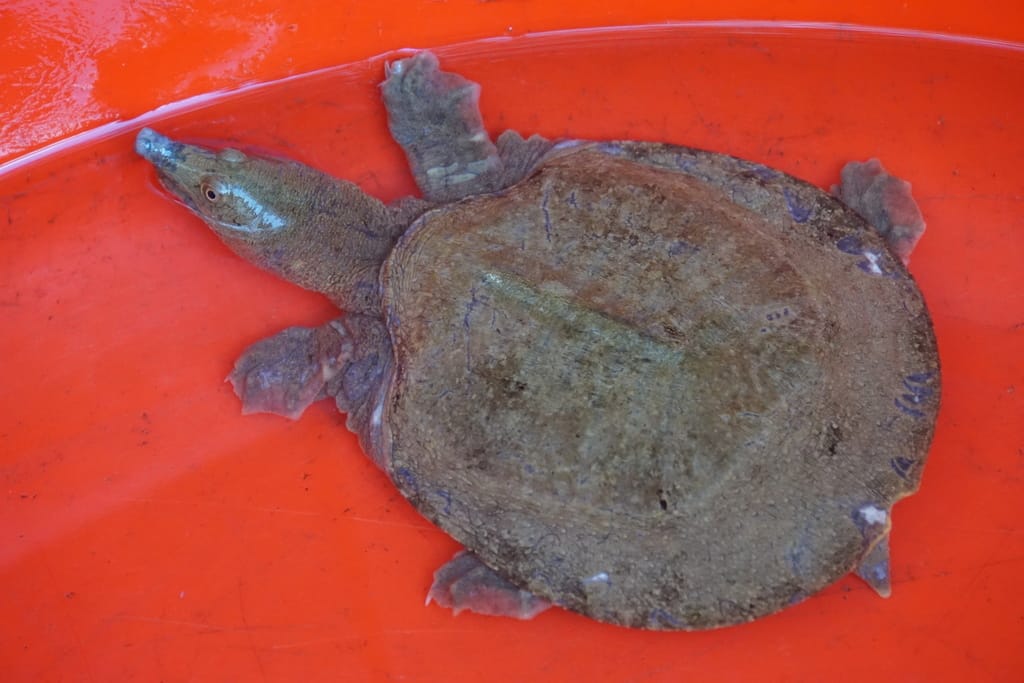
The Chinese softshell turtle is the most widely available softshell turtle in the world. That’s not because of the pet trade though — it’s because hundreds of millions of them are farmed in China for the food industry. Yeah, they’re considered a delicacy over there.
But the hatchlings from these farms also end up in pet stores worldwide. And the albino morph of the Chinese softshell? That’s become one of the most sought-after turtles in the hobby.
These turtles are native to China, Taiwan, and Vietnam, with introduced populations in Thailand, Japan, and even Hawaii.
How Big Do Chinese Softshells Get?
This is where it gets interesting.
Adults typically reach 9 to 14 inches. That’s it.
No crazy gender size difference. No 2-foot females. The Chinese softshell is one of the smallest softshell species you can keep, which makes tank requirements much more realistic.
Tank Requirements
A 75 to 100-gallon tank works for an adult Chinese softshell.
That’s way more manageable than the 400-gallon stock tanks you’d need for a full-grown female Florida softshell. This smaller size requirement is honestly one of the biggest reasons to consider this species.
Tank Setup Essentials
- Fine sand substrate — same as all softshells, they love to burrow
- Good water filter — Chinese softshells have a unique ability to process urea through their mouths rather than just their kidneys, which actually makes them slightly more tolerant of imperfect water conditions. But “more tolerant” doesn’t mean “doesn’t care.” Still keep the water clean.
- Water heater — maintain around 75 to 80 degrees Fahrenheit
- Basking dock — basking temperature between 86 to 95 degrees Fahrenheit
- UVB lighting — absolutely essential for calcium metabolism
What Do Chinese Softshells Eat?
Same carnivorous profile as the North American species.
They’re aggressive predators that will eat fish, worms, insects, shrimp, and turtle pellets. They’ll take down fish bigger than themselves without blinking.
Calcium and vitamin D3 supplementation applies here too.
Temperament
Here’s the catch.
Chinese softshells are very aggressive toward other turtles. They’ll attack their own species, other turtle species, and basically anything in their tank that they don’t want to eat.
But here’s the weird part — when left alone, they’re actually relatively calm. They stress easily and don’t like being handled, but they’re not constantly on the attack when there’s no one else in the tank.
Definitely house them alone.

The Albino Morph
The albino Chinese softshell is a stunner. Golden yellow body with a whitish-pink base color and hints of orange and peach. They look like they’re glowing.
They’re also the only softshell species being bred in captivity in an albino morph, which makes them the crown jewel of any softshell collection.
Expect to pay significantly more for an albino than a normal Chinese softshell. We’re talking $100 to $300+ for a well-started juvenile from a reputable breeder, compared to $30-50 for a normal morph.
Difficulty Level
| Gender | Difficulty |
|---|---|
| Male | Intermediate |
| Female | Intermediate |
Easier than the North American species in terms of space requirements. But the aggression and sensitivity to handling still put this firmly in the “not for beginners” category.
Quick Comparison: All Four Pet Softshell Species
Here’s a side-by-side breakdown to help you figure out which softshell might work for you:
| Feature | Florida Softshell | Spiny Softshell | Smooth Softshell | Chinese Softshell |
|---|---|---|---|---|
| Adult Size (Male) | 6-12 inches | 5-9.5 inches | 5-11 inches | 9-14 inches |
| Adult Size (Female) | 24-29 inches | 6.5-18 inches | 6.5-14 inches | 10-14 inches |
| Min Tank Size | 100 gal (400+ ideal) | 75-90 gal (400+ ideal) | 75 gal | 75-100 gal |
| Water Temp | 70-80°F | 70-75°F | 70-80°F | 75-80°F |
| Basking Temp | ~90°F | 85-90°F | 75-85°F | 86-95°F |
| Lifespan | 20-30+ years | Up to 50 years | 20+ years | Up to 30 years |
| Aggression | Very High | High | Moderate-High | High (but calmer alone) |
| Difficulty | Advanced | Intermediate-Advanced | Intermediate | Intermediate |
| Price Range | $30-$100 | $30-$80 | $30-$100 | $30-$300+ (albino) |
| Best For | Experienced keepers | Experienced keepers | Intermediate keepers | Intermediate keepers |
Is It Okay To Keep A Softshell Turtle As A Pet?
Absolutely. Softshell turtles can make fantastic pets — for the right person.
They’re engaging, active, and way more interactive than your average red-eared slider just sitting on a rock. Softshells will learn to recognize you. They’ll swim to the front of the tank when they see you coming with food. Some keepers describe it as the closest thing to having an aquatic dog.
But here’s what you need to accept before buying one.
Never take a softshell turtle from the wild. Always buy captive-bred specimens from reputable breeders. Many softshell species globally are endangered or vulnerable. The North American species (Florida, Spiny, Smooth) are currently listed as Least Concern by the IUCN, but wild populations still face threats from habitat loss, pollution, and harvesting.
In fact, Florida banned the commercial harvest and sale of wild Florida softshell turtles after environmental groups raised concerns about unsustainable collection. So yeah, buy captive-bred. Always.
Good places to buy captive-bred softshell turtles include:
- The Turtle Source (theturtlesource.com)
- Tortoise Town (tortoisetown.com)
- Backwater Reptiles (backwaterreptiles.com)
- MorphMarket (morphmarket.com)
- Local reptile expos
Expect to pay $30 to $100 for common species, with shipping usually running around $45 for overnight delivery.
Can A Beginner Keep A Softshell Turtle?
I’m going to be honest with you. No.
Softshell turtles are sensitive. Their soft shells make them vulnerable to infections, scratches, and bacterial issues that hard-shelled turtles can just shrug off. The water quality requirements are strict. The feeding needs are specific. And one wrong move — rough substrate, dirty water, wrong temperature — can spiral into a serious health problem fast.
Experienced turtle forum members consistently say the same thing: softshells are not beginner turtles. They’re for keepers who already understand water chemistry, proper filtration, and the general demands of keeping aquatic turtles.
If you’re brand new to turtles, start with a musk turtle or mud turtle or a red-eared slider. Get a year or two of experience. Then graduate to softshells.
How To Choose The Right Softshell Turtle For You
Still want a softshell after everything you just read? Good. That probably means you’re the right kind of person for one.
Here’s how to narrow down your choice:
Go for a Chinese softshell if: You want the smallest species with the most manageable tank requirements. Bonus points if you want the albino morph — it’s genuinely one of the prettiest freshwater turtles alive.
Go for a Smooth softshell if: You want a North American species that’s slightly less aggressive and slightly easier to manage than the other two.
Go for a Spiny softshell if: You like the look of the spiny tubercles on the shell and you have room for a big setup. The males are much more manageable than the females.
Go for a Florida softshell if: You’re experienced, you have serious space (think stock tanks or ponds), and you want the biggest, baddest softshell in North America.
No matter which species you choose, ask yourself these questions first:
- Can I afford a 75+ gallon setup with proper filtration, heating, and UVB?
- Am I okay with a turtle that might live 20 to 50 years?
- Can I commit to weekly water maintenance and regular tank cleaning?
- Do I have access to a reptile vet who knows turtles?
- Am I buying from a reputable captive breeder?
If you answered yes to all of those, pick your species and go for it.
Wrapping Up
Softshell turtles aren’t the easiest pets. They’re not the cheapest either, once you factor in the tank, filtration, and ongoing food costs.
But they’re one of the most rewarding turtle species you can keep. Watching a softshell bury itself in the sand with just its weird little snorkel nose poking out never gets old. And the way they launch at prey like an underwater missile? Pure entertainment.
Just do your homework, set up the tank right, keep the water clean, and don’t try to pick them up unless you enjoy getting bitten.
Your softshell turtle will thank you for it. Probably by glaring at you from under the sand. That’s their version of affection.

About Author
Muntaseer Rahman started keeping pet turtles back in 2013. He also owns the largest Turtle & Tortoise Facebook community in Bangladesh. These days he is mostly active on Facebook.