How Fast Can A Tortoise Run? Real Speeds By Species
This post was created with help from AI tools and carefully reviewed by a human (Muntaseer Rahman). For more on how we use AI on this site, check out our Editorial Policy.
Type “how fast can a tortoise run” into Google and you will get a number in about half a second.
Then you will get five more numbers, none of which match.
One site says 0.13 mph. Another says 5 mph. A surprising number of them claim Russian tortoises hit 8 km/h, which would make your pet faster than most people jog.
I went looking for where those numbers actually come from. Most of them come from nowhere. They are copied from other blogs, which copied them from other blogs, and nobody ever measured anything.
So here is what the actual research says, what the Guinness record actually is, and which numbers you should stop repeating.
A tortoise moves at roughly 0.2 to 0.6 mph (0.3 to 1 km/h, or 0.08 to 0.28 m/s). The Guinness world record for the fastest tortoise is 0.28 m/s, which is 0.63 mph. For comparison, a relaxed human walk is about 3 mph, so a person strolling is roughly five times faster than the fastest tortoise ever timed.
And the more useful answer: tortoises do not really run. They have one gear. What looks like running is just walking with more motivation.
Can Tortoises Run At All?
Not in the way a dog or a horse runs.
Running, in the biomechanical sense, means a gait with an aerial phase, a moment where the animal is airborne with no feet on the ground. Tortoises never do this. They always have feet down.
Tortoises use a single gait across their entire speed range. Research on Mediterranean spur-thighed tortoises found they could only sustain a walking gait over a narrow band from 1.2 to 6.0 meters per minute, and that was the whole range. There is no second gear to shift into.
So when your tortoise sees you coming with a strawberry and speeds up, it is not switching to a run. It is walking at the top of its one and only gait.
That is why the answer to “how fast can a tortoise run” and “how fast can a tortoise walk” are basically the same number. The gap between a tortoise’s cruising speed and its absolute maximum is small.

Tortoise Speed By Species
Here is where I have to be honest with you in a way most articles are not.
Reliable measured speeds exist for only a handful of tortoise species. Everything else circulating online is estimate, folklore, or straight-up copied error.
I have split the table accordingly. The top block is measured in published research or verified by Guinness. The bottom block is the commonly repeated figures, flagged as what they are.
| Tortoise | Speed | How solid is this? |
|---|---|---|
| Leopard tortoise (Bertie, record holder) | 0.28 m/s / 1.0 km/h / 0.63 mph | Guinness-verified, timed course, 2014 |
| Galápagos giant tortoise | 0.16 m/s / 0.58 km/h / 0.36 mph | Published biomechanics study, force-plate measured |
| Spur-thighed tortoise (Testudo graeca) | up to 0.1 m/s / 0.36 km/h / 0.22 mph | Published treadmill study, full speed range measured |
| Leopard tortoise (Charlie, 1977 record) | 0.125 m/s / 0.45 km/h / 0.28 mph | Previous Guinness record |
| Sulcata / African spurred | ~0.3 mph claimed | Widely repeated, no primary source found |
| Indian star tortoise | ~0.5 km/h claimed | Widely repeated, no primary source found |
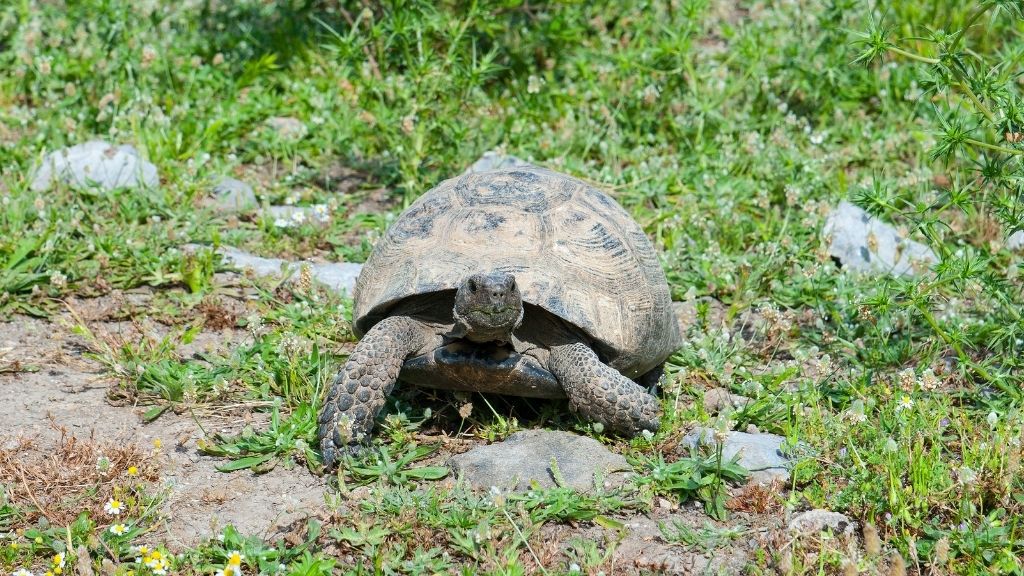
| Gopher tortoise | ~0.13-0.3 mph claimed | Widely repeated, no primary source found |
| Russian tortoise | 8 km/h or 5 mph claimed | False. See below. |
The pattern in the measured column is tight. Everything real lands between 0.1 and 0.28 m/s. That is the actual range of tortoise speed, and it barely varies across species that differ in weight by a factor of a hundred.
A 500-pound Galápagos giant and a 2-pound spur-thighed tortoise move at roughly the same speed. That tells you something important, which I will come back to.
The Russian Tortoise 8 km/h Myth
This one deserves its own callout because it is everywhere, and this site used to repeat it too.
No tortoise moves at 8 km/h. That is 5 mph, roughly a human jogging pace, and about eight times the Guinness world record.
The claim seems to have come from a unit error that got copied a few thousand times. Actual Russian tortoise speeds sit in the same range as every other tortoise, well under 1 km/h.
If a Russian tortoise could genuinely hit 8 km/h, it would have shattered the world record decades ago. It has not, because it cannot.

This Hilarious Turtle Book Might Know Your Pet Better Than You Do

Let’s be real—most turtle care guides feel like reading a textbook written by a sleep-deprived zookeeper.
This one’s not that.
Told from the snarky point of view of a grumpy, judgmental turtle, 21 Turtle Truths You’ll Never Read in a Care Guide is packed with sarcasm, sass, and surprisingly useful insights.
And hey—you don’t have to commit to the whole thing just yet.
Grab 2 free truths from the ebook and get a taste of what your turtle really thinks about your setup, your food choices, and that weird plastic palm tree.
It’s funny, it’s honest, and if you’ve ever owned a turtle who glares at you like you’re the problem—you’ll feel seen.
The Fastest Tortoise In The World
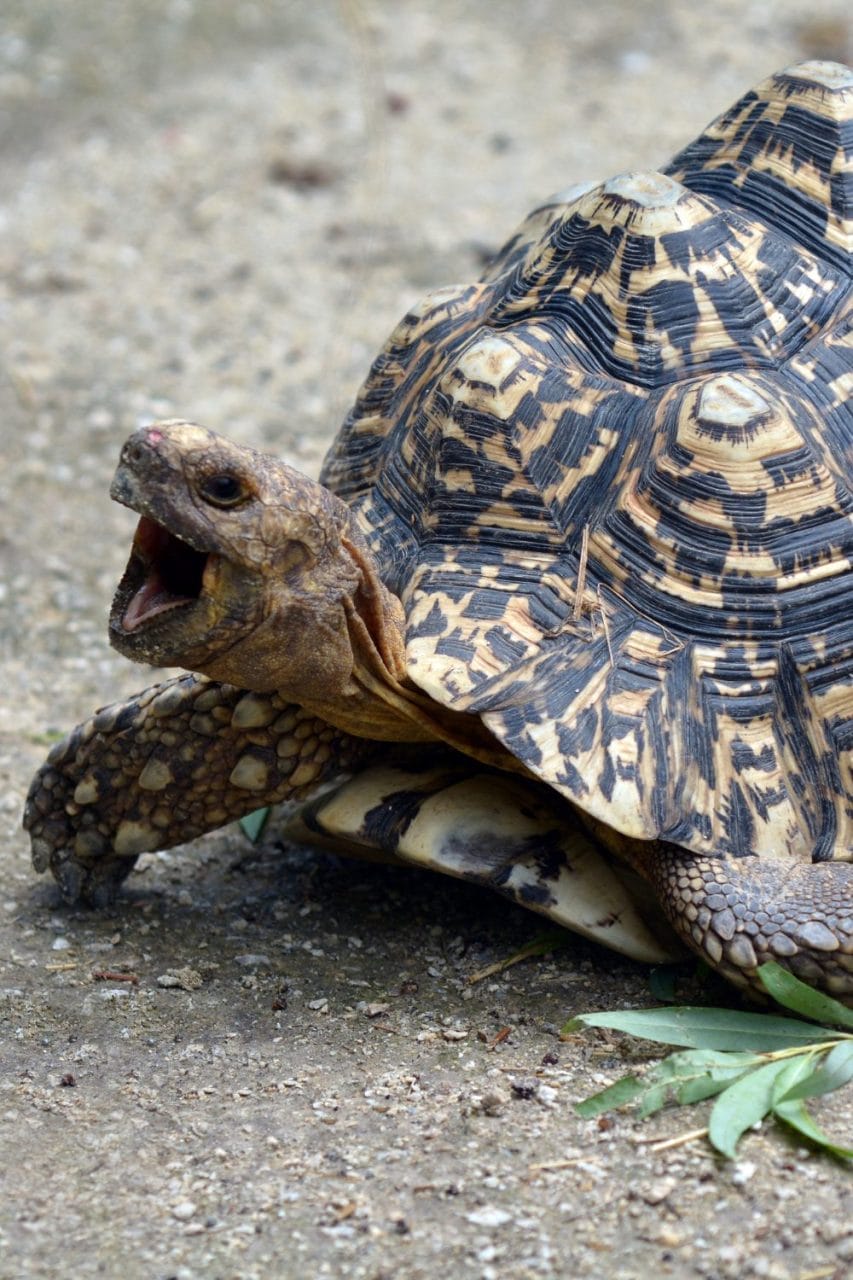
The record holder is Bertie, a leopard tortoise who covered 5.48 meters in 19.59 seconds at Adventure Valley in Brasside, Durham, UK, on 9 July 2014. That works out to 0.28 m/s, or 0.63 mph.
The details are better than the number.
Bertie ran the course uphill, on a 1:12 gradient. So the record is not a flat-track time, it is a hill climb.
And his motivation was strawberries. His keeper confirmed Bertie was chasing fruit the entire way, which is the most tortoise thing imaginable.
Bertie beat a record that had stood since 1977, held by a tortoise named Charlie who took 43.7 seconds on the same distance. Bertie was more than twice as fast.
The press called him the Usain Bolt of tortoises. Usain Bolt runs at 27 mph. Bertie ran at 0.63 mph. The comparison is generous.
Why Are Tortoises So Slow?
The usual answer is “the shell is heavy.” That answer is wrong, and the real one is far more interesting.
The Shell Is Not The Problem
Here is the finding that surprised me most. Tortoises are unusually efficient walkers.
The treadmill study on spur-thighed tortoises measured their metabolic cost of transport, the energy burned to move one kilogram of body weight one meter. The minimum was 4.11 joules per kilogram per meter, which is roughly half of what body-size scaling predicts for an animal that size.
Read that again. A tortoise carrying a bony fortress on its back uses about half the energy per meter that a generic animal of its mass should.
So the shell is not making them wasteful. Whatever is limiting tortoise speed, it is not an energy budget problem.
They Cannot Use The Pendulum Trick
This is the real mechanism.
When you walk, your body vaults over your stiff leg like an upside-down pendulum. You rise and slow slightly, then fall and speed up, trading height for speed and back again with every step. That exchange recycles energy for free, which is why walking feels so cheap.
Almost every walking animal does this. Tortoises do not.
Researchers measured Galápagos giants on force plates and found their kinetic and potential energy fluctuated nearly at random, only sporadically out of phase. They recovered just 29.8% of their mechanical energy, one of the lowest figures documented in any vertebrate.
The reason is a geometry trap. To make the pendulum exchange work at their speed, a tortoise’s center of mass would need to rise and fall by less than half a millimeter per step. That is not physically achievable for a walking animal.
They are, in a real sense, too slow to walk efficiently the way other animals do. And they are too slow to walk that way because they are slow, which is a loop they cannot break out of.
Sprawling Legs And A Spine That Cannot Help
A tortoise’s legs stick out sideways from the body rather than underneath it. Every step costs extra effort just to hold the body clear of the ground.
Worse, the shell fuses to the spine. When a cheetah runs, its back flexes and extends, adding huge distance to every stride. A tortoise’s back cannot move at all. All propulsion comes from four short legs and nothing else.
Built From Slow Muscle
Tortoise limb muscles are dominated by slow-twitch type I fibers, the endurance kind. These are fatigue-resistant and cheap to run, but they contract slowly and cannot generate the rapid power a sprint needs.
Committing to one gait across a narrow speed range lets those fibers operate at peak efficiency almost all the time. The tortoise traded top speed for the ability to keep going, more or less forever.
They Are Cold-Blooded
Tortoises are ectotherms. Their muscle performance tracks their body temperature, and optimal reptile locomotion happens around 35°C.
A cold tortoise is a genuinely slower tortoise, not a lazy one. This is why yours crawls on an overcast morning and picks up noticeably after an hour under the basking lamp (my pick: Zoo Med PowerSun).
They Never Needed Speed
Every mechanism above is only tolerable because tortoises never had selective pressure to move fast.
They eat plants. Plants do not flee.
They wear armor that can take enormous force, so the shell handles predators that speed would otherwise have to. When threatened, retracting beats running.
An animal that does not chase food and does not flee predators has no reason to pay for speed. Evolution stopped optimizing, and 200 million years later, here we are.

Tortoises Have An Optimal Speed
Here is a detail almost nobody covers. Tortoises have a speed that is most efficient for them, and it is not their slowest.
The treadmill research found the sweet spot at 4 to 6 meters per minute. Below that, cost of transport actually gets worse, because the fixed overhead of just being awake gets spread over less distance.
So a tortoise dawdling at 1 m/min is burning more energy per meter than one cruising at 5 m/min.
This is the same curve humans have. There is a walking pace that feels effortless, and going deliberately slower feels oddly tiring. Tortoises live on that curve too.
How Far Can A Tortoise Walk In A Day?
Slow does not mean stationary, and this is where tortoises quietly impress.
GPS tracking on Galápagos giants gives us real numbers instead of guesses:
- Normal daily movement: 40 to 50 meters. On an ordinary day, a tortoise covers about half a football field.
- Migrating: 200 to 300 meters per day. Adult males and some females make seasonal migrations of roughly 6 km over two to three weeks, climbing between lowland and highland zones as vegetation changes.
- Long-term range: up to 20 km over two years, recorded on Wolf Volcano, Isabela Island.
A 6 km migration at 0.16 m/s is genuinely impressive endurance. The animal is not fast, but it is relentless, and it does this while carrying a shell that weighs more than most dogs.
Your garden tortoise operates on the same principle at a smaller scale. Give it a large enclosure and it will patrol far more of it than you would guess.
Does Size Or Age Change Tortoise Speed?
Barely, and that is the strange part.
Remember the table: a Galápagos giant at 0.16 m/s and a spur-thighed tortoise at 0.1 m/s differ enormously in mass but hardly at all in speed. Bigger tortoises take longer strides at a lower step rate, and the two effects roughly cancel.
Hatchlings are a partial exception. They are proportionally quicker and noticeably more restless than adults, though their absolute speed is tiny because their legs are tiny.
That restlessness fades. A young tortoise that seems to explore constantly usually settles into adult sluggishness within a few years.

When Does A Tortoise Actually Speed Up?
Your tortoise has a top gear, and these are the things that unlock it:
- Food, especially favorites. The single most reliable trigger. Bertie set a world record chasing strawberries. Your tortoise recognizes the sound of the fridge.
- You. Tortoises learn to associate their keeper with food and will make straight for you.
- Mating season. Males become dramatically more mobile and will cross an entire enclosure to reach a female.
- Escaping a threat. Not fleeing exactly, but moving purposefully toward cover.
- A warm body. Straight after basking is when your tortoise is fastest all day.
- New territory. Put a tortoise somewhere unfamiliar and it will patrol the perimeter with unusual determination, looking for a way out.
- Heading for a known destination. A tortoise that knows where the water dish or the burrow is moves noticeably faster than one wandering.
Is My Tortoise Too Slow, Or Is It Sick?
This is the question most people are really asking, and it is the one the speed trivia does not answer.
Slowness is normal. A sudden change in slowness is not.
Work through these in order before you worry:
Check temperature first. This solves the majority of cases. A tortoise below its preferred range physically cannot move normally. Check your basking spot with an actual thermometer, not by hand.
Check the time of day. Tortoises are slowest in early morning and late evening. Judge activity at midday when they are warmest.
Check the season. If your species brumates, slowing down in autumn is the system working correctly, not a problem.
Check the surface. Smooth tile and deep loose substrate both wreck a tortoise’s traction. A tortoise scrabbling on laminate is not weak, it just has nothing to grip.
Now the warning signs. See a vet if the slowness comes with:
- Dragging or splayed back legs, or an inability to lift the shell clear of the ground when walking
- Wobbling, tipping, or listing to one side while moving
- Soft or lumpy shell alongside weak movement, which points toward metabolic bone disease
- Loss of appetite on top of the lethargy
- Runny nose, puffy or closed eyes, or audible wheezing, especially with a respiratory infection
- Sudden lethargy in a warm, correctly set-up enclosure, which is the clearest red flag of all
That last one matters most. A slow tortoise at the right temperature, in the right season, with a good appetite is a normal tortoise. A tortoise that goes quiet while everything else is correct needs looking at. I covered the full picture in signs your tortoise is sick.

How To Measure Your Own Tortoise’s Speed
Want a real number instead of a guess? It takes five minutes.
- Warm the tortoise up. Give it 30 to 60 minutes under the basking spot. A cold reading is meaningless.
- Mark a straight course. Two meters is plenty. Use tape or two objects on a surface with decent grip.
- Bring the motivation. Have someone stand at the finish with a favorite food. This is the whole trick.
- Time the run. Start the clock when the front legs cross the line, stop when they cross the far one.
- Do the math. Distance in meters divided by seconds gives you m/s. Multiply by 2.24 for mph, or by 3.6 for km/h.
- Run it three times and take the best. Tortoises get bored fast, and attempt one is rarely the good one.
Anything from 0.05 to 0.2 m/s is a perfectly normal healthy result. If you break 0.28 m/s on a level course, you should probably call Guinness.
Tortoise vs Turtle: Which Is Faster?
Turtles win on land, and it is not close. Softshell turtles manage around 3 mph, roughly five times the tortoise record, and even ordinary box turtles beat most tortoises.
The reason is build. Turtles carry flatter, lighter shells and have longer, less column-like limbs. Tortoises are built as walking tanks: heavy domed shell, thick elephantine legs designed to bear weight rather than move it quickly.
In water the gap becomes absurd, because tortoises cannot swim at all. They float, badly, and drown. I covered why in can tortoises swim.
For the full breakdown of turtle land and water speeds, see can turtles run. And if the terminology is tripping you up, turtle vs tortoise vs terrapin sorts it out.
How Tortoises Rank Among The Slowest Animals
Tortoises have a reputation as the slowest thing alive. They are not, and they are not especially close.
| Animal | Top speed |
|---|---|
| Three-toed sloth | 0.27 km/h |
| Garden snail | 0.05 km/h |
| Koala (on ground) | ~10 km/h |
| Slow loris | 1.9 km/h |
| Tortoise (record) | 1.0 km/h |
| Human walking | ~4.8 km/h |
Tortoises comfortably beat sloths and snails. They lose to the slow loris, which is badly named, and they are demolished by the koala, which has an undeserved reputation for laziness.
Among land animals, the tortoise sits near the bottom but not at it. The sloth keeps that crown.
Is The Tortoise And The Hare Actually True?
Sort of, and the real version is better than the fable.
A tortoise will never out-sprint anything. But endurance is a different contest, and the Galápagos migration data makes the case: 6 km of continuous climbing over two to three weeks, carrying enormous weight, without stopping to rest the way a mammal would need to.
Those slow-twitch muscles and that miserly cost of transport buy something real. A tortoise cannot go fast, but it can go for a very, very long time, which is the actual moral of the story.
It also fits the rest of the animal. Tortoises live longer than nearly anything else on land, with the best-documented individual reaching over 190 years. Slow metabolism, slow movement, long life. It is all the same strategy, and I broke down the numbers in tortoise lifespan.
Can Tortoises Walk Backwards?
Yes, tortoises can walk backwards. It is slow and awkward, so they only do it when they have a reason, but the idea that tortoises are physically incapable of reversing is a myth.
Some animals genuinely cannot reverse. Kangaroos and emus are the famous examples. Tortoises get lumped in with them, and they should not be.
The reason tortoises look like they cannot is that reversing is genuinely hard work for them. A bulky domed shell and a neck that does not swivel far mean the animal is stepping backwards into territory it cannot see.
So they rely on feel rather than sight. The front legs act as anchors while the stumpy back legs push off the ground, and the whole body shifts back in a jerky little shuffle.
Size matters here too. A Pancake tortoise reverses far more easily than a Sulcata, because there is much less animal to drag backwards.
6 Reasons A Tortoise Walks Backwards
- It is stuck. Wedged between rocks, furniture, or enclosure walls, reversing is the only way out.
- It needs to turn around. A tortoise cannot pivot on the spot in a tight space, so it backs up first and then turns.
- Soaking time is over. Most tortoise baths and water dishes have one entrance, so the only way out is the way it came in.
- It is nesting. A gravid female backs into the egg chamber using her rear legs. If she is entering a hole backwards, she is nesting rather than burrowing.
- Something ahead is a threat. Backing away is quicker than executing a full turn when danger is in front.
- Weak or underdeveloped legs. A tortoise that cannot get solid grip may wobble and drift backwards without meaning to. This one is worth a vet visit if it keeps happening.
The first five are completely normal. Only the last one is a reason to worry, and even then it is about the legs rather than the reversing itself.
Walking backwards is not the same as pacing back and forth on repeat, which has its own set of causes. I broke those down in why your tortoise is pacing.
Frequently Asked Questions
How fast can a tortoise run in mph?
Between roughly 0.2 and 0.6 mph. The verified record is 0.63 mph, set by Bertie in 2014.
Can a human outrun a tortoise?
Easily. A casual human walk is about 3 mph, roughly five times the fastest tortoise ever timed. You could outpace any tortoise while walking backwards yourself.
What is the fastest tortoise species?
The leopard tortoise, which holds both the current and the previous Guinness records. Whether it is genuinely the fastest species or simply the one that got timed is an open question, since most species have never been formally measured.
Do tortoises get tired?
Yes, but far less than you would expect. Slow-twitch muscle and a low cost of transport make them endurance specialists. They fatigue from heat far sooner than from effort.
Why does my tortoise walk fast sometimes and slow other times?
Almost always temperature or motivation. A warm tortoise expecting food moves several times faster than a cool tortoise with nothing to do.
Are tortoises faster on grass or hard ground?
Grass and soil, generally. They need traction to push against, and smooth surfaces like tile cause the legs to slip. Note that Bertie set the world record on an uphill gradient, so grip beats gradient.
Can tortoises climb, and does that slow them down?
They climb better than most people expect, though it is slower and riskier than walking. A fall onto a hard surface can crack a shell. More in do tortoises like to climb.
How fast do baby tortoises move?
Proportionally quicker and much more restless than adults, but slower in absolute terms because of their size. The restlessness settles as they mature.
Do tortoises walk in straight lines?
Rarely, unless they have a destination. Left alone they wander in loops and arcs. A tortoise moving in a determined straight line is usually heading somewhere specific, often the edge of the enclosure.
Does shell size or weight determine speed?
No, and this is the biggest misconception. Tortoises are about twice as energy-efficient per meter as their body size predicts. The limit is gait mechanics and muscle type, not shell weight.
Can a tortoise walk on a leash like a dog?
You can buy tortoise harnesses, but most keepers find them pointless. The tortoise sets the pace regardless, and a harness that fits snugly enough to work risks rubbing the shell. Supervised free-roaming in a safe space works better. See letting your tortoise walk around the house.
The Bottom Line
A tortoise moves at 0.2 to 0.6 mph, cannot run in any technical sense, and has exactly one gear.
But the reason is not the one everyone repeats. The shell is not too heavy, and tortoises are not inefficient. They are about twice as economical per meter as their body size suggests they should be.
They are slow because their gait cannot recycle energy the way other walkers do, their legs sprawl sideways, their spine is fused solid, and their muscles are built for endurance instead of power. Then evolution left it there, because an armored herbivore has nothing to chase and nothing to outrun.
What they got in exchange is serious stamina. A Galápagos tortoise walking 6 km up a volcano over three weeks is doing something no sprinter could.
For you as a keeper, the practical part is short. Slow is normal. Slow while cold is normal. Slow in brumation season is normal. Slow in a warm enclosure with a full food dish and no appetite is the one that needs a vet.
Go time your tortoise this weekend. Bring strawberries, and let me know if you beat Bertie.

About Author
Muntaseer Rahman started keeping pet turtles back in 2013. He also owns the largest Turtle & Tortoise Facebook community in Bangladesh. These days he is mostly active on Facebook.