Why Do Turtles Stack? The Real Reasons Behind This Weird (But Genius) Behavior

This post was created with help from AI tools and carefully reviewed by a human (Muntaseer Rahman). For more on how we use AI on this site, check out our Editorial Policy.
You walk up to a pond, minding your own business, and there it is.
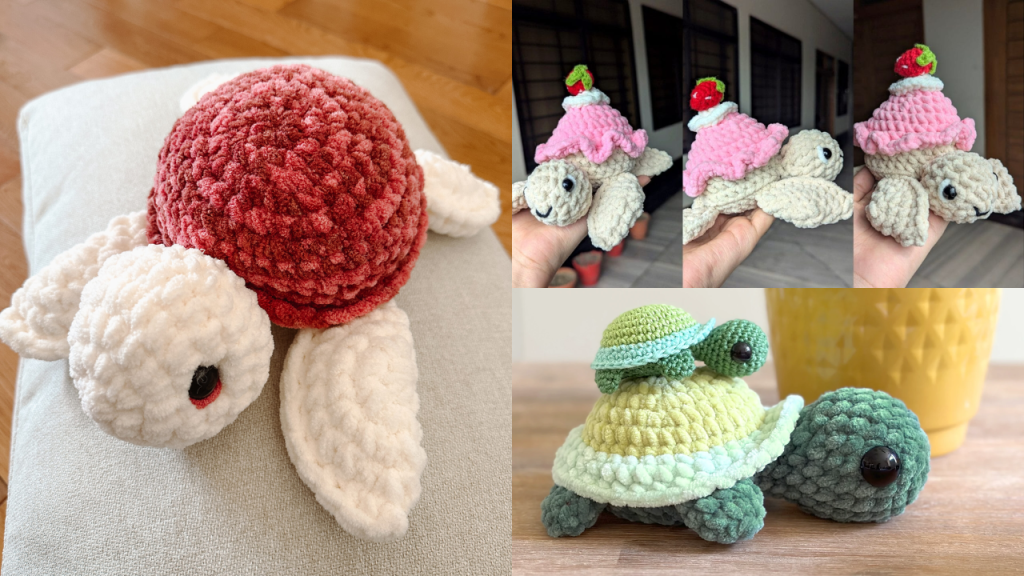
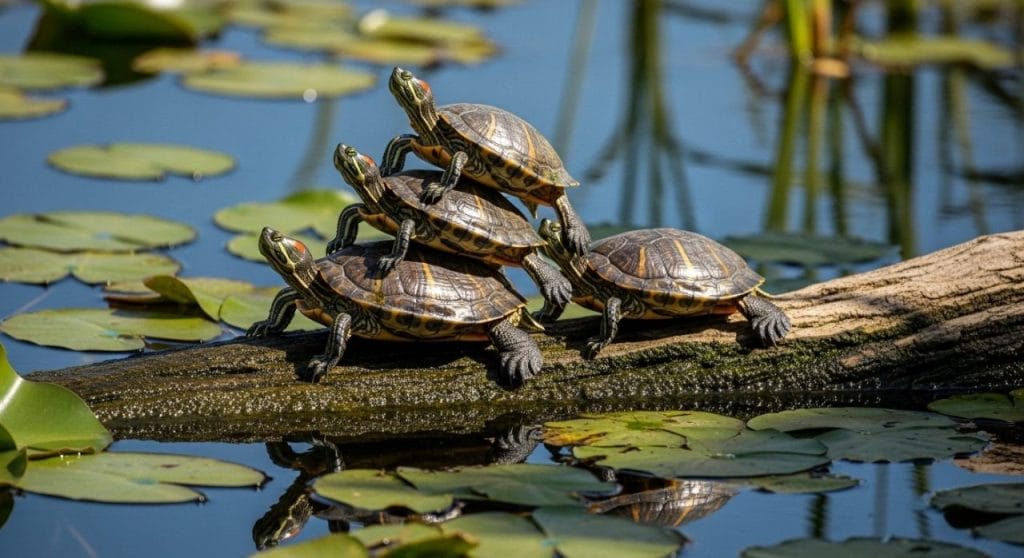
A tower of turtles. Just… stacked. Like reptilian pancakes.
One on top of the other. Sometimes three deep. Sometimes four. Just vibing in the sun like they invented the concept of teamwork.
So what’s actually going on here?
Turtles stack mainly to get better access to UV light and heat while basking. They also do it to look bigger to predators and, sometimes, to flex dominance over weaker turtles.
But there’s a lot more to this than meets the eye. Let’s break it all down.
What Is Turtle Stacking?
Turtle stacking is exactly what it sounds like.
One turtle climbs on top of another turtle’s shell. Then maybe a third one climbs on top of that one. You end up with a little turtle skyscraper on a log or rock.
It’s a completely natural behavior. You’ll see it in the wild all the time, especially among pond turtles like red-eared sliders and painted turtles.
And no, nobody is forcing them to do it. They choose this life.
Why Do Turtles Stack? The 3 Main Reasons
There’s no single answer here. Turtles stack for a few different reasons depending on the situation. Here’s what the research and real-world observation tells us.
1. They Need More UV Light (And They Need It Bad)
This is the big one. The number one reason turtles pile on top of each other.
Turtles are ectothermic. That’s a fancy way of saying they can’t make their own body heat. They depend entirely on their environment to warm up.
But it goes deeper than just staying warm.
UVB (my pick: Zoo Med ReptiSun 10.0) rays from the sun trigger vitamin D3 production in a turtle’s skin. Without D3, a turtle literally cannot absorb calcium from its food. And without calcium, bones get soft, shells get deformed, and you end up with a condition called Metabolic Bone Disease (MBD).
MBD is no joke. It causes soft jaws, broken limbs, spinal deformities, and can be fatal if it goes untreated.
So when a turtle basks, it’s not just relaxing. It’s doing something essential to stay alive.
Now imagine a pond with 15 turtles and only two decent logs to bask on.
Not everyone fits. So what do they do?
They stack.
The turtle on top gets the most direct UV exposure. But the turtles below still benefit from the collective warmth radiating through the group. It’s not a perfect system, but it beats not basking at all.
Think of it like a crowded subway car. Nobody loves standing pressed up against strangers, but it beats waiting for the next train in the freezing cold.
2. They’re Trying to Look Bigger to Predators
Here’s something most people don’t think about.
Turtles are super vulnerable when they’re basking. They’re out of the water, sitting on a log, basically advertising themselves as a snack.
Their biggest threats while basking? Birds of prey, raccoons, and in some areas, alligators.
A single turtle sitting alone on a rock looks like an easy meal. But a stack of four or five turtles? That looks like way more trouble than it’s worth.
The stacked turtles appear larger as a group, and a predator would have to bite through multiple layers of incredibly tough shell to get to any actual meat.
Speaking of shell toughness, a study by Hu et al. found that an adult turtle’s shell can resist roughly 40 times the bite force of a predator of the same weight. The fracture toughness of a turtle shell is about 36.4 MPa m^0.5, which is actually stronger than aluminum alloy.
So yeah. A stack of turtle shells is basically a fortress.
There’s also the “more eyes” advantage. When turtles are stacked, the ones on top have a better vantage point to spot danger. If one turtle dives, the rest get the signal and follow. It’s like having a built-in alarm system.
3. Dominance (The Turtle Power Move)
This one is a bit more debated among turtle keepers and researchers, but it’s worth talking about.
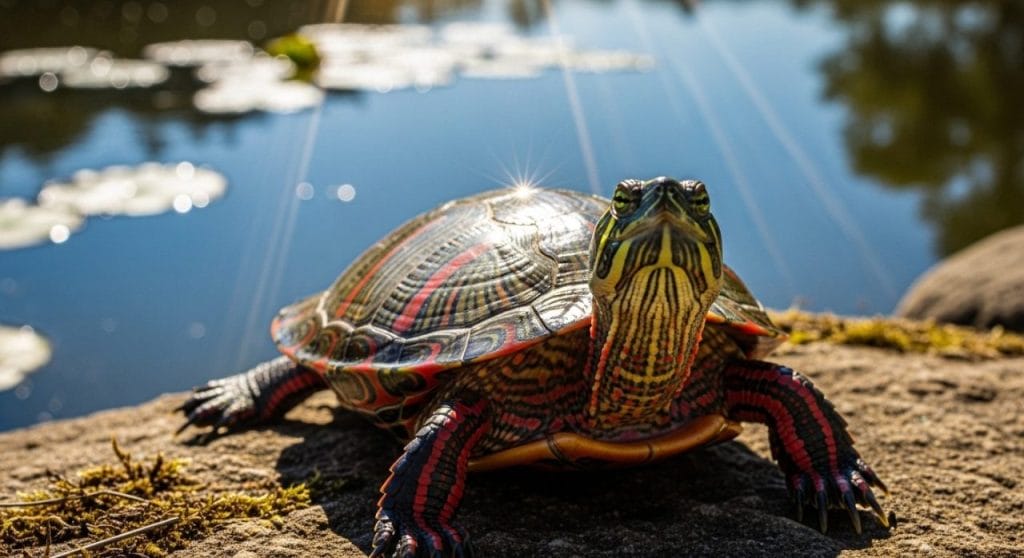
Some turtle owners report that the same turtles always end up on top of the stack. These tend to be the bigger, more confident individuals.
Being on top means you get the most UV light and the most direct heat. So it’s the best seat in the house.
The theory is that dominant turtles claim the top spot as a way to assert themselves over younger, smaller, or weaker turtles.
Now, turtles aren’t social animals. They don’t have complex hierarchies like wolves or primates. They mostly prefer to be left alone.
But when resources are limited, like a good basking spot, the bigger turtle tends to win. It’s not aggressive in the way a dog fight is. It’s more like… the big turtle just climbs up there and the smaller ones don’t argue.
When dominance goes beyond stacking and turns into persistent chasing, biting, or food stealing, that crosses into bullying territory — we break down the full spectrum in our article on whether turtles bully each other.
This Hilarious Turtle Book Might Know Your Pet Better Than You Do

Let’s be real—most turtle care guides feel like reading a textbook written by a sleep-deprived zookeeper.
This one’s not that.
Told from the snarky point of view of a grumpy, judgmental turtle, 21 Turtle Truths You’ll Never Read in a Care Guide is packed with sarcasm, sass, and surprisingly useful insights.
And hey—you don’t have to commit to the whole thing just yet.
Grab 2 free truths from the ebook and get a taste of what your turtle really thinks about your setup, your food choices, and that weird plastic palm tree.
It’s funny, it’s honest, and if you’ve ever owned a turtle who glares at you like you’re the problem—you’ll feel seen.
Which Turtle in the Stack Gets the Best Deal?
This is the question everyone asks. And the answer is more interesting than you’d expect.
| Position | UV Exposure | Heat | Other Benefits |
|---|---|---|---|
| Top | Highest (direct sunlight) | Good (direct + from turtles below) | Best vantage point for spotting predators |
| Middle | Moderate (partially blocked) | Highest (heat from above and below) | Protected from both sides |
| Bottom | Lowest (most blocked) | Good (absorbs group warmth) | Most stable, no risk of falling |
The top turtle wins overall. It gets the most UV rays and direct heat, which is what matters most for health.
But here’s the thing: turtles rotate positions. It’s not like the bottom turtle is stuck there forever. Over the course of a day or across multiple basking sessions, they swap around.
They seem to understand that the system only works if everyone cooperates. Fighting over the top spot would waste energy and time that could be spent actually basking.
It’s weirdly diplomatic for an animal that isn’t supposed to be social.
Is Turtle Stacking Dangerous?
Short answer: not really.
I used to worry about the bottom turtle getting crushed. I mean, it’s carrying the weight of one, two, sometimes three other turtles on its shell.
But turtle shells are built different.
Research shows that a turtle shell can withstand forces up to 200 times the turtle’s own weight. We’re talking about a structure with fracture toughness comparable to steel. A few turtles piled on top isn’t going to cause any damage.
The only real concern would be if the bottom turtle already had shell rot or existing damage. In that case, the extra weight could make things worse. But for healthy turtles in the wild, stacking is perfectly safe.
Dark Sides of Turtle Stacking: Are There Any?
People worry about three things:
1. Does the bottom turtle miss out on UV rays?
In theory, yes. But in practice, the top turtle doesn’t completely block UV light. It sits in a way that still allows some rays to reach the lower turtles. Plus, they rotate positions throughout the day.
2. Does the bottom turtle get cold?
Actually, no. The collective body heat from the turtles above can keep the bottom turtle surprisingly warm. It might not get direct sunlight, but it’s still getting more warmth than it would basking alone.
3. Do turtles fight over the top spot?
Rarely. Turtles are smart enough to know that fighting wastes basking time. The whole point of stacking is to solve a problem cooperatively, not create a new one.
So no, there’s no real “dark side” to turtle stacking in the wild. It’s a net positive for everyone involved.
Why Do Pet Turtles Stack in Captivity?
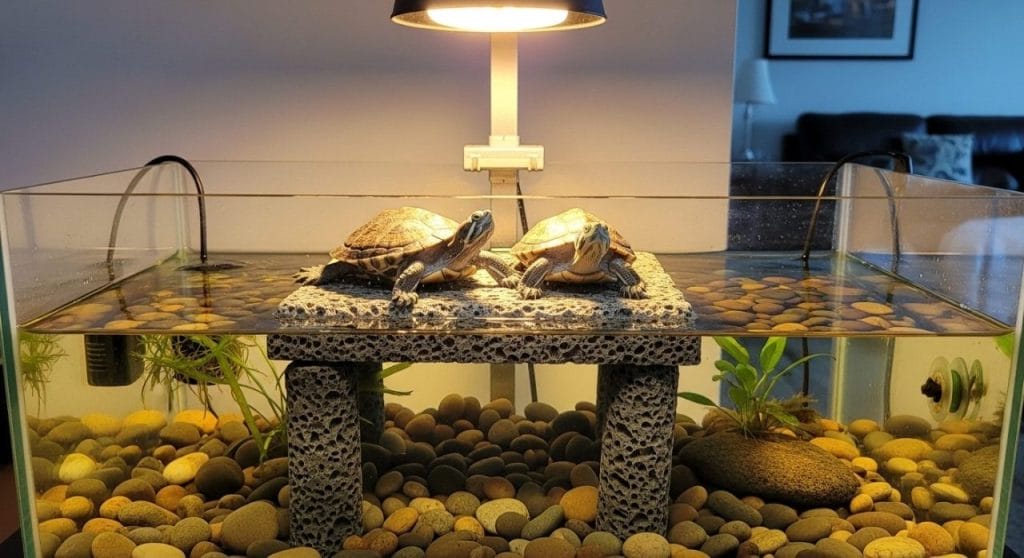
If you have multiple turtles in an indoor setup and you see them stacking, pay attention.
In the wild, stacking is normal and harmless. In captivity, it’s usually a sign that something is wrong with your setup.
Here’s what’s probably going on:
The Basking Area Is Too Small
This is the most common cause. If your basking dock (my pick: floating basking platform) can’t fit all your turtles at the same time, they’re going to start climbing on each other.
Fix: Get a bigger dock. Every turtle should be able to bask comfortably without touching its neighbor.
If commercial docks are too expensive or too small for your setup, our DIY turtle basking area guide shows you how to build custom platforms that fit any tank size.
The UV Lamp Isn’t Covering Enough Area
A single UV bulb creates a small hot spot. Turtles crowd into that one area because the rest of the dock is basically useless.
Fix: Use two lower-wattage bulbs spread apart instead of one high-wattage bulb. This gives even coverage across the whole basking platform.
The Heating Lamp Is Weak or Poorly Positioned
If the lamp isn’t putting out enough heat, your turtles will stack to pool their body warmth. That’s a survival instinct, not a preference.
Fix: Check your basking spot temperature. For most common pet turtle species like red-eared sliders, you want 90-95 degrees Fahrenheit at the basking surface. Juveniles need it slightly warmer, around 95-100 degrees.
Burn Risk Is Real Indoors
Here’s something wild owners don’t have to worry about but pet owners absolutely do.
When turtles stack in a tank, the one on top gets closer to the heat lamp (my pick: heat lamp). A few extra inches can mean a huge temperature difference. Turtles can and do get burns from being too close to a bulb.
Always make sure there’s enough distance between the basking surface and the lamp, even if turtles are stacking.
How to Prevent Stacking in Your Turtle Tank
You don’t need to stop stacking itself. You need to fix the root cause. Here’s a quick checklist:
| Problem | Solution |
|---|---|
| Small basking area | Upgrade to a larger dock that fits all turtles |
| Weak UV coverage | Add a second UV bulb or use a wider reflector |
| Low heat output | Check temp with a thermometer, upgrade lamp if needed |
| Dock in wrong position | Make sure it’s directly under the heat and UV source |
| Too many turtles | Consider a second basking area in the tank |
If you fix these issues, stacking will drop on its own. Your turtles won’t need to pile up because everyone will have enough space and light.
Is Turtle Stacking a Social Thing?
Nope. Not even close.
Turtles are some of the least social reptiles out there. They don’t hang out together because they enjoy each other’s company. They share logs and rocks because those happen to be the best basking spots.
That said, turtles aren’t completely incapable of connection — research shows they can recognize individual humans and form trust-based bonds with their owners, as we explain in our article on whether turtles get attached to their owners.
The only time turtles get remotely “social” is during mating season. And even that’s more business than pleasure.
So when you see a stack of turtles, don’t think “friendship.” Think “resource sharing under pressure.”
It’s the reptile equivalent of strangers sharing an umbrella during a rainstorm. Nobody’s making friends. Everyone just wants to stay dry.
Fun Fact: Even Turtle Embryos “Bask”
Here’s something that blew my mind.
A study published in the Proceedings of the National Academy of Sciences found that turtle embryos actually move inside their eggs toward the warmer side. Even at less than 0.1 grams in size, these tiny embryos can detect temperature differences and reposition themselves to get more heat.
Scientists had always assumed embryos were passive, just sitting wherever the egg happened to be. Turns out, turtles are optimizing their heat exposure before they’re even born.
If that doesn’t tell you how important warmth and UV are to these animals, nothing will.
Bottom Line
Turtle stacking looks funny. It makes for great photos and videos. But it’s actually a smart, practical behavior that helps turtles survive.
In the wild, it’s totally normal and nothing to worry about. Turtles stack to bask efficiently, deter predators, and manage limited space.
In captivity, it’s a red flag. It means your setup needs work. Bigger basking area, better UV coverage, proper heat. Fix those, and the stacking stops.
Either way, don’t stress about the bottom turtle. That shell can take it.
Now go check on your basking setup. Your turtles will thank you.

About Author
Muntaseer Rahman started keeping pet turtles back in 2013. He also owns the largest Turtle & Tortoise Facebook community in Bangladesh. These days he is mostly active on Facebook.