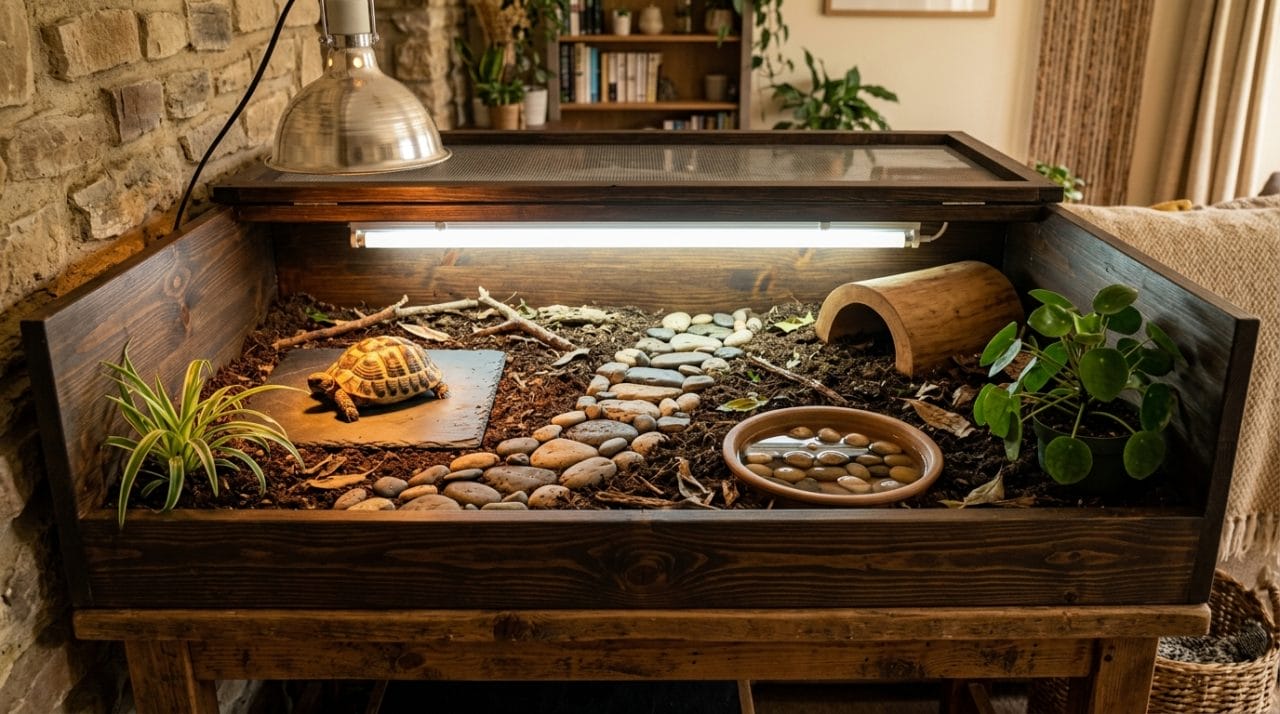
27 Indoor Tortoise Enclosure Ideas: DIY, Small Setups & Species-Specific Builds
This post was created with help from AI tools and carefully reviewed by a human (Muntaseer Rahman). For more on how we use AI on this site, check out our Editorial Policy.
If you’ve been searching “indoor tortoise enclosure (my pick: Aivituvin Wooden Tortoise Habitat) ideas” and still can’t picture what a good setup looks like, this is the post you needed.
Building the space is the fun part; keeping the daily care consistent is what actually keeps a tortoise healthy, which is where a care app made for tortoise keepers that tracks feeding, soaking, and UVB (my pick: Zoo Med ReptiSun 10.0) changes earns its keep.
Below are 20 real keeper builds — organized by build type and species — each with a step-by-step breakdown you can copy at home. Whether you need a massive DIY pit for a sulcata, a compact minimalist table for a Hermann’s, or something stylish enough to live in your apartment, there’s a setup here for you.
DIY Indoor Tortoise Enclosure Ideas
You don’t need to spend $200+ on a commercial tortoise table. These tortoise enclosure indoor DIY builds use basic lumber, cinder blocks, or repurposed containers — and every one of them is bigger and better than anything sold in pet stores.
1. Large DIY Cinder Block Tortoise Pit in Basement
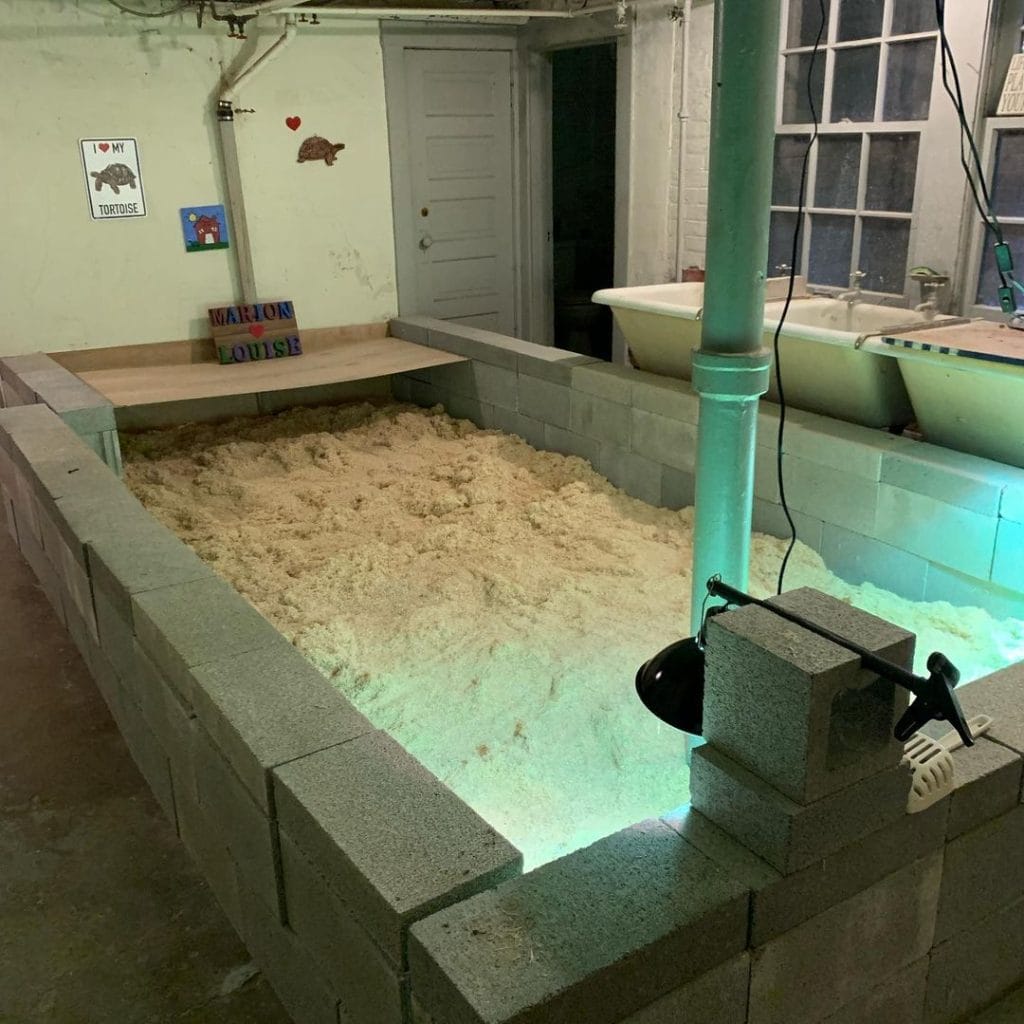
This one’s all about space and function. Built with cinder blocks, it offers tons of room for a large tortoise to roam, dig, and explore. It’s set in a basement or utility space — perfect for something long-term and low-maintenance.
What makes it unique:
The size. It’s massive and totally tortoise-proof. The use of cinder blocks makes it sturdy, affordable, and adjustable.
How to copy this setup:
- Outline your enclosure shape with cinder blocks (no need for mortar).
- Fill the base with a deep layer of coconut coir or aspen bedding.
- Mount a heat lamp (my pick: heat lamp) on one side for the basking area.
- Add a raised wood section for feeding or a dry zone.
- Personalize it with signs or artwork for fun.
For a large enclosure like this, you need a ceramic heat emitter (CHE) or basking bulb (my pick: Zoo Med PowerSun) hitting 100–110°F surface temperature, a separate UVB fixture covering at least 2/3 of the enclosure, and temperature monitoring at both warm and cool ends.
2. Custom Wood Enclosure With Caesar’s Nameplate
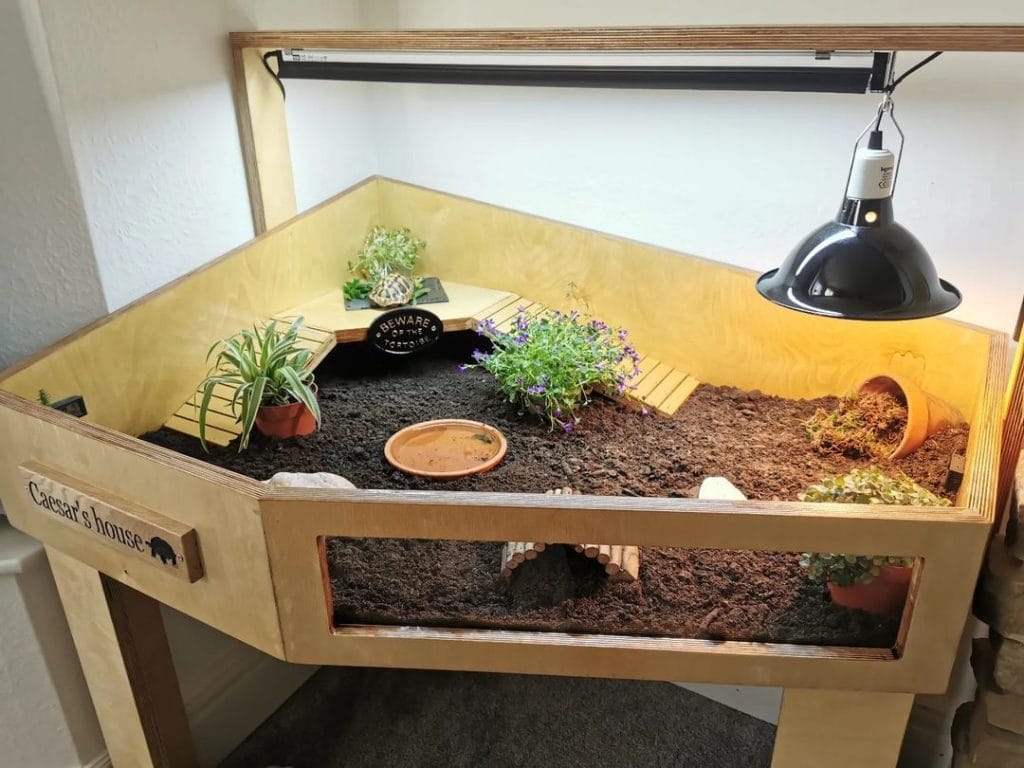
This is clearly a custom job, and it shows. The build includes angled corners, raised panels, bridges, tunnels, and labeled plant zones. It’s both practical and personal — with the tortoise’s name carved right into the front.
What makes it unique:
It’s a fully custom design with clever layout and lots of attention to detail. That viewing window is a sweet bonus.
How to copy this setup:
- Build or order a custom tortoise table with high wood sides.
- Include cutouts for tunnels and bridges for extra enrichment.
- Use topsoil as a deep base layer.
- Add potted plants and wood decor that can be rearranged easily.
- Set up basking lamps and UVB fixtures across the open top.
- Customize it with a nameplate or sign — it makes the setup feel special.
3. Two-Level Tortoise Pen With Mini Fence Divider
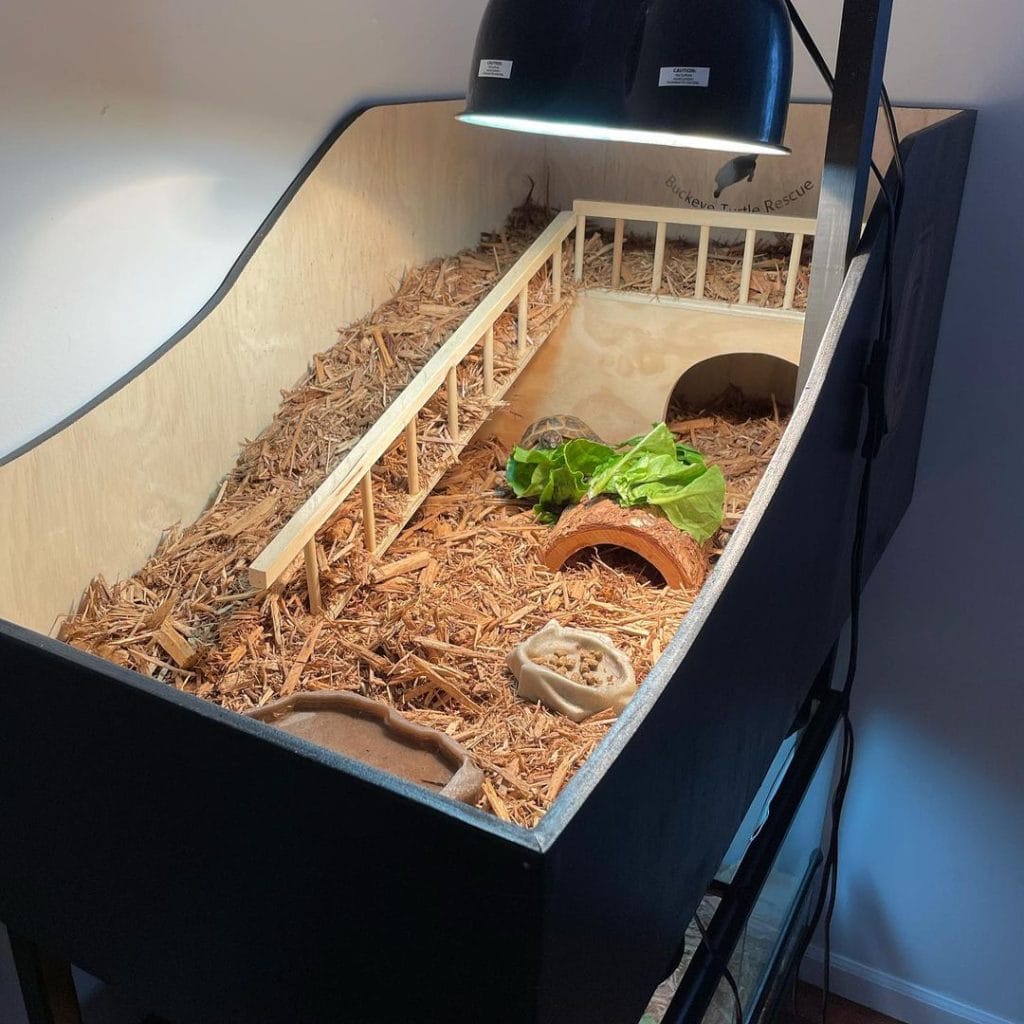
A brilliant use of space with a mini “balcony” layout. The divider adds a second level or secure feeding space. The lighting is well-positioned, and the substrate is soft and deep.
What makes it unique:
The fence-style divider adds visual interest and separation — great if you want to rotate zones.
How to copy this setup:
- Build a deep tortoise table with a divider using dowels or bamboo sticks.
- Add coco husk or cypress mulch across the floor.
- Use a ceramic heat emitter or basking lamp above the main open zone.
- Place hides and feeding dishes on both sides.
- Add a ramp if you want to connect levels.
4. Wooden Zen Garden Enclosure
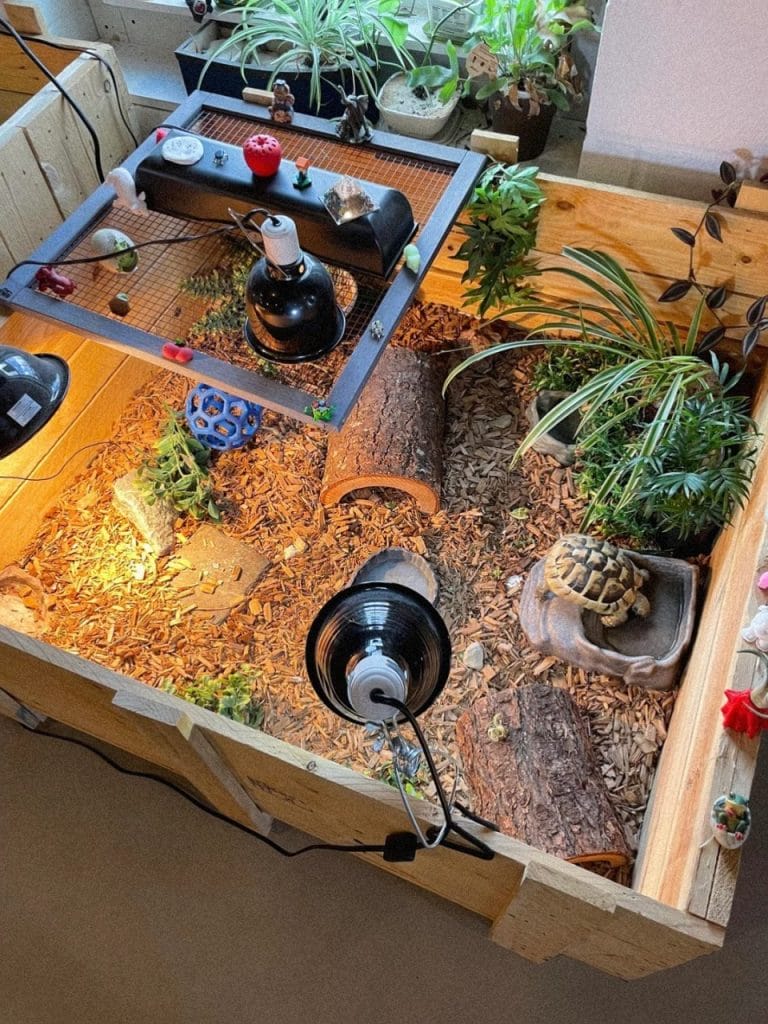
Built with a clean wood frame, this enclosure has strong nature vibes with climbing logs, deep mulch, plants, and soft lighting. It sits near a window for added light.
What makes it unique:
It feels peaceful and well-balanced — like a mix of a garden and a cozy cave.
How to copy this setup:
- Build a low wooden frame with smooth edges.
- Fill with cypress mulch and smooth bark chips.
- Add hollow logs, flat stones, and small animal-safe plants.
- Place near a window for natural light and warmth.
- Use dome lights with UVB and heat on one side.
5. Kiddie Pool Free-Roam Zone
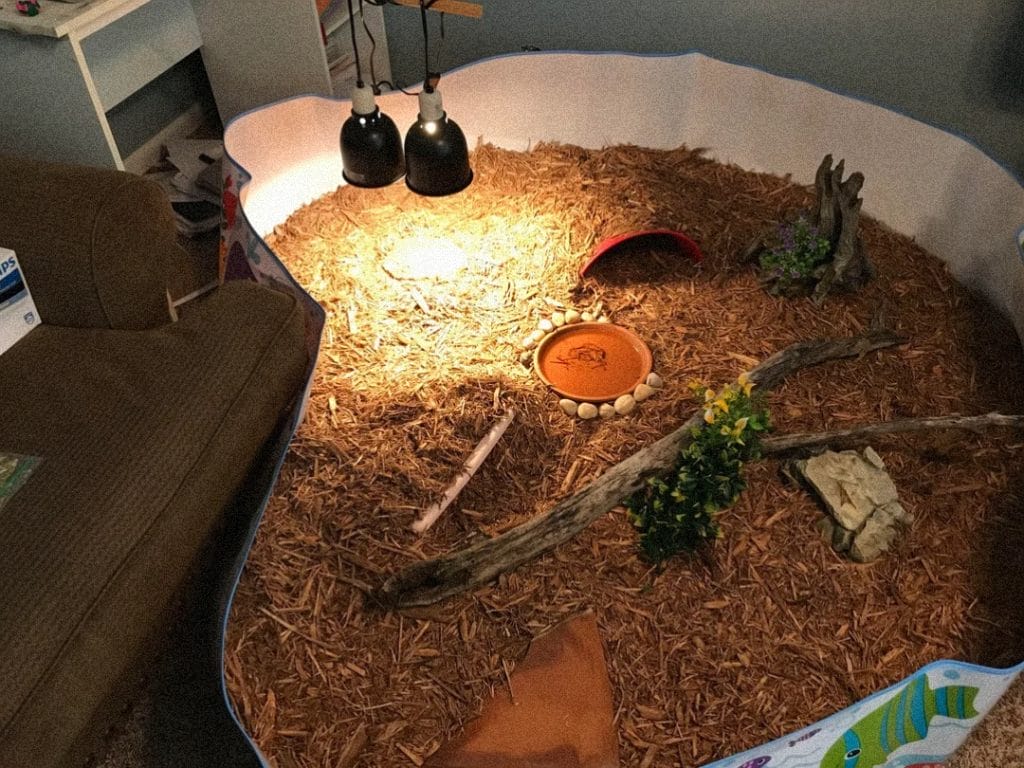
This setup uses a kiddie pool to give a tortoise lots of room indoors. It’s filled with mulch, branches, a hide, and simple lighting hung above.
What makes it unique:
Super budget-friendly, but still offers a huge roaming space. It’s casual and effective.
How to copy this setup:
- Get a wide plastic kiddie pool and line it with mulch.
- Add large branches, plants, and hides made from clay pots or boxes.
- Use hanging lamps or clamp-on bulbs with UVB and heat.
- Set it in a low-traffic corner so the tort feels secure.
- Keep everything lightweight for easy cleaning.
You still need quality UVB lighting (not a cheap coil bulb), adequate heating with temperature control, proper substrate depth (4–6 inches), and temperature monitoring. The structure can be cheap — the equipment can’t.
Small Tortoise Enclosure Ideas for Apartments
A small tortoise enclosure can still give your tortoise proper UVB, a warm basking zone, hides, and enrichment — without taking over a room. These compact setups work in apartments, small homes, and spare corners.
6. Tortoise Cottage-Style Enclosure With Floral Vibes
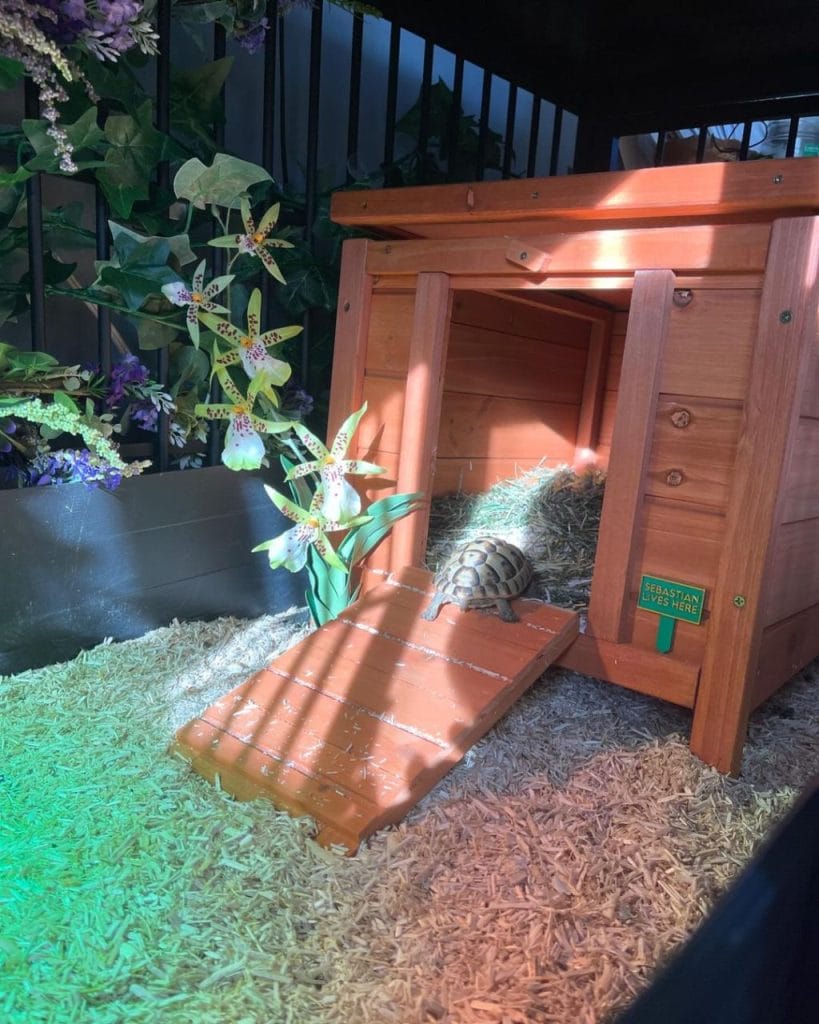
This setup uses a small wooden house as the centerpiece, complete with a ramp and cozy hay inside. The fake flowers and soft lighting give it a garden feel, even indoors. It’s not just pretty — it’s warm, safe, and calming for the tortoise.
What makes it unique:
It looks like a mini countryside cottage for your tortoise. The floral decoration adds charm, and the ramp makes it easier for the tort to come and go.
How to copy this setup:
- Buy a small wooden pet house or repurpose a rabbit hutch.
- Line the inside with hay for warmth and bedding.
- Add a wooden ramp for easy access.
- Decorate with plastic or silk plants along the wall.
- Use soft, shredded wood or aspen as substrate.
- Place near a light source or add a basking lamp.
7. Minimalist Tortoise Table With Slate Tile Basking Zone
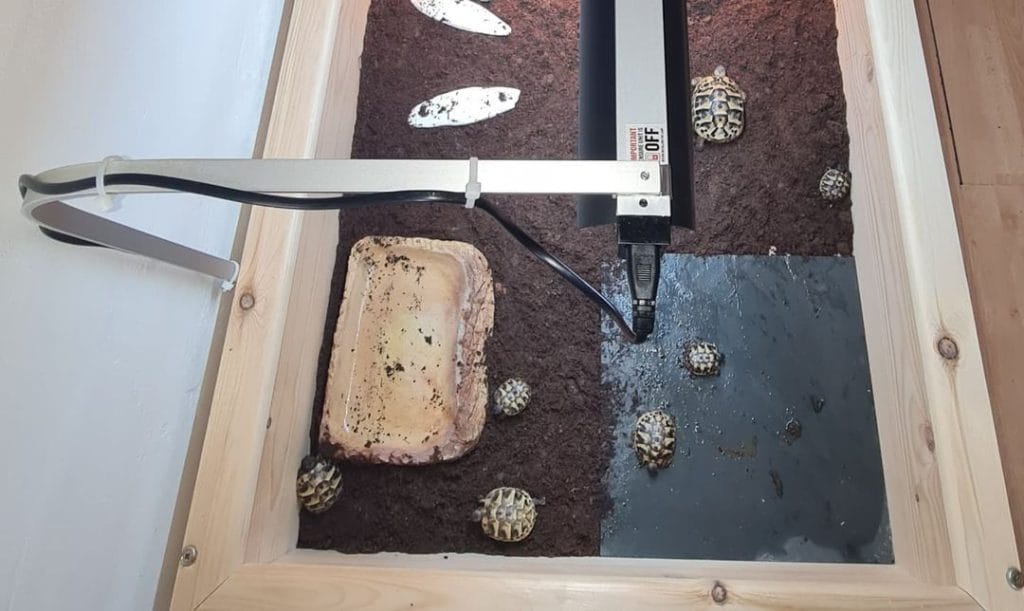
This setup is all about simplicity and function. It uses natural-colored coco fiber substrate, a flat slate tile for basking, and a deep dish for soaking. The UVB bar is mounted perfectly above the slate to create a hot zone.
What makes it unique:
It’s super clean and practical — ideal for hatchlings or anyone who wants easy upkeep.
How to copy this setup:
- Build a pine-framed tortoise table with tall sides.
- Use coco coir as the main substrate.
- Add a flat slate tile for a basking surface.
- Place a deep but low-sided water dish nearby.
- Mount a UVB bar over the tile for direct exposure.
The slate should reach 100–110°F surface temperature (check with an infrared thermometer). Use a ReptiSun 10.0 T5 HO or similar, and keep a cool end (70–80°F) away from the basking zone.
8. Jungle Corner Indoor Habitat With Tucked Hide
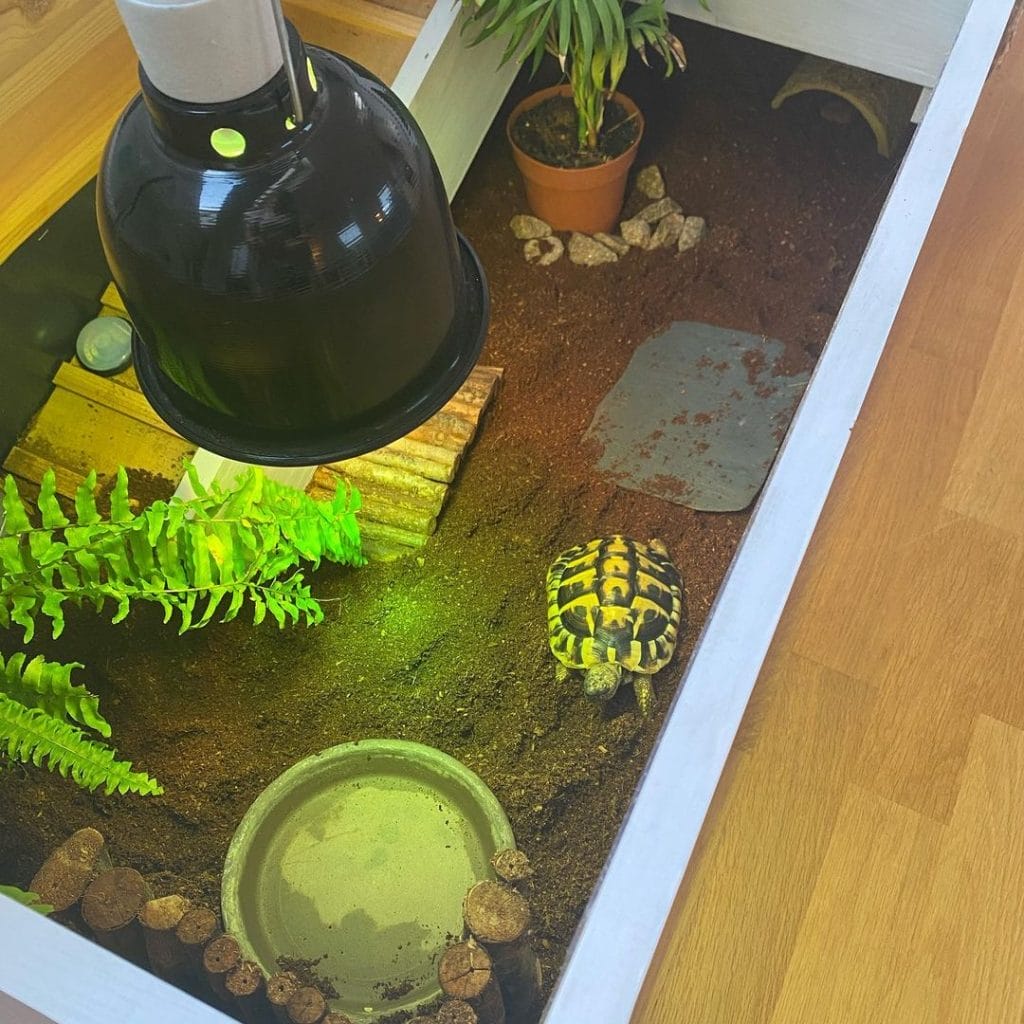
This layout packs a lot into a small corner space. It mixes live plants, bark pieces, a shaded log tunnel, and a basking tile. The tortoise has both open space and shaded cover, with natural textures everywhere.
What makes it unique:
It uses vertical layering well — plants, logs, and rocks create a sense of depth and variety.
How to copy this setup:
- Use a rectangular wood bin or storage box.
- Fill it with organic soil and add a fern or two in pots.
- Place a log or half-tube for hiding.
- Add a slate or ceramic tile under the heat lamp.
- Place smooth bark or stones to break up the floor.
9. “Sheldon’s Shack” Cozy Corner With Built-in Cam
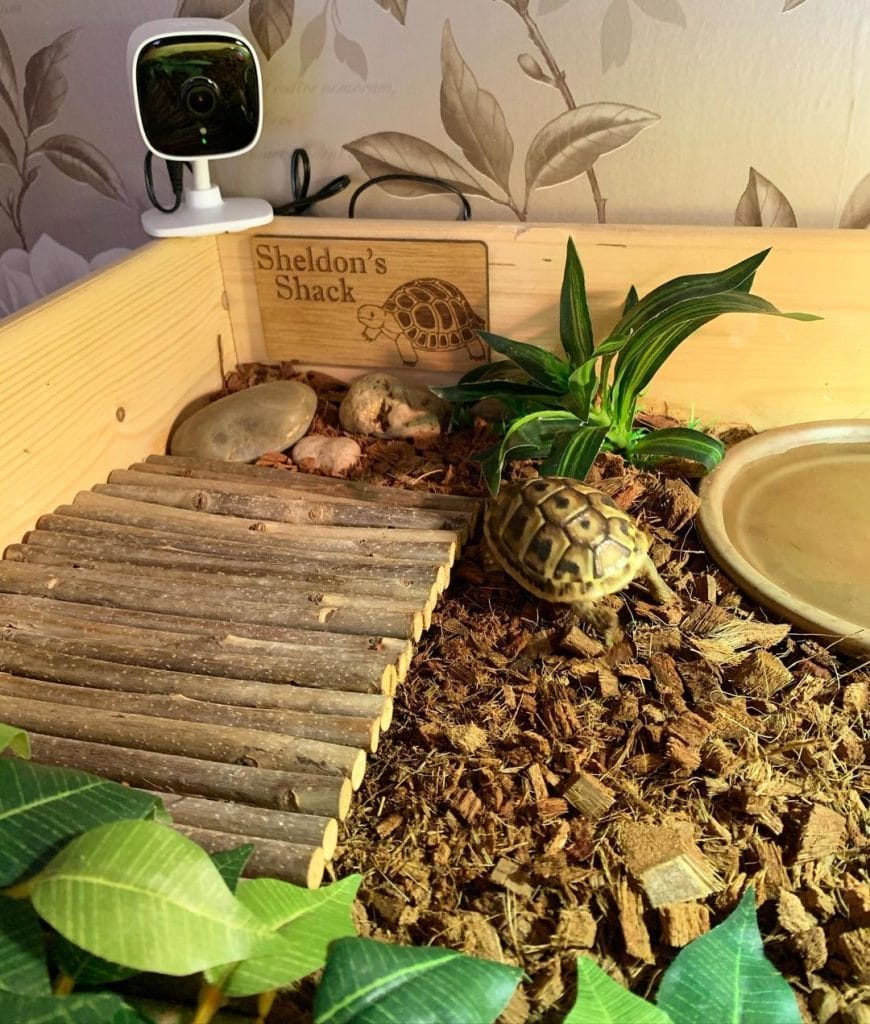
This one has personality right from the nameplate. It uses bark chips for substrate, a wooden bridge for walking enrichment, and a webcam setup to keep an eye on the tortoise. It’s a compact and cozy setup made with care.
What makes it unique:
It’s got a personal touch with the engraved sign and a webcam for live tortoise monitoring.
How to copy this setup:
- Use a small tortoise table with wooden sidewalls.
- Fill it with coconut husk chips or reptile-safe mulch.
- Add a curved log bridge for texture and climbing.
- Place smooth rocks and a shallow water dish.
- Mount a simple webcam in the corner for fun or monitoring.
This Hilarious Turtle Book Might Know Your Pet Better Than You Do

Let’s be real—most turtle care guides feel like reading a textbook written by a sleep-deprived zookeeper.
This one’s not that.
Told from the snarky point of view of a grumpy, judgmental turtle, 21 Turtle Truths You’ll Never Read in a Care Guide is packed with sarcasm, sass, and surprisingly useful insights.
And hey—you don’t have to commit to the whole thing just yet.
Grab 2 free truths from the ebook and get a taste of what your turtle really thinks about your setup, your food choices, and that weird plastic palm tree.
It’s funny, it’s honest, and if you’ve ever owned a turtle who glares at you like you’re the problem—you’ll feel seen.
Corner Tortoise Enclosure Ideas for Tight Rooms
A corner tortoise enclosure uses the one part of a room nothing else wants. Two walls do half the containment work for you.
It also helps thermally. A corner shields the cool end from door drafts, so the gradient between basking spot and cool side stays stable.
10. L-Shaped Corner Tortoise Table With Tucked Hide Box
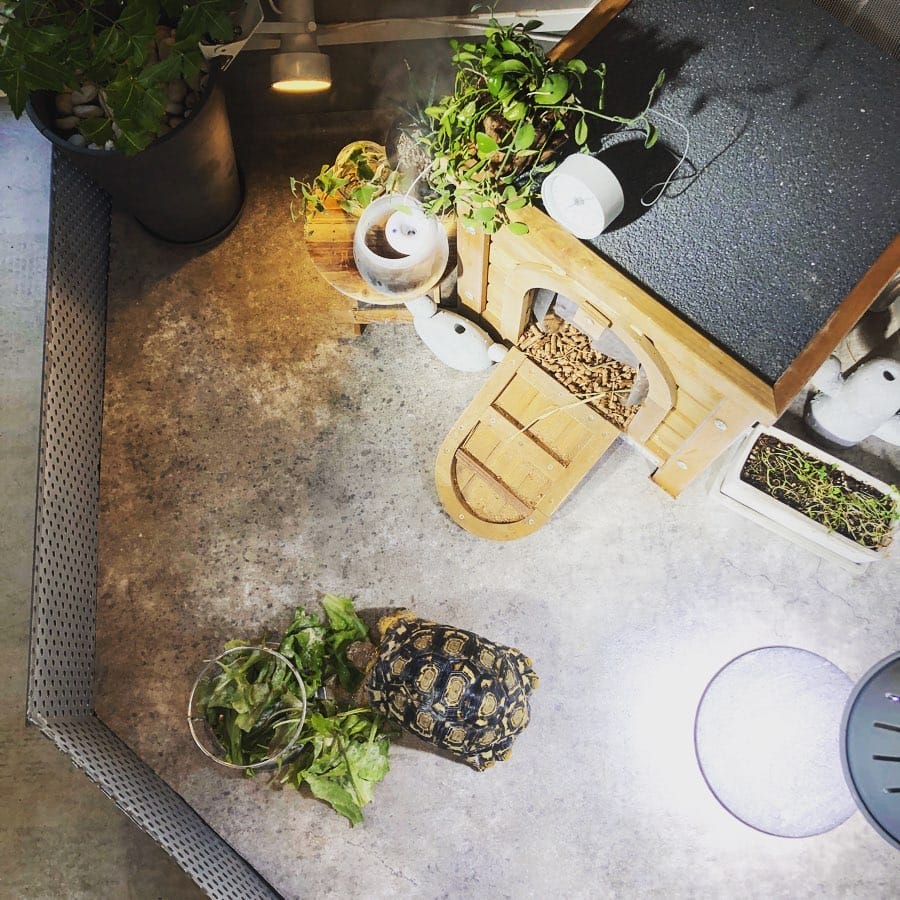
This build wraps around a corner in an L, which gives a long walking run in a footprint that would otherwise be dead floor space. The hide box sits in the short leg, far from the lamp.
What makes it unique:
The L shape forces a genuine temperature gradient. The basking end and the hide end are physically around a bend from each other, so heat does not bleed across.
How to copy this setup:
- Measure both walls and cut two rectangular boxes that meet at 90 degrees.
- Join them with corner brackets and line the whole floor with pond liner (my pick: 10x15 FT 20 Mil HDPE pond liner).
- Put the basking lamp over the long leg and the hide in the short leg.
- Fill with 4 to 6 inches of topsoil and play sand so the walking run is diggable.
- Add a low water saucer at the bend where the tortoise passes most often.
Check the temperature at both ends after 24 hours. You want 100 to 110 degrees F on the basking surface and 70 to 80 degrees F in the hide leg.
11. Triangular Corner Enclosure Built From Two Wall Cleats
The simplest corner build there is. Two lengths of timber screwed to the walls as cleats, one diagonal front board, and a floor. No back or side panels needed.
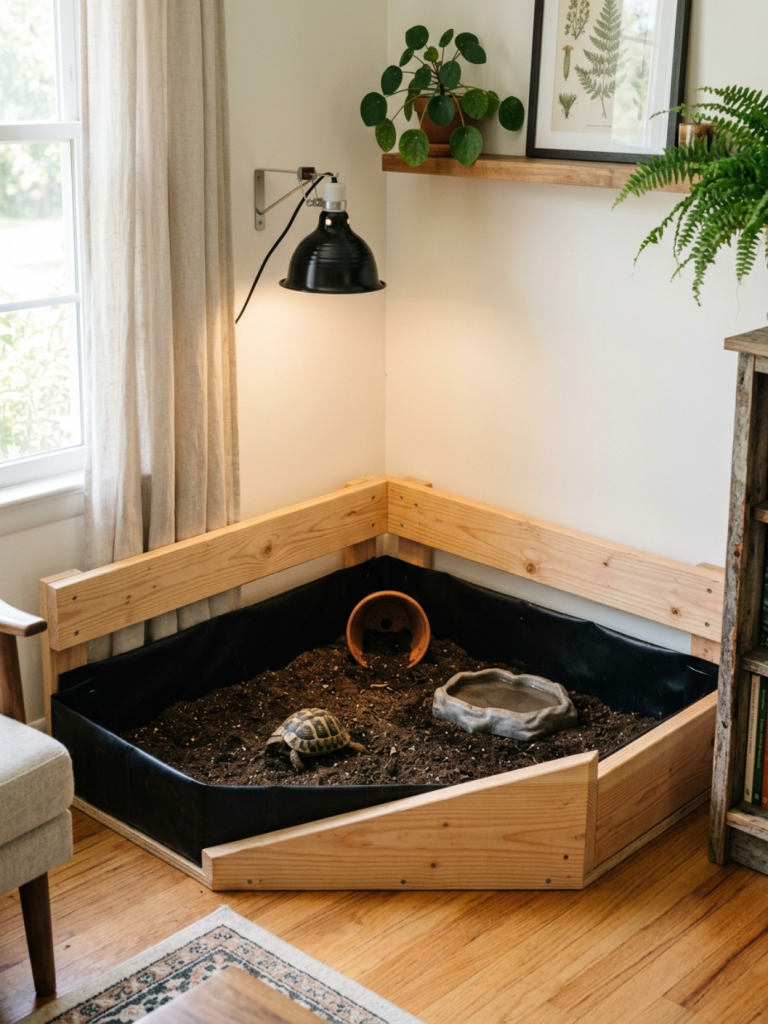
What makes it unique:
It is the cheapest tortoise enclosure on this list because the room supplies two of the four walls. Materials come in under $25 for a small Mediterranean species.
How to copy this setup:
- Screw two 4 inch tall cleats into the studs along both walls at floor level.
- Cut one diagonal front board and screw it to the ends of the cleats.
- Drop in a plywood floor and seal every seam with aquarium-safe silicone.
- Line with pond liner that runs up the painted walls to protect them from substrate moisture.
- Mount a clamp lamp on a shelf bracket above the widest part of the triangle.
Seal the wall-facing edges properly. Damp substrate against drywall will grow mould long before you notice it.
Perfect Wooden Tortoise House For Outdoor & Indoor!
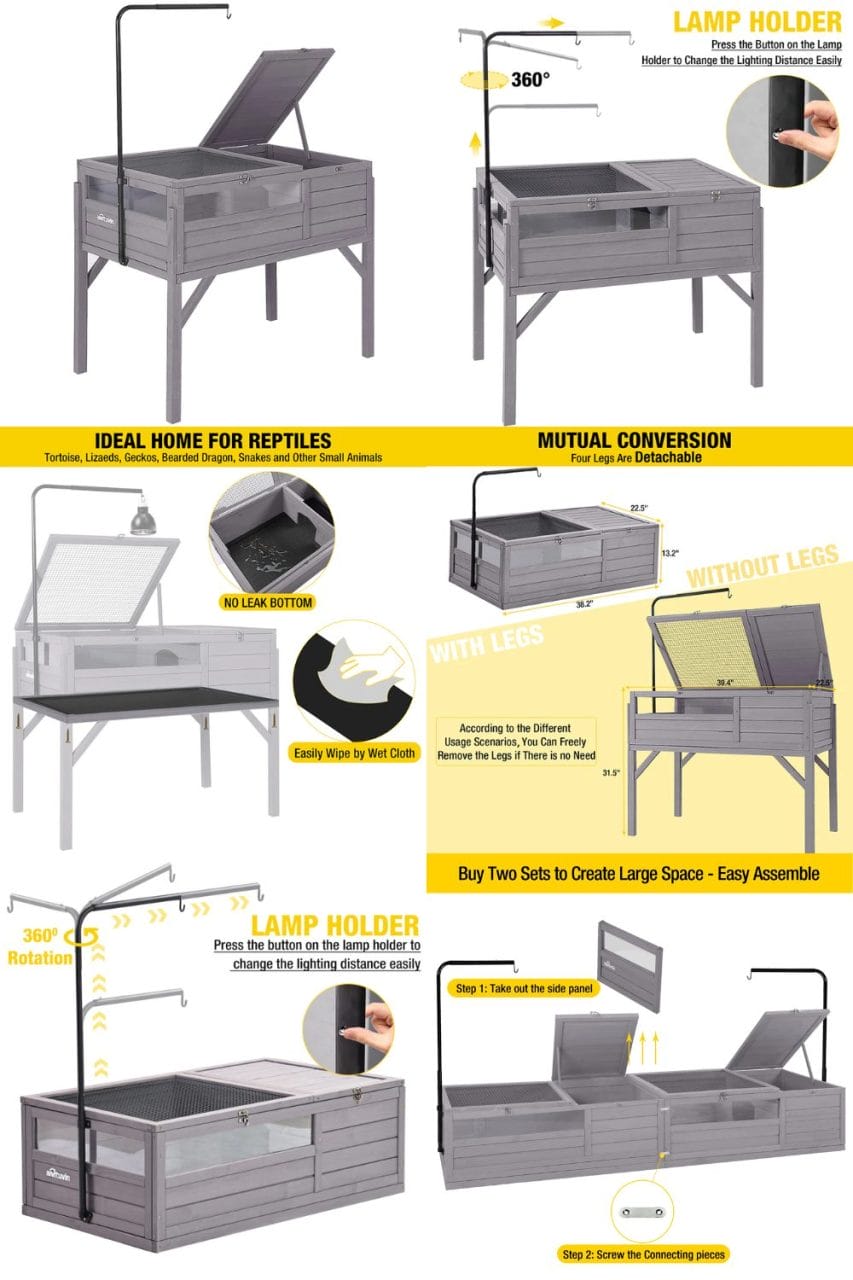
This tortoise house isn’t cheap — but that’s because it’s not your average wooden box.
Built with durable wood, a waterproof liner, and smart design features like a sunbathing area and a hideout zone, the Aivituvin Large Wooden Habitat is made to last.
It’s perfect for tortoises or box turtles, indoors or out. And yep, it even has detachable legs.
If you’re serious about giving your tortoise a safe, comfy home without building one from scratch, this is the one.
👉 Grab the Aivituvin Tortoise House here — it’s currently $10 off.
Hermann Tortoise Enclosure Indoor Setup
Hermann’s tortoises need a proper indoor enclosure with a warm basking zone hitting 100–110°F, a T5 UVB tube (not a coil bulb), and enough floor space to actually roam. These setups are sized and configured specifically for Hermann’s and other Mediterranean tortoises.
12. Naturalistic Wooden Enclosure With Plants and Stones
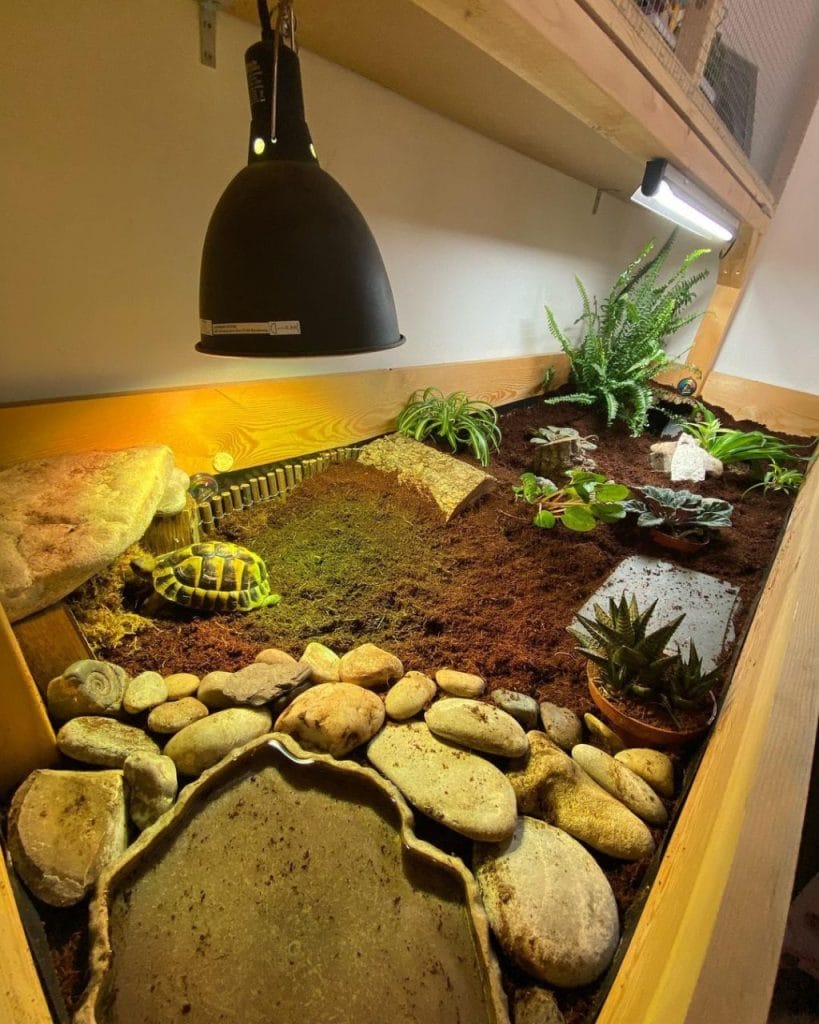
This setup feels like a forest floor. It blends soil, rocks, live plants, and proper lighting to create a rich, natural vibe. The rocks also help wear down nails naturally.
What makes it unique:
It looks like a mini jungle. The lighting, real plants, and rock placements make it feel alive and stimulating.
How to copy this setup:
- Build or buy a deep wooden tortoise table with a tall border.
- Use coconut coir or topsoil as the main substrate.
- Add flat stones for walking paths and decoration.
- Plant safe greens like spider plant or haworthia.
- Set up a wide shallow water dish surrounded by smooth rocks.
- Hang a UVB light and a basking bulb overhead for proper heat and light.
Use a ReptiSun 10.0 T5 HO at 12–18 inches, with a separate basking bulb creating 100–110°F on the rock surface, and a cool end staying 70–80°F.
13. Clean and Stylish Tortoise Table With “Beware” Sign
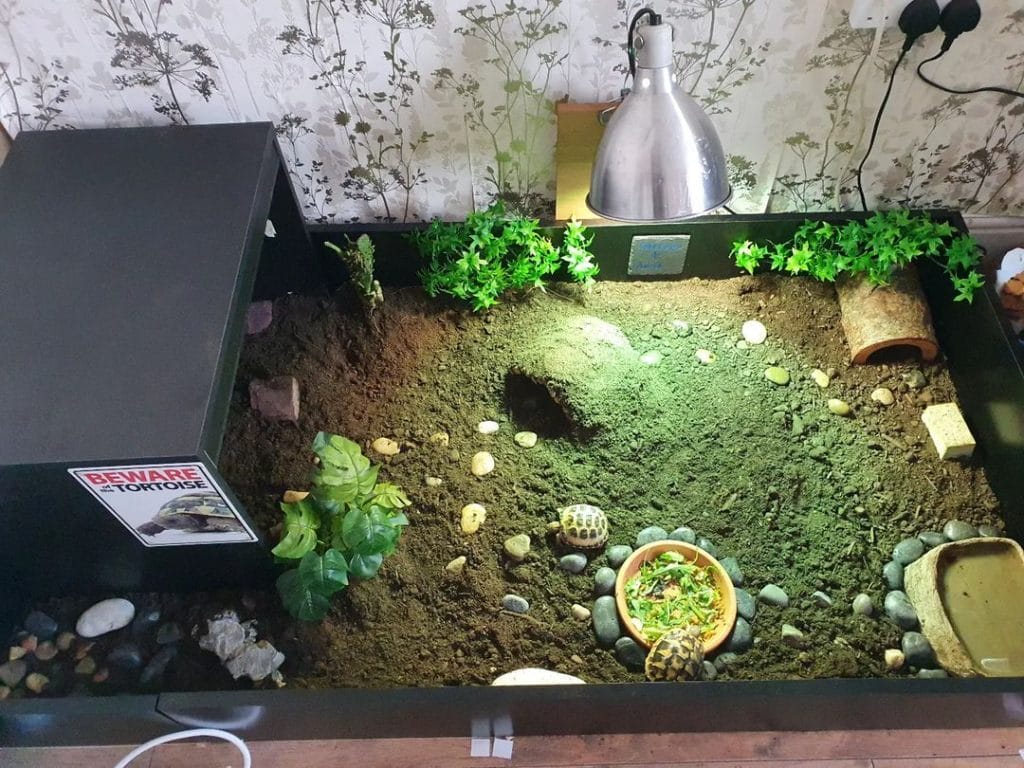
This setup nails both function and looks. It features a clean soil base, live plants, smooth river stones, a large shaded hide, and clear zones for basking, feeding, and water. The “Beware the Tortoise” sign adds a cheeky personality touch.
What makes it unique:
It’s neatly laid out, super organized, and has strong visual zones — each area has a clear purpose.
How to copy this setup:
- Use a tortoise table or repurpose a deep bookshelf frame.
- Add organic topsoil mixed with sand for digging.
- Create a basking zone with a heat lamp and smooth rocks underneath.
- Set up a shaded hide using a wooden box or mini cabinet.
- Add fake or safe live plants for greenery.
- Use a shallow plant saucer for the water bowl.
14. Balanced Indoor Habitat With Shade, Light, and Plants
This tortoise table offers everything in moderation: good lighting, natural plants, cozy hides, and plenty of walking space. The curved bamboo fencing around the inside gives it a warm, tropical touch.
What makes it unique:
It’s simple but balanced — sunny spots, shady corners, and a full feeding and water zone.
How to copy this setup:
- Use a large wooden enclosure with a waterproof liner.
- Create height differences with mounds of soil.
- Place real or fake tortoise-safe plants for cover.
- Add a wide saucer for water with stones to prevent tipping.
- Use a basking bulb and UVB tube mounted above.
15. Log Tunnel Paradise With Real Plants and Stones
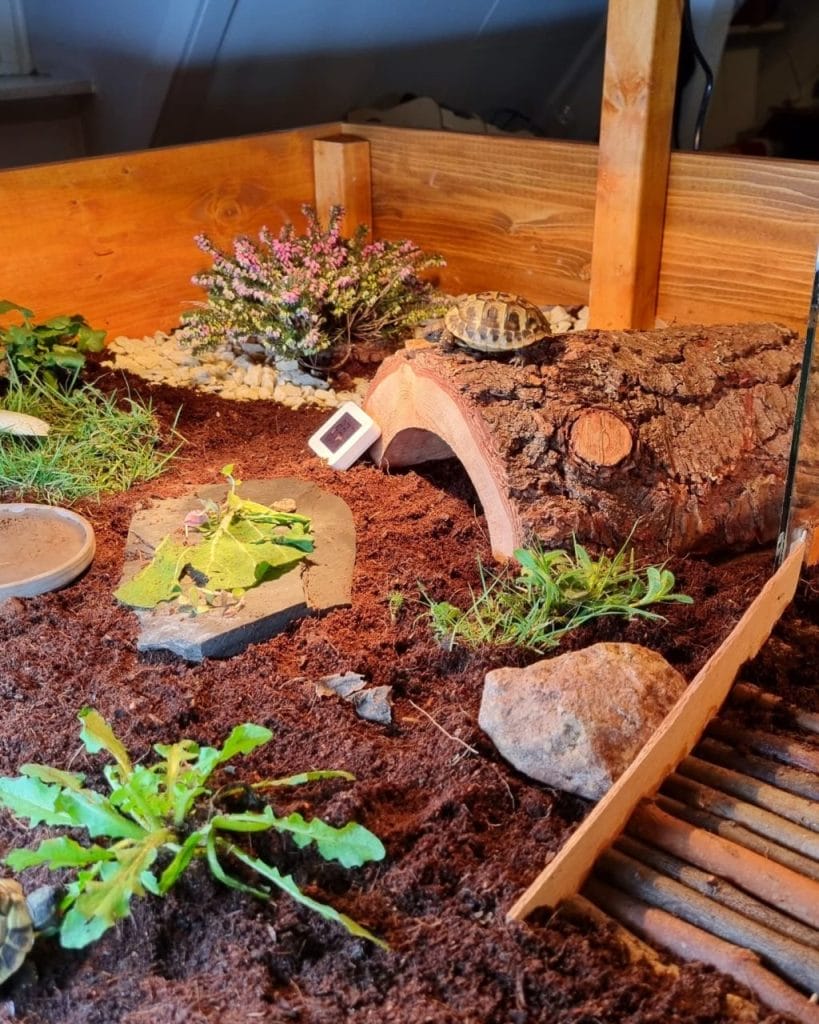
This naturalistic setup blends bark substrate with wild greens, flower plants, smooth stones, and a log tunnel. It even has a thermometer in the middle to monitor the environment. The tortoise looks totally at home.
What makes it unique:
It’s like a slice of nature — everything looks alive, useful, and well-spaced.
How to copy this setup:
- Use coco coir or topsoil mixed with orchid bark.
- Add real tort-safe greens like dandelions or clover.
- Place a large natural log tunnel for shelter and climbing.
- Decorate with rocks and safe flowering plants.
- Insert a digital thermometer at tortoise level to track temps.
You should have: a digital thermometer at tortoise level for ambient temp, an infrared temp gun for basking surface, and a hygrometer for humidity. Temps at human eye level are meaningless.
Sulcata Tortoise Enclosure Indoor Setup
Sulcatas grow to 100+ lbs. Most “large” tortoise enclosures are still too small. These sulcata indoor setups prioritize serious floor space, deep bedding for burrowing, and the temperature gradients a sulcata actually needs.
16. Straw-Filled Indoor Tortoise Room With Heater
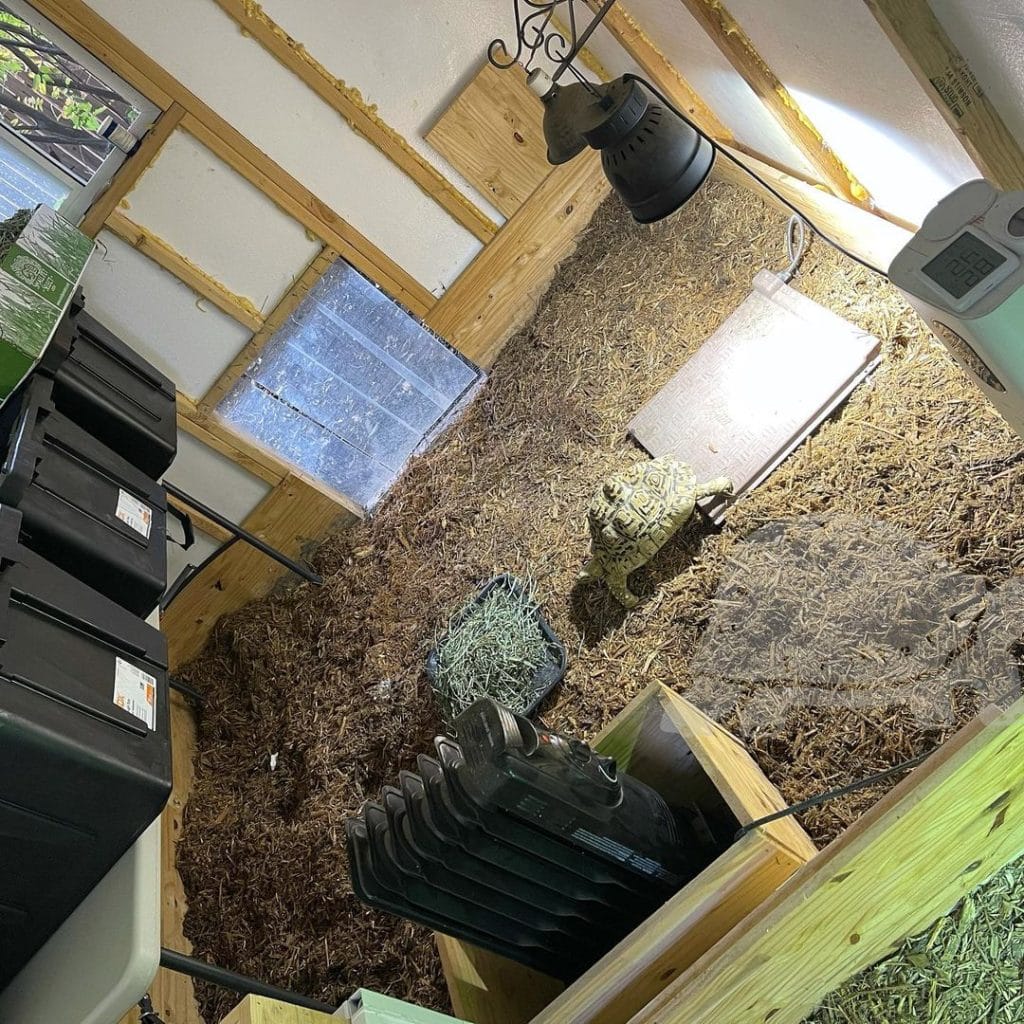
This one’s a full walk-in tortoise room, set up like a cozy stall. It’s designed with deep mulch bedding, hay piles, a heat pad, hanging lamps, and even a space heater. It’s clearly made for a big tortoise like a sulcata or leopard tortoise.
What makes it unique:
It feels like a mini stable for a tortoise — warm, breathable, and fully climate-managed.
How to copy this setup:
- Choose an unused shed, basement, or spare room.
- Line the floor with deep mulch or straw bedding.
- Add a hay pile in a tray for feeding.
- Mount a ceramic heat emitter or hanging lamp above a tile.
- Place a space heater in a corner (with safety clearance and a thermostat).
- Keep a thermometer nearby to monitor temps.
Sulcatas need a 70–90% grass/hay diet, lower humidity, and specific temperature gradients. Large enclosures may need multiple heat sources. See our heating guide for wattage calculations.
17. Giant Coffee Table Tortoise Kingdom
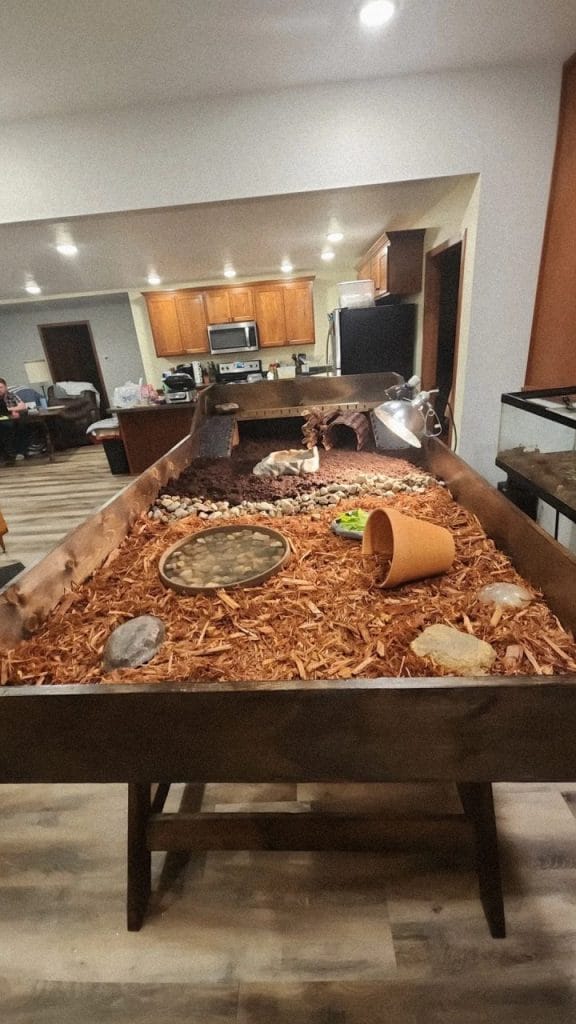
This setup turns a large wooden table into a tortoise paradise, with different zones for basking, burrowing, and roaming. There’s a water dish, a hide, bark chips, and even a dirt mound for digging.
What makes it unique:
It blends right into the living room. Looks like furniture — but it’s actually a fully decked-out tortoise habitat.
How to copy this setup:
- Build a deep wooden table with tall sides for safety.
- Create zones with soil, mulch, pebbles, and hides.
- Add a ceramic heat lamp on one end.
- Place a large water bowl and climbing features like stones or logs.
- Keep it in a bright, open space to stay connected with your tortoise.
18. Galvanized Jungle Tank
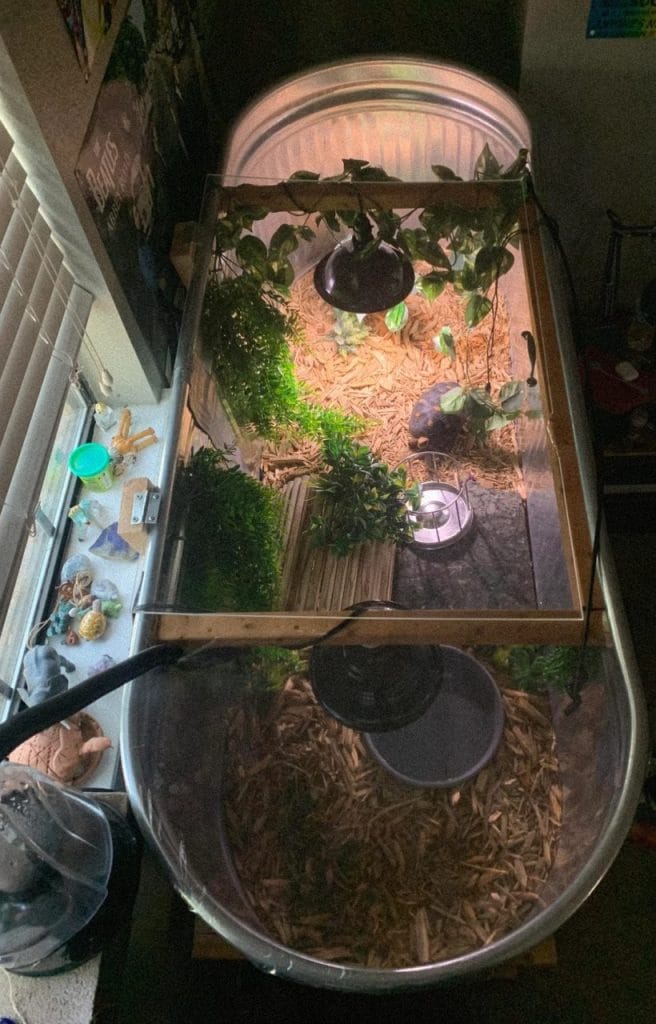
This enclosure uses a metal stock tank with a clear top and jungle-style greenery to create a lush home. The lighting brings out the plants and creates a cozy vibe.
What makes it unique:
It feels like a tropical garden in a bathtub. The mix of real and fake plants makes it feel wild but easy to maintain.
How to copy this setup:
- Use a galvanized stock tank or horse trough as the base.
- Add a clear acrylic or mesh lid to keep the tortoise safe.
- Mix in fake vines, leafy plants, and wood chips.
- Hang a dome heat lamp above.
- Include a basking spot, water dish, and feeding area.
Russian Tortoise Enclosure Indoor Setup
Russian tortoises (also sold as Horsfield’s tortoises) are steppe animals, and steppe animals dig. A shallow tortoise table that suits a Hermann’s will not hold one.
Plan for a dry setup, a deep substrate they can actually tunnel into, and sides they cannot climb. Everything else follows the standard Mediterranean recipe in our Russian tortoise care guide.
19. Deep-Substrate Russian Tortoise Burrow Table
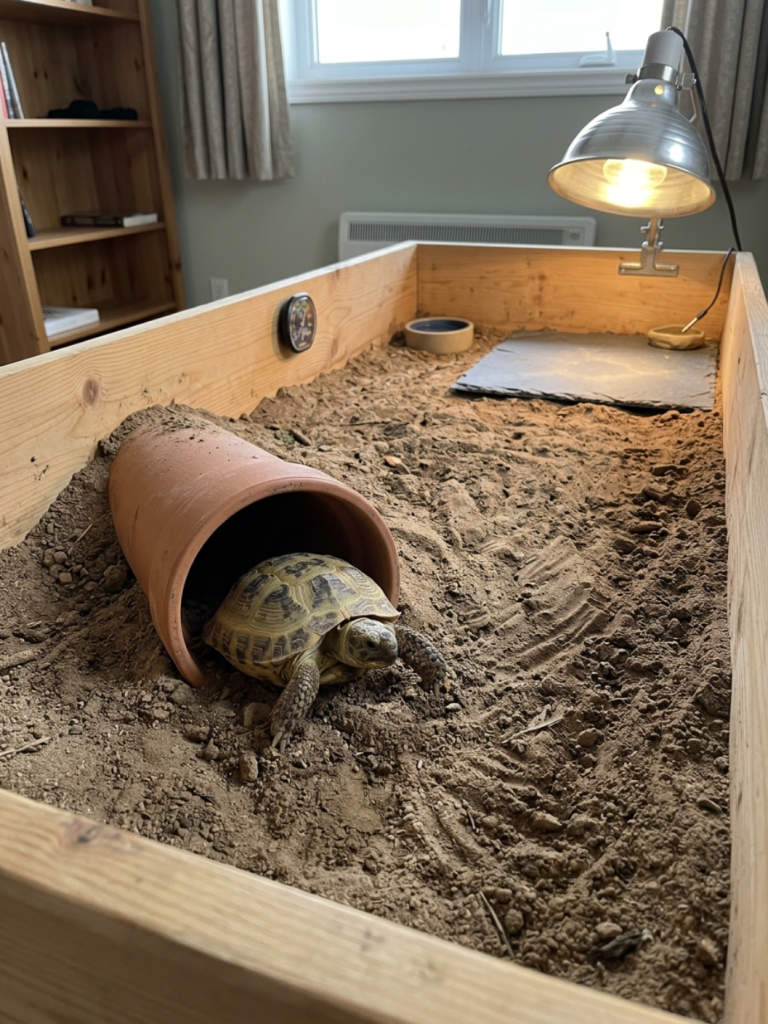
A standard 4×2 foot tortoise table with one crucial change: the sides are 12 inches tall instead of 6, and the substrate goes in 8 inches deep. The tortoise gets to build its own burrow instead of sitting on top of the floor.
What makes it unique:
Burrowing is not enrichment for a Russian tortoise, it is thermoregulation. A tortoise that can dig down to a cooler layer stops pacing the walls.
How to copy this setup:
- Build or buy a 4×2 foot table with sides at least 12 inches tall.
- Mix substrate 60/40 topsoil to play sand so tunnels hold their shape instead of collapsing.
- Pack the mix down slightly damp, then let the surface dry out.
- Bury a length of clay drainage pipe at an angle to give a starter burrow.
- Keep the basking end lamp well clear of the burrow entrance.
Substrate that is too dry crumbles and too wet causes shell rot. Damp enough to hold a shape when squeezed, dry on top, is the target.
20. Escape-Proof Russian Tortoise Table With Overhang Lip
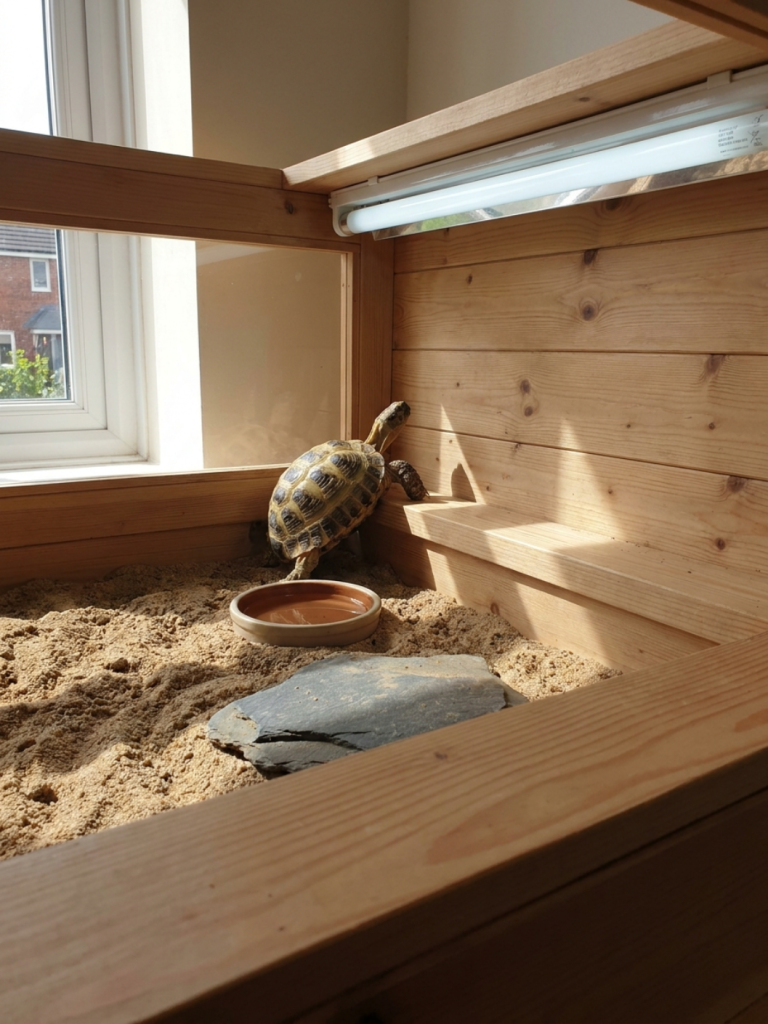
Same table, one addition: a 2 inch lip running around the inside of the top edge, pointing inward. Russian tortoises are the best climbers of the common pet species and they will scale a corner.
What makes it unique:
The inward lip defeats the corner-wedging trick. Most keepers only learn they needed it after finding the tortoise behind the sofa.
How to copy this setup:
- Rip a 2 inch strip of timber and screw it flush along the inside top edge of every wall.
- Pay extra attention to the corners, where climbing attempts always start.
- Keep hides, rocks, and water dishes at least 6 inches from any wall.
- Never place a ramp or log where it can act as a launch point.
- Check the enclosure after any redecoration, since one moved rock is all it takes.
Red Foot Tortoise Indoor Enclosure: Closed Chamber Builds
Red foots are tropical, and that flips every rule on this page. An open tortoise table vents humidity straight into your living room and leaves them at 30 percent when they need 70 to 80.
The answer is a closed chamber: solid sides, a mostly sealed top, ventilation you control rather than ventilation the room decides. Pair it with the feeding side of our red footed tortoise care guide.
21. Closed Chamber PVC Frame With Clear Panels
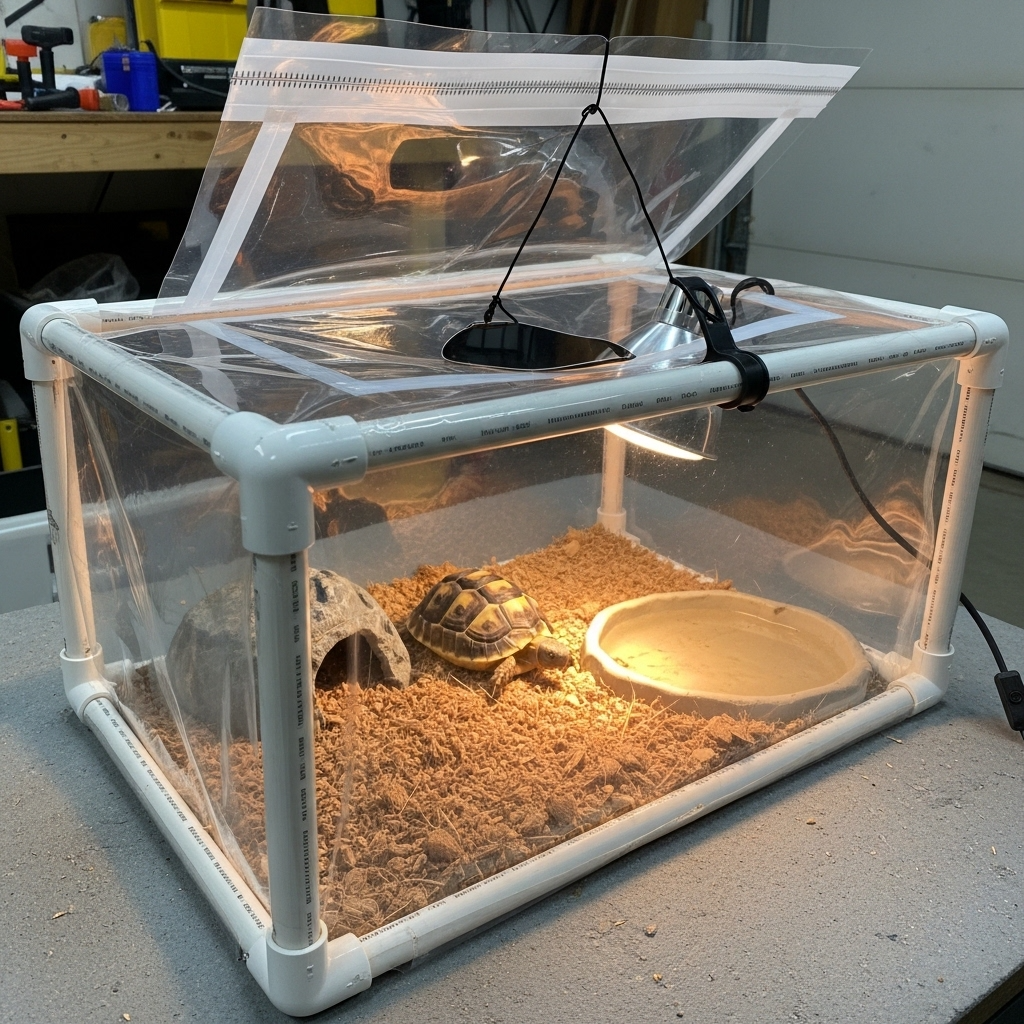
A PVC pipe skeleton wrapped in clear corrugated plastic. Light, cheap, and it holds humidity far better than any open table because there is nowhere for the moist air to escape.
What makes it unique:
You can dial the humidity by how much of the top you leave open. Two adjustable vent panels give you 60 percent or 85 percent from the same build.
How to copy this setup:
- Build a rectangular PVC frame using elbow and tee fittings, no glue needed at first.
- Cut clear corrugated plastic panels and zip-tie them to all four sides.
- Leave the top mostly covered with two small openings for the lamps.
- Use damp coconut coir at least 4 inches deep as the humidity reservoir.
- Add a hygrometer at tortoise level, not on the wall above it.
Closed chambers need a ceramic heat emitter or a deep heat projector rather than a bright basking bulb, otherwise the enclosed light keeps the tortoise awake.
22. Sealed Wooden Vivarium With Sliding Glass Front
The furniture-grade version of a closed chamber. A sealed plywood box with sliding glass doors on the front, a mesh vent strip at each end, and the lighting mounted inside the roof.
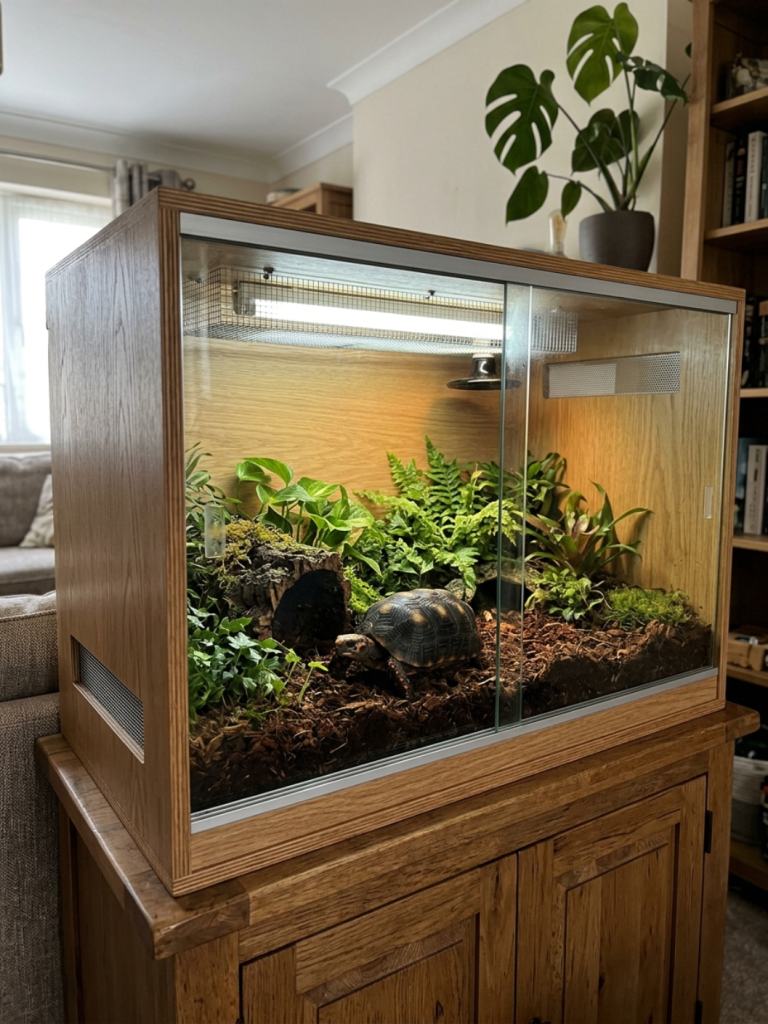
What makes it unique:
It is the only build here that holds 80 percent humidity and still looks like a piece of furniture. The sliding front also makes daily spot-cleaning a two-second job.
How to copy this setup:
- Build a plywood box and seal every internal seam with aquarium-safe silicone.
- Fit a glass runner track to the front and cut two sliding panes.
- Cut a vent strip low on one end and high on the opposite end to create passive airflow.
- Mount the UVB tube and the heat emitter inside the roof, behind a guard.
- Fill with 5 to 6 inches of damp coco coir and cypress mulch, and add a large humid hide.
Run it empty for three days with a hygrometer before the tortoise moves in. Adjust the vent strips until it holds steady between 70 and 80 percent.
Desert Tortoise Indoor Enclosure Setup
A quick legal note first. Desert tortoises are protected in the United States, so in Arizona, California, and Nevada they come through state adoption programs, never a pet shop.
Indoors, they are the driest setup on this page. Humidity above 50 percent is a respiratory infection waiting to happen, and the burrow matters more than the basking spot.
23. Arid Indoor Burrow Box With Sand-Soil Mix
A large open table with a plywood burrow box buried under a mound of packed sand and soil. The tortoise sleeps in the dark, cool box and comes out to bask.
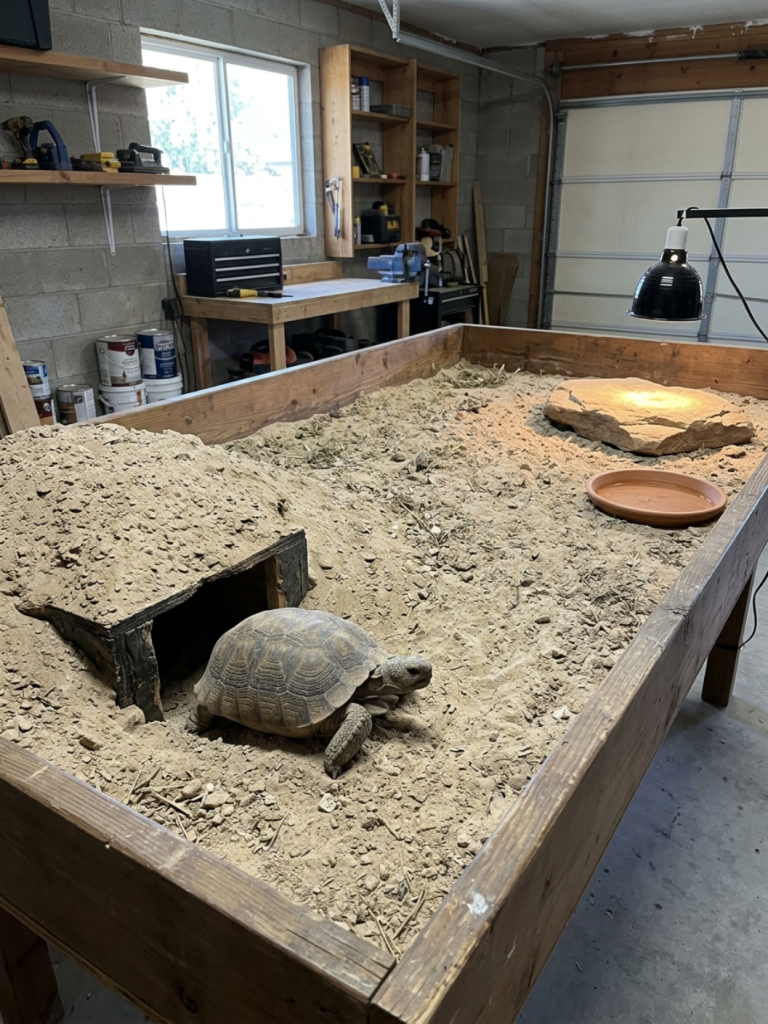
What makes it unique:
Most indoor desert tortoise setups fail because they offer a hide instead of a burrow. A burrow is dark, snug, and cooler than the room, and that difference is what stops winter pacing.
How to copy this setup:
- Build the biggest table your room allows, 8×4 feet if you can manage it.
- Make a plywood box roughly twice the tortoise’s length with one low entrance.
- Bury it under a packed mound of 70/30 play sand and topsoil.
- Keep the whole enclosure dry and offer water in a shallow saucer instead of misting.
- Put the basking lamp at the far end so the burrow stays 65 to 75 degrees F.
Never use a heat mat under a desert tortoise. They sense heat from above and will sit on it until they burn.
Aesthetic & Furniture-Style Indoor Tortoise Enclosures
These are the setups people mean when they search for a cute tortoise enclosure or a modern one. They do not look like reptile tanks, they look like home décor.
Glass-sided tables, furniture-grade builds, and naturalistic terrariums that genuinely belong in a living room. If you want the full salvaged-furniture route, we cover it in 10 ways to turn old furniture into a tortoise enclosure.
24. Premium Glass Enclosure With Grasses and Rocks
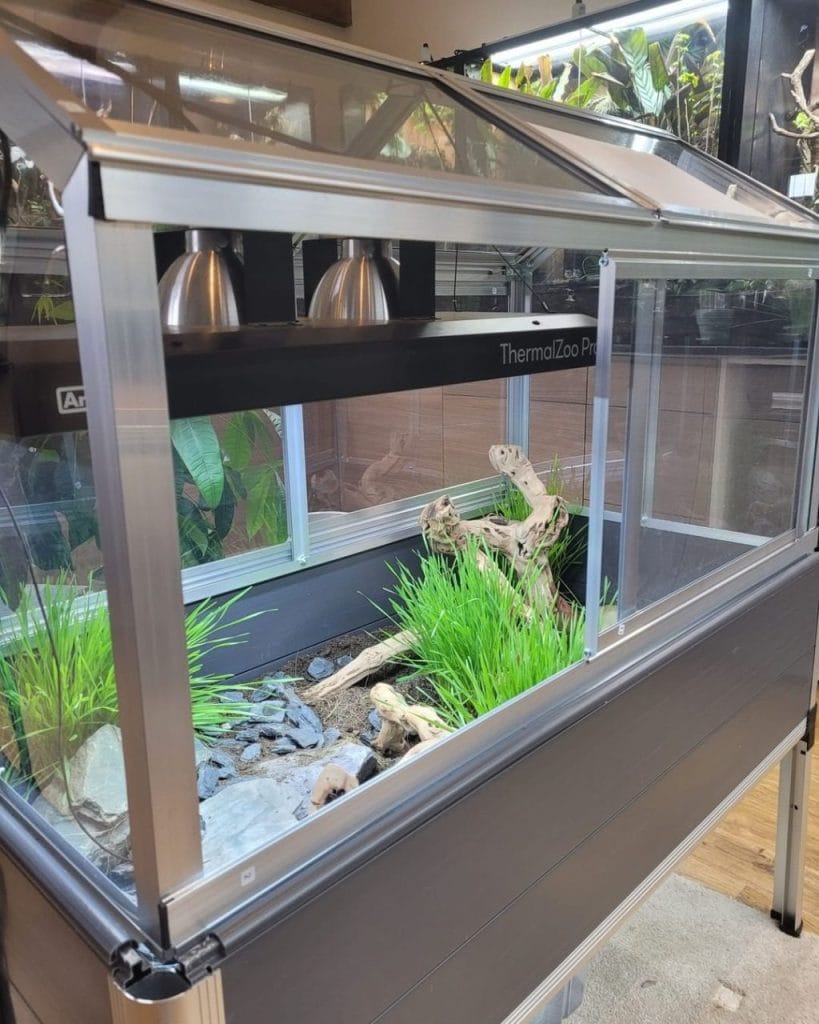
This is a modern tortoise tank done right. Fully enclosed with glass and metal framing, it includes natural rocks, driftwood, thick grass patches, and dual heat lamps. It’s clean, escape-proof, and looks like a museum terrarium.
What makes it unique:
It’s sleek, escape-proof, and visually stunning. Ideal for showing off your tort in a stylish way.
How to copy this setup:
- Get a large, well-ventilated glass terrarium (like a Zen Habitats or similar).
- Use soil or coconut coir substrate.
- Add real or artificial ornamental grass and small logs.
- Place flat rocks to create a climbing path.
- Install UVB and basking bulbs overhead.
- Keep it in a bright room but avoid direct sun through the glass.
Glass terrariums can trap humidity and heat dangerously. You need proper ventilation (mesh top preferred) and careful temperature monitoring. UVB doesn’t penetrate glass — the light must be inside or over mesh.
25. Indoor Jungle Vibes With Real Grass and Flowers
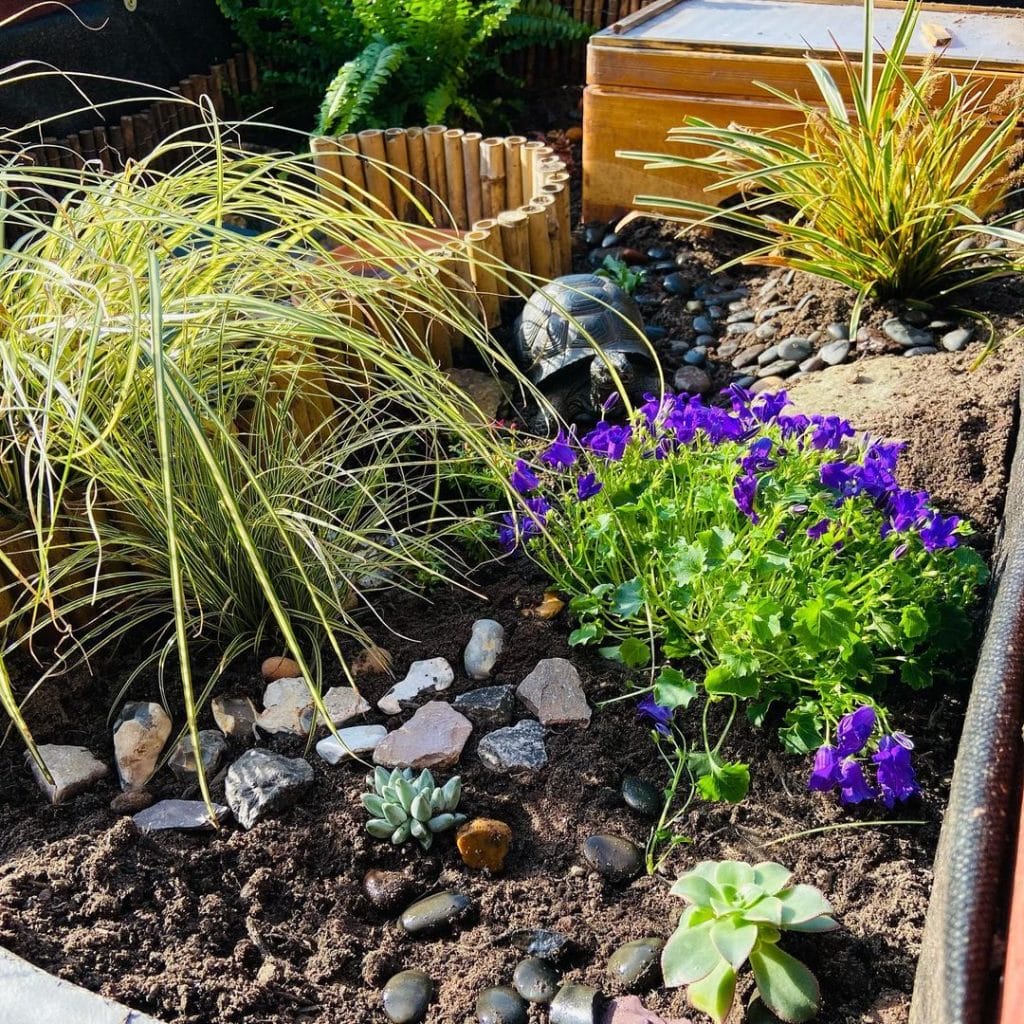
This setup looks like a slice of backyard brought indoors. With tall grasses, succulents, blooming flowers, and smooth stones, it’s rich in texture and color. You can tell the tortoise has plenty of hiding spots and enrichment here.
What makes it unique:
It feels like a wild patch of earth. The living plants and curved bamboo wall add a natural and peaceful touch.
How to copy this setup:
- Choose a large raised bed or tortoise table.
- Use organic topsoil mixed with sand as substrate.
- Add real tortoise-safe plants like violas, spider grass, and ferns.
- Place smooth rocks and natural wood to create micro-habitats.
- Add a basking zone and hideout tucked among the foliage.
26. Stylish Tortoise Table That Doubles as Living Room Furniture
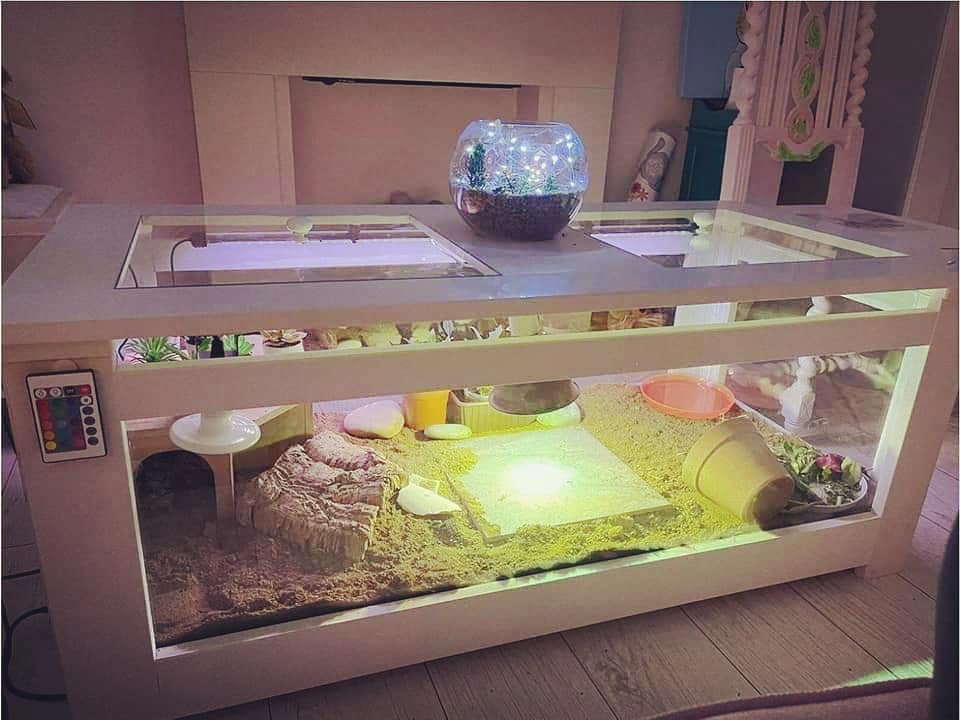
This one’s both a habitat and a decor piece. It’s a glass-sided, fully enclosed tortoise table with built-in lighting and even a decor bowl on top. The enclosure looks great in a living room and doesn’t scream “reptile tank.”
What makes it unique:
It’s furniture-grade — blends into the home while still being functional for the tortoise.
How to copy this setup:
- Build or buy a raised glass tortoise table with wood trim.
- Use sand-loam mix as the base.
- Add hides, tunnels, basking rocks, and shallow bowls.
- Install mounted UVB and basking bulbs inside the lid.
- Keep decor minimal and add a plant bowl or lamp on top.
27. Sleek Urban Jungle Table
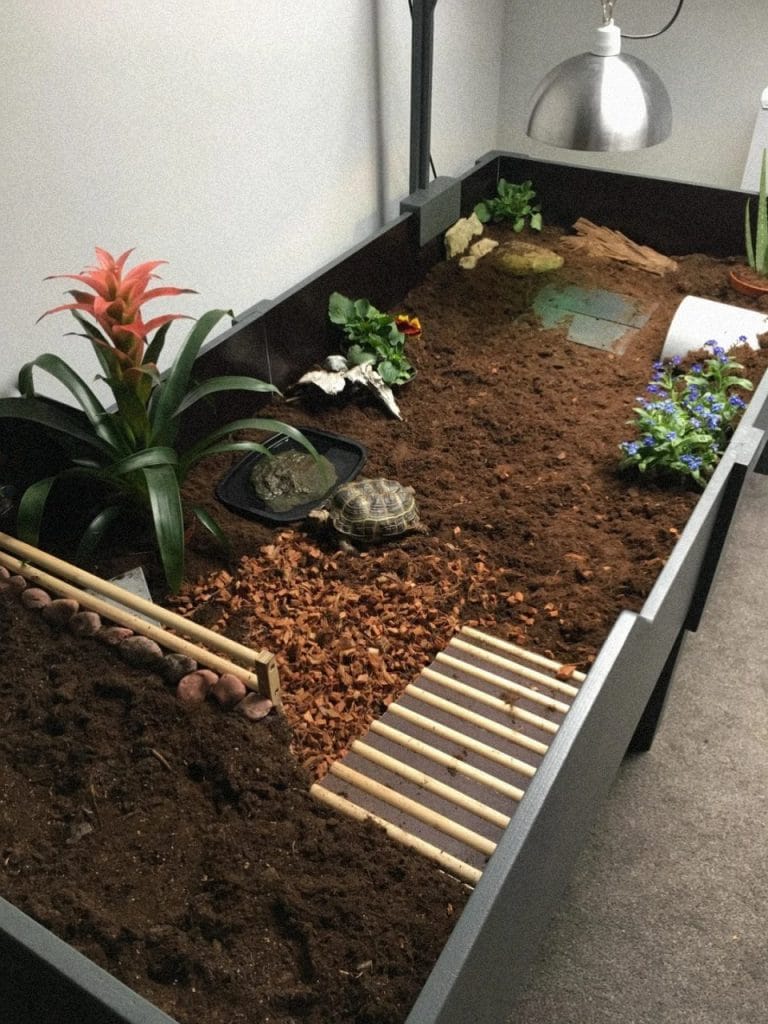
This setup has a clean black base with a mix of soil, bark, bridges, plants, and flowers. It’s like a tiny landscape in your room with thoughtful zones and décor.
What makes it unique:
Looks like a mix of science lab and rainforest garden. Modern, colorful, and very well thought out.
How to copy this setup:
- Use a long wooden or plastic table with deep sides.
- Divide it into zones: soft soil, bark paths, and feeding spots.
- Use wooden slats or bamboo pieces as bridges.
- Decorate with real or fake flowers and leafy greens.
- Hang a bright dome lamp overhead for basking.
Glass vs Plastic vs Wood: Which Indoor Tortoise Enclosure Material Wins?
Almost every build on this page is one of three materials, and the choice decides your ventilation, your humidity, and how long the thing lasts.
| Material | Best for | Ventilation | Humidity control | Watch out for |
|---|---|---|---|---|
| Wood (tortoise table) | Hermann’s, Russian, Greek, desert | Excellent, open top | Poor, dries out fast | Needs sealing or the substrate rots the base |
| Glass (terrarium) | Display setups, small species | Poor unless the top is mesh | Good, traps moisture | UVB will not pass through glass, and clear walls stress some tortoises |
| Plastic (tub, stock tank, coroplast) | Red foots, hatchlings, closed chambers | Controllable, you cut the vents | Excellent | Thin tubs bow outward once substrate goes 6 inches deep |
Short version: wood for dry Mediterranean and arid species, plastic for anything tropical or a closed chamber, glass only when you want a display piece and can solve ventilation.
For hatchlings the answer is almost always plastic, and we go deeper on that in our baby tortoise enclosure ideas.
Frequently Asked Questions
What size should an indoor tortoise enclosure be?
For most Mediterranean tortoises (Hermann’s, Russian, Greek), the minimum is 4×2 feet of floor space — bigger is always better. For a sulcata, start with at least 8×4 feet indoors, knowing they’ll eventually need a room or outdoor space as they grow to 100+ lbs. Hatchlings can start smaller but will need upgrades within 1–2 years.
What is the best substrate for an indoor tortoise enclosure?
A 50/50 mix of topsoil and play sand is the most versatile option and works for most species. Coco coir is a good alternative — it holds humidity well and is easy to spot-clean. Avoid gravel, reptile carpet, or wood shavings. Substrate depth matters: aim for at least 3–4 inches so your tortoise can partially burrow.
Can I keep a Hermann’s tortoise in an apartment?
Yes. Hermann’s tortoises are one of the best species for apartment living. A 4×2 foot tortoise table fits on a bookshelf or against a wall, and they don’t produce much noise or smell. You need a T5 UVB tube, a basking lamp hitting 100–110°F, and proper substrate. That’s it.
Can I keep a sulcata tortoise indoors long-term?
Only when they’re small. Sulcatas grow to 100+ lbs and need outdoor space as adults. As juveniles (under 10 lbs), a large indoor pit or room setup works fine. Plan for outdoor housing once they hit 6–8 inches. A cinder block basement pit is the best long-term indoor option if outdoor space isn’t available year-round.
Can I build a DIY tortoise enclosure at home?
Yes, and it’s usually better than buying one. A basic wooden tortoise table made from pine boards and plywood costs $30–60 in materials and can be built in an afternoon. Cinder block pits cost even less and are adjustable. The equipment (UVB light, basking lamp, thermostat) is where the real budget goes — don’t cut corners there.
What lighting does an indoor tortoise enclosure need?
Every indoor tortoise enclosure needs two things: a T5 HO UVB tube (like the Arcadia 12% or Zoo Med ReptiSun 10.0) and a separate basking bulb. The UVB should run the full length of the enclosure. The basking spot should hit 100–110°F surface temperature on a flat slate or ceramic tile. Replace UVB bulbs every 12 months even if they still light up — the UV output degrades before the visible light does.
What’s the difference between a tortoise table and a glass tank?
A tortoise table is an open-top wooden enclosure — better airflow, easier access, and usually cheaper to build. Glass tanks have ventilation issues (heat and humidity build up) and UVB doesn’t penetrate glass, so the bulb must be inside or over a mesh top. For most tortoise species, a wooden tortoise table is the better choice. Glass works if ventilation is properly handled and it’s large enough.
What is a closed chamber tortoise enclosure?
A closed chamber has solid sides and a mostly sealed top, so you control the humidity instead of the room controlling it. It is the standard build for tropical species like red foots and for hatchlings of any species, which dehydrate far faster than adults. Open tortoise tables are the opposite and suit dry Mediterranean and arid species.
Do Russian tortoises need a different enclosure than Hermann’s?
Same floor space, different depth. Russian tortoises dig hard, so they need 8 inches of substrate rather than 3 or 4, and taller sides with an inward lip because they climb better than any other common pet tortoise. A setup that safely holds a Hermann’s will often not hold a Russian.
Can I put a tortoise enclosure in a corner of the room?
Yes, and it is usually the best spot in a small room. Two walls block drafts and stabilise the cool end, and an L-shaped or triangular build turns dead floor space into a walking run. Just seal the wall-facing edges so damp substrate never touches drywall.

About Author
Muntaseer Rahman started keeping pet turtles back in 2013. He also owns the largest Turtle & Tortoise Facebook community in Bangladesh. These days he is mostly active on Facebook.