How To Determine Snapping Turtle Gender?

This post was created with help from AI tools and carefully reviewed by a human (Muntaseer Rahman). For more on how we use AI on this site, check out our Editorial Policy.
So you’ve got a snapping turtle and you’re trying to figure out if it’s a boy or a girl.
Maybe you’re thinking about breeding them, or maybe you just want to know if “Steve” is actually “Stephanie.”
Either way, sexing a snapping turtle can feel like solving a mystery when you’re new to this.
Here’s the good news: male snapping turtles have longer, thicker tails and curved plastrons (bottom shells), while females have shorter tails and flat plastrons.
And once you know where to look, it’s actually pretty straightforward.
Why Gender Even Matters (Besides Avoiding Awkward Name Changes)
Look, I get it.
If you’re just keeping one turtle as a pet, gender might not seem like a big deal.
But here’s where it gets interesting: if you’re planning to breed, you need to know who’s who.
And if you find your “male” turtle laying eggs one day, well… surprise!
Trust me, it’s better to know upfront.
The Two Types of Snapping Turtles (And Why It Matters)
Before we dive into the gender stuff, let’s get clear on what kind of snapper you’ve got.
There are two main types:
Common Snapping Turtle (Chelydra serpentina)
This is your typical “I found it in the pond” snapping turtle.
They’re everywhere in the eastern United States and can grow to about 8-20 inches.
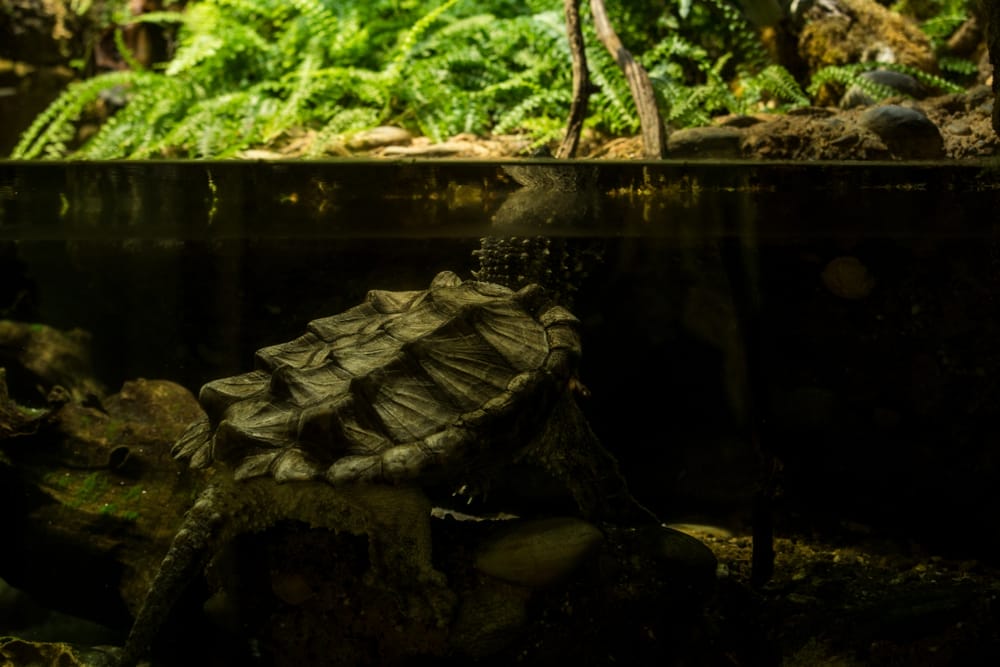
Alligator Snapping Turtle (Macrochelys temminckii)
These are the absolute units of the snapping turtle world.
They’ve got those crazy ridges on their shells that look like dinosaur armor, and males can hit 110 kg (220+ pounds).
No, that’s not a typo.
The gender determination methods work for both types, but alligator snappers have more dramatic size differences between males and females.
This Hilarious Turtle Book Might Know Your Pet Better Than You Do

Let’s be real—most turtle care guides feel like reading a textbook written by a sleep-deprived zookeeper.
This one’s not that.
Told from the snarky point of view of a grumpy, judgmental turtle, 21 Turtle Truths You’ll Never Read in a Care Guide is packed with sarcasm, sass, and surprisingly useful insights.
And hey—you don’t have to commit to the whole thing just yet.
Grab 2 free truths from the ebook and get a taste of what your turtle really thinks about your setup, your food choices, and that weird plastic palm tree.
It’s funny, it’s honest, and if you’ve ever owned a turtle who glares at you like you’re the problem—you’ll feel seen.
Four Dead Giveaways: How To Tell Male From Female
1. The Tail Test (Easiest Method)
This is hands-down the most reliable way to sex a snapping turtle.
Males have long, thick tails that extend well past the midpoint of their shell.
Females? Short and thin tails.
It’s like comparing a baseball bat to a pencil.
The difference is so obvious once you’ve seen both that you’ll wonder how you ever missed it.
2. The Cloaca Location (The “Vent” Position)
Okay, this sounds weird, but stay with me.
The cloaca is that opening on the underside of the tail where… well, everything happens.
Mating, egg-laying, bathroom business—all through one opening.
Nature is efficient like that.
In females, the cloaca sits close to the plastron (the bottom shell), almost right at the base of the tail.
In males, it’s way down toward the tip of that long tail.
Why? Because males need their reproductive organ to reach the female during mating, so it’s positioned further out.
Makes sense when you think about it.
3. The Plastron Shape (Bottom Shell Check)
Flip that turtle over (carefully—more on that later) and look at the bottom shell.
Males have a curved, almost concave plastron.
It’s like someone took a scoop out of it.
Females have flat plastrons, sometimes even slightly domed.
The male’s curved shell helps him stay balanced on top of the female’s back during mating.
Evolution thought of everything.

4. Size and Weight (But Don’t Rely On This Alone)
Generally speaking, male snapping turtles grow bigger than females.
For common snappers:
| Gender | Carapace Length | Weight |
|---|---|---|
| Male | 10-20 inches | 6-22 kg (13-48 lbs) |
| Female | 6.5-18 inches | 4-16 kg (9-35 lbs) |
For alligator snappers, the difference is even more dramatic:
| Gender | Carapace Length | Weight |
|---|---|---|
| Male | Can exceed 30 inches | 70-80 kg, up to 110 kg (220+ lbs) |
| Female | Typically under 22 inches | 25-50 kg (55-110 lbs) |
But here’s the catch: size can be misleading.
A sick male might be smaller than a healthy female.
A younger male and older female of the same age might look similar in size.
So yeah, use this as a clue, but don’t bet the farm on it.
What About Baby Snapping Turtles?
Honestly? Good luck with that.
Baby snapping turtles are notoriously difficult to sex.
The physical differences just aren’t obvious yet.
You might see some tail length variation, but it’s subtle enough that even experienced keepers get it wrong.
Wait until they’re at least a few years old before making a call.
Save yourself the headache.
The Wild World of Temperature-Dependent Sex Determination
Here’s where things get wild.
Unlike humans, where chromosomes determine sex, snapping turtle gender is decided by the temperature of the nest during incubation.
No X or Y chromosomes.
Just… heat.
For common snapping turtles:
- Intermediate temperatures (23-27°C / 73-81°F) produce males
- Extreme temperatures—either very cool (below 22°C / 72°F) or very warm (above 30°C / 86°F)—produce females
It’s called Pattern II temperature-dependent sex determination.
Males in the middle, females at the extremes.
So if you’re incubating eggs and want mostly males, keep the temperature steady around 24-26°C (75-79°F).
Want females? Go cooler (below 22°C / 72°F) or hotter (above 30°C / 86°F).
Want a mix? Aim for temps right around 22-23°C or 27-29°C.
Why This Matters (Climate Change Alert)
This temperature thing isn’t just a fun fact.
It’s actually becoming a conservation concern.
As global temperatures rise, turtle nests are getting warmer, which means more females are being born.
Sounds great for population growth, right?
Wrong.
Too many females and not enough males means fewer successful breeding opportunities.
Plus, recent studies found that mercury pollution and agricultural practices are messing with nest temperatures, leading to skewed sex ratios with too many males in some areas.
Nature needs balance, and we’re tipping the scales.
How To Safely Handle a Snapping Turtle (Without Losing Fingers)
Okay, so you need to pick up your snapper to check its gender.
Let’s talk safety, because these turtles didn’t get their name for being friendly.
First rule: Never pick them up by the tail.
I know, I know—it seems like the obvious handle.
But you can seriously damage their spine and tail doing that.
Here’s the right way:
- Wear thick rubber gloves. Their bite can break bones.
- Approach from behind slowly and quietly. No sudden movements.
- Grab the shell at the back, behind the rear legs. Use both hands.
- Keep the turtle’s body close to the ground and the head facing away from you.
- For larger turtles, hold them by the back legs with the carapace facing away from your body.
And look, if you’ve got a 40-pound snapper, maybe just… don’t.
Call in a professional or someone with more experience.
Your fingers will thank you.
Behavioral Differences (If You’re Patient Enough)
Males are generally more aggressive during breeding season.
They’ll actively pursue females, mount them from behind, and grip their shells tightly with all four feet.
Females might fight back if they’re not interested.
But here’s the thing: you’re probably not going to witness snapping turtle mating unless you’re really dedicated (or really lucky).
It often happens underwater, and these turtles aren’t exactly keen on performing for an audience.
So yeah, behavioral observation is cool in theory, but not super practical for everyday gender identification.
Common Snapping Turtle vs. Alligator Snapping Turtle: Quick ID Guide
Before you even start sexing, make sure you know which species you’ve got.
| Feature | Common Snapping Turtle | Alligator Snapping Turtle |
|---|---|---|
| Shell ridges | Smooth or slightly ridged | Three distinct rows of spiky ridges |
| Supermarginal scutes | Absent | Present |
| Eye position | Toward top of head | On sides of head |
| Tongue | Normal | Red, worm-like (used as a lure) |
| Size range | 8-20 inches typically | Can exceed 30 inches |
Alligator snappers look like something from the Jurassic period.
If your turtle looks like it could audition for a dinosaur movie, it’s probably an alligator snapper.
Pro Tips From Someone Who’s Been There
Always Check Multiple Features
Don’t just look at tail length and call it a day.
Check the cloaca position, the plastron shape, and the overall size.
The more clues you gather, the more confident you can be.
When In Doubt, Ask A Professional
There’s no shame in asking a vet or experienced turtle keeper for help.
They’ve seen hundreds of turtles and can spot the differences way faster than you can.
Be Patient With Juveniles
If your turtle is still young, give it time.
The gender characteristics will become more obvious as it matures.
Trying to force a determination on a baby turtle is just going to frustrate you.
The Bottom Line
Determining snapping turtle gender isn’t rocket science once you know what to look for.
Males have long tails, cloacas near the tail tip, and curved plastrons.
Females have short tails, cloacas near the shell edge, and flat plastrons.
Size helps as a clue, but don’t rely on it alone.
And if you’re incubating eggs, remember that temperature determines gender—intermediate temps for males, extreme temps for females.
Now go forth and figure out if your turtle is a Todd or a Tanya.
Just… you know, watch those fingers.

About Author
Muntaseer Rahman started keeping pet turtles back in 2013. He also owns the largest Turtle & Tortoise Facebook community in Bangladesh. These days he is mostly active on Facebook.