How To Tell The Gender Of A Softshell Turtle?
This post was created with help from AI tools and carefully reviewed by a human (Muntaseer Rahman). For more on how we use AI on this site, check out our Editorial Policy.
So you’re staring at your softshell turtle wondering if you’ve got a Steve or a Stephanie on your hands.
I get it. Unlike dogs where you can just… well, check, turtles make you work for it.
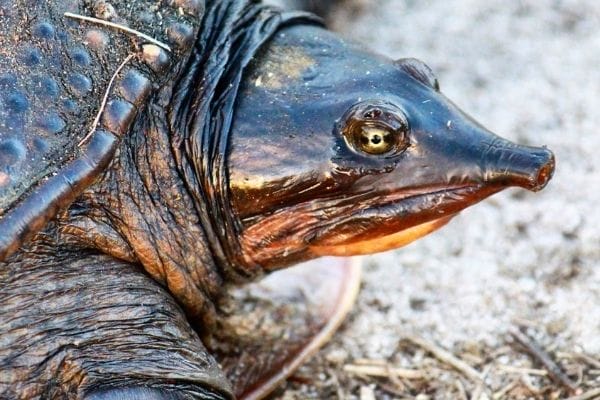
The good news? Softshell turtles actually make gender identification easier than most turtle species because they show clear physical differences between males and females.
Let me walk you through exactly how to tell if your pancake-looking friend is a boy or a girl.
Why Even Bother Figuring Out Your softshell Turtle’s Gender?
Look, I know what you’re thinking: “Does it really matter?”
Actually, yes. Knowing your softshell turtle’s gender helps with breeding decisions, housing multiple turtles together without World War III breaking out, and understanding their behavior.
Plus, it’s nice to stop calling your turtle “it” like they’re a piece of furniture.
Quick softshell turtle Gender ID Checklist
| Feature | Male | Female |
|---|---|---|
| Size | Smaller (about half) | Larger (often double) |
| Tail | Long, thick, extends past shell | Short, thin, barely past shell |
| Hind Claws | Shorter | Longer (for digging nests) |
| Shell Color | Lighter with rings/dots | Darker with blotchy patterns |
| Shell Texture | Sandpaper-like with ridges | Smooth |
| Sexual Maturity | Reaches earlier (4-5 years) | Reaches later (8-12 years) |
This Hilarious Turtle Book Might Know Your Pet Better Than You Do

Let’s be real—most turtle care guides feel like reading a textbook written by a sleep-deprived zookeeper.
This one’s not that.
Told from the snarky point of view of a grumpy, judgmental turtle, 21 Turtle Truths You’ll Never Read in a Care Guide is packed with sarcasm, sass, and surprisingly useful insights.
And hey—you don’t have to commit to the whole thing just yet.
Grab 2 free truths from the ebook and get a taste of what your turtle really thinks about your setup, your food choices, and that weird plastic palm tree.
It’s funny, it’s honest, and if you’ve ever owned a turtle who glares at you like you’re the problem—you’ll feel seen.
The Dead Giveaway: Size Matters (Like, A Lot)
Here’s where softshell turtles flip the script on most animals.
Female softshell turtles are absolutely massive compared to males.
We’re talking about females being almost twice the size of males in the same species at the same age.
It’s like comparing a dinner plate to a saucer.
Size Comparison By Species
| Softshell Turtle Species | Adult Male Size | Adult Female Size |
|---|---|---|
| Florida Softshell | 6-12 inches (around 1 foot) | 8-25 inches (up to 2 feet!) |
| Spiny Softshell | 5-9.5 inches | 6.5-18 inches |
| Smooth Softshell | 5-11 inches | 6.5-14 inches |
| Chinese Softshell | 6-11 inches | 8-13 inches |
| Malayan Softshell | 10 inches | 13.7 inches |
Now here’s the catch: this only works if you’ve got multiple turtles of the same age and species to compare.
If you’ve only got one turtle, you’ll need to use the other methods below.
Check Out That Tail (The Most Reliable Method)
Alright, time to look at your turtle’s rear end without feeling weird about it.
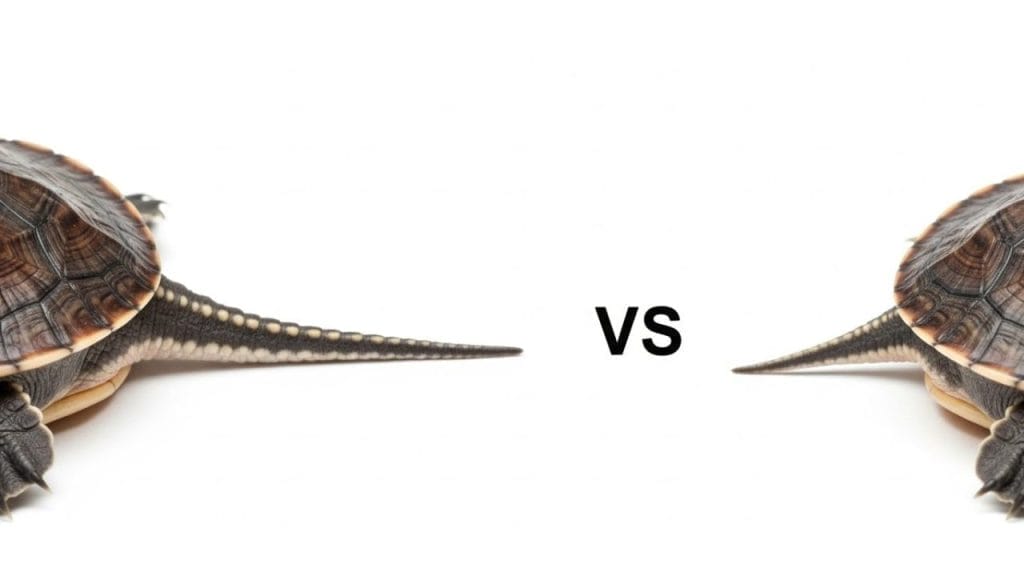
Male softshell turtles have thick, long tails that extend way past the edge of their shell.
Females? Their tails are short, thin, and barely peek out beyond the shell edge despite being bigger overall.
It’s like males got all the tail and females got all the body.
The vent (where everything happens, if you know what I mean) is also positioned differently: closer to the tail tip in males, closer to the body in females.
The Claw Situation Gets Interesting
Here’s where softshell turtles do something different from their hard-shelled cousins.
Female softshell turtles have longer hind claws (the back ones) than males.
Why? Because pregnant females need those claws to dig nests for their eggs.
Think of it like nature gave them built-in excavators.
Males have shorter hind claws but use them during mating to grip the female’s shell.
(Yes, turtle romance is exactly as awkward as it sounds.)
Weight: The Unreliable Friend
Sure, females typically weigh more than males because they’re bigger.
But here’s the problem: weight varies wildly based on health, diet, and whether your turtle’s been stress-eating.
A sick female could weigh less than a healthy male of the same age.
So while weight can give you a hint, don’t bet the farm on it.
Weight Differences (When Healthy)
| Species | Male Weight | Female Weight |
|---|---|---|
| Spiny Softshell | 18-22 lbs | 26.5-33 lbs |
| Florida Softshell | 6.6+ lbs | 13-97 lbs (yeah, seriously) |
| Indian Narrow-Headed | 37-58 lbs | 30-125 lbs |
When They Hit Puberty (Because Turtles Have That Too)
Males and females become sexually mature at completely different times.
Males are basically the overachievers of the turtle world, reaching maturity way earlier.
Male smooth softshell turtles mature at around 4 years old.
Females? They don’t hit maturity until year 9.
For Florida softshells, males are ready when their plastron (bottom shell) reaches about 6 inches, while females need to hit 8 inches.
Spiny softshell females don’t mature until age 12, while males are good to go at age 4-5.
It’s like females took the scenic route to adulthood.
Shell Color and Texture Tells a Story
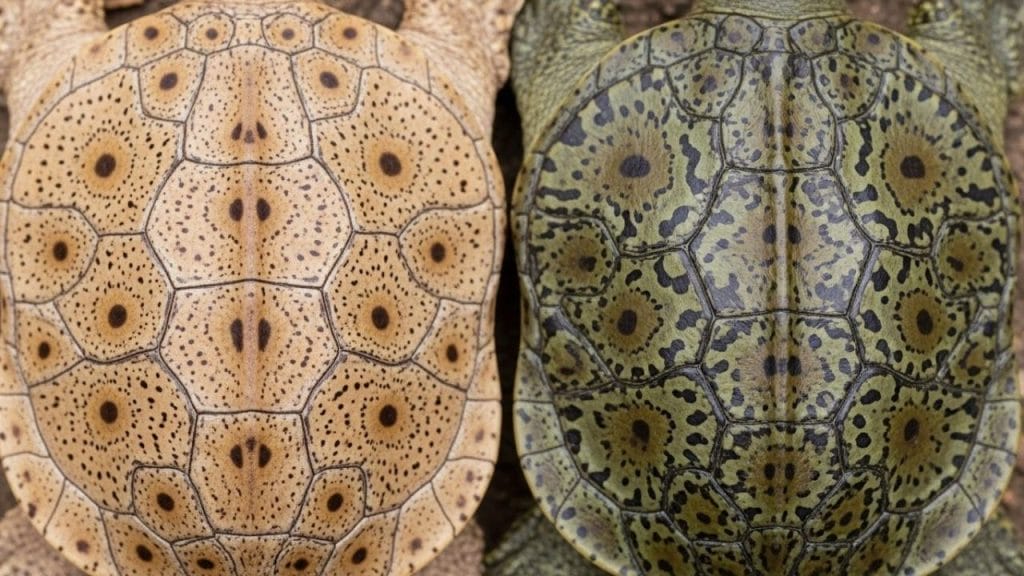
If you look closely (and I mean really closely), male and female shells look different.
Males have lighter-colored shells with distinct rings or circular patterns.
Females have darker shells that get even darker with age, with blotchy grey, olive, or brown mottling.
Run your hand over the shell too.
Males feel like sandpaper with soft ridges on the front edges.
Females? Smooth as butter.
The Temperature Plot Twist
Here’s something wild: in many turtle species, the temperature of the eggs during incubation determines gender.
But softshell turtles? They don’t play by those rules.
According to recent research, softshell turtle embryos actually start as males, then some become female based on protein production and temperature.
Warmer incubation temps can produce more males, which is the opposite of many other turtle species.
If climate change keeps cranking up the heat, we could end up with way more male softshell turtles than females.
Not great for the species’ future, honestly.
Pro Tips for Gender Detective Work
Never rely on just one characteristic. Check multiple features to be sure.
Don’t try to sex baby turtles. Wait until they’re at least 3-5 years old when the differences become obvious.
Handle your turtle gently. They’ve got soft shells and can be aggressive when stressed.
Compare with others. If possible, look at multiple turtles of the same species to see the differences clearly.
When in doubt, ask a vet. A reptile veterinarian can give you a definitive answer.
The Bottom Line
Figuring out if your softshell turtle is male or female isn’t rocket science, but it does take patience and observation.
The tail is your best friend here – it’s the most reliable indicator and easy to check once you know what you’re looking for.
Combine that with size differences and claw length, and you’ll have your answer.
Just remember: baby turtles are masters of disguise, so give them a few years to show their true colors (literally).
And if you’re still scratching your head after checking all these features? There’s no shame in calling up a reptile vet.
They’ve seen enough turtle butts to know the difference.

About Author
Muntaseer Rahman started keeping pet turtles back in 2013. He also owns the largest Turtle & Tortoise Facebook community in Bangladesh. These days he is mostly active on Facebook.