5 Ways to Track a Real Sea Turtle’s Journey Across the Ocean
This post was created with help from AI tools and carefully reviewed by a human (Muntaseer Rahman). For more on how we use AI on this site, check out our Editorial Policy.
Right now, as you’re reading this, there are sea turtles swimming hundreds of miles across open ocean — and you can follow them in real time from your phone.
Not in some simulated, educational-game kind of way. Real turtles. Real satellite data. Real paths traced across the Atlantic, the Caribbean, the Gulf of Mexico.
Researchers have been attaching satellite transmitters to sea turtles for decades. The data helps them study migration patterns, feeding grounds, and threats. But what used to be locked inside research labs is now available to anyone — through apps, websites, and even a $17 bracelet that assigns you a specific turtle by name.
I’ve been tracking my own sea turtle — a loggerhead named PopTart — for over three years. I know where she feeds, when she moves, and roughly how far she’s swum. It’s oddly addicting.
Here are the five best ways to do it yourself.

1. Fahlo Journey Bracelet — Get Your Own Turtle to Track
Cost: $16.95 | Best for: people who want a personal connection to one specific turtle
This is the option I use, and it’s the one I recommend to anyone who asks.
When you buy a Fahlo Journey Bracelet, you get a card with a QR code. Scan it with the Fahlo app, and you’re assigned a real sea turtle — a loggerhead, leatherback, hawksbill, or green sea turtle tracked by the Sea Turtle Conservancy.
You learn the turtle’s name, see a real photo, read their backstory, and then follow their journey on a 3D interactive map. You can see stats like how far they’ve traveled and how fast they’re moving.
What makes this different from the free options below is that it’s personal. You don’t just browse a list of turtles — one becomes yours. My turtle is PopTart, and I’ve watched her loop around the Bahamas and ride the Gulf Stream for years.
Fahlo donates 10% of all profits to their conservation partners and has given over $5.6 million to organizations like Sea Turtle Conservancy since 2018. They’re the exclusive turtle tracking jewelry partner of STC — verified on STC’s own website, confirmed by NBC, and accredited by the BBB.
The bracelet itself is made from crushed stone or glass beads on a biodegradable stretch band with a hand-carved turtle charm. It’s not luxury jewelry — it’s $17, water-friendly, and meant to be worn daily.
Fair warning: Fahlo guarantees tracking for six months. Satellite transmitters typically last about a year before they detach naturally. If your turtle’s tracker falls off within that six-month window, Fahlo will assign you a replacement animal.
A note about scams: There are dozens of copycat sites — Wildlife Team, Turtle’s Journey, Wildlife Mission, Ocean Project, Club Ocean — that steal STC tracking data and donate nothing. Fahlo is the only legitimate partner. My full Fahlo sea turtle tracking bracelet review breaks down every red flag to watch for on copycat sites.
For a deeper look at how the bracelet works, what colors are available, and whether it’s worth it, read my full Fahlo sea turtle tracking bracelet review.
Track A Real Sea Turtle With Each Bracelet!


Learn Name
You get to learn your sea turtle’s name, size, age. Also a picture!
Enjoy Stories
Enjoy the story of your sea turtle, where it came from, where is it going?
Follow Me
You get to follow the sea turtle’s journey on an interactive tracking map!
Click Here & Use Coupon Code: THETURTLEHUB20 For A 20% Discount!
2. STC Turtle Tracker App — Follow Dozens of Turtles for Free
Cost: Free (optional adoption/subscription) | Best for: people who want to browse many turtles without spending anything
The Sea Turtle Conservancy — the world’s oldest sea turtle research organization, founded in 1959 — runs their own Turtle Tracker app, available on both iPhone and Android.
The app lets you follow sea turtles that have been tagged with satellite transmitters from nesting beaches, in-water research sites, and rehabilitation centers across Florida, Costa Rica, Panama, Bermuda, and beyond. Each turtle has a name, a backstory, a release date, and a map showing every recorded location since tagging.
STC has tagged and monitored over 550 turtles throughout their history, and the app currently shows both active turtles (those still pinging) and archived tracks from previous years.
The app recently got a major redesign with a cleaner interface, an “active” icon for turtles that have pinged in the last 30 days, and the ability to sort by most recently updated. STC has mentioned they’re working on a favorites feature and archiving improvements for older tracks.
You can use the app completely free. If you want to go further, STC offers turtle adoptions and in-app subscriptions to directly fund their research and conservation programs.
This is the most data-rich free option available — and since Fahlo’s tracking data comes from STC, browsing this app gives you a broader view of the same turtles and research.
This Hilarious Turtle Book Might Know Your Pet Better Than You Do

Let’s be real—most turtle care guides feel like reading a textbook written by a sleep-deprived zookeeper.
This one’s not that.
Told from the snarky point of view of a grumpy, judgmental turtle, 21 Turtle Truths You’ll Never Read in a Care Guide is packed with sarcasm, sass, and surprisingly useful insights.
And hey—you don’t have to commit to the whole thing just yet.
Grab 2 free truths from the ebook and get a taste of what your turtle really thinks about your setup, your food choices, and that weird plastic palm tree.
It’s funny, it’s honest, and if you’ve ever owned a turtle who glares at you like you’re the problem—you’ll feel seen.
3. Tour de Turtles — The Annual Migration Marathon
Cost: Free to follow | Best for: anyone who loves a good competition (and sea turtles)
Every summer, the Sea Turtle Conservancy runs the Tour de Turtles — a three-month “race” where satellite-tagged sea turtles compete to see which one swims the farthest distance after being released from nesting beaches.
It started in 2008, and it’s become one of the most engaging public conservation events in the country. Corporate sponsors like Disney, Atlantis Bahamas, and Four Seasons fund individual turtles — and the names are incredible. Recent competitors include Seayonce, Turt Reynolds, Donna Shello, Reef Witherspoon, Miso Speedy, and Tortellini.
Each turtle is tagged at a live release event (some of which are open to the public at beaches in Florida, Costa Rica, and the Caribbean), and you can follow the race at tourdeturtles.org. The 2025 Tour included 11 tagged turtles and collectively they swam over 50,000 km.
Each turtle in the race also represents a specific conservation cause — light pollution, plastic debris, illegal egg harvesting, climate change — so you learn about real threats while watching the migration unfold.
It’s free, educational, and surprisingly fun to root for a sea turtle named Tortellini.
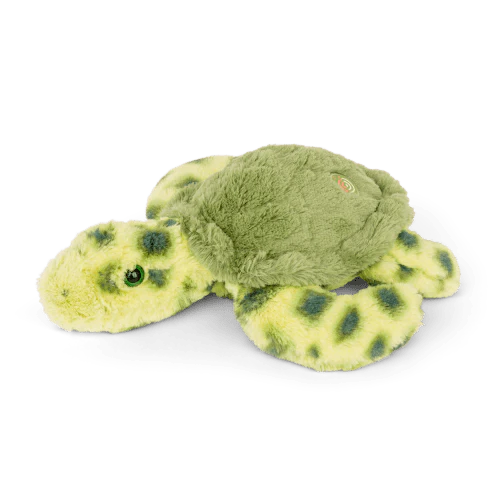
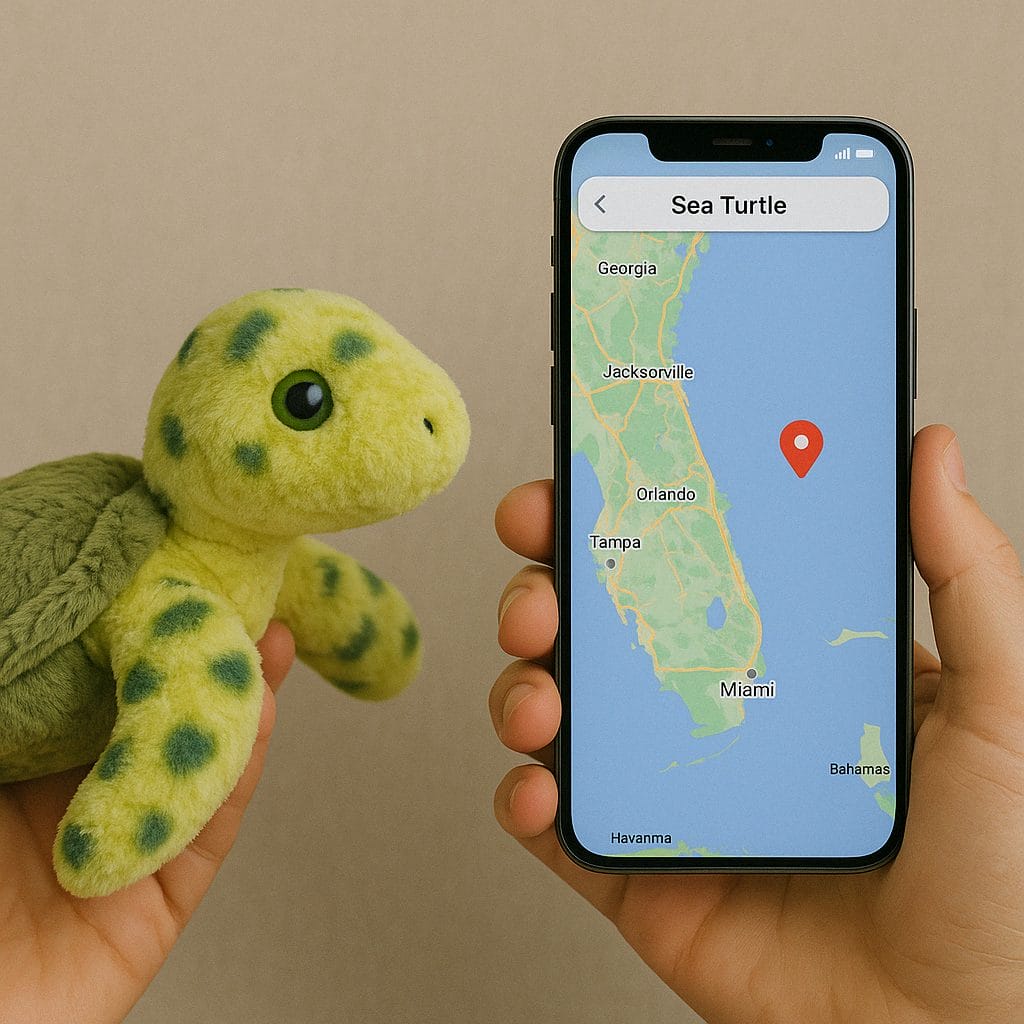
Snuggle a Plush. Track a Turtle.
🧸 + 🌊 = 🐢 A toy that connects you to real sea turtles in the wild.
Meet Your Turtle
Scan the tag to meet your real sea turtle. Learn its name, species, and see a real photo!
Follow the Journey
Watch your turtle swim across the ocean using the 3D tracking map. It’s like a sea adventure in your pocket.
Support Wildlife
Every plush supports turtle conservation efforts through the Sea Turtle Conservancy.
Click Here & Use Coupon Code: THETURTLEHUB20 For A 20% Discount! (Your hug helps a turtle.)
4. TrackTurtles.com — Raw Satellite Data from Florida’s Leatherbacks
Cost: Free (optional turtle adoption) | Best for: data-minded people who want real-time satellite tracking
TrackTurtles.com is run by Florida Leatherbacks Inc. (FLI), a volunteer research group that conducts fieldwork on endangered leatherback sea turtles in Martin County, Florida.
This site is more raw and research-oriented than the polished Fahlo or STC experiences. You get direct satellite data — location pings, depth readings, water temperature — plotted on a live map. It’s the kind of data researchers actually work with, presented in a way that’s still accessible.
FLI currently tracks leatherbacks tagged each summer from Florida’s nesting beaches, with some data also provided by their partner Fisheries and Oceans Canada. The number of actively tracked turtles varies by season (at the time of writing, three leatherbacks are being actively tracked).
You can “adopt” a tracked turtle on the site, and 100% of donated funds go directly to purchasing satellite transmitters, covering tracking fees, and maintaining the website. No overhead, no middlemen.
If TrackTurtles.com is too research-heavy for your taste, it’s still worth a quick visit just to see a leatherback’s actual migration path across the Atlantic — the scale of the distances they cover is jaw-dropping.
5. Citizen Science Apps — Report Your Own Sea Turtle Sightings
Cost: Free | Best for: anyone near the coast who wants to contribute to real research
If you want to go beyond watching from your phone and actually contribute data, there are citizen science apps that let you report sea turtle sightings:
iSeaTurtle App
Created by the lab of Dr. Pamela Plotkin at Texas A&M and expanded through a partnership with Turtle Island Restoration Network. Originally built for an ecosystem assessment of Matagorda Bay, the app now covers the entire Texas coast.
If you spot a sea turtle from a boat, pier, beach, or jetty, you can log the sighting and contribute to real scientific data. Texas is home to five species of threatened and endangered sea turtles, including the Kemp’s ridley — the state’s official sea turtle.
STC Inwater Sea Turtle Sighting App
Run by Sea Turtle Conservancy, this app lets boaters, fishermen, and anyone on the water report in-water sea turtle sightings in Florida, Bermuda, and the Bahamas. It also helps you identify which species you’re looking at.
Neither of these apps tracks turtles via satellite — they’re crowd-sourced sighting databases. But they’re a powerful way to participate in conservation if you spend time near the water. If you ever spot an injured turtle or find one walking across a road, resist the urge to rehome it yourself; here’s what you should do instead.
How Satellite Tracking Actually Works
Every tracking option on this list relies on the same core technology: satellite telemetry.
Researchers attach small devices called Platform Transmitter Terminals (PTTs) to sea turtles. For hard-shelled species like loggerheads and greens, the transmitter is either glued with epoxy or secured with a fiberglass-and-resin cover on the shell. For leatherbacks, it’s attached directly through the dorsal ridge because their shells are too flexible for surface bonding.
Each time the turtle surfaces to breathe, the transmitter sends a signal to NOAA’s polar-orbiting satellites — the same satellites used for global weather monitoring. The ARGOS system onboard those satellites picks up the signal and estimates the turtle’s location using Doppler shift calculations.
The data gets processed and sent to researchers, who then share it through apps and websites like the ones above.
It’s not perfect — location accuracy ranges from about 50 meters to 2.5 kilometers, signals depend on the turtle surfacing while satellites are overhead, and transmitters eventually run out of battery or get covered in barnacles. But the accumulated data paints a remarkably detailed picture of where these animals go and what they need to survive.
Which Option Should You Pick?
If you want a personal connection to one turtle and you’re happy to spend $17, get a Fahlo bracelet. It’s the most engaging experience, and your money directly funds conservation. Use code THETURTLEHUB20 for 20% off.
If you want to explore dozens of turtles for free, download the STC Turtle Tracker app. It’s the most comprehensive free resource available.
If you like the idea of following a competition, bookmark Tour de Turtles and check in each summer.
If you’re a data nerd, visit TrackTurtles.com for raw satellite feeds.
And if you live near the coast, download a citizen science app and start logging your own sightings.
Whatever you choose, you’ll be watching one of the most remarkable migrations on the planet — animals that have been navigating these same ocean routes for over 100 million years.

About Author
Muntaseer Rahman started keeping pet turtles back in 2013. He also owns the largest Turtle & Tortoise Facebook community in Bangladesh. These days he is mostly active on Facebook.