How Many Types of Painted Turtles Are There? All Subspecies With Photos
This post was created with help from AI tools and carefully reviewed by a human (Muntaseer Rahman). For more on how we use AI on this site, check out our Editorial Policy.
There are four types of painted turtles, and they all belong to the same species — Chrysemys picta. The four subspecies are the Eastern, Midland, Western, and Southern painted turtle.
Each one has a different look, a different home range, and a different personality. Whether you spotted one at a pond and have no idea what it is, or you’re shopping for a pet turtle and feeling overwhelmed — this guide will clear everything up.
Let’s get into it.
The 4 Types of Painted Turtles: Quick Overview
Before we go deep, here’s the big picture.
| Subspecies | Adult Size | Easiest ID Feature | Native Range |
|---|---|---|---|
| Eastern | 4.5–6 inches | Plain yellow plastron, aligned scutes | Atlantic coast to Appalachians |
| Midland | 5–7 inches | Dark blotch in the center of plastron | Great Lakes, Ohio Valley |
| Western | 6–10 inches | Complex head stripes, biggest of them all | Western U.S. and Canada |
| Southern | 4–5 inches | Bold orange-red stripe down the back | Mississippi River valley |
Now let’s break each one down properly.
Eastern Painted Turtle (Chrysemys picta picta)
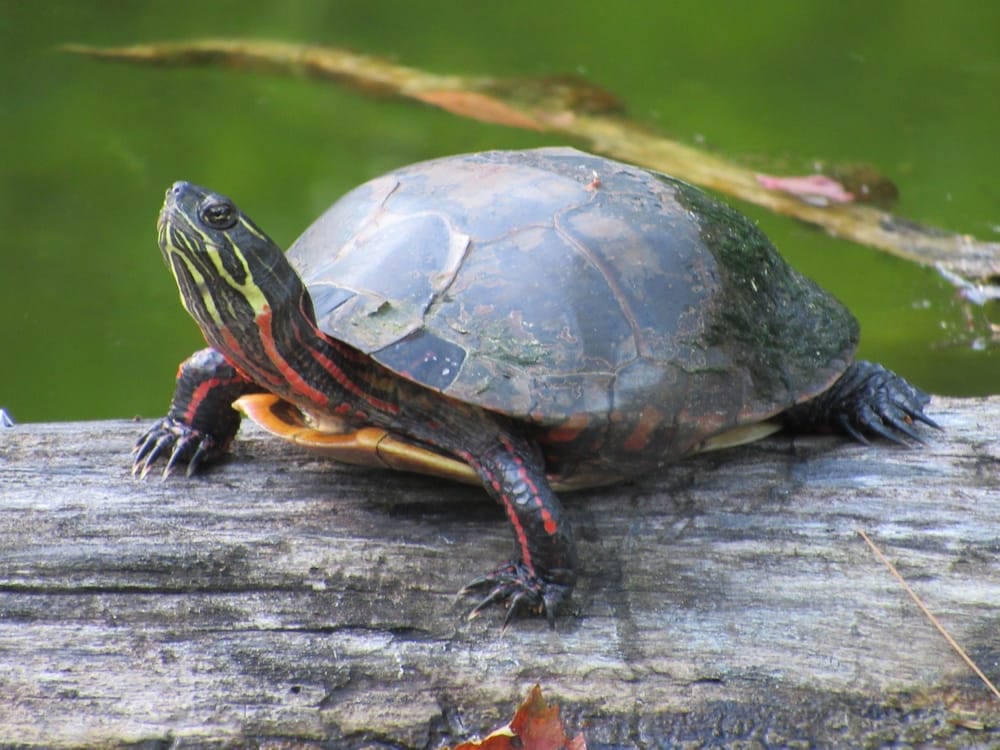
The Eastern painted turtle is the “original” — it was the first one scientifically described, which is why the species name picta repeats twice.
Think of it as the classic model before the upgrades came out.
What Does It Look Like?
The Eastern is 4.5 to 6 inches long as an adult. Not huge, not tiny — just a solid medium-sized turtle.
The top shell (carapace) is smooth, oval, and usually dark olive-green to black. Here’s the thing that makes Eastern painted turtles stand out from the others: the scutes (the plates on the shell) line up in perfectly straight rows across the shell. Every other subspecies has them staggered. This one doesn’t.
Flip it over and you’ll see a plain yellow or cream plastron with zero dark markings. Clean. Simple.
The head and neck have yellow stripes, and the shell edges show those classic red or orange crescent markings underneath.
Where Does It Live?
Eastern painted turtles stick to the eastern side of North America.
Their range runs from Nova Scotia and southern Quebec in the north, down to northern Georgia and Alabama in the south. East to west, they go from the Atlantic coast to roughly the Appalachian Mountains.
States like Maine, New York, Pennsylvania, Virginia, and the Carolinas are prime Eastern painted turtle territory.
Personality and Behavior
These turtles are pretty chill. They’re docile, not particularly aggressive, and love basking — you’ll often find groups of them stacked on logs like they’re fighting for the last sunny spot.
They’re active from April through October and hibernate underwater during winter. During the day, most of their feeding happens in the morning and late afternoon.
Diet-wise, young Eastern painted turtles are mostly carnivorous (insects, worms, small fish). Adults eat more plants as they get older.
This Hilarious Turtle Book Might Know Your Pet Better Than You Do

Let’s be real—most turtle care guides feel like reading a textbook written by a sleep-deprived zookeeper.
This one’s not that.
Told from the snarky point of view of a grumpy, judgmental turtle, 21 Turtle Truths You’ll Never Read in a Care Guide is packed with sarcasm, sass, and surprisingly useful insights.
And hey—you don’t have to commit to the whole thing just yet.
Grab 2 free truths from the ebook and get a taste of what your turtle really thinks about your setup, your food choices, and that weird plastic palm tree.
It’s funny, it’s honest, and if you’ve ever owned a turtle who glares at you like you’re the problem—you’ll feel seen.
Midland Painted Turtle (Chrysemys picta marginata)
The Midland painted turtle is the Great Lakes turtle. If the Eastern is the east coast classic, the Midland is the Midwest workhorse.

What Does It Look Like?
Midland painted turtles grow to 5 to 7 inches, making them slightly bigger than Eastern ones.
The shell is smooth like the others, ranging from olive to nearly black. But here’s the dead giveaway: there’s a large, irregular dark blotch smack in the center of the yellow plastron. It can look grayish, brownish, or almost black depending on the turtle. No other painted turtle has this.
The other fun feature? A yellow horizontal stripe that passes directly through the eye. Not above it, not below it — straight through the pupil like a line drawn with a ruler. Once you see it, you can’t unsee it.
Where Does It Live?
Midland painted turtles are all over the interior of the eastern U.S. and southern Canada.
Their core range covers the Great Lakes region and Ohio River valley — Wisconsin, Michigan, Illinois, Indiana, Ohio, Kentucky, and surrounding states. Southern Ontario in Canada also has healthy populations.
Here’s the interesting part: the Midland’s range overlaps with the Eastern in Pennsylvania and Ohio, with the Western in Wisconsin and Iowa, and with the Southern in Missouri and Illinois. Those overlap zones are where you find hybrid turtles with mixed features.
Personality and Behavior
Midland painted turtles are dedicated baskers. Like, almost aggressively dedicated. They’ll spend hours soaking up heat to get their body temperature into that 75–85°F sweet spot.
They tend to be slightly more skittish than Eastern painted turtles at first. But captive-raised ones calm down quickly with regular handling.
In winter, they hibernate buried in mud underwater — sometimes for months — surviving by absorbing oxygen through their throat lining and cloaca. Wild, right?
Western Painted Turtle (Chrysemys picta belli)
Okay, this is the big one. Literally.
The Western painted turtle is the largest, most colorful, and most widespread of all four subspecies. If painted turtles had a hall of fame, the Western would have its own wing.
What Does It Look Like?
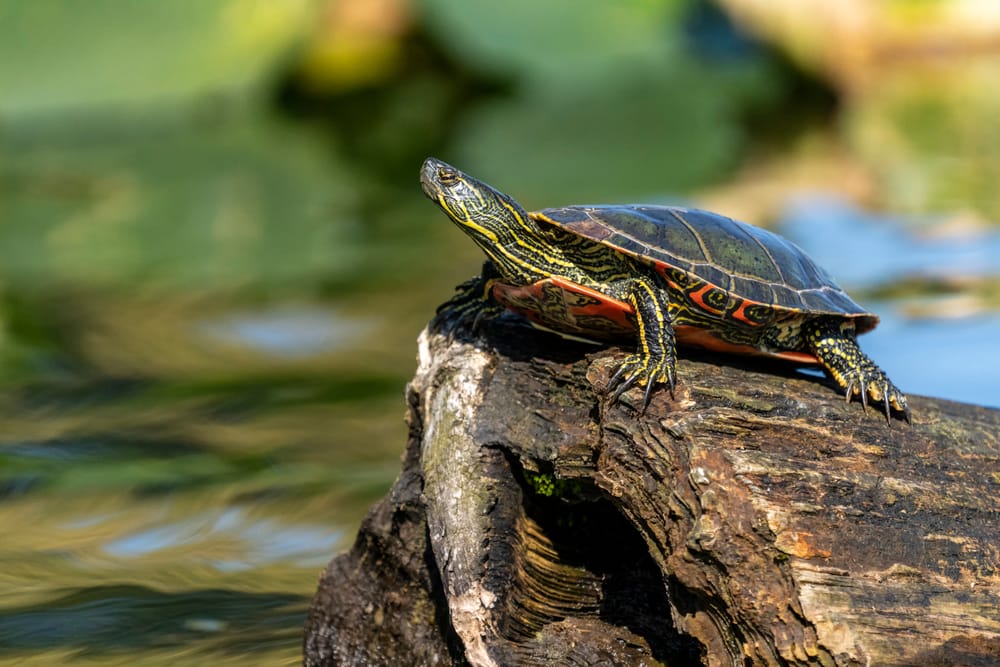
Western painted turtles commonly reach 8 to 10 inches, with some females pushing past 10. Compare that to the 4–5 inch Southern and you realize these things are almost a different animal.
The carapace has a reticulated (net-like) pattern — thin light-colored lines spreading across the dark shell like a road map. It’s intricate and honestly pretty cool looking.
The plastron is yellow with an elaborate branching dark pattern that sprawls across the entire bottom shell. It’s more complex than the Midland’s simple center blotch — it branches out like tree roots.
But the real show is on the head. Multiple thick yellow stripes cover the head and neck. And on the chin? All those yellow lines converge at the tip of the jaw into a shape like an arrow or funnel pointing forward. That chin pattern is the Western’s fingerprint — no other subspecies has it.
The red and orange stripes on the neck and legs are also more vivid on Western painted turtles. The colors pop.
Where Does It Live?
The Western painted turtle has the largest range of any subspecies — and it’s not even close.
Their territory stretches from British Columbia in Canada down to northern Mexico, and from western Ontario all the way to the Pacific coast. That’s an enormous chunk of the continent.
States like Washington, Oregon, Montana, Idaho, Wyoming, Colorado, and the Dakotas are solidly Western painted turtle country. They’ve even adapted to desert conditions in parts of the Southwest.
They’re also the most adaptable subspecies. Farm ponds, golf course lakes, irrigation ditches, urban park ponds — if there’s still water, Western painted turtles will figure it out.
Personality and Behavior
Bold. That’s the word for Western painted turtles.
They’re less shy than Eastern subspecies, more active, and will straight-up climb over other turtles to grab the best basking spot. Groups of 10–20 turtles piled on a log is a totally normal sight.
They’re also tolerant of temperature extremes — staying active in cooler water (down to 50°F) and handling heat better than most. In cold northern regions they hibernate 4–6 months. In hot southern parts of their range, they may actually go dormant in summer instead.
Lifespan: 20–30 years in the wild, potentially 40+ in captivity with proper care.
Southern Painted Turtle (Chrysemys picta dorsalis)
The Southern painted turtle is the smallest of the four — and honestly, probably the easiest to identify.
One look and you know.

What Does It Look Like?
Southern painted turtles top out at 4 to 5 inches. Males rarely break 4.5 inches. They’re genuinely small turtles.
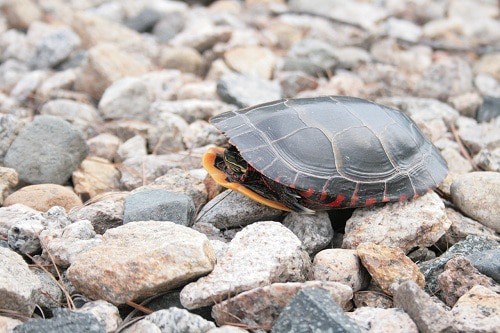
The signature feature is a bright orange-red or red stripe running down the center of the shell from neck to tail. It follows the vertebral scutes right down the spine like a racing stripe. Bold, unmistakable, unique to this subspecies.
The base shell color is olive to dark green or black, so that stripe really pops. The plastron is plain yellow with no dark markings — super clean.
Head stripes are simpler compared to the Western. Less complex, less flashy, but still present.
Where Does It Live?
Southern painted turtles are the most range-restricted of all four subspecies.
They’re mostly found in the Mississippi River drainage system — from southern Illinois down to the Gulf Coast. Arkansas, Louisiana, Mississippi, western Tennessee, western Kentucky, and eastern Texas are their home turf.
They prefer warm, slow-moving southern waters — oxbow lakes, bayous, swamps, and backwater areas. They can even tolerate slightly brackish water near the Gulf Coast.
Personality and Behavior
Southern painted turtles are the most docile of all four subspecies. They rarely scratch when handled, almost never bite, and generally just want to chill.
This calm temperament plus their small size is exactly why they’re so popular in the pet trade.
Because they live in warm climates, they have the shortest hibernation period of any painted turtle. In the Deep South, they may stay active all winter during warm spells. In the northern parts of their range, they hibernate briefly from December to February.
Diet-wise, something interesting happens as they age. Juveniles are 80–90% carnivorous. But adults flip to 60–70% plant matter — more extreme than any other subspecies.
Lifespan: 15–25 years wild, 25–35 years in captivity.
How to Tell Painted Turtle Subspecies Apart (Step-by-Step)
Found a painted turtle and not sure which one it is? Work through this.
Step 1: Look for a stripe down the back
Is there a bold orange-red stripe running down the center of the shell?
- Yes → Southern painted turtle. Done.
- No → Move to Step 2.
Step 2: Check the plastron (bottom shell)
Flip it over gently or watch it from below.
- Plain yellow, no markings → Eastern painted turtle
- Large irregular dark blotch in the center → Midland painted turtle
- Elaborate branching dark pattern across most of the plastron → Western painted turtle
Step 3: Check the eye stripe
Is there a yellow line passing directly through the pupil of the eye?
- Yes, perfectly horizontal → Confirms Midland painted turtle
Step 4: Check the chin (for Western)
Do the yellow lines on the underside of the jaw all meet at the tip in an arrow or funnel shape?
- Yes → Confirms Western painted turtle
Step 5: Consider size and location
- Tiny (4–5 inches) in the Deep South → Southern
- Large (8–10 inches) anywhere in the West → Western
- Medium, Atlantic coast → Eastern
- Medium, Great Lakes region → Midland
What About Hybrid Painted Turtles?
Here’s something most people don’t know: where the ranges of two subspecies overlap, they interbreed and produce hybrids.
These hybrids are called intergrades, and they’re actually pretty common in certain areas.
| Overlap Zone | Subspecies Involved | What You Might See |
|---|---|---|
| Ohio, Pennsylvania | Eastern × Midland | Aligned scutes + partial plastron blotch |
| Wisconsin, Iowa | Midland × Western | Intermediate plastron pattern |
| Illinois, Missouri | Midland × Southern | Faint dorsal stripe + plastron blotch |
| Missouri (rare) | Western × Southern | Western size with hints of a dorsal stripe |
If you find a turtle in one of these zones that doesn’t quite fit any subspecies perfectly — that’s probably why. It’s not a new species, just nature doing what nature does.
Which Painted Turtle Makes the Best Pet?
All four subspecies are kept as pets, but they’re not the same experience.
Best for beginners: Southern painted turtle
Small size, calm personality, lower food costs. The whole package for someone just starting out. If you want something even smaller, consider a musk or mud turtle instead.
Best for color lovers: Western painted turtle
Vibrant reds, complex patterns, bold personality. These are genuinely impressive animals. Just know you’ll need a big tank — at least 75–100 gallons for an adult.
Most commonly available: Eastern and Midland
Widely captive-bred, hardy, adaptable. Great all-around pet turtles for most people.
Basic Care Requirements (All Subspecies)
All painted turtles need the same foundational setup regardless of subspecies:
- Tank size: Minimum 55 gallons for most adults (75–100 for Western)
- Water temp: 75–80°F
- Basking area temp: 90–95°F
- UVB (my pick: Zoo Med ReptiSun 10.0) lighting: 10–12 hours daily — non-negotiable
- Filtration: Strong canister filter (my pick: Penn-Plax Cascade)
- Diet: Commercial pellets + live/frozen prey + leafy greens + calcium supplement (my pick: Rep-Cal Calcium with D3)
The main differences come down to size and diet ratios. Western painted turtles need more space and produce more waste. Southern painted turtles need more plant matter as adults. Midland painted turtles are a bit more sensitive to poor water quality.
Are Painted Turtles Endangered?
Not at all. Painted turtles as a species are listed as Least Concern on the IUCN Red List, and all four subspecies have stable populations.
That said, they do face real threats:
- Road mortality during nesting season (May–July) is a serious problem near wetlands
- Nest predation — raccoons, skunks, and foxes destroy 70–90% of nests in many areas
- Habitat loss from wetland drainage
- Climate change — painted turtle sex is determined by incubation temperature, so rising temps could skew wild populations heavily female
They’re not in danger of disappearing anytime soon. But they’re not completely in the clear either.
Frequently Asked Questions
What are the 4 types of painted turtles?
The four subspecies are Eastern (Chrysemys picta picta), Midland (C. p. marginata), Western (C. p. belli), and Southern (C. p. dorsalis). They’re all the same species but live in different regions and have distinct physical traits.
Which painted turtle is the biggest?
The Western painted turtle, hands down. Adults commonly reach 8 to 10 inches, with some females exceeding 10 inches. The Southern is the smallest at just 4 to 5 inches.
Which painted turtle has a red stripe on its back?
That’s the Southern painted turtle (C. p. dorsalis). That orange-red dorsal stripe is its signature feature and the easiest way to identify it. No other subspecies has it.
Can painted turtle subspecies interbreed?
Yes, and they do it regularly where their ranges overlap. The hybrids (called intergrades) show mixed features from both parent subspecies. It’s completely natural.
Which painted turtle subspecies is the rarest?
None are rare, but the Southern painted turtle has the most restricted range — mostly confined to the Mississippi River valley. The Western has the largest range by far.
How long do painted turtles live?
It varies a bit by subspecies. Eastern and Midland live 20–30 years in the wild, up to 40 in captivity. Western painted turtles live 25–30 years wild, potentially 40+ captive. Southern painted turtles average 15–25 years wild and 25–35 in captivity.
Final Thoughts
Four subspecies, four different looks, four different corners of North America — but all the same lovable, colorful painted turtle underneath.
If you’re trying to ID one in the wild, the dorsal stripe (Southern), plastron blotch (Midland), plain plastron (Eastern), and massive size with complex chin stripes (Western) are your four fastest clues.
And if you’re picking one as a pet, now you actually know what you’re getting into with each type — not just guessing based on whatever’s at the pet store.
Painted turtles have been around for 15 million years. They’ve outlasted a lot. The least we can do is learn their names.

About Author
Muntaseer Rahman started keeping pet turtles back in 2013. He also owns the largest Turtle & Tortoise Facebook community in Bangladesh. These days he is mostly active on Facebook.