Turtle Eggs 101: What Every Owner Needs to Know
This post was created with help from AI tools and carefully reviewed by a human (Muntaseer Rahman). For more on how we use AI on this site, check out our Editorial Policy.
Your pet turtle just laid eggs in the tank, and you have no idea what to do next. Or maybe you’re trying to breed turtles and want to maximize your hatch rate. Either way, this guide covers everything about turtle eggs, from identifying fertile ones to hatching healthy babies.
Not sure when your turtle eggs will hatch? Try our free Turtle Egg Hatch Calculator for instant predictions!
Do Female Turtles Lay Eggs Without a Male?
Yes. Female turtles produce and lay eggs regardless of whether they’ve mated. Think of it like chickens. Every female turtle has eggs developing inside her, and once she reaches maturity (typically 3 to 5 years old for most pet species), she will start laying them.
If there’s been no mating, the eggs are infertile. No babies will come from them. You can safely discard infertile eggs.
Here’s the important part most owners miss: even without a male around, your female turtle can become egg-bound if she doesn’t have a proper place to lay. Egg-binding happens when she retains eggs because she can’t find suitable nesting substrate. Signs include:
- Straining or making digging motions repeatedly
- Lethargy and loss of appetite
- Swollen cloaca
- Repeated climbing and dropping from the basking area
- Digging everywhere but never actually laying
Egg-binding is a veterinary emergency. A reptile vet can treat it with oxytocin injections or, in severe cases, surgery. Do not try to treat egg-binding at home.
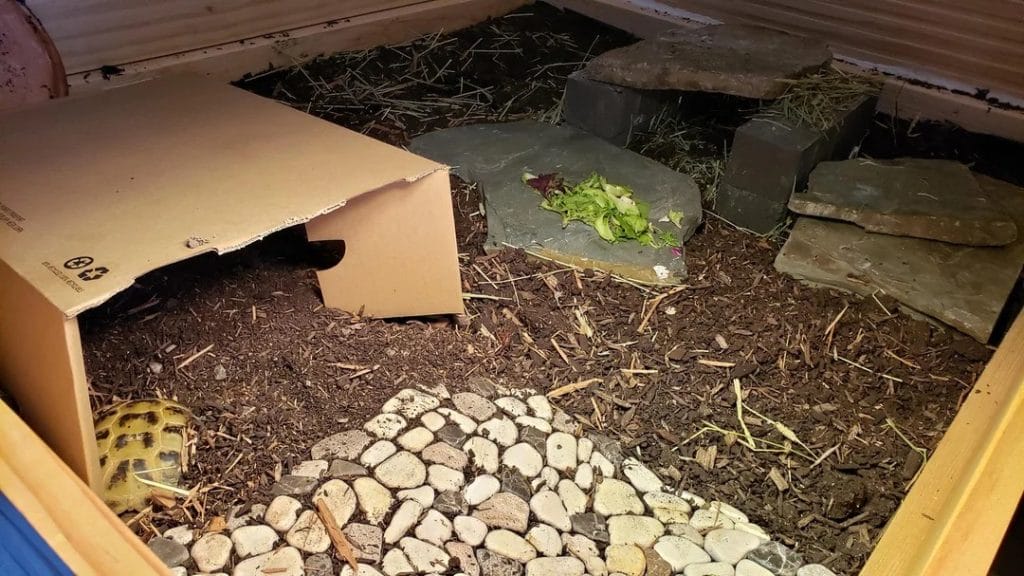
Prevention is simple: always provide at least 6 to 8 inches of loose, sandy or loamy substrate where your turtle can dig a nest. This applies to every female turtle, even if she’s never been near a male.
How to Tell When Your Turtle Is Ready to Lay
When a female turtle is about to lay eggs, she’ll show clear behavioral changes:
- Stops eating. Turtles are normally greedy eaters, so a sudden lack of interest in food is a big signal.
- Gets restless. She’ll pace the enclosure, climb onto the basking platform (my pick: floating basking platform) and jump back in, over and over.
- Starts exploring and digging. She’s looking for the right nesting spot. When she finds one, she’ll dig a flask-shaped hole with her hind legs.
When you notice these signs, provide access to a nesting area with moist soil or sand. Some owners move their turtle’s enclosure outdoors temporarily so she can dig naturally.
How to Tell If Turtle Eggs Are Fertile
There’s no method that’s 100% accurate in the first few days, but several techniques give you a strong indication.
Chalking
This is the most reliable early sign. Within 24 to 48 hours of being laid, a fertile egg develops a chalky white band or spot on the upper surface. This is called “chalking” and it happens as the embryo begins absorbing calcium. Infertile eggs stay uniformly translucent or yellowish.
Candling
Take the egg into a dark room and hold a bright LED penlight (not a heat-producing bulb) against the shell for a few seconds. In a fertile egg, you’ll see:
- A reddish web of blood vessels
- A small dark embryo spot
If the egg looks uniformly yellow and translucent with no structures, it’s likely infertile. But don’t decide too quickly. Wait at least 7 days of incubation before making a final call.
Critical: Never candle for more than a few seconds. The concentrated heat from the light can damage or kill the embryo.
Color and Texture Changes
As fertile eggs develop, they change:
- Color goes from pinkish-white to a darker, more opaque shade
- Texture becomes harder and more rubbery
Infertile eggs stay the same color and texture throughout.
Signs of Embryo Death
If you notice a rotten smell, dark spots on the shell surface, or an opaque shapeless interior when candling, the embryo has likely died. Remove dead eggs from the incubator immediately to prevent mold from spreading to viable eggs.
This Hilarious Turtle Book Might Know Your Pet Better Than You Do

Let’s be real—most turtle care guides feel like reading a textbook written by a sleep-deprived zookeeper.
This one’s not that.
Told from the snarky point of view of a grumpy, judgmental turtle, 21 Turtle Truths You’ll Never Read in a Care Guide is packed with sarcasm, sass, and surprisingly useful insights.
And hey—you don’t have to commit to the whole thing just yet.
Grab 2 free truths from the ebook and get a taste of what your turtle really thinks about your setup, your food choices, and that weird plastic palm tree.
It’s funny, it’s honest, and if you’ve ever owned a turtle who glares at you like you’re the problem—you’ll feel seen.
Incubation: Temperature, Humidity, and Setup
Getting incubation conditions right is the difference between a healthy clutch and total failure.
Temperature and Humidity by Species
| Species | Temperature | Humidity | Incubation Period |
|---|---|---|---|
| Red-eared slider | 80-86°F (27-30°C) | 80-90% | 60-90 days |
| Painted turtle | 77-86°F (25-30°C) | ~80% | 70-80 days |
| Box turtle | 80-85°F (27-29°C) | ~90% | 60-90 days |
| Snapping turtle | 80-85°F (27-29°C) | ~80% | 80-90 days |
The standard incubation substrate is vermiculite mixed with water at a 1:1 ratio by weight. This creates the right moisture level without drowning the eggs.
Use dechlorinated or distilled water for mixing the substrate. Chlorine in tap water can harm developing embryos.
How Temperature Controls Your Turtle’s Sex
This is something most turtle owners don’t know: the incubation temperature determines whether hatchlings are male or female. This is called temperature-dependent sex determination (TSD), and it applies to most turtle species.
The pivotal temperature for most freshwater turtles sits around 84°F (29°C). Here’s how it works:
- Above 86°F (30°C): Predominantly female hatchlings
- Below 82°F (28°C): Predominantly male hatchlings
- Between 82-86°F: A mix of both sexes
The sex is determined during the middle third of the incubation period, known as the thermosensitive period. So if you’re breeding intentionally, you have direct control over the sex ratio of your clutch through temperature management.
At extreme temperatures (above 88°F), you can get 100% female clutches. At or below 82°F, 100% male. This isn’t just interesting trivia. It’s a practical tool for breeders.
DIY Turtle Egg Incubator
You don’t need an expensive reptile incubator to hatch turtle eggs. Here’s how to build one with household items:
What you need:
- A 5-gallon plastic container
- A 10-gallon aquarium
- Submersible water heater
- Vermiculite (or sand as a backup)
- Two digital thermometers
- A sheet of plexiglass
- A drill
Setup steps:
- Fill the plastic container with vermiculite mixed 1:1 by weight with dechlorinated water. Leave 2 to 3 inches free at the top. Place one thermometer at least one inch deep in the substrate.
- Place the container inside the aquarium. Add the submersible heater (recommended: submersible aquarium heater) to the aquarium and set it to 80°F.
- Pour lukewarm dechlorinated water into the aquarium until the water line sits half an inch above the substrate line in the container. Place the second thermometer in the outer aquarium water.
- Drill 5 to 6 ventilation holes in the plexiglass sheet and place it over the aquarium as a cover.
- Monitor temperatures in both the container and aquarium for several days before adding eggs. You’re aiming for 82 to 84°F in the substrate.
When you’re ready to add eggs, make small indentations in the substrate with your finger and place the eggs without changing their orientation. The eggs should be half-buried, not fully covered.
Check the incubator twice a week. Monitor temperature and humidity daily.
Handling Turtle Eggs: The Rules
Turtle eggs are fragile and unforgiving of mistakes. Follow these rules:
- Mark the top immediately. Use a soft pencil to mark the “up” side of each egg as soon as you find them. Never use a marker. Chemicals can seep through the shell.
- Never rotate or flip eggs. After the first 12 to 24 hours, the embryo attaches to the shell membrane. Changing the orientation detaches the embryo and kills it. This is the single most common mistake owners make.
- Handle as little as possible. Only touch eggs when moving them to the incubator or during candling. Excessive handling introduces bacteria and causes temperature fluctuations.
- Don’t discard dented eggs. Slight denting early on can be normal, especially if humidity was low initially. Correct the humidity and the egg may recover. Only discard eggs that smell rotten or show signs of mold.
How to Protect an Outdoor Turtle Nest
If your turtle laid eggs outdoors, or you’ve found a wild turtle nest in your yard, protecting it dramatically improves hatch rates. Studies show that predators (mainly raccoons) destroy up to 90% of unprotected freshwater turtle nests.
Building a Nest Cage
The most effective protection is a wire mesh cage over the nest:
- Use hardware cloth with 1/4-inch openings (23-gauge). Do not use chicken wire. The openings are too large and snakes, rodents, and small predators can get through.
- Bury the cage edges at least 12 inches deep to stop digging predators like raccoons and skunks.
- Leave at least 12 inches of cage above ground.
- Remove the cage before the expected hatch date so hatchlings can emerge and leave freely.
Other Protective Measures
- Sprinkle water over the nesting area right after the turtle finishes laying. This washes away the egg fluid scent that predators use to locate nests.
- If the nest is in a public area, place a visible marker or sign to prevent accidental disturbance.
- Check the nest area regularly during early fall, which is the most common hatching season. A warm day after rain is often when hatchlings emerge.
How Baby Turtles Hatch
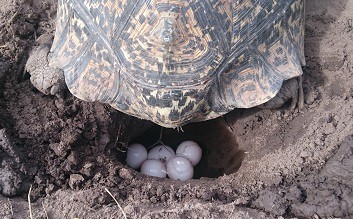
Whether freshwater or sea turtle, all species lay their eggs on land. The female digs a hole, deposits her eggs, covers the nest, and leaves. She never returns. The hatchlings are completely on their own from the moment they break out.
The Hatching Process
Baby turtles have a temporary egg tooth called a caruncle on the tip of their snout. They use this to slash through the leathery eggshell. Breaking out of the shell takes at least 20 minutes, sometimes longer.
Not all eggs in a clutch hatch at the same time. Hatching can be staggered over several days to a week. Research from the University of Western Sydney found that turtle embryos within a nest can actually communicate with each other to coordinate emergence timing.
After Hatching
When a hatchling emerges, it will have an egg sac (yolk sac) attached to its underbelly. This sac provides essential nutrition for the first couple of weeks. Do not try to remove it.
Once the yolk sac is fully absorbed, you can start feeding the baby turtles. Hatchlings need a protein-rich diet daily. Good options include:
- Commercial turtle hatchling pellets
- Bloodworms
- Small pieces of cooked shrimp
- Daphnia
Baby turtles are extremely vulnerable at this stage because their shells haven’t fully hardened. Keep them in a separate enclosure away from adult turtles, with proper heating and UVB (my pick: Zoo Med ReptiSun 10.0) lighting.
Overwintering in the Nest
Here’s something surprising: hatchlings from painted turtles, snapping turtles, and box turtles can survive winter inside the nest. In cold climates, they simply stay underground until spring. Painted turtle hatchlings can even survive temperatures below freezing through a natural antifreeze mechanism in their bodies.
If you find a turtle nest in late fall and no hatchlings have emerged, don’t dig it up. They may be overwintering and will come out when temperatures warm up in spring.
Common Mistakes That Kill Turtle Eggs
Avoid these errors and your hatch rate will improve significantly:
- Rotating eggs after collection. Always mark the top side and keep the same orientation.
- Wrong humidity. Denting eggs means too dry. Mold means too wet. Adjust substrate moisture accordingly.
- Opening the incubator too often. Every time you open it, you cause temperature and humidity fluctuations. Check twice a week, not daily.
- Using tap water. Chlorine damages embryos. Always use dechlorinated or distilled water for substrate moisture.
- Assuming no male means no eggs. Female turtles lay eggs regardless of mating. Not providing a nesting site because “there’s no male” is how egg-binding happens.
- Throwing away dented eggs too early. Give them a chance. Correct the humidity and check again in a few days.
- Incubating at the wrong temperature. Too hot and you’ll cook the embryos. Too cold and development stalls. Stay within your species’ recommended range.
- Not providing a nesting area for solo females. Every female turtle needs nesting substrate, whether she’s been with a male or not. This prevents the life-threatening condition of egg-binding.

About Author
Muntaseer Rahman started keeping pet turtles back in 2013. He also owns the largest Turtle & Tortoise Facebook community in Bangladesh. These days he is mostly active on Facebook.