How To Tell The Gender Of A Box Turtle?

This post was created with help from AI tools and carefully reviewed by a human (Muntaseer Rahman). For more on how we use AI on this site, check out our Editorial Policy.
So you’ve got a box turtle and you’re staring at it thinking… are you a boy or a girl?
Don’t worry. You’re not alone. This is one of the most common questions box turtle keepers ask.
Here’s the thing though. Box turtles keep their private parts hidden inside their shells. There’s no obvious “tell” like you’d find with many other animals.
But nature left us plenty of clues. You just need to know where to look.
Let me walk you through exactly how to figure out if your box turtle is Mr. Shell or Ms. Shell.
The Quick Answer
The most reliable ways to determine a box turtle’s gender are: the shape of the plastron (bottom shell), tail length and thickness, cloaca position, and eye color.
No single method is foolproof. You’ll want to check at least 3-4 characteristics before making your final call.
And here’s a heads up. You won’t be able to reliably sex a box turtle until it reaches sexual maturity, which takes anywhere from 5 to 10 years depending on the subspecies and whether it’s wild or captive-raised.
Baby box turtles? Good luck. They all pretty much look the same.
Quick Reference: Male vs Female Box Turtle
| Characteristic | Male | Female |
|---|---|---|
| Plastron Shape | Concave (curved inward) | Flat or slightly convex |
| Tail | Long, thick, muscular | Short, thin, stubby |
| Cloaca Position | Further down tail, past shell edge | Near body, under shell edge |
| Eye Color (Eastern) | Bright red/orange | Brown or dark red |
| Rear Claws | Short, thick, curved like talons | Long, straight, thinner |
| Front Claws | Long (for gripping during mating) | Short |
| Shell Shape | Flatter carapace | Higher domed carapace |
| Overall Color | More vibrant markings | Duller coloration |
| Cloaca Shape | Slit-shaped, longer | Round, star-shaped |
This Hilarious Turtle Book Might Know Your Pet Better Than You Do

Let’s be real—most turtle care guides feel like reading a textbook written by a sleep-deprived zookeeper.
This one’s not that.
Told from the snarky point of view of a grumpy, judgmental turtle, 21 Turtle Truths You’ll Never Read in a Care Guide is packed with sarcasm, sass, and surprisingly useful insights.
And hey—you don’t have to commit to the whole thing just yet.
Grab 2 free truths from the ebook and get a taste of what your turtle really thinks about your setup, your food choices, and that weird plastic palm tree.
It’s funny, it’s honest, and if you’ve ever owned a turtle who glares at you like you’re the problem—you’ll feel seen.
Turtle Gender Identification Chart
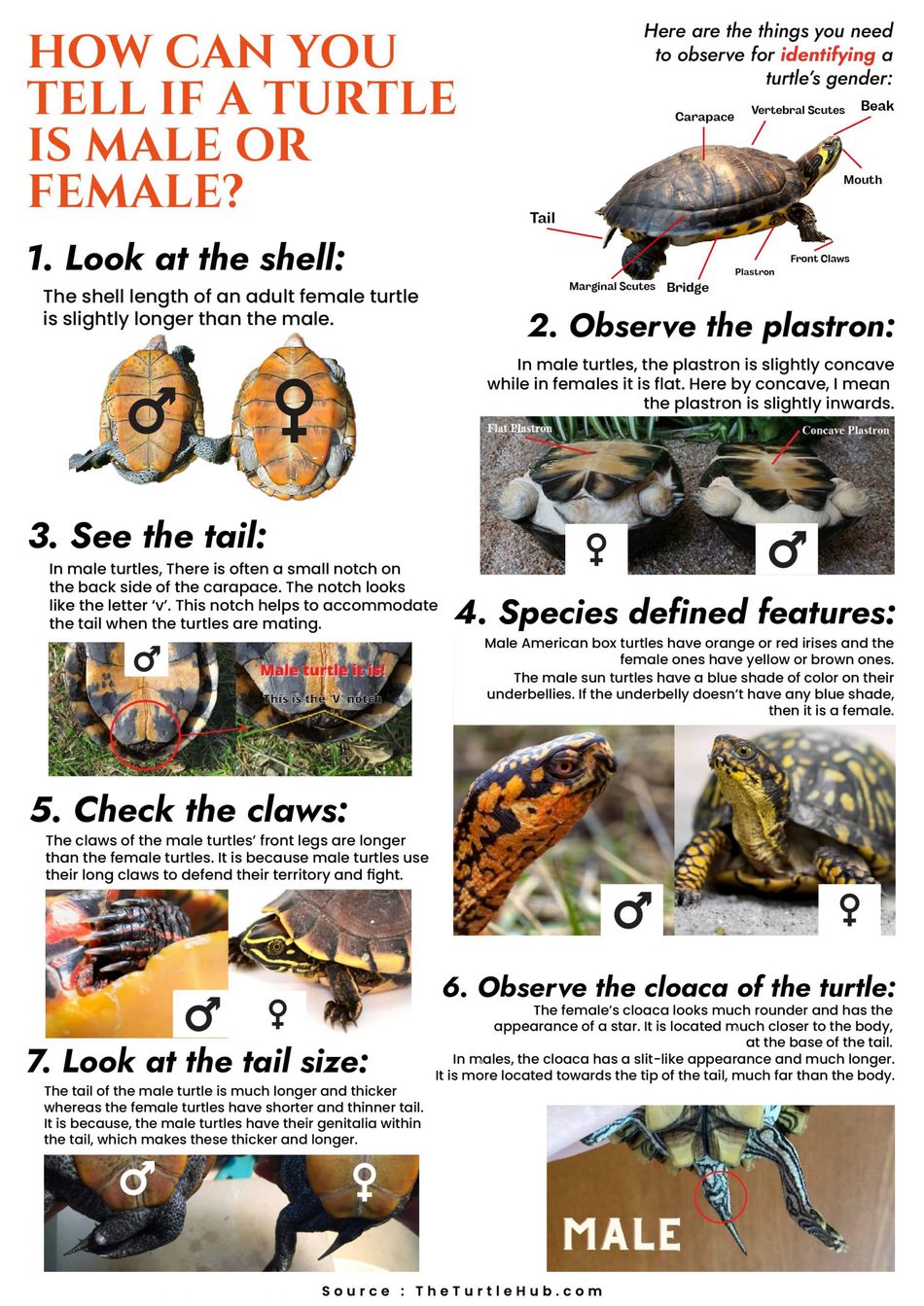
For a printable version of this amazing visual chart, click here!
The Most Reliable Methods
Check The Plastron (Bottom Shell)
Flip your turtle over gently. Look at the underside of the shell.
Male box turtles have a concave (curved inward) plastron. Think of it like a shallow bowl. This dip helps males balance on top of the female’s rounded shell during mating.
Female box turtles have a flat plastron. Sometimes it’s even slightly convex (curved outward). This gives females more room inside to carry eggs.
This is one of the most reliable indicators. But here’s the catch. Some females can have a slight concavity too. And some males barely show any dip at all.
So don’t stop here.
Look At The Tail
This one’s pretty telling.
Male box turtles have longer, thicker tails. The tail is muscular and beefy, especially at the base where it connects to the body.
Female box turtles have short, thin tails. Almost stubby by comparison.
Why the difference? Males use their tails for balance and positioning during mating. They need that extra heft.
There’s also a V-shaped notch at the rear edge of the male’s carapace (top shell) that accommodates the thicker tail. Females don’t have this notch.
Check The Cloaca Position
The cloaca is the vent opening on the underside of the tail. Both males and females have one.
On males, the cloaca is positioned further down the tail, closer to the tip. It extends past the edge of the shell.
On females, the cloaca sits much closer to the body, right at the base of the tail. It practically disappears under the shell’s edge.
This is actually one of the most reliable methods according to experienced keepers. But it requires you to compare, which means it works best if you have multiple turtles to look at side by side.
Look At The Eyes
This is the method everyone talks about. And honestly, it’s useful but not as reliable as people think.
Male Eastern box turtles typically have bright red or orange eyes. Like glowing ruby red.
Female Eastern box turtles usually have brown or dark reddish-brown eyes.
Sounds simple right?
But here’s the problem. Females can have red eyes too. Experienced keepers say female red eyes tend to be darker, more muted compared to the vibrant, almost neon red of breeding males.
Also, eye color seems to intensify in males during breeding season. It’s likely hormone-related.
And some subspecies don’t follow this pattern at all. Florida box turtles don’t show reliable eye color differences between sexes.
So use eye color as supporting evidence, not your only clue.
Other Clues That Can Help
Head and Body Coloration
Male box turtles are generally the show-offs.
Males tend to have more colorful heads and legs with bright orange, red, white, and black markings. Their face and neck markings are more pronounced.
Females are usually more muted. Browns and darker colors dominate.
Shell Shape
Beyond the plastron, there are differences in the top shell too.
Female box turtles typically have a higher, more domed carapace. This extra space helps accommodate eggs.
Males tend to have a flatter, more streamlined shell. The marginal scutes (the scales around the shell’s edge) also flare outward more on males.
Rear Claw Differences
This one’s interesting and often overlooked.
Male box turtles have shorter, thicker, more curved hind claws. They look almost like small talons. Males use these to grip the female’s shell during mating.
Female box turtles have longer, straighter hind claws. They use these for digging nests when laying eggs.
The “Fanning” Behavior
If you ever catch your box turtle “fanning” in water or wet grass, you’ve got a male.
This is when the turtle extends and displays its penis, which looks kind of like a dark purple flower. It’s a definitive sign, but you have to catch them doing it.
Subspecies Differences
The characteristics I’ve described apply broadly, but there are some subspecies quirks worth knowing.
Eastern Box Turtle
The “classic” box turtle. Eye color differences are most pronounced here. Males typically have very red eyes, females have brown.
The plastron concavity is usually quite noticeable in mature males.
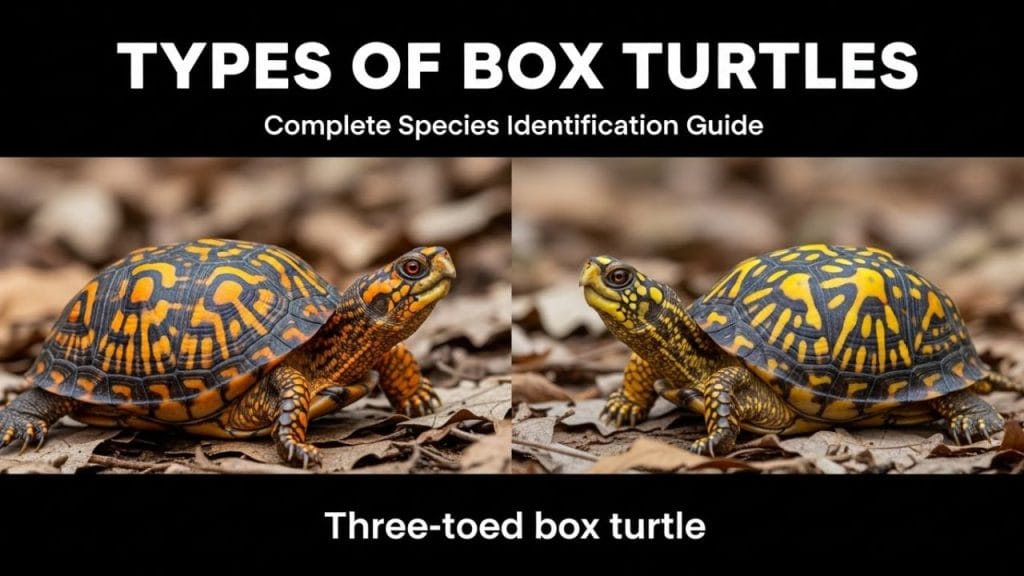
Three-Toed Box Turtle
Male three-toed box turtles often have dark red heads. The eye color distinction can be trickier here. Some keepers report seeing rusty orange eyes that are hard to classify as either male or female.
Check the plastron and tail. The plastron indentation may or may not be present.
Ornate Box Turtle
Here’s where things get different.
Female ornate box turtles are often larger than males at the same age. That’s the opposite of most subspecies.
Male ornates have a greenish or yellowish head. Females have brown heads.
Males have a distinctive curved inner claw on their back foot that turns inward.
The plastron concavity is much less obvious in ornates. Some males show only a very slight dip.
Gulf Coast Box Turtle
These guys are tricky because both sexes look very similar.
The male has a red iris while females don’t. Tail length and plastron shape remain your best bets.
Florida Box Turtle
Remember how I said eye color isn’t reliable for Florida box turtles? This subspecies doesn’t show the typical red vs brown eye distinction.
Focus on tail, plastron, and overall size instead.
Why Does Gender Even Matter?
Good question.
If you’re keeping a single box turtle as a pet, honestly? It doesn’t matter much.
But here’s when it does matter:
Housing multiple turtles.
Male box turtles can be aggressive toward each other. They’ll fight. They can also be aggressive toward females when they want to mate. If you’re not breeding, it’s often easier to house same-sex groups or keep turtles separate.
Breeding.
Obviously you need to know who’s who if you want baby turtles.
Health monitoring.
Female box turtles lay eggs even without a male around (they just won’t be fertile). If your turtle is a female, you need to provide appropriate nesting areas and watch for signs of egg-binding.
Can You Tell The Gender Of A Baby Box Turtle?
Short answer: Not reliably.
The physical differences between male and female box turtles develop as they mature. Before sexual maturity, the characteristics just aren’t pronounced enough to make a confident call.
Most box turtles don’t show clear gender characteristics until they’re at least 3-4 inches long and several years old. Full sexual maturity can take:
- 5-7 years for captive turtles
- 7-10 years for wild turtles
- Up to 20 years in some cases according to some sources
Captive box turtles often mature faster due to consistent food availability and optimal conditions.
If you hatched your turtle from an egg, there is one other option. Box turtles have temperature-dependent sex determination. Eggs incubated at cooler temperatures (below about 28°C/82°F) tend to produce males. Warmer temperatures produce females.
So if you know your incubation temperature, you have a pretty good guess.
The Only 100% Certain Methods
Let’s be real. Even experienced keepers sometimes get fooled.
The only ways to be absolutely certain:
- Eggs. If your turtle lays eggs, congratulations, she’s female.
- Fanning. If you see the penis display, definitely male.
- Mating behavior. If you witness actual mating… well, you know who’s who.
Everything else is educated guessing based on physical characteristics.
Common Mistakes To Avoid
Don’t rely on just one characteristic.
Eye color alone can fool you. Plastron shape alone can fool you. Use multiple indicators.
Don’t try to sex juveniles.
You’ll likely be wrong. Wait until the turtle is mature.
Don’t compare turtles of different ages.
A young male will look different from an adult female. Make sure you’re comparing apples to apples.
Don’t assume size indicates gender.
While males are often larger in some subspecies, ornate females are actually bigger. And a young male will always be smaller than an older female regardless of subspecies.
When In Doubt
Take your turtle to a reptile vet or an experienced herpetologist.
They’ve seen thousands of box turtles and know the subtle signs that come with experience. Some variations just require a trained eye.
Or simply wait. As your turtle ages, the differences become more apparent.
Wrapping Up
Figuring out your box turtle’s gender takes a bit of detective work.
Check the plastron shape. Look at the tail length and thickness. Find the cloaca position. Consider eye color for Eastern subspecies.
Put all those clues together, and you’ll have your answer.
Just remember: no single characteristic is 100% reliable, and young turtles are basically impossible to sex accurately.
Give your turtle time to grow. The truth will reveal itself eventually.
And if you’re still stumped after checking everything? At least you can pick a gender-neutral name.

About Author
Muntaseer Rahman started keeping pet turtles back in 2013. He also owns the largest Turtle & Tortoise Facebook community in Bangladesh. These days he is mostly active on Facebook.