How to Determine Box Turtle Age?
This post was created with help from AI tools and carefully reviewed by a human (Muntaseer Rahman). For more on how we use AI on this site, check out our Editorial Policy.
So you’ve got a box turtle and you’re dying to know how old it actually is.
Maybe you rescued it from the road. Maybe it’s been in your family for decades. Maybe you just want to brag about having an ancient reptile roommate.
Here’s the honest truth: there is no 100% accurate way to determine a box turtle’s exact age unless you were literally there when it hatched.
But don’t worry. There are several methods that can get you pretty close. Or at least close enough to impress people at parties.
Why Does Your Box Turtle’s Age Even Matter?
Knowing your turtle’s approximate age helps you provide better care.
Younger turtles need more protein in their diet. Adults eat more plants.
Feeding requirements, habitat needs, and even health concerns vary by life stage. A juvenile box turtle under 5 years needs daily feeding. An adult might only need food every other day.
Plus, box turtles can live 50 to 100+ years. If you’re taking one in, you might be signing up for a lifelong commitment. Literally.

Method 1: Count the Shell Rings (The Popular But Flawed Method)
This is the method everyone talks about.
Look at your box turtle’s shell. See those individual plates? Those are called scutes. Inside each scute, you’ll notice rings.
The idea is that each ring represents a year of growth, like counting tree rings.
How to Count the Rings
Pick one scute on your turtle’s carapace (the top shell). The costal scutes on the sides work best.
Look for alternating wide and narrow bands inside the scute.
Wide rings represent periods of healthy eating and warm weather growth. Narrow rings represent slower growth during winter or food scarcity.
Count all the rings in that scute. Then divide by two.
Example: 16 rings ÷ 2 = approximately 8 years old.
Why This Method Is Unreliable
Here’s where it gets complicated.
Rings don’t represent years. They represent growth spurts.
A turtle that finds an amazing food source might grow multiple rings in a single season. A sick turtle might not grow any rings for years.
Researchers who reviewed 145 scientific papers on ring counting found that only 6 studies reported it was reliable for aging turtles past sexual maturity. That’s a pretty terrible track record. Once you have a working estimate, our turtle age calculator converts it into human years for your species.
Field herpetologists say they’re not confident in ring counts beyond 10-12 years. Some say the method becomes useless after just 6-8 years, when turtles mature and growth slows down.
After about 15-20 years, the rings pack together so tightly they become impossible to count. In older turtles, the rings wear off completely from decades of scraping against rocks and dirt.
Bottom line: Ring counting works okay for juveniles under 10 years old. After that, it’s mostly guesswork.
This Hilarious Turtle Book Might Know Your Pet Better Than You Do

Let’s be real—most turtle care guides feel like reading a textbook written by a sleep-deprived zookeeper.
This one’s not that.
Told from the snarky point of view of a grumpy, judgmental turtle, 21 Turtle Truths You’ll Never Read in a Care Guide is packed with sarcasm, sass, and surprisingly useful insights.
And hey—you don’t have to commit to the whole thing just yet.
Grab 2 free truths from the ebook and get a taste of what your turtle really thinks about your setup, your food choices, and that weird plastic palm tree.
It’s funny, it’s honest, and if you’ve ever owned a turtle who glares at you like you’re the problem—you’ll feel seen.
Method 2: The Size Comparison Method
This one’s more practical for young turtles.
Box turtles grow at relatively predictable rates during their first several years. By measuring your turtle’s shell length and comparing it to growth charts, you can estimate age.
Box Turtle Size by Age (General Guide)
| Age | Approximate Shell Length |
|---|---|
| Hatchling | 1-1.5 inches |
| 1 year | 2-3 inches |
| 2-3 years | 3-4 inches |
| 4-6 years | 4-5 inches |
| Adult (7+ years) | 4.5-7 inches |
To measure, use the straight carapace length from the front of the shell to the back. Don’t follow the curve.
Subspecies Matters
Not all box turtles grow to the same size.
Eastern box turtles (Terrapene carolina carolina) typically reach 4.5-6 inches, occasionally up to 8 inches.
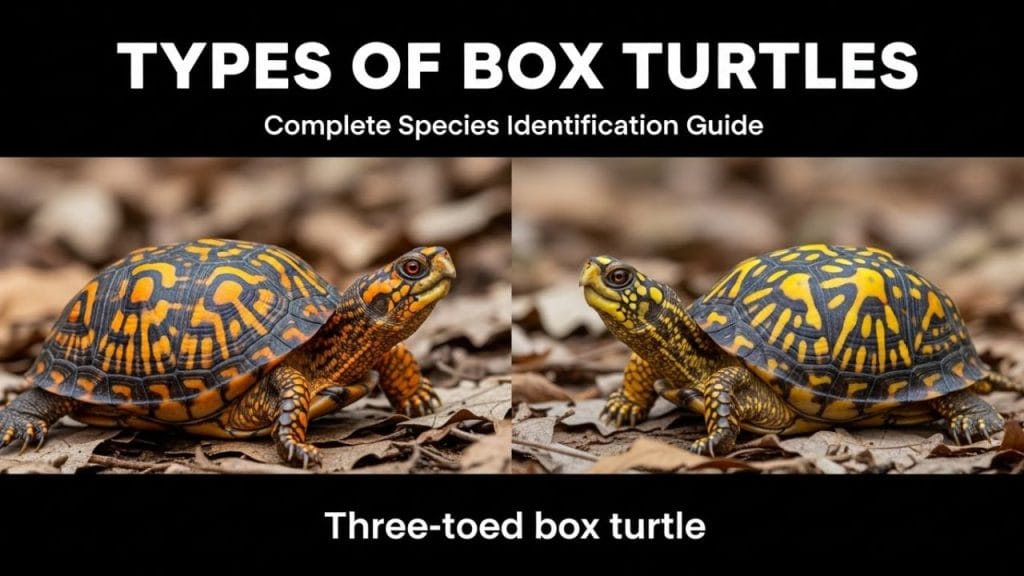
Three-toed box turtles (Terrapene carolina triunguis) are the smallest eastern subspecies, maxing out around 4.5-6 inches.
Gulf Coast box turtles (Terrapene carolina major) are the largest, reaching up to 7 inches or more.
Ornate box turtles (Terrapene ornata) stay smaller at 4-5 inches.
Why This Method Is Also Imperfect
Growth rate depends on diet, temperature, health, and whether the turtle hibernates.
Captive turtles grow faster than wild ones because they eat regularly and don’t hibernate.
A 5-inch turtle could be 6 years old or 20 years old depending on its history.
Once a box turtle reaches full adult size (usually by 15-20 years), this method becomes useless.
Method 3: Check for Signs of Sexual Maturity
Box turtles reach sexual maturity around 5-10 years old, with some taking up to 20 years in the wild.
If your turtle shows signs of being sexually mature, you know it’s at least this old.
How to Tell If Your Box Turtle Is Mature
For males:
- Red or orange eyes (females have brown or yellow-brown eyes)
- Concave (curved inward) plastron (belly shell)
- Thicker, longer tail with the cloaca positioned further from the shell
- More colorful head and neck markings
For females:
- Brown or yellow-brown eyes
- Flat plastron
- Has laid eggs (even infertile ones indicate maturity)
If your female has ever laid eggs, she’s definitely at least 5-10 years old.
Method 4: Observe Overall Shell Condition
This won’t give you a specific age, but it can help you distinguish between young, middle-aged, and old turtles.
Young Turtles (Under 15 Years)
- Bright, vivid shell colors
- Clearly defined scute patterns
- Visible, countable growth rings
- Smooth-edged marginal scutes (the small ones around the shell’s rim)
Middle-Aged Turtles (15-40 Years)
- Some fading of shell colors
- Growth rings starting to compress
- Slight wear on shell surfaces
- Still relatively smooth shell overall
Old Turtles (40+ Years)
- Shell appears worn and smooth like a river rock
- Growth rings completely worn away or impossible to count
- Dents, chips, and scars accumulated over decades
- Faded coloration
- Possible algae staining or mineral deposits
- Tips of marginal scutes may be worn or broken
Experienced keepers say an old box turtle’s shell takes on a polished, weathered look that’s unmistakable.
Method 5: Skeletochronology (The Scientific Method)
This is how researchers get the most accurate age estimates.
Scientists examine growth marks inside the turtle’s bones, similar to counting tree rings. The humerus bone (from the front leg) is most commonly used.
These Lines of Arrested Growth (LAGs) form annually during periods of slow growth, making them more reliable than shell rings.
The Catch
The turtle has to be dead.
This method requires removing and processing bones in a laboratory. It’s used for research and population studies, not for figuring out how old your pet is.
Even this method has limitations. The accuracy depends on the species and environment. Turtles in tropical areas without distinct seasons may not form clear annual marks.
Method 6: Known History (The Only Accurate Method)
The only way to know your box turtle’s exact age is to have documentation from when it hatched.
This could be:
- Records from a breeder
- Documentation from a rescue organization
- Family records (if grandpa carved his initials into its shell in 1952)
That documented 100-year-old box turtle in North Carolina? It was found in 2002 with markings on its shell made by a naturalist in 1921, who had already judged it to be at least 20 years old back then.
Without documentation, you’re estimating.
The Combined Approach: Your Best Bet
Since no single method is reliable, smart turtle keepers use multiple methods together.
Here’s a practical approach:
For hatchlings and juveniles:
- Measure shell length and compare to growth charts
- Count rings if clearly visible
- Note: Captive-raised? Subtract a bit, they grow faster
For adults:
- Confirm sexual maturity
- Assess shell condition (worn vs. pristine)
- If rings are visible and countable, use as a rough guide
- Consider asking a reptile vet for their assessment
For old turtles:
- Look for worn, smooth shells with faded colors
- Assume 30+ years if heavily weathered
- Accept that you’ll never know exactly
How Long Do Box Turtles Actually Live?
Since we’re talking about age, let’s address the elephant in the room.
Wild box turtles typically live 30-50 years, with many reaching 50-80 years.
In captivity with proper care, box turtles routinely live 40-50 years, and living past 100 is documented.
According to Wikipedia, “the average life span of adult box turtles is 50 years, while a significant portion lives over 100 years.”
The Smithsonian National Zoo states box turtles “generally live for 25-35 years but have been known to survive to over 100 years old.”
A North Carolina study is currently tracking box turtles for 100 years specifically because their lifespan matches human lifespan.
What Age Should You Tell People?
If someone asks how old your box turtle is, here’s what I recommend:
- If it’s a juvenile with measurable rings: Give your estimate with a disclaimer. “Based on the rings and size, probably around 6-8 years old.”
- If it’s an adult with worn rings: Give a range. “Somewhere between 20 and 40 years old, hard to say exactly.”
- If it’s clearly ancient with a smooth, weathered shell: Just say “old.” Because honestly, it could be 50 or 100 and there’s no good way to know.
- If you have documentation: Brag away.
Final Thoughts
Box turtles are one of nature’s most impressive survivors. They’ve been around essentially unchanged for 15 million years.
The fact that we can’t easily age them is kind of fitting. They live on their own schedule, growing when conditions are right, surviving when they’re not.
Your box turtle might be 20 years old. It might be 80. Does it really matter?
What matters is providing proper care now. Good diet, appropriate habitat, proper temperature, and clean water.
Do that, and your turtle might outlive you. Literally.
And wouldn’t that be something to brag about?

About Author
Muntaseer Rahman started keeping pet turtles back in 2013. He also owns the largest Turtle & Tortoise Facebook community in Bangladesh. These days he is mostly active on Facebook.