Box Turtle vs Tortoise: 6 Differences (And Why It Matters)

This post was created with help from AI tools and carefully reviewed by a human (Muntaseer Rahman). For more on how we use AI on this site, check out our Editorial Policy.
Here’s a scenario that plays out in pet stores every single week.
Someone spots a box turtle. Domed shell. Walks on land. Moves like it has absolutely nowhere to be. They turn to the store employee and go, “So this is basically a tortoise, right?”
Wrong. But honestly? It’s a very understandable mistake.
Box turtles and tortoises look so similar that even experienced reptile keepers do a double-take sometimes. But they are genuinely different animals — different families, different needs, different biology. And if you’re planning to keep one as a pet, mixing them up can seriously hurt your animal.
Let’s clear this up once and for all.
The One-Sentence Answer
Box turtles belong to the family Emydidae — the pond turtle family. Tortoises belong to the family Testudinidae. Different families, different animals.
That’s the short version. The longer version is a lot more interesting.
Warning: You Might Spend Hours Here
I’ve built the ultimate turtle and tortoise species database. This isn’t your average turtle list. Filter by genus, conservation status, and more. How many species? Which are endangered? What’s the tiniest one? It’s all there.
Side-by-Side Comparison
| Feature | Box Turtle | Tortoise |
|---|---|---|
| Scientific family | Emydidae | Testudinidae |
| Shell plastron | Hinged — can fully close | Fixed — cannot fully close |
| Habitat | Moist forests, near water | Dry land, arid environments |
| Humidity needs | High (60–80%) | Low |
| Feet | Slightly webbed with claws | Thick, columnar, elephant-like |
| Can they swim? | Yes, short distances | No — will drown in deep water |
| Diet | Omnivore | Mostly herbivore |
| Lifespan | Up to 40–50 years | 80–150+ years |
| Size | 4–7 inches typically | Varies — up to 1.3m for giants |
| Native range | Primarily North America | Africa, Asia, Americas |
| Homing instinct | Extremely strong | Moderate |
| Conservation status | Many species vulnerable | Varies by species |
This Hilarious Turtle Book Might Know Your Pet Better Than You Do

Let’s be real—most turtle care guides feel like reading a textbook written by a sleep-deprived zookeeper.
This one’s not that.
Told from the snarky point of view of a grumpy, judgmental turtle, 21 Turtle Truths You’ll Never Read in a Care Guide is packed with sarcasm, sass, and surprisingly useful insights.
And hey—you don’t have to commit to the whole thing just yet.
Grab 2 free truths from the ebook and get a taste of what your turtle really thinks about your setup, your food choices, and that weird plastic palm tree.
It’s funny, it’s honest, and if you’ve ever owned a turtle who glares at you like you’re the problem—you’ll feel seen.
Why Do People Confuse Them?
Because they’re both playing the same trick on you.
Box turtles live mostly on land. They have a domed shell. They’re slow. They eat plants. From a distance, they look almost identical to a tortoise. This is called convergent evolution — two unrelated animals developing similar traits because they face similar challenges.

The problem is that “looks similar” doesn’t mean “is the same.” Classification in biology is about evolutionary history and shared anatomy, not just appearance. And when you look closely at box turtles and tortoises side by side, the differences are hard to miss.
The Actual Differences
1. The Family Tree
This is the one that matters most scientifically.
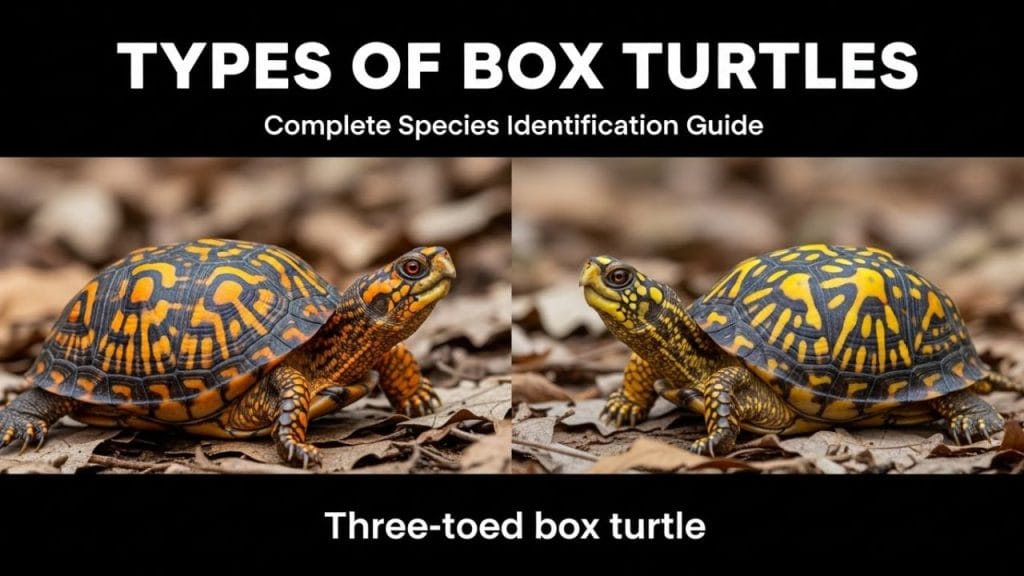
Box turtles (genus Terrapene) sit inside the family Emydidae — the same family as red-eared sliders, painted turtles, and map turtles. These are pond and river turtles. Box turtles just happen to be the land-loving members of that group.
Tortoises belong to a completely separate family: Testudinidae. All true tortoises — Russian tortoises, Sulcata tortoises, Galapagos giants — live in this family and have done so for millions of years.
Think of it this way. A bat and a bird both have wings and can fly. But a bat is a mammal and a bird is, well, a bird. The wings are a coincidence of evolution, not proof of shared ancestry. Box turtles and tortoises are in a similar situation.
2. The Hinged Shell
This is the box turtle’s most distinctive feature — and it’s something no tortoise has.
A box turtle’s plastron (the bottom part of the shell) has a flexible hinge. When threatened, the turtle can pull everything inside and literally close itself shut, like a box. Air gets pushed out as it seals up, sometimes making a small hissing sound. The shell locks so tight that most predators simply give up.
Tortoises can pull their head and legs into their shell, but they can’t close it completely. Their plastron is fixed, not hinged.
If you see a turtle that can completely seal itself into its own shell — it’s a box turtle, not a tortoise.
3. Moisture and Water Needs
Here’s where the care difference becomes critical.
Box turtles need moisture. They live in deciduous forests, swamps, marshy meadows, and areas near water. They require humidity levels of 60–80%, regular soaking, and moist substrate to burrow into. If a box turtle can’t find moisture, it will burrow deeper and deeper trying to find it. A dry enclosure will stress it, weaken its immune system, and eventually kill it.
Tortoises are the opposite. They evolved in hot, dry environments — deserts, scrublands, arid grasslands. They get most of their hydration from the plants they eat. Too much humidity and you’re looking at shell rot and respiratory infections.
Put a box turtle in a dry tortoise enclosure (my pick: Aivituvin Wooden Tortoise Habitat): you’ll have a sick turtle within days. Put a tortoise in a humid box turtle setup: same result, different direction.
This is the most important practical difference if you’re keeping either as a pet.

4. The Feet
Look at the feet and you can tell immediately.
Box turtles have somewhat webbed feet with claws — a holdover from their Emydidae pond turtle relatives. They’re not great swimmers, but they can wade through shallow water and have been observed swimming across rivers and ponds when needed.
Tortoises have thick, columnar legs that look like miniature elephant feet. No webbing. No flippers. Pure land-walking machinery. Drop a tortoise in deep water and it sinks — it has no mechanism for swimming and will drown.
5. Diet
Both will eat plants. But box turtles go well beyond that.
Box turtles are true omnivores. Their diet in the wild includes worms, insects, berries, mushrooms, carrion, and pretty much anything else they can find. Interestingly, they can eat certain mushrooms that are toxic to humans without any ill effect — scientists think this may actually make box turtle meat temporarily toxic to humans who eat them, which is a wild defense mechanism.
Tortoises are primarily herbivores. Grasses, leafy greens, weeds, the occasional fruit. Some species like Redfoot tortoises lean more omnivorous, but as a general rule tortoises are plant eaters and box turtles are not.
6. Home Range and Homing Instinct
Box turtles have one of the strongest homing instincts in the reptile world.
Studies show that eastern box turtles can stay within the same home range for over 30 years. If you relocate one, it will often spend the rest of its life trying to walk back to where it came from — sometimes tripling its normal range in the attempt. Some give up eating entirely in the effort. This is why wildlife organizations strongly advise against moving wild box turtles, even with good intentions.
Tortoises don’t show the same level of site fidelity. They roam more freely within their territory and don’t have the same obsessive attachment to a specific patch of land.

So What Is a Box Turtle, Exactly?
A box turtle is a land-adapted member of the pond turtle family that evolved to live on land — but never fully cut ties with moisture and water.
It’s like someone who grew up near the ocean, moved inland, but still needs to take a long bath every week and can’t stop craving seafood. Technically inland. Spiritually still coastal.
Box turtles sit in a genuinely unique ecological position. They’re not aquatic like sliders. They’re not desert-dry like tortoises. They’re somewhere in the middle, which is part of what makes them so interesting — and also what makes them tricky to care for if you don’t understand what they actually are.
Does It Matter for Pet Care?
Yes. A lot.
The single most common mistake box turtle owners make is treating them like tortoises — dry enclosure, minimal water, substrate that doesn’t hold moisture. Box turtles kept in those conditions will burrow constantly (a stress signal), stop eating, and develop health problems fast.
A proper box turtle setup needs:
- Moist substrate at least 4 inches deep for burrowing
- Humidity maintained at 60–80%
- A shallow water dish big enough to soak in — water level should only reach the bottom of the shell when standing
- Access to natural sunlight or full-spectrum UVB (my pick: Zoo Med ReptiSun 10.0) lighting
- A varied omnivorous diet — not just vegetables
A tortoise setup is almost the opposite in most of those categories. Know which one you have before you build the enclosure.
The Bottom Line
Box turtles are not tortoises. They look similar because evolution produced two animals facing some of the same land-dwelling challenges — but their family trees diverged a long time ago, and their biology reflects that.
The three things to remember:
- Box turtles have a hinged shell that closes completely. Tortoises don’t.
- Box turtles need moisture and humidity. Tortoises need dry heat.
- Box turtles are classified in the pond turtle family (Emydidae). Tortoises are in their own family (Testudinidae).
If you’ve got a domed turtle that seals itself shut when you pick it up — that’s your box turtle. Treat it like the moisture-loving, mushroom-eating, surprisingly territorial little pond turtle it actually is.

About Author
Muntaseer Rahman started keeping pet turtles back in 2013. He also owns the largest Turtle & Tortoise Facebook community in Bangladesh. These days he is mostly active on Facebook.