10 Free Crochet Turtle Keychain Patterns (No-Sew, Mini & Under 20 Minutes)
This post was created with help from AI tools and carefully reviewed by a human (Muntaseer Rahman). For more on how we use AI on this site, check out our Editorial Policy.
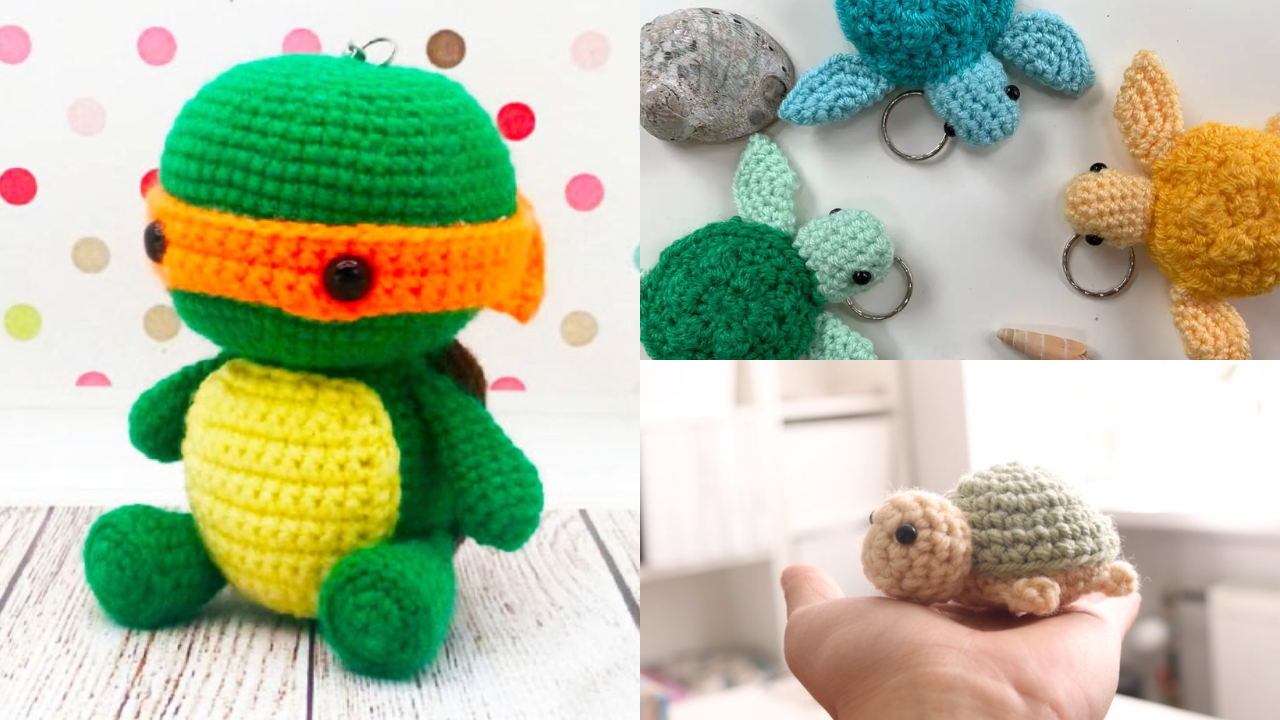
There is a specific kind of joy in pulling your keys out of your bag and finding a tiny turtle staring back at you.
Turtle keychains are the perfect crochet project for the exact reason most projects are not. They are small, they are fast, and they use the sad little leftover bits of yarn you have been refusing to throw away for two years.
You can finish one during a single episode of something. Some of these you can finish during the opening credits.
Here is the annoying part though. Search for a free turtle keychain pattern and you get a wall of sites that copied someone else’s pattern, slapped ads on it, and did not credit the designer.
So we went and found the real ones. Every pattern below is genuinely free, and every link goes to the designer who actually wrote it. We checked each one.
We also cut a few that looked great until we opened them. One popular “keychain” pattern turned out to be $3.50. Another finishes at seven inches across, which is not a keychain, that is a hostage situation for your pocket.
What Makes a Good Keychain Pattern (It Is Not Just “Small”)
A turtle keychain lives a rough life. It gets shoved in pockets, sat on, dropped on parking lot gravel, and yanked around by a set of keys heavier than it is.
That changes what you want from the pattern.
Tight stitches matter more than usual. Loose amigurumi shows stuffing through the gaps, and on something this small it looks messy fast.
Fewer pieces is better. Every sewn-on limb is a limb that can work loose after three months in a bag.
Size is the whole game. Anything over about 4 inches stops being a keychain and starts being a small stuffed animal you are dragging around.
Most of these use a hook between 2.5mm and 4mm, which is smaller than you would use for a normal amigurumi of the same pattern. That is deliberate. Smaller hook, tighter fabric, no stuffing peeking out.
The 10 Free Patterns at a Glance
| # | Pattern | Designer | Hook | Finished Size | Sewing |
|---|---|---|---|---|---|
| 1 | Small Amigurumi Turtle | Abigail, Knits and Knots by AME | 3.5mm | Palm-sized | One seam |
| 2 | No Sew Turtle Keychain | Nina Valovirta | 2.5mm | Mini | None at all |
| 3 | Free Turtle Pattern | Mariska Vos-Bolman, DIY Fluffies | 2.5mm or 5mm | 8cm or 17cm | Almost none |
| 4 | Small Turtle Keychain | Vicki Roberts, Off the Hook for You | 4mm + 3.5mm | 9cm x 7cm | Some |
| 5 | Amigurumi Turtle Keychain | Bi Do Handmade, My Crafty Basket | 2.5mm | 10cm | Yes |
| 6 | Sitting Turtle Keychain | Bi Do Handmade, My Crafty Basket | 2.5mm | Mini | Yes |
| 7 | Tori the Turtle | Jade, Sweet Softies | 3.25mm | 4 inches | Yes |
| 8 | Ninja Turtle Keychain | Oksana Sonnova, Amigurumi Day | 2.5mm | 13cm | Yes |
| 9 | No-Sew Crochet Turtle | Fay, Stitch by Fay | 2.5mm (2mm to shrink) | Small | None |
| 10 | Jelly Bean No-Sew Turtle | Sara, Darling Maple Designs | 5mm | Tiny | None |
Your Yarn Stash Called. It Wants to Be a Turtle.
Look, you could spend another weekend scrolling Pinterest for the “perfect” turtle pattern.
Or you could grab one that’s already perfect.
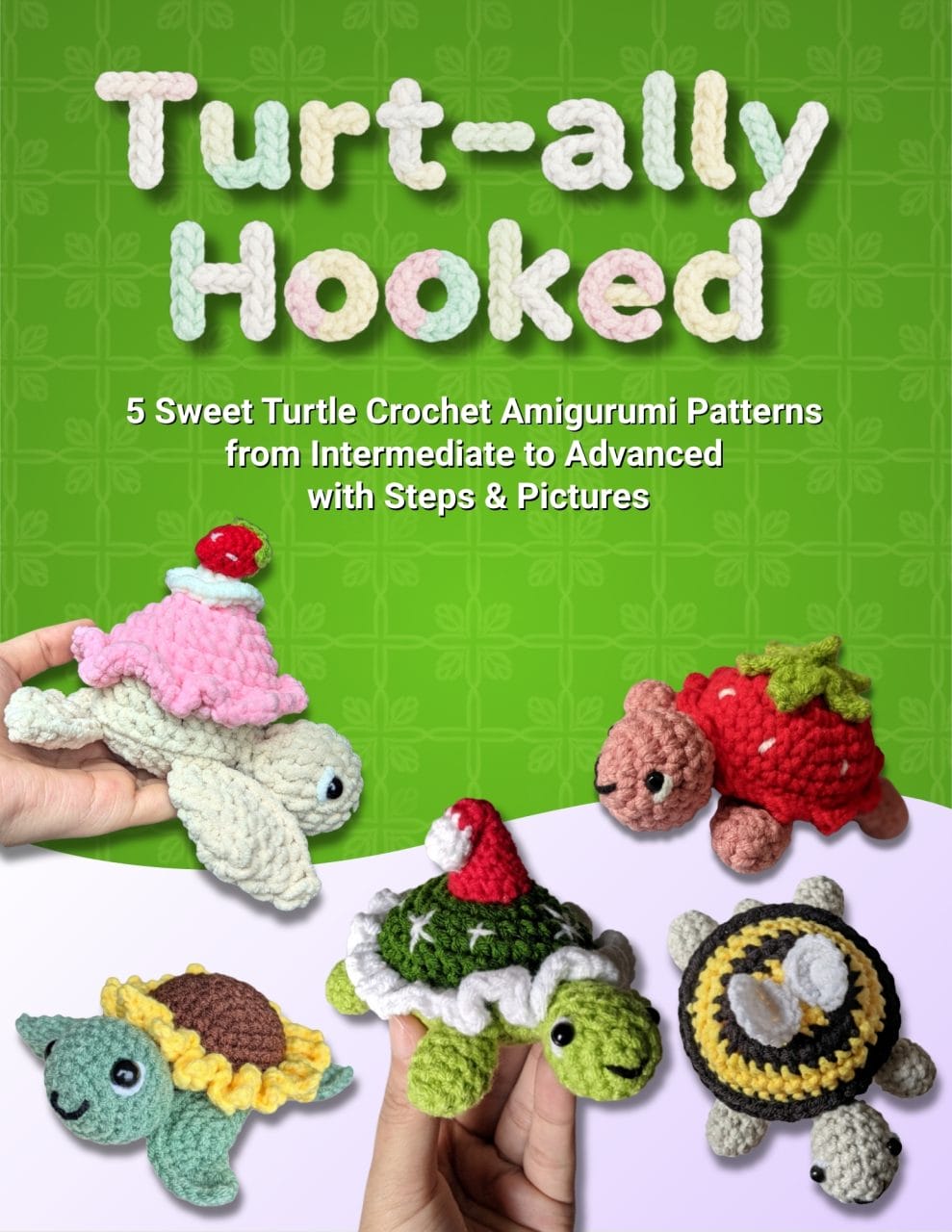
Turt-ally Hooked gives you 5 complete turtle patterns—each with a different theme, personality, and skill level.
Bee, strawberry, sunflower, Christmas, and cupcake. All adorable. All doable.
It’s straightforward, it’s cute, and if you’ve been meaning to make something other than another scarf—here’s your chance.
Fast Turtles You Can Finish Tonight
These are the ones to start with if you want a finished keychain today, not a project that sits in a basket judging you.
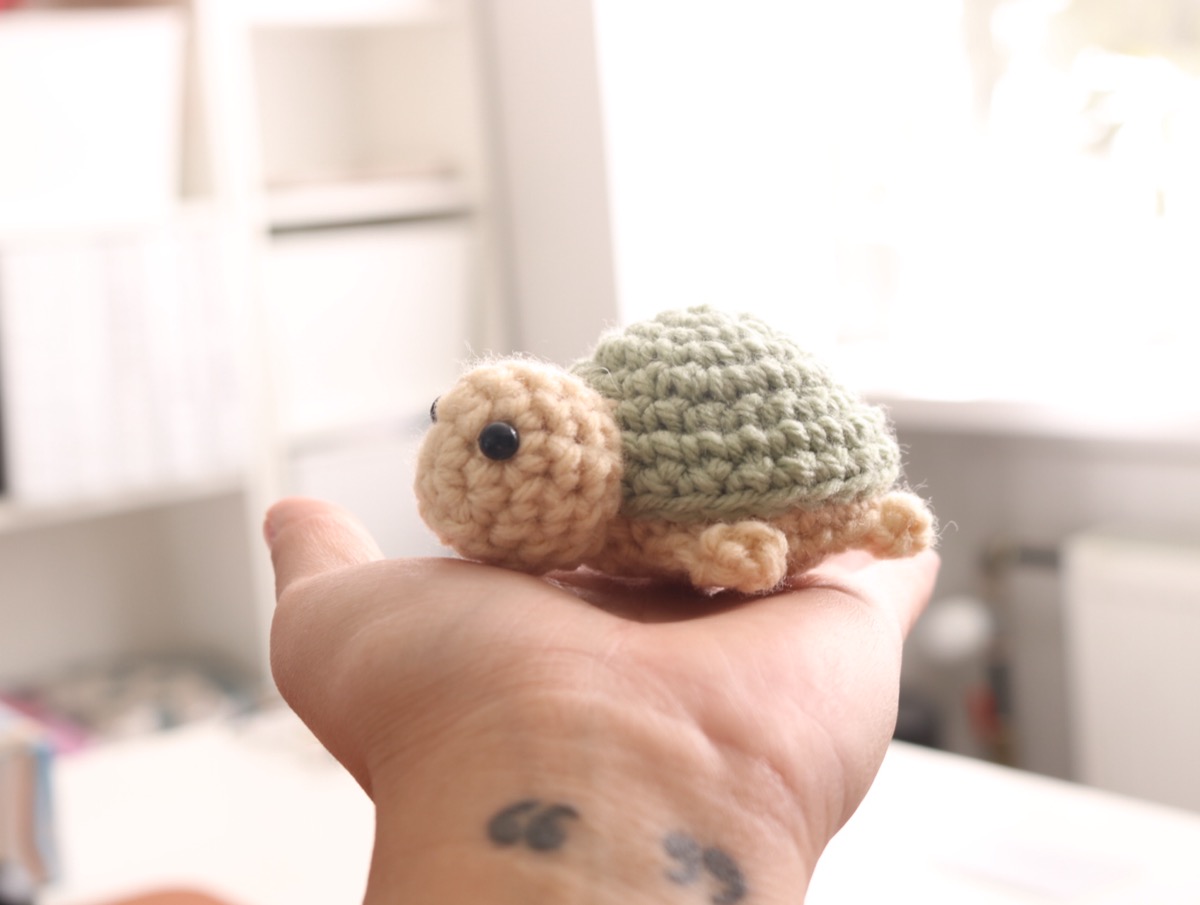
1. Small Amigurumi Turtle by Knits and Knots by AME
Abigail’s turtle takes less than 20 minutes.
That is not marketing language, that is the actual working time once you know the stitches. It uses worsted weight yarn and a 3.5mm hook, so the fabric works up quick and dense.
It finishes small enough to sit in your palm. The shell and body are made separately and the head gets one seam with a curved needle, which is the only sewing in the whole thing.
If you want to make ten of these for a craft fair table, this is the one.
Get the free pattern from Knits and Knots by AME
2. No Sew Turtle Keychain by Nina Valovirta
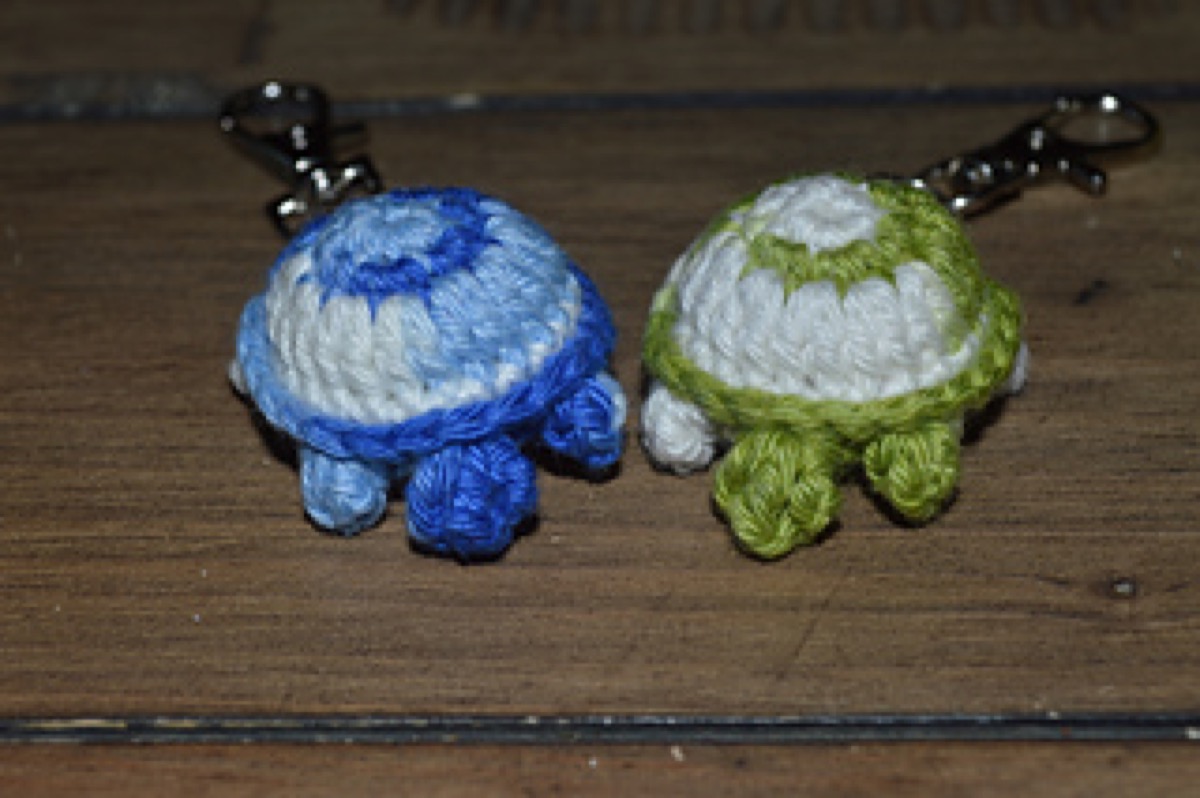
This is the only pattern on this list with truly zero sewing.
Not “almost no sew.” Not “just attach the head.” You start at the top of the shell and work continuously down to the bottom of the body, and it comes off your hook finished.
It uses sport weight yarn with a 2.5mm hook. The pattern is a free Ravelry download and comes in both English and Finnish.
If you hate seaming, and most people quietly do, start here.
Get the free pattern on Ravelry
3. Free Turtle Pattern by DIY Fluffies
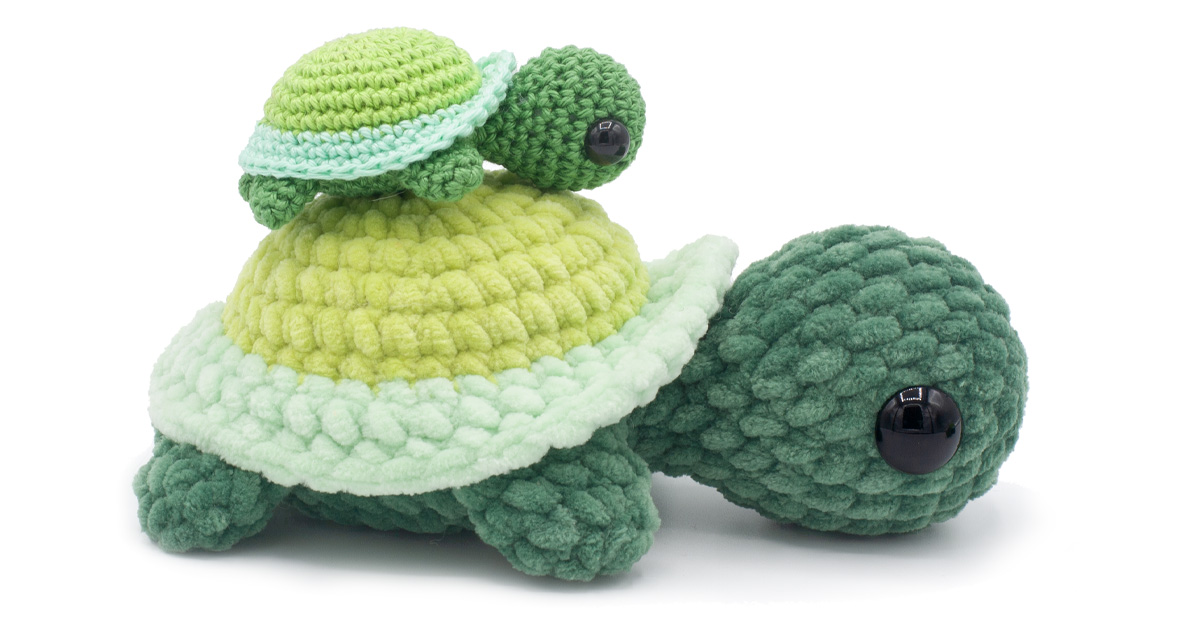
Mariska Vos-Bolman built this one to take 1 to 2 hours, and it is almost no-sew. The only thing you attach is the head.
What makes it worth a slot is the sizing flexibility. Work it in sport weight cotton on a 2.5mm hook and you get an 8cm turtle that she specifically notes is a great keychain size.
Work the same pattern in chenille on a 5mm hook and you get a 17cm squishy plush instead.
One pattern, two completely different objects. Good value for the time it takes to read it.
Get the free pattern from DIY Fluffies
Classic Amigurumi Turtle Keychains
These take a bit longer and involve real assembly. They also look the most finished, which matters if you are gifting or selling.
4. Small Crochet Turtle Keychain by Off the Hook for You
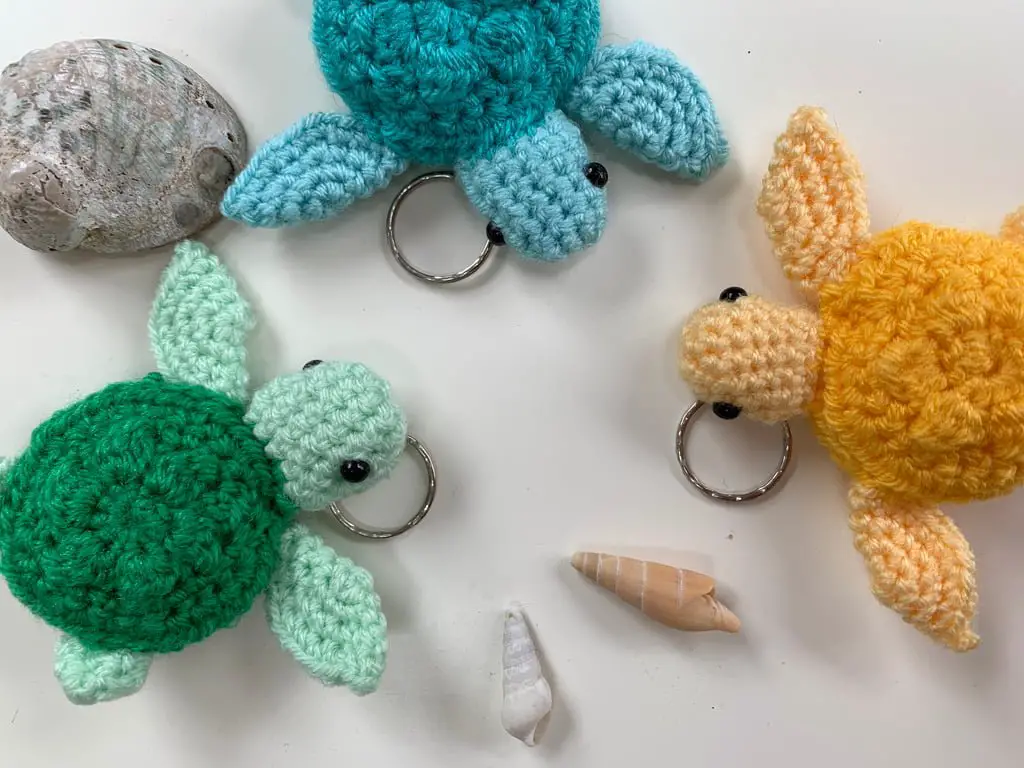
Vicki Roberts designed these as keyrings from the start, and it shows.
The standout detail is the shell. She works it in bobble stitch, so instead of a flat green disc you get actual raised texture that reads as a real turtle shell.
It finishes at 9cm x 7cm and sits about 2cm tall when lightly stuffed. She wrote it in both US and UK terms, which saves you the usual translation headache.
It uses DK yarn with a 4mm hook for the body and a 3.5mm for the shell. Genuine scrap-buster.
Get the free pattern from Off the Hook for You
5. Amigurumi Turtle Keychain by My Crafty Basket
Bi Do Handmade’s version is the most polished-looking turtle here, and it comes with a video tutorial alongside the written pattern.
That combination is rare in free patterns and it is the reason this one is worth your time if you are still shaky on shaping.
It uses milk cotton yarn (my pick: 24-pack milk cotton yarn) in two colors with a 2.5mm hook and finishes around 10cm wide. This one does need real sewing, including assembling the shell pieces and attaching the limbs.
Written in US and UK terms.
Get the free pattern from My Crafty Basket
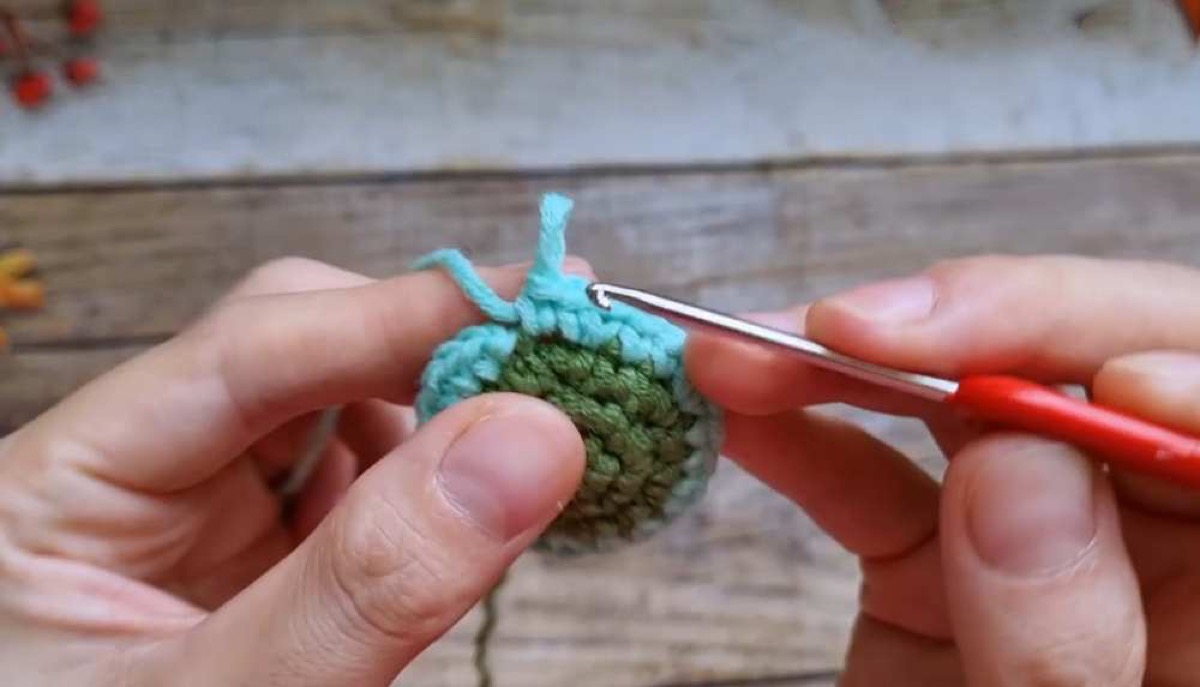
6. Sitting Turtle Keychain by My Crafty Basket
Yes, this is Bi Do Handmade again. No, we are not padding the list.
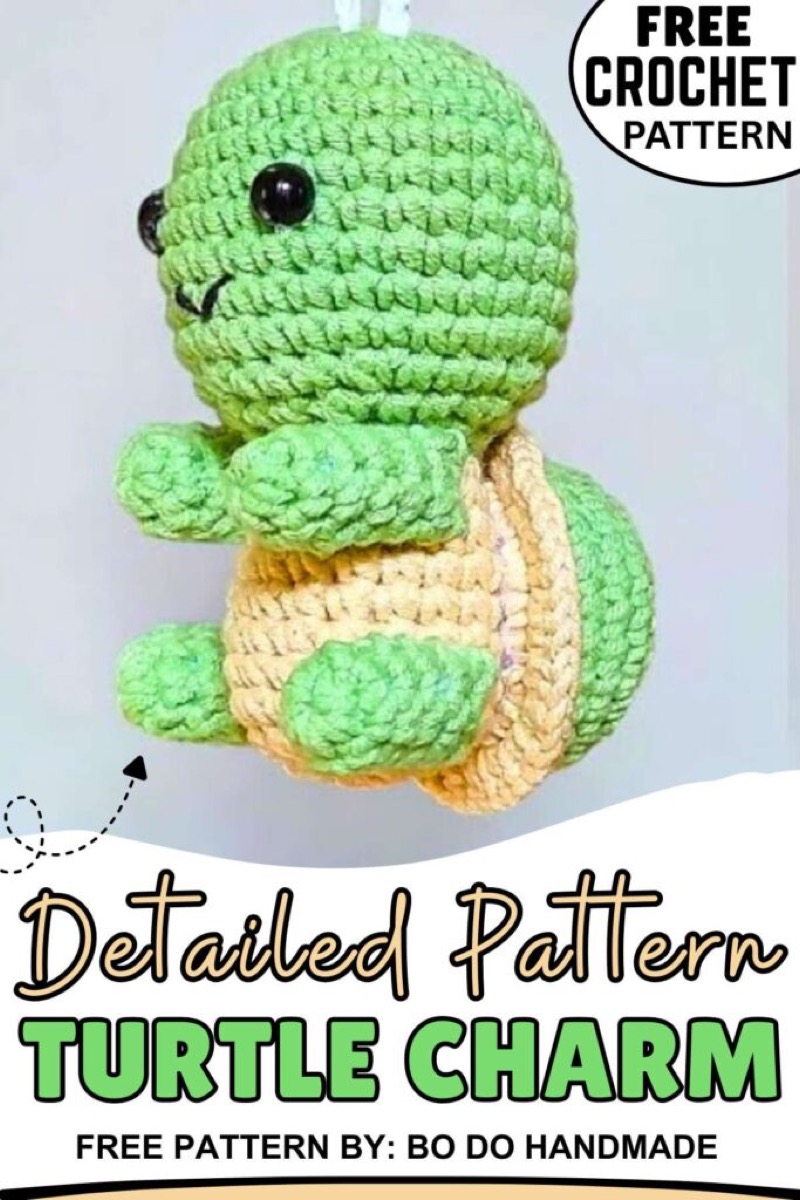
The first one is a turtle lying flat, the way almost every amigurumi turtle is built. This one sits upright on its back legs, which changes how it hangs off a keyring completely.
A flat turtle spins and shows you its underside half the time. A sitting turtle keeps facing forward.
It uses the same 2.5mm hook and milk cotton, this time in green and cream. The pieces are small and it sticks to single crochet with basic increases and decreases, so it is a genuine beginner project.
Get the free pattern from My Crafty Basket
7. Tori the Turtle by Sweet Softies
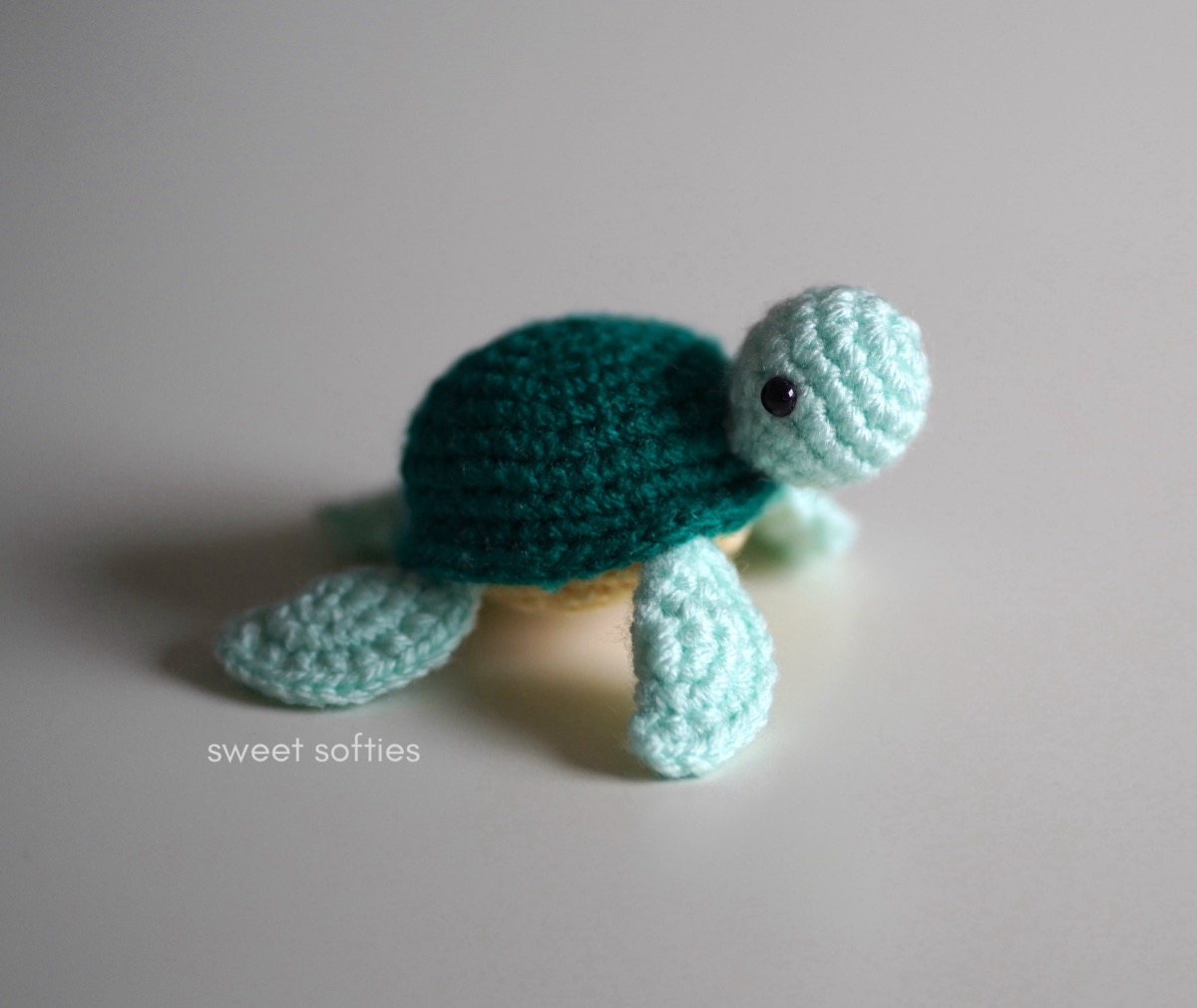
Tori is a beginner pattern from Jade at Sweet Softies, worked at 3.25mm and finishing about 4 inches across.
She is at the upper end of keychain size, so this is the one to make if you want something closer to a bag charm than a key fob.
What Jade does well here is leave room for customizing. She built Tori as a blank canvas and openly suggests adding buttons, bows, or flowers, which means you can make six and have six different turtles.
Tori also stands up on her own, so she works as a desk turtle when she is not on your keys.
Get the free pattern from Sweet Softies
8. Ninja Turtle Keychain by Amigurumi Day
If you grew up on pizza and sewers, this one is for you.
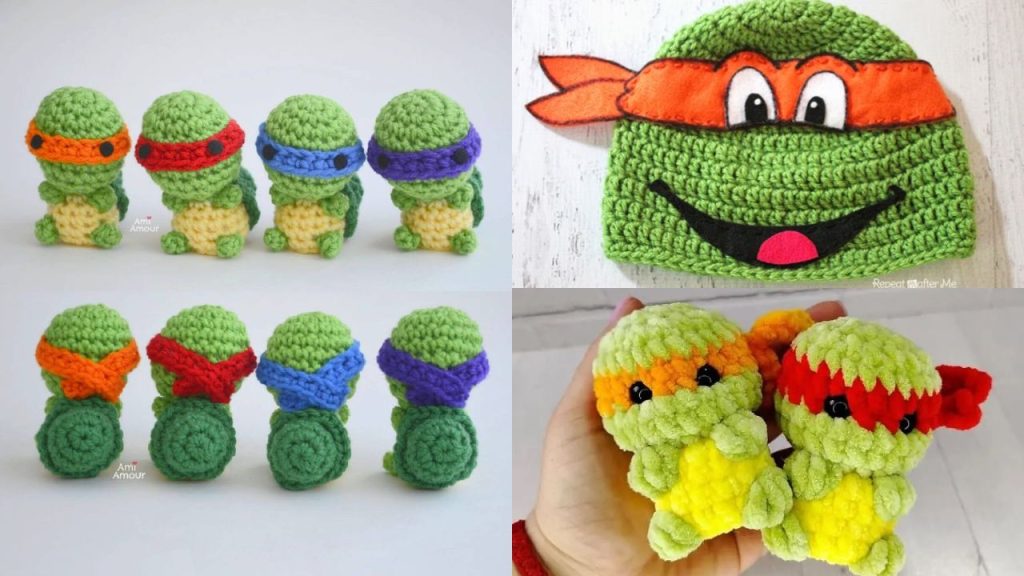
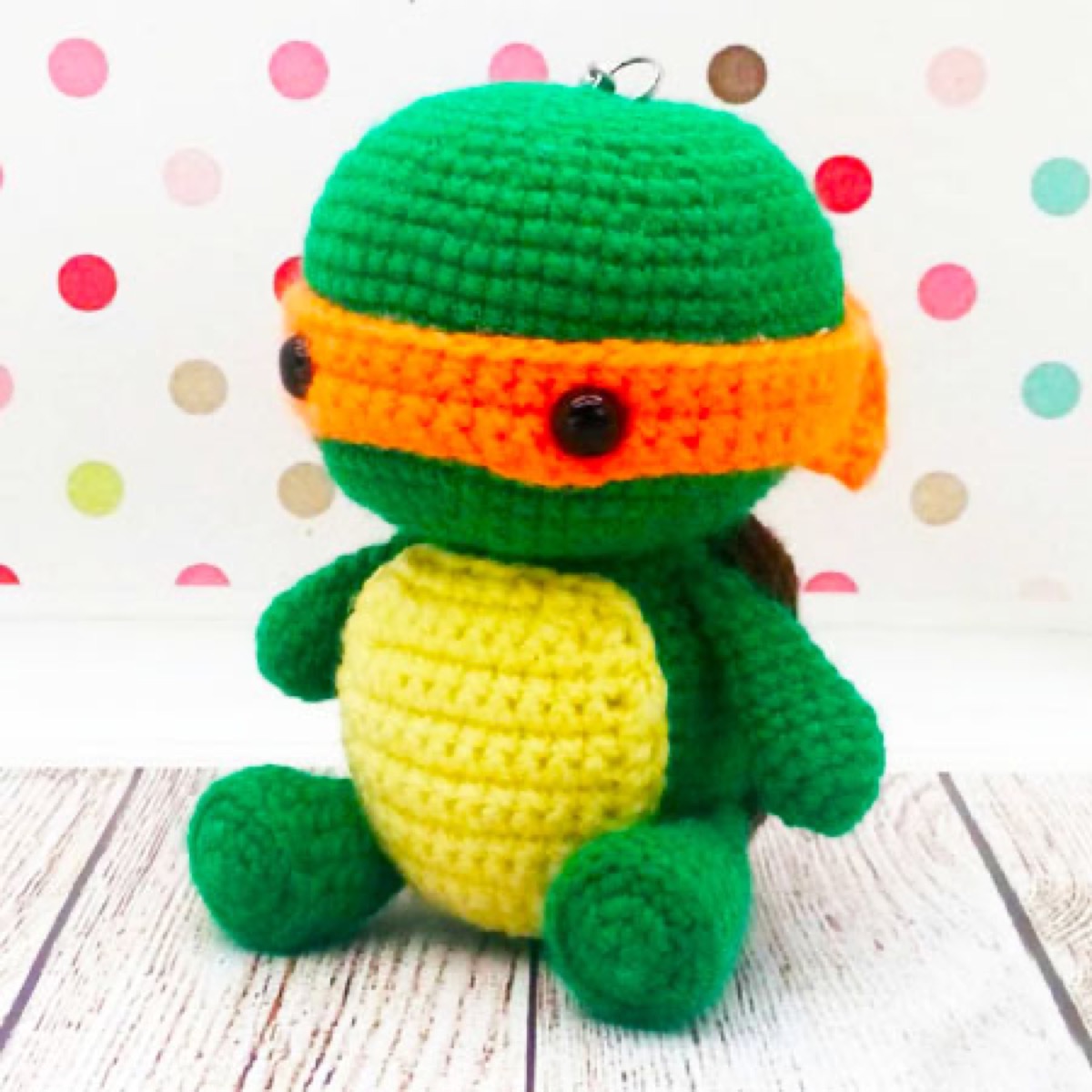
Oksana Sonnova’s pattern uses a 2.5mm hook with acrylic yarn and finishes around 13cm. The point of it is the bandana, which you make in blue, purple, orange or red to get Leonardo, Donatello, Michelangelo or Raphael.
Making all four and putting them on four different sets of house keys is a genuinely good idea that we are not taking credit for.
Get the free pattern from Amigurumi Day
If you want the rest of the crew in hat and blanket form, we rounded those up in our free crochet ninja turtle patterns post.
Two Turtles to Size Down Into Keychains
These were not written as keychains, but both shrink beautifully and both are no-sew, which makes them ideal candidates.
9. No-Sew Crochet Turtle by Stitch by Fay
Fay’s turtle is built from 6 separate pieces, but the head and flippers get crocheted in as you work the body, so nothing is seamed afterward.
She writes it for cotton DK on a 2.5mm hook, which is already a tight little turtle. To take it down to keychain size, go to fingering weight on a 2mm hook and reduce your starting stitch count slightly.
That last part is our suggestion rather than hers, so treat the first one as a test run. She does note the pattern tolerates yarn swaps as long as you adjust the starting stitches for the head and shell to stop them coning.
The construction is the real draw here. Because the pieces join as you go, the finished turtle holds its shape better than a sewn one of the same size.
Get the free pattern from Stitch by Fay
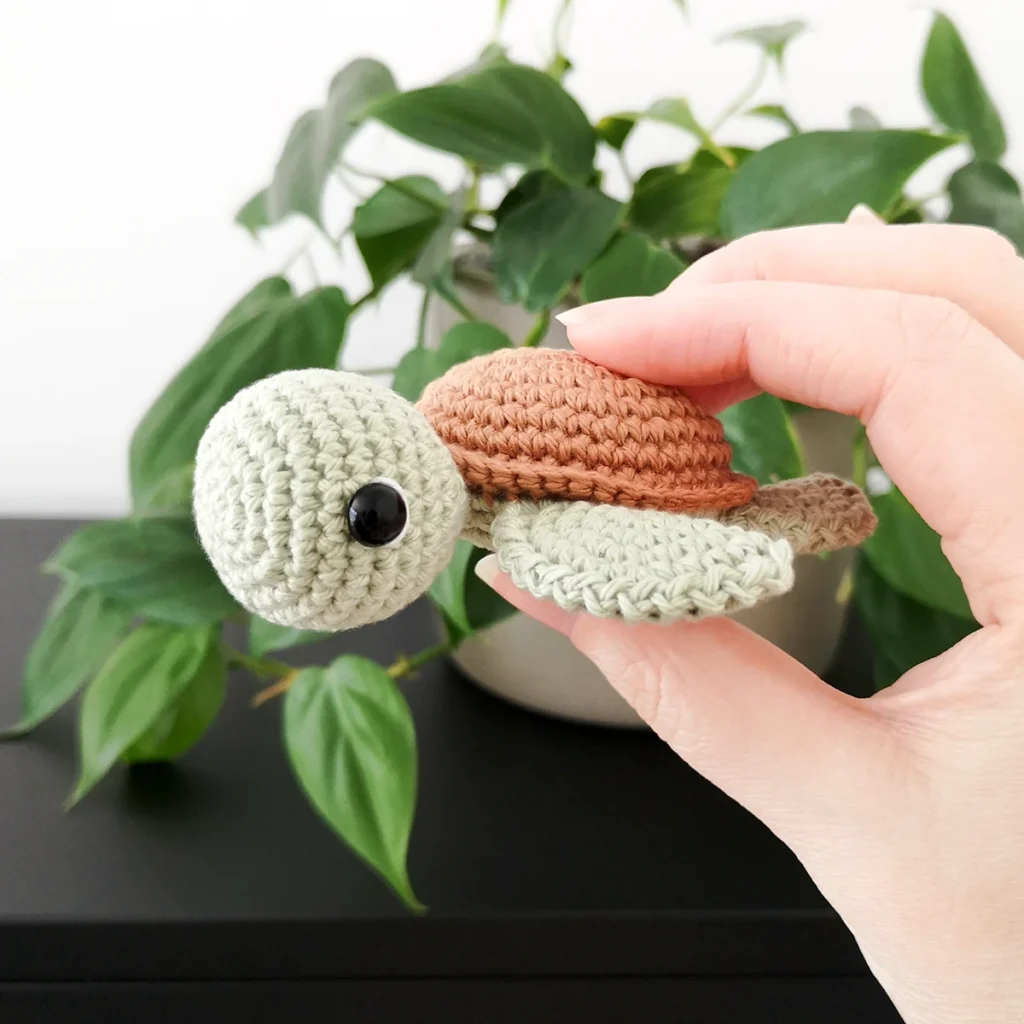
10. Jelly Bean No-Sew Turtle by Darling Maple Designs
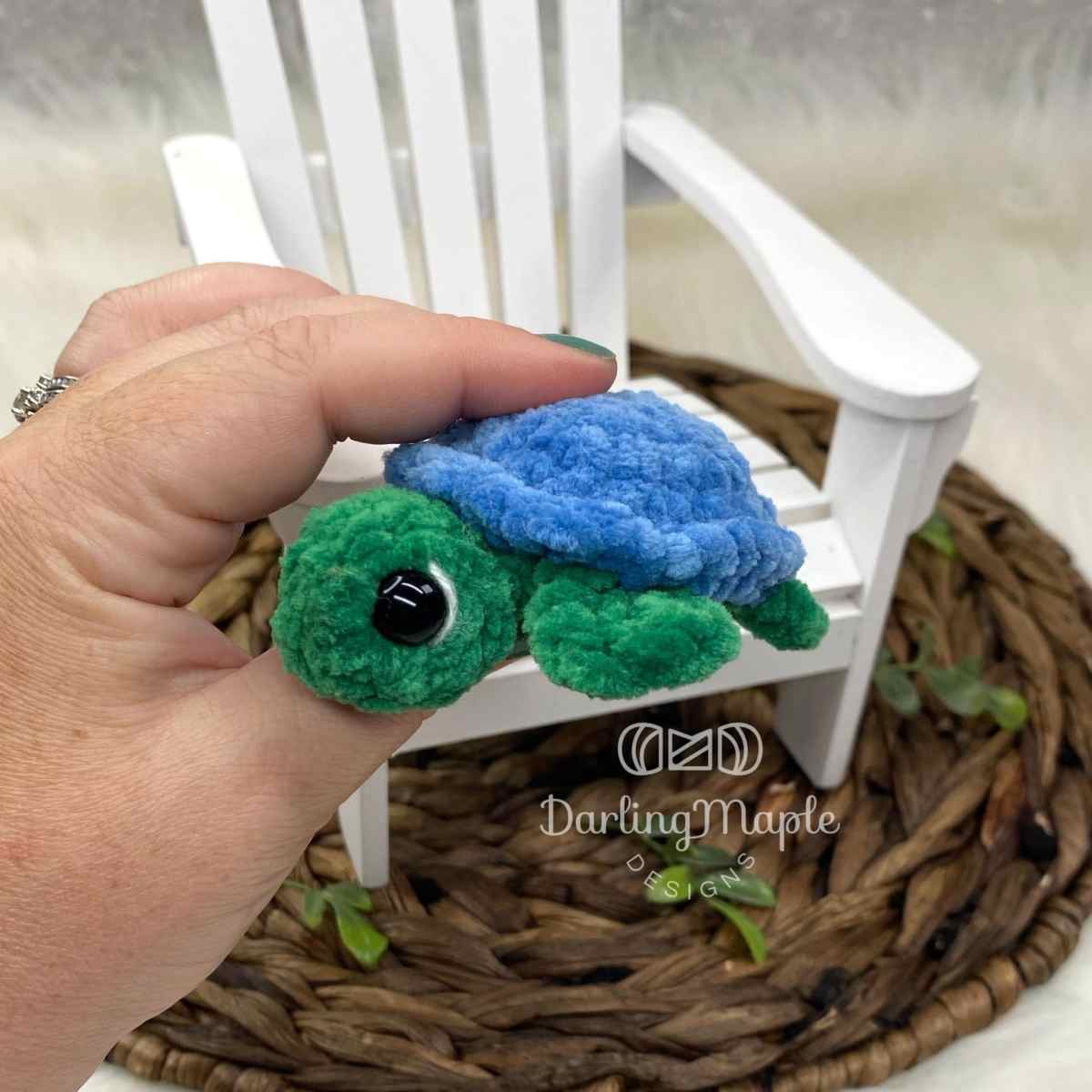
Sara’s jelly bean turtle is the roundest, squishiest one on this list.
The written version uses super bulky yarn on a 5mm hook and takes about 12 yards of your main color and 10 of your accent, which is nothing.
She notes it works in any yarn weight, so a lighter yarn and a smaller hook gives you a proper mini. The shell and body are crocheted together rather than seamed.
Get the free pattern from Darling Maple Designs
Turn Any Crochet Turtle Into a Keychain
Here is the thing nobody tells you. You do not actually need a keychain pattern.
You need a small turtle and about four dollars of hardware. Any turtle you have already made can become a keychain in under five minutes.
This is the same trick that turns a turtle into an ornament, a bag charm, or a zipper pull. Only the hardware changes.
Pick Your Hardware
All keychain hardware (my pick: swivel lobster clasp keyring set) does the same job, but the type you pick changes how the turtle hangs and how long the attachment lasts.
Here is what each one is actually good at.
| Hardware | Best For | Why |
|---|---|---|
| Split ring | House keys | Cheapest, holds forever, annoying to thread |
| Swivel lobster clasp | Bags and belt loops | Clips on and off, spins so the turtle does not twist |
| Ball chain | Backpacks and zippers | Flexible, looks good on a zipper pull |
| Lanyard clip | Work badges and car keys | Widest opening, easiest one-handed |
| Screw eye pin | Firmly stuffed turtles | Sits flush, nearly invisible |
For most people a swivel lobster clasp is the right answer. The swivel is the part that matters, because a turtle on a fixed ring slowly twists its own attachment loop into a tight little rope over a few weeks.
Attach It So It Does Not Fall Off
This is where handmade keychains usually fail, and it is always the same mistake.
Do not tie the ring to a loop of loose yarn. That yarn will fray against the metal and your turtle will vanish somewhere in a parking lot.
Instead, do this.
- Pick your anchor point at the top center of the shell, right where the shell meets the body. That spot carries weight straight down through the middle so the turtle hangs level.
- Thread a doubled length of your shell yarn onto a yarn needle.
- Go through actual stitches, not through the gaps between them. Catch at least two stitches, and go through the fabric rather than around it.
- Pull through until you have a loop about 1cm long, then pass it through the split ring or clasp.
- Knot it twice, then run both tail ends back down inside the turtle before trimming.
That last step is the one everyone skips. Burying the tails inside the stuffing means there is no exposed knot to work itself loose.
If you want it bulletproof, add a drop of fabric glue on the knot before you bury the tails.
Our Own Turtles Work Too
We have three step-by-step patterns on this site that all take the hardware swap nicely.
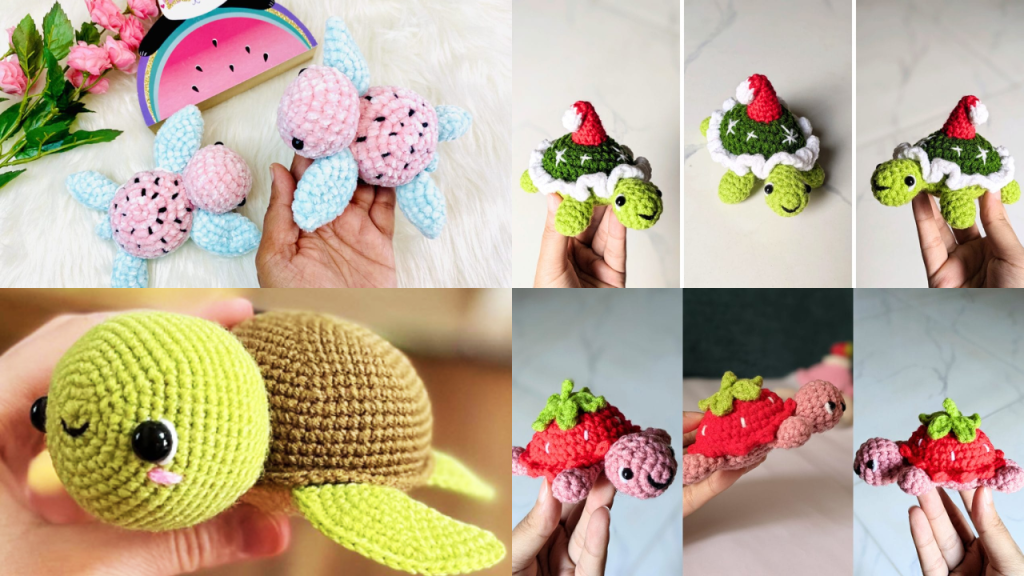
The strawberry turtle is the best of the three for keys, because the red shell stays visible at the bottom of a bag.
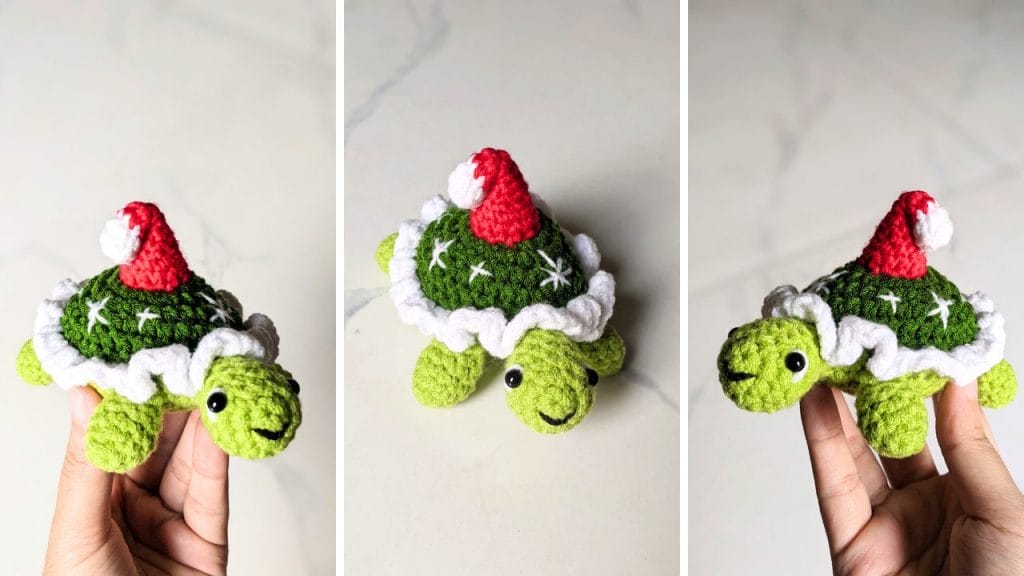
The sunflower turtle and the Christmas tortoise both work, though the sunflower petals take more abuse than you would expect and do fluff out over time.
Worth knowing: we already wrote up all three as Christmas ornaments. The pattern is identical. An ornament uses a hanging loop of yarn or ribbon, a keychain uses metal hardware. That is the entire difference.
So if you make the ornament version in November, you can make the exact same turtle in January and put it on your keys instead.
What You Need
The supply list for a turtle keychain is short, which is most of the appeal.
- Scrap yarn in two colors, one for the shell and one for the body
- A crochet hook (my pick: Clover Amour set) one or two sizes smaller than your yarn label suggests
- A small amount of stuffing, roughly a walnut’s worth
- 6mm safety eyes, or black embroidery thread if you are giving it to a small child
- A yarn needle
- Your keychain hardware from the table above
Cotton holds shape better than acrylic on something this small, and it does not pill when it rubs against the inside of a bag.
If you are new to any of this, our magic ring tutorial covers the one stitch that trips up most beginners, and every pattern on this list starts with it.
Tips for Keychains That Survive Real Life
Stuff it firmer than feels right. An under-stuffed keychain goes floppy and shapeless within a month of pocket time.
Go down a hook size. Every pattern above assumes tight fabric. Loose stitches on a 3cm turtle look like a mistake rather than a style.
Skip safety eyes for kids under three. Embroidered eyes take an extra two minutes and remove the risk entirely.
Make two. The first one teaches you where the pattern is fiddly, and the second one is the one you actually keep.
Weave ends in twice as far as usual. A keychain gets handled hundreds of times more than a shelf plush.
Frequently Asked Questions
Are these crochet turtle keychain patterns really free?
Yes, all ten. We opened every single one and confirmed the full written pattern is on the page at no cost.
Some designers also sell an ad-free printable PDF, which is a fair way to support someone who gave away the pattern. The free version is always complete.
Can I sell the turtle keychains I make?
It depends on the designer, and you have to check each one.
Most of these creators allow selling finished items as long as you credit the pattern designer and do not resell or repost the pattern itself. Abigail at Knits and Knots by AME specifically mentions crafters selling hers at craft fairs.
Never assume. The permission is usually written right on the pattern page.
What size hook should I use for a turtle keychain?
Between 2.5mm and 4mm for almost every case.
Go by the fabric, not the number. Hold it up to a light, and if you can see through the stitches, go down a size.
How long does a crochet turtle keychain take?
Anywhere from 20 minutes to about 2 hours depending on the pattern and how much assembly it needs.
The no-sew ones are fastest because seaming is what actually eats the time on small amigurumi.
Which pattern is best for a complete beginner?
Nina Valovirta’s no-sew keychain, because there is no assembly step to get wrong.
If you want something with a bit more shape to it, Abigail’s 20-minute turtle is the next easiest. For more starting points, we have a full list of beginner crochet turtle patterns.
Why does my turtle keychain look messy?
Almost always one of two things. Your stitches are too loose, or you did not stuff it firmly enough.
At this size there is nowhere for mistakes to hide, so both problems show up immediately.
Can I make these without safety eyes?
Yes, and for a keychain you arguably should.
Embroidered eyes cannot pop out, which matters on something that gets crushed in a pocket daily. Use black embroidery thread and two small satin stitches.
Go Pick One
If you have never made a turtle keychain before, make Nina’s no-sew one first. No assembly, nothing to mess up, and you will have a finished turtle in your hand before you lose interest.
If you already have a turtle sitting on a shelf, skip all of this and go buy a swivel clasp. Five minutes and it is a keychain.
And if you get hooked on tiny turtles, which happens more often than you would think, we have more where these came from in our kawaii crochet turtle patterns and free crochet sea turtle patterns collections.

About Author
Muntaseer Rahman started keeping pet turtles back in 2013. He also owns the largest Turtle & Tortoise Facebook community in Bangladesh. These days he is mostly active on Facebook.