10 Ways to Turn Old Furniture Into a Tortoise Enclosure (Dresser, TV Stand, Bookshelf)
This post was created with help from AI tools and carefully reviewed by a human (Muntaseer Rahman). For more on how we use AI on this site, check out our Editorial Policy.
Here is a fun truth nobody tells you when you get a tortoise.
The “perfect” enclosure you keep seeing online is usually just a piece of furniture somebody refused to throw away.
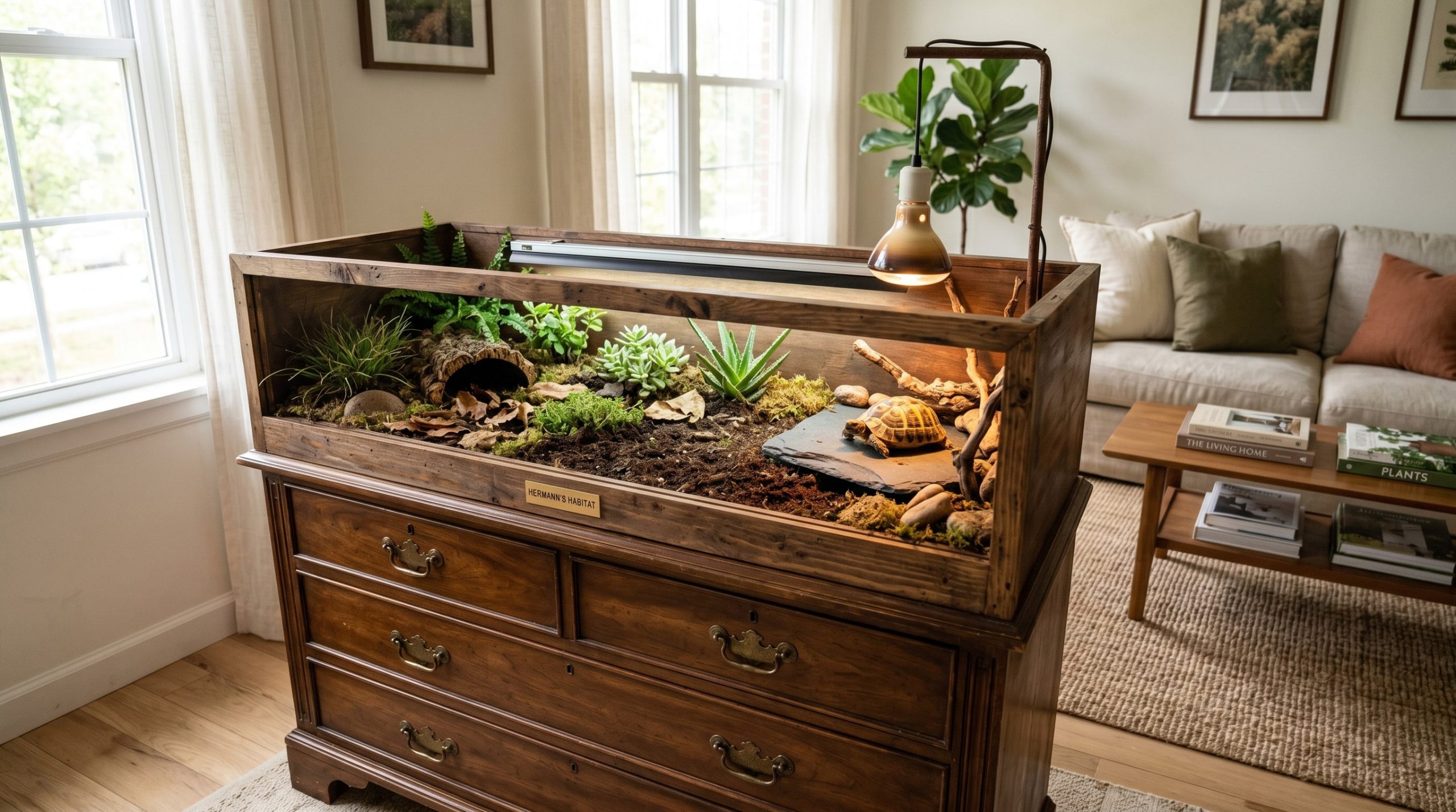
That sad dresser in your garage? That TV stand you replaced when you upgraded the living room? They are basically tortoise enclosures (my pick: Aivituvin Wooden Tortoise Habitat) wearing a disguise.
This post is not about building a table from raw lumber. We already covered that in our tortoise table ideas.
This is about converting furniture you already own into a home your tortoise will actually love. Less sawdust, less cost, way more impressive than it sounds.
Let’s get into the 10 best pieces to hijack.
Before You Grab a Saw: 4 Quick Rules
Upcycling furniture is easy, but a few details separate a great enclosure from a moldy mess.
Read these first. They apply to every idea on this list.
1. Seal the wood or it will rot
This is the big one. Damp substrate sitting on bare wood will warp, swell, and rot within a year.
You have three solid options. Drop in a pond liner (my pick: 10x15 FT 20 Mil HDPE pond liner), staple in a heavy plastic liner (even a shower curtain works in a pinch), or paint the inside with a pet-safe waterproof sealant.
Line the floor and the bottom few inches of the walls. That is where moisture pools.
2. Watch out for particleboard and MDF
A lot of cheap furniture (looking at you, flat-pack specials) is made of particleboard or MDF.
These soak up water like a sponge and can off-gas glue smells when new. Seal them fully, and let a newer piece air out in the garage for a week before your tortoise moves in.
Solid wood is better, but sealed particleboard works fine for a dry-species setup.
3. Match the size to the species
Furniture conversions shine for small and young tortoises. Hermann’s, Russian, Greek, and Horsfield tortoises fit beautifully.
A full-grown Sulcata or leopard tortoise will outgrow almost any dresser fast. For those, treat the conversion as a temporary or juvenile home and plan an outdoor pen later.
Aim for at least 4 times your tortoise’s shell length in each direction.
4. Open top beats closed box
Tortoises need airflow, not a sealed terrarium. Most of these ideas involve opening up the furniture so the top is exposed.
That lets a basking lamp (my pick: Zoo Med PowerSun) and UVB (my pick: Zoo Med ReptiSun 10.0) shine straight down and keeps the air moving, which prevents respiratory infections.
If you have cats or dogs, add a wire mesh lid. Never glass or solid wood on top.
1. The Dresser With the Drawers Pulled
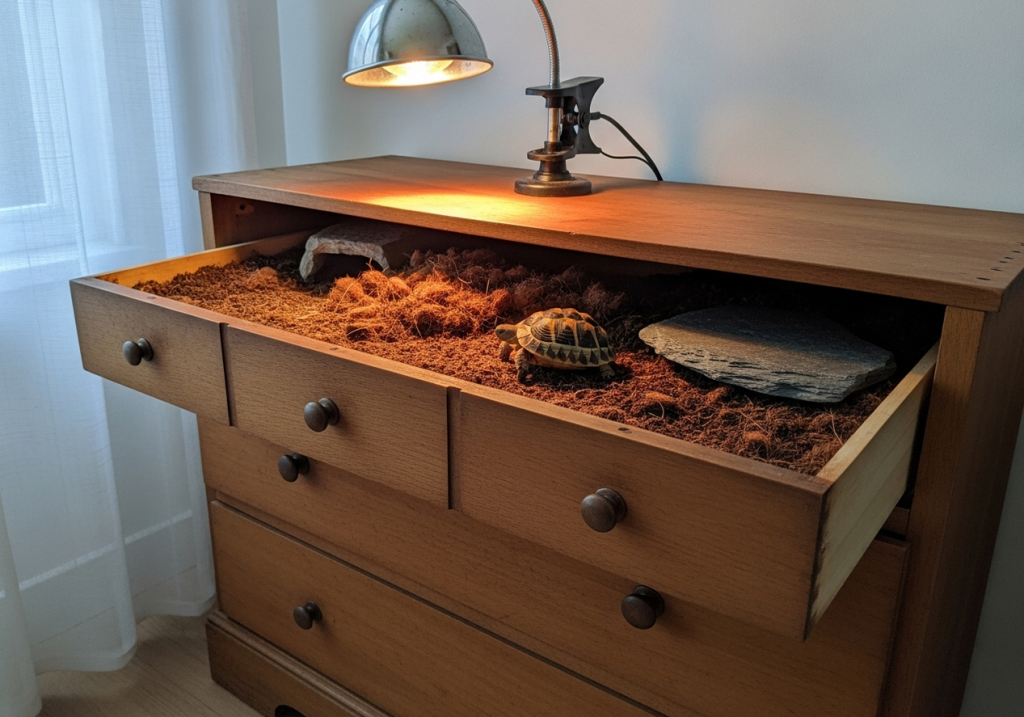
This is the classic for a reason. A chest of drawers is already a deep, sturdy box on legs.
Pull out the top drawers and the wooden rails between them. You are left with one open cavity that is the perfect depth for substrate and digging.
Seal the inside, drop in a liner, and fill with a soil and coco coir mix.
Why it works: The leftover bottom drawers become built-in storage for substrate, food, and supplements. Raised height means no bending over to feed.
Best for: Hermann’s, Russian, and Greek tortoises. A 5 or 6-drawer dresser gives a single tortoise plenty of room.
Watch out: Skip dressers with a glued-on decorative back panel that is just thin cardboard. Reinforce it with a plywood sheet first.
This Hilarious Turtle Book Might Know Your Pet Better Than You Do

Let’s be real—most turtle care guides feel like reading a textbook written by a sleep-deprived zookeeper.
This one’s not that.
Told from the snarky point of view of a grumpy, judgmental turtle, 21 Turtle Truths You’ll Never Read in a Care Guide is packed with sarcasm, sass, and surprisingly useful insights.
And hey—you don’t have to commit to the whole thing just yet.
Grab 2 free truths from the ebook and get a taste of what your turtle really thinks about your setup, your food choices, and that weird plastic palm tree.
It’s funny, it’s honest, and if you’ve ever owned a turtle who glares at you like you’re the problem—you’ll feel seen.
2. The TV Stand or Media Console
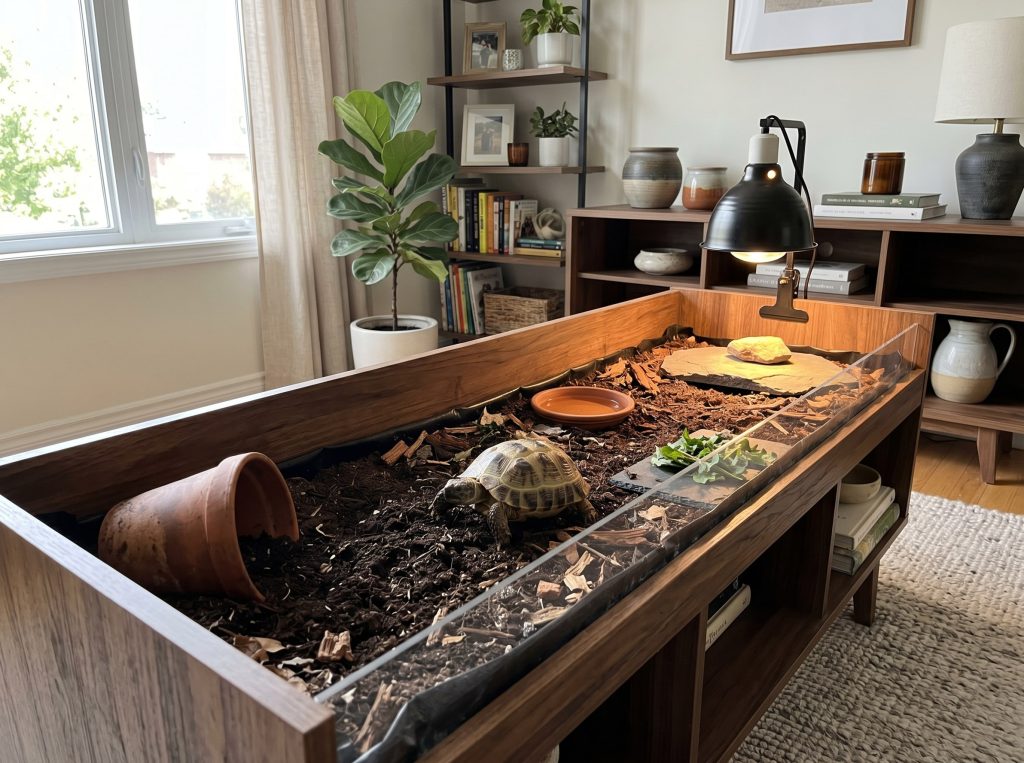
If you want a footprint that is long, low, and already shaped right, raid your living room.
A media console is basically a tortoise table that someone already built and stained for you. Long, shallow, and open across the front.
Remove the doors and interior shelves to create one open run. Seal it, line it, and you are done.
Why it works: The long-and-low shape gives a clear warm-to-cool gradient end to end. Open shelving cubbies on the side make great spots for a hide.
Best for: Active species like Russian tortoises that love to pace and explore a long space.
Tip: Many TV stands sit low to the ground, so they fit nicely under a window for indirect natural light (just never direct sun, which cooks one side).
Perfect Wooden Tortoise House For Outdoor & Indoor!
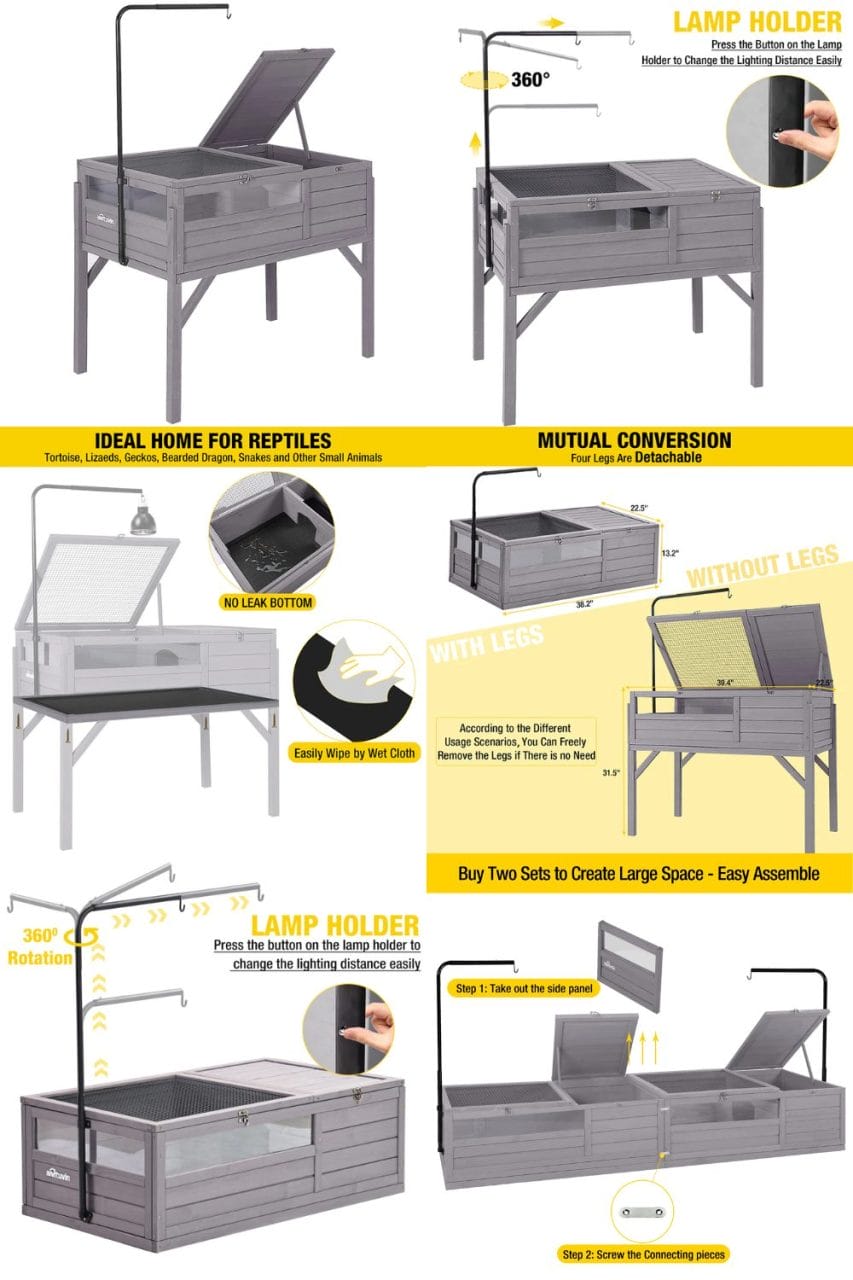
This tortoise house isn’t cheap — but that’s because it’s not your average wooden box.
Built with durable wood, a waterproof liner, and smart design features like a sunbathing area and a hideout zone, the Aivituvin Large Wooden Habitat is made to last.
It’s perfect for tortoises or box turtles, indoors or out. And yep, it even has detachable legs.
If you’re serious about giving your tortoise a safe, comfy home without building one from scratch, this is the one.
👉 Grab the Aivituvin Tortoise House here — it’s currently $10 off.
3. The Bookshelf Tipped on Its Back
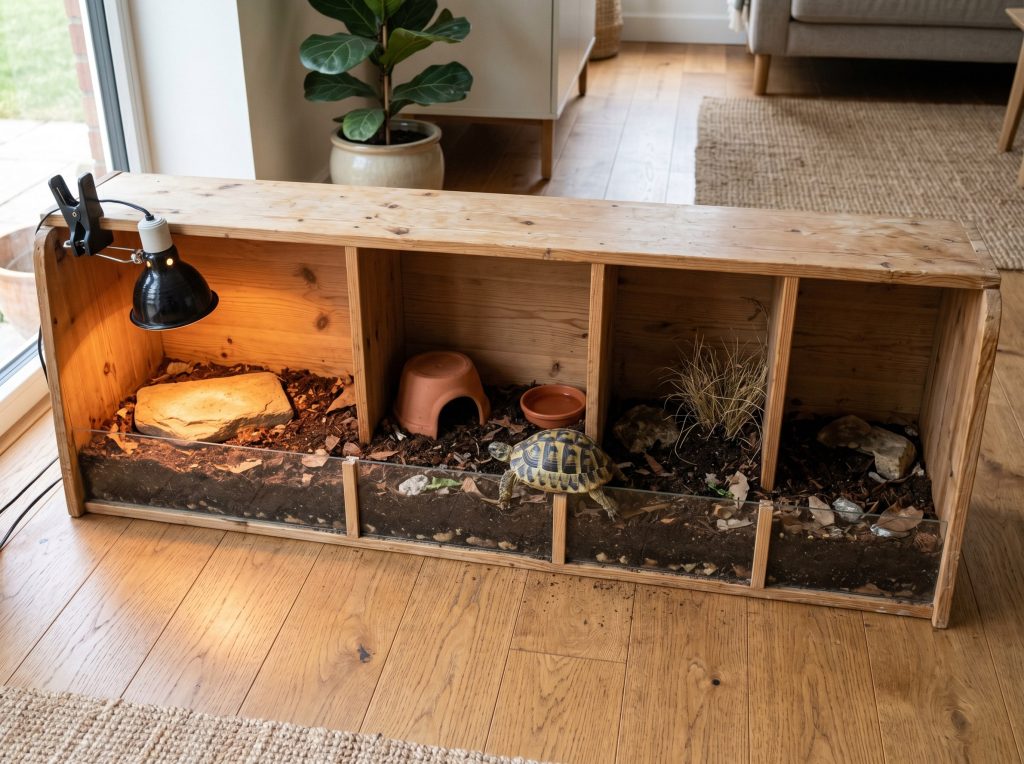
Here is the move most people miss. Take a tall bookshelf, lay it flat on its back, and suddenly those shelf dividers become enclosure walls.
An IKEA Billy or any basic 5-shelf unit works great. Laid down, the open front of the bookcase points straight up. That is your open top.
The fixed shelves divide the space into natural zones. Use one bay for the basking area, one for the hide, one for food and water.
Why it works: You get instant zones without building any internal walls. A standard tall bookcase laid flat gives you a 6 to 8-foot-long run, which is huge for an indoor setup.
Best for: Anyone with a long wall and a small-to-medium tortoise. Also one of the cheapest conversions since old bookshelves are everywhere.
Tip: Reinforce the back (now the floor) with a plywood sheet before adding substrate. Bookshelf backs are usually flimsy.
4. The IKEA Kallax Cube Shelf
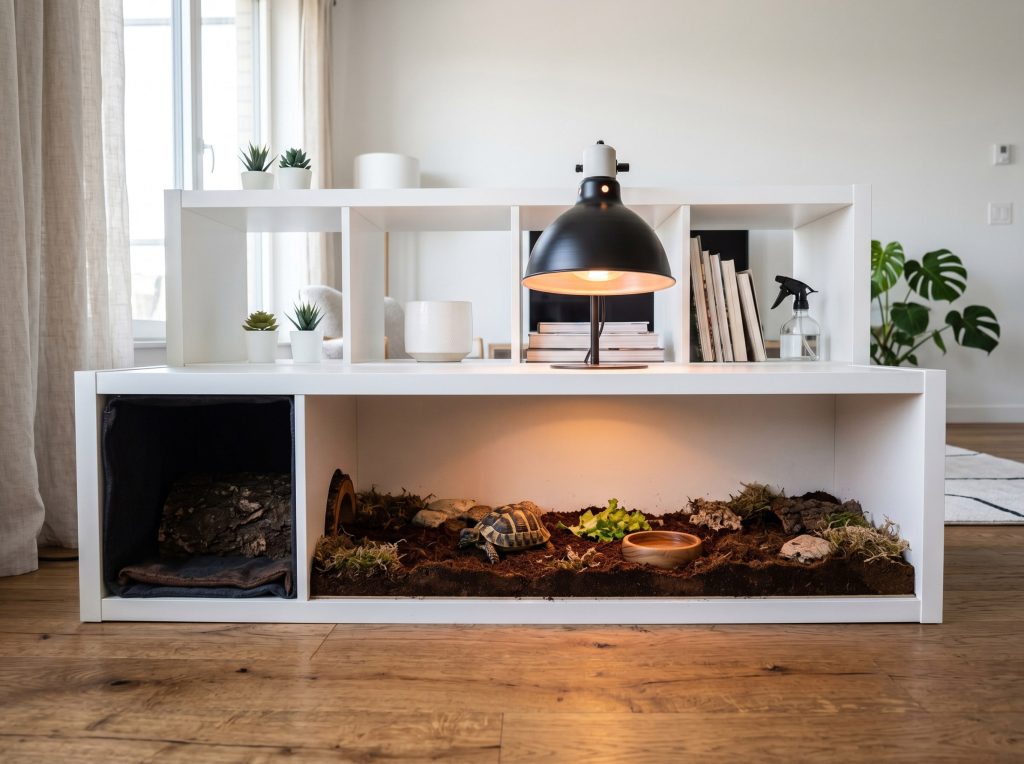
The Kallax (and the older Expedit) is a cult favorite in the reptile world for good reason.
Lay a 2×4 or 4×4 Kallax flat and you get a grid of sturdy cubes. Knock out a few interior dividers to open up the floor, or leave some in to section off zones.
The thick cube walls hold their shape better than most flat-pack furniture.
Why it works: Modular by design. Keep one cube row as a closed hide tunnel, open the rest into a roaming space.
Best for: Apartment keepers and anyone who likes a clean, modern look. Coat the inside with vinyl or sealant since Kallax is MDF.
Tip: Two Kallax units side by side double your footprint and still look intentional in a living room.
6 More IKEA Units That Make Great Tortoise Enclosures
The Kallax gets all the attention, but it is not the only IKEA piece worth hacking.
These units are cheap, easy to find secondhand, and shaped almost right out of the box. Same rules apply: seal any MDF, and let a brand-new piece off-gas for a week first.
IKEA IVAR (the keeper favorite)
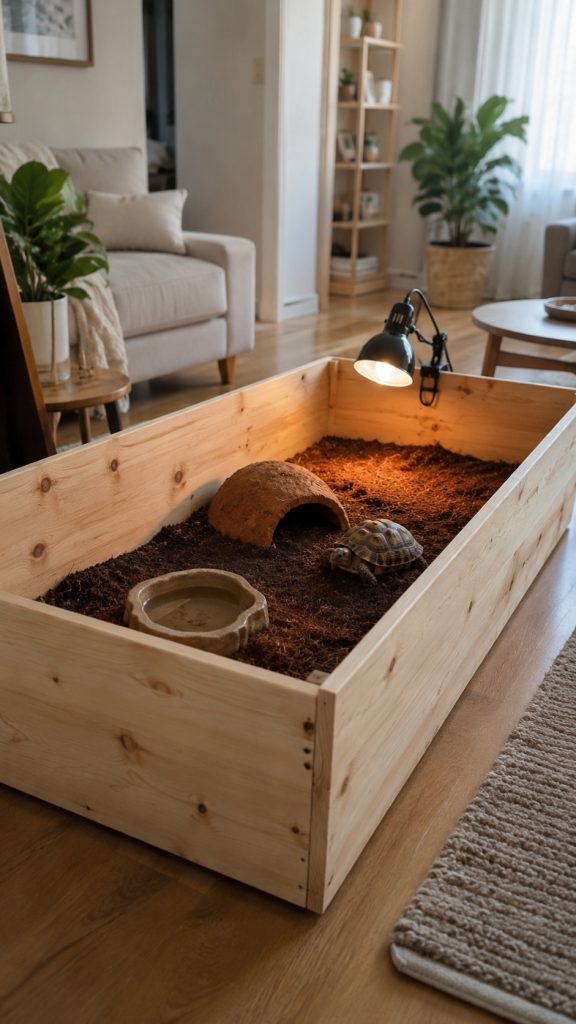
The Ivar is untreated solid pine, which makes it the best IKEA piece for a conversion.
Real wood seals cleanly, holds screws, and skips the MDF off-gassing worry. Build a shallow open box from Ivar shelf boards, or lay an Ivar cabinet on its back for an instant run.
Best for: Anyone who wants a solid-wood build without buying raw lumber.
IKEA RAST (the $40 hack)
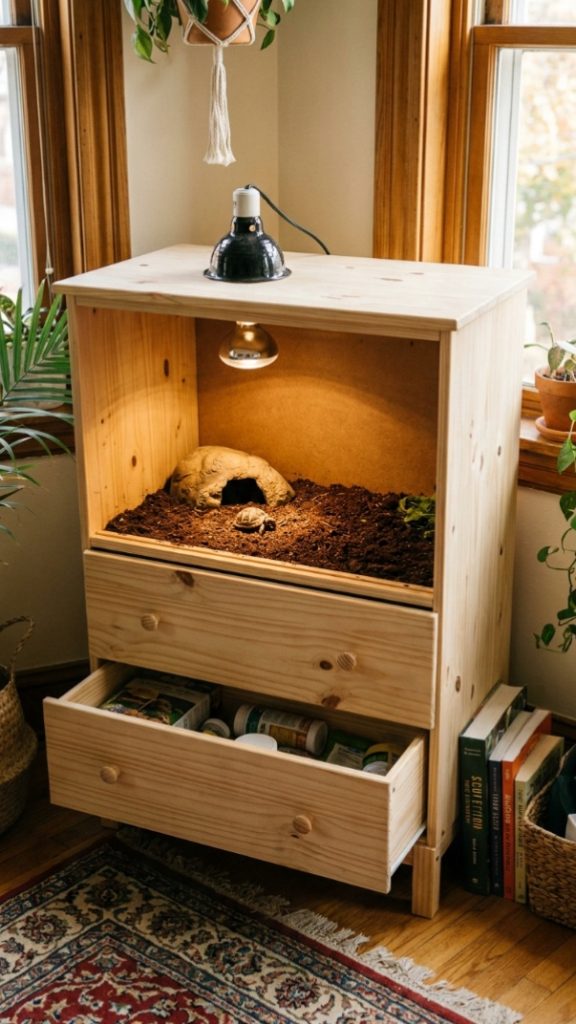
The Rast is a tiny 3-drawer pine dresser that costs about the price of a pizza.
Pull the drawers and the rails exactly like the dresser method above, and you have a raised, open-top box that is perfect for a hatchling or a single small tortoise.
Best for: Grow-out setups and keepers on the tightest budget.
IKEA BESTA or sideboard-style cabinet
Besta is IKEA’s low, long media-cabinet system, basically a flat-pack credenza.
Open the top, seal it, and you get the same furniture-grade look as the sideboard idea, with door storage underneath for all your gear.
Best for: A clean enclosure that blends into a living room.
IKEA HEMNES (the showpiece)
The Hemnes line is solid wood and beautifully finished, so a Hemnes dresser or console converts into a display-worthy home.
Treat it like the dresser or sideboard method. The sturdier build easily handles a full load of substrate.
Best for: An enclosure that has to look intentional in a main room.
IKEA TROFAST (for hatchlings)
Trofast is the kids’ storage frame with sliding plastic bins.
Skip the frame and use a single large Trofast bin as a ready-made, fully waterproof hatchling tub. No sealing needed since it is solid plastic.
Best for: Baby tortoises and quarantine boxes.
IKEA DETOLF (with a big caveat)
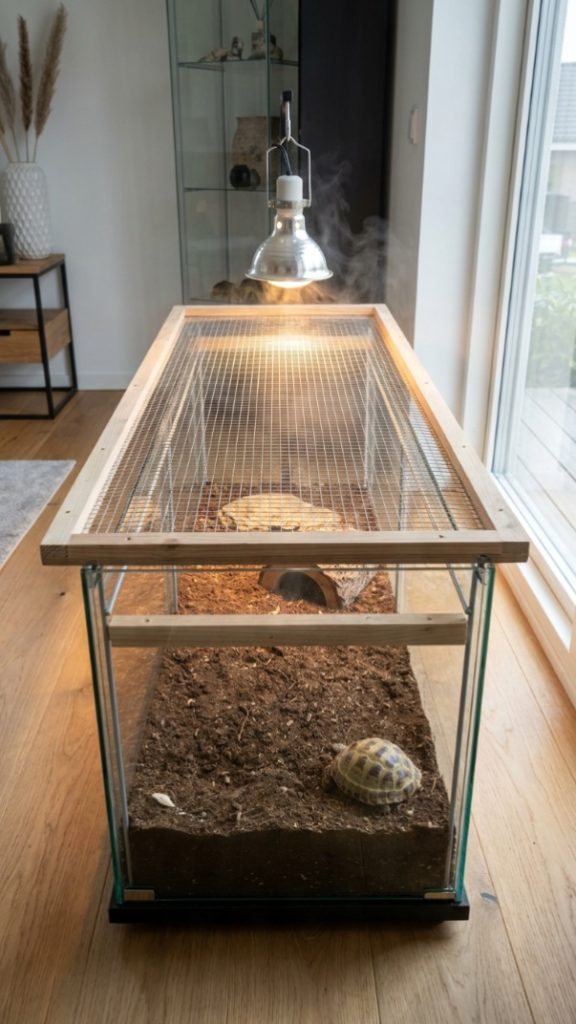
The Detolf glass cabinet laid on its back is a reptile-hobby classic, but tortoises are the wrong tenant.
Glass on all sides traps heat and kills airflow, which tortoises hate. Only use one for short-term grow-out, and always add a full mesh top for ventilation.
Best for: Temporary hatchling viewing only, never a permanent home.
Already using the Kallax or a Billy bookcase? Those two IKEA hacks are covered in detail above.
5. The Old Coffee Table
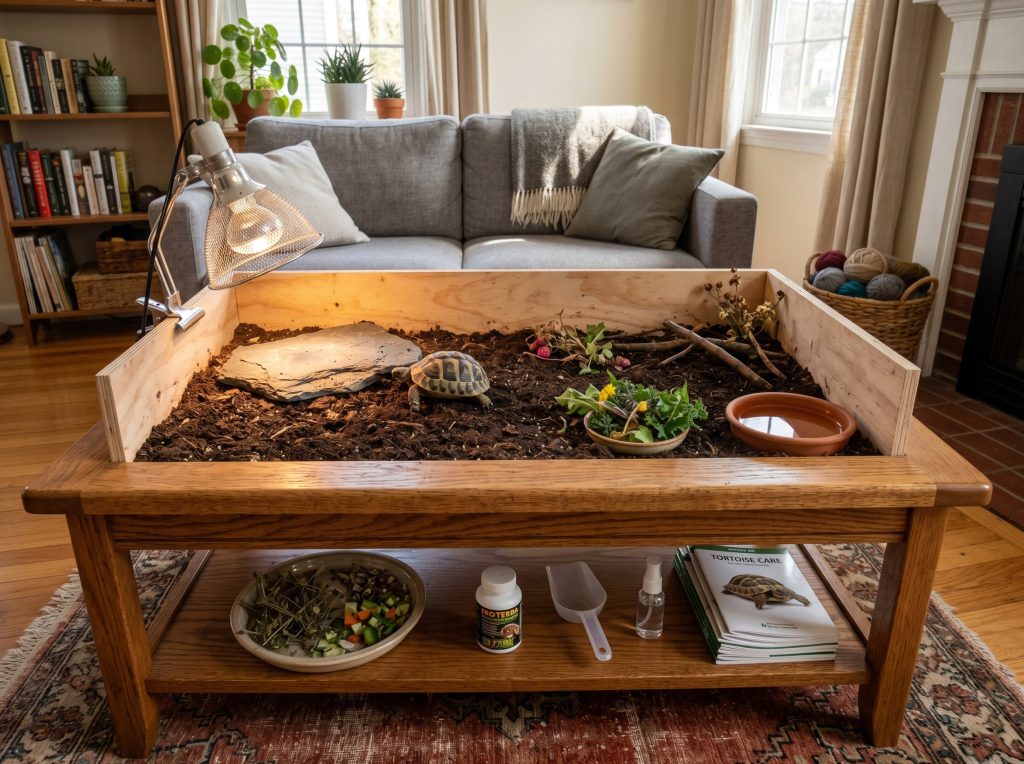
Got a coffee table gathering dust? It is already the right height and has a solid top to work from.
Flip the script: build short walls (8 to 12 inches) around the tabletop using plywood or reclaimed wood, and you have an open tortoise table at a comfy working height.
If the table has a lower shelf, that becomes storage.
Why it works: Coffee tables are built tough to hold weight, so the legs handle 40 to 60 pounds of substrate and rock without wobbling.
Best for: A single small tortoise, or a starter setup while you plan something bigger.
Tip: Stack two matching coffee tables to make a two-level setup with a ramp between them, if you keep a climber like a Russian.
6. The Sideboard or Buffet Credenza
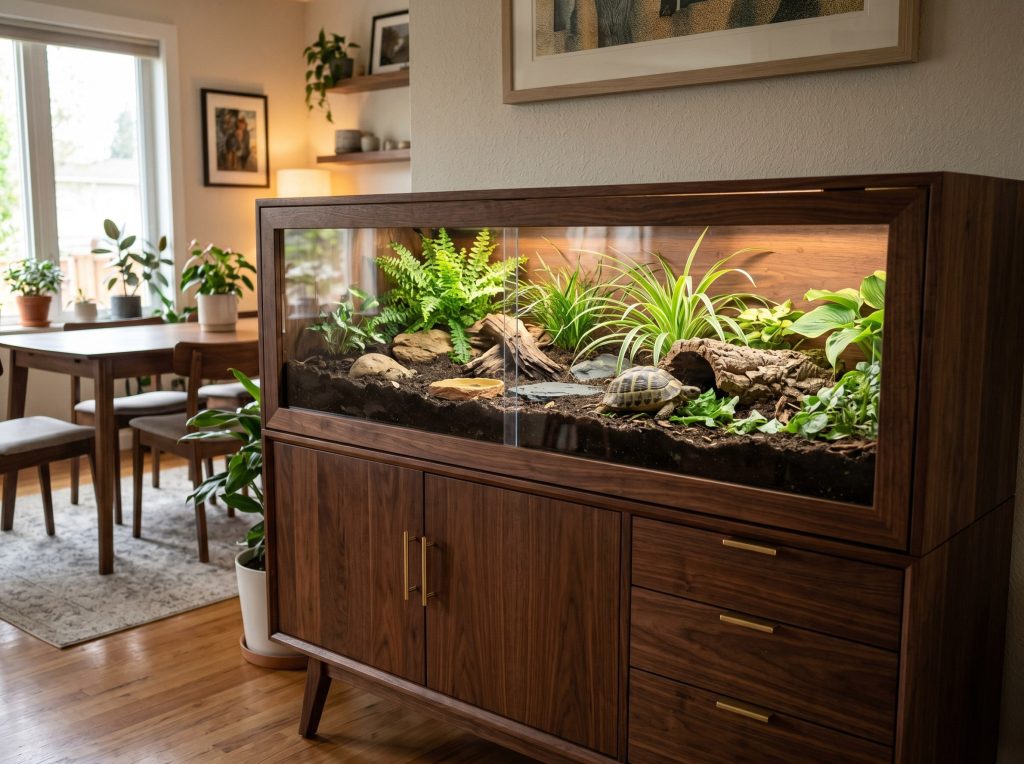
This is the showpiece option. A sideboard is that long, low cabinet people put in dining rooms, often with a gorgeous wood finish.
Open the top, seal the inside, and you have a furniture-grade enclosure that looks like it belongs in your home, not a science lab.
Some keepers swap the back panel for clear acrylic so guests can watch the tortoise at eye level.
Why it works: Credenzas are usually solid, heavy, and beautifully finished. The cabinet doors below hide all your gear.
Best for: Anyone whose enclosure lives in a main room and needs to look intentional. Pair it with live tortoise-safe plants for a planted look.
Watch out: These can be heavy before you even add substrate. Make sure your floor and the piece itself can take the load.
7. The Wardrobe or Armoire Laid Flat
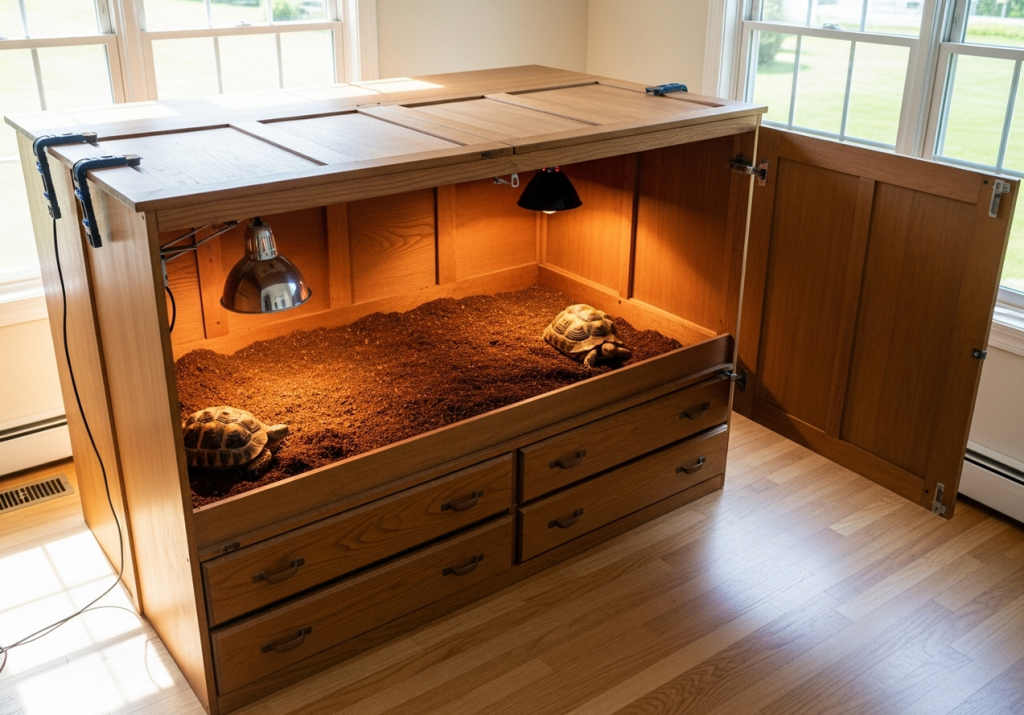
Need more room than a dresser gives? Tip a wardrobe onto its back.
A wardrobe laid down is enormous. The hanging space becomes one big open run, and any built-in shelves or drawers at the bottom become storage or a raised platform.
This is one of the few conversions with enough floor for a larger juvenile.
Why it works: A laid-flat wardrobe can hit 6 feet long and 2 feet deep, rivaling a custom-built table for a fraction of the cost.
Best for: Growing tortoises that have outgrown a baby setup. See our baby tortoise enclosure ideas if you are starting smaller.
Tip: Remove the mirror if it has one. Tortoises see their reflection, think it is a rival, and stress out.
8. The Blanket Chest or Storage Trunk
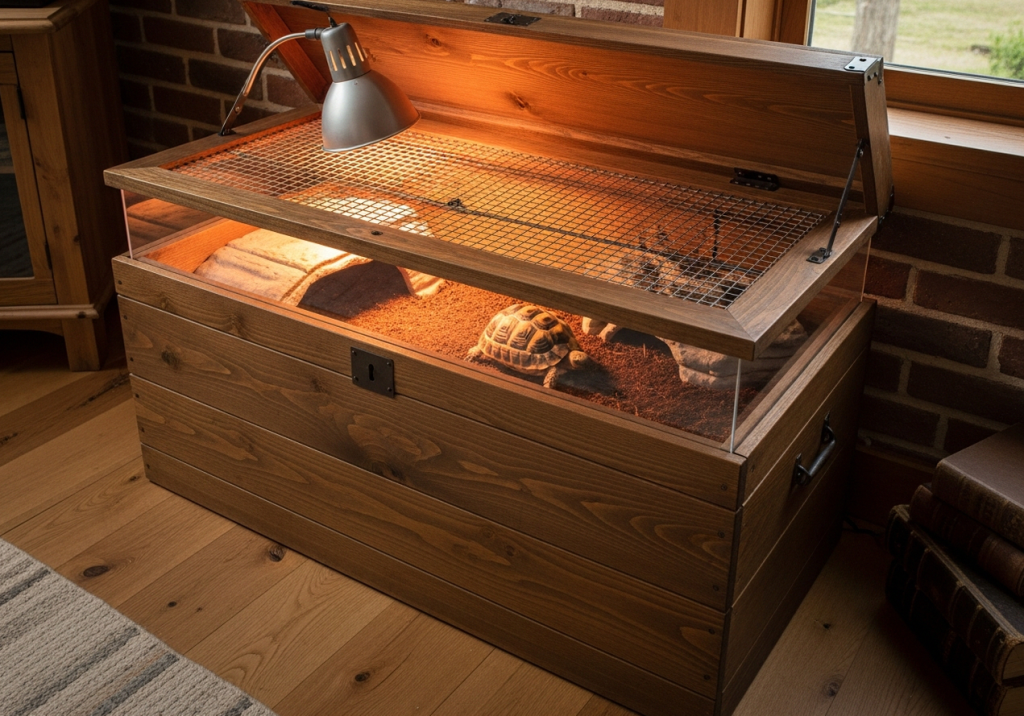
A wooden blanket chest or toy box is already a deep, single-cavity box. Honestly, half the work is done.
Seal it, line it, and add a layer of substrate. The high walls mean zero escape risk, even for a determined climber.
Because the walls are tall, add a mesh lid rather than leaving it fully open if the chest is very deep, so light still reaches the floor.
Why it works: No cutting or drawer removal needed. It is the lowest-effort conversion on this list.
Best for: Small species and quick setups. Great as a quarantine or grow-out box.
Watch out: Deep walls can trap heat and block light. Keep the basking lamp low and check temps with a thermometer.
9. The Desk With a Hutch
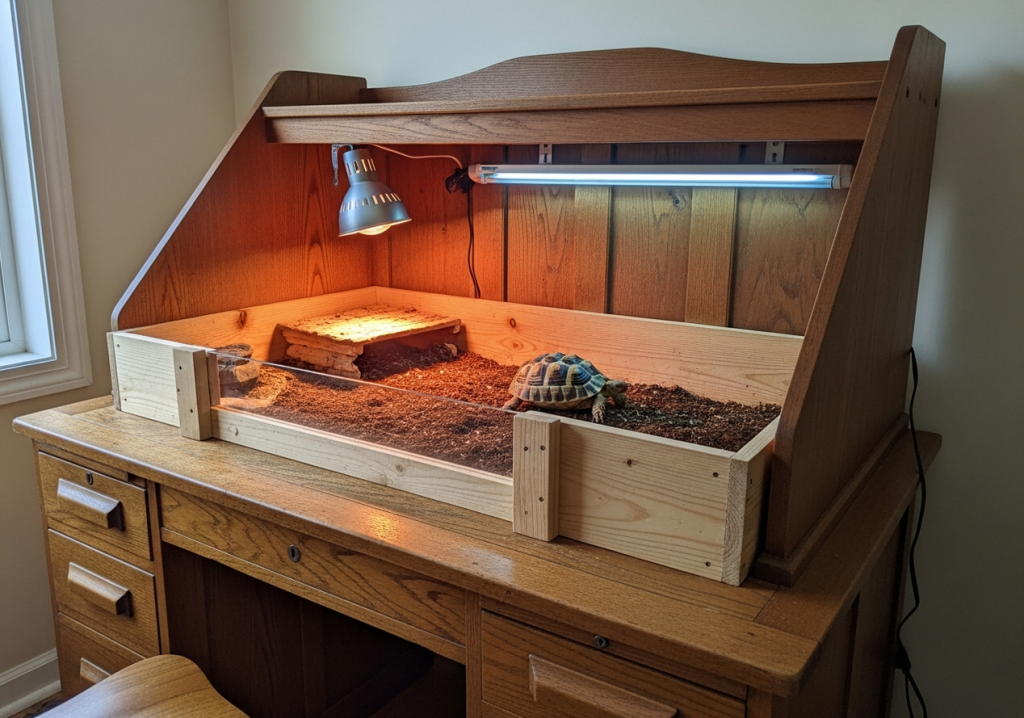
An old desk with an overhead hutch or shelf unit is secretly perfect. The desktop is your floor, and the hutch above it is a built-in lighting rig.
Build short walls around the desktop. Then mount the heat lamp (my pick: heat lamp) and UVB tube to the underside of the hutch shelf above.
Everything sits in one tidy tower.
Why it works: The hutch holds your lights at the right height with zero extra hardware. Desk drawers store all your supplies.
Best for: Keepers tight on space who want lighting, enclosure, and storage in one footprint.
Tip: Make sure there is enough gap between the hutch shelf and the basking spot so the lamp does not scorch the wood. Leave at least 12 inches.
10. The Kitchen Base Cabinet or Bathroom Vanity
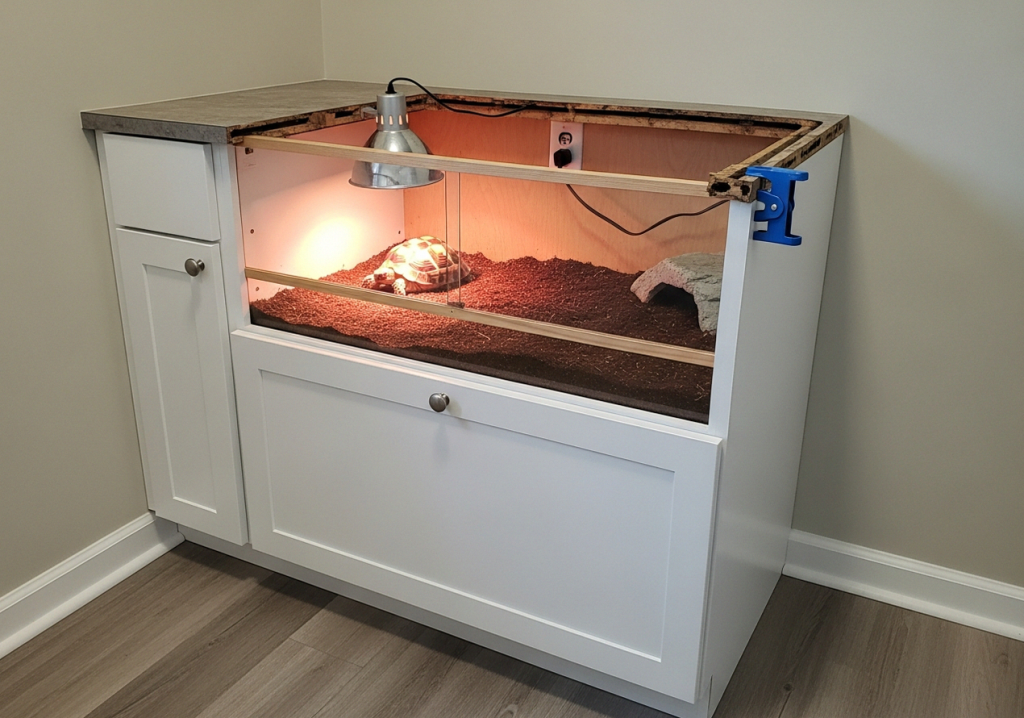
When a kitchen gets remodeled, those base cabinets usually hit the curb. Grab one.
A base cabinet is a rock-solid box built to survive years of abuse. Remove the countertop and door, open the top, seal it, and line it.
The cabinet space below stays as storage behind a door.
Why it works: Kitchen cabinets are some of the sturdiest furniture you can find for free. They are built to hold heavy counters and survive splashes.
Best for: A durable, no-nonsense enclosure that will last for years. Budget keepers, this one is often free. More money-saving tricks in our budget tortoise habitat guide.
Tip: Bathroom vanities work the same way and often come pre-sealed for moisture, which saves you a step.
Quick Comparison: Which Furniture Should You Convert?
| Furniture Piece | Footprint | Effort | Best For |
|---|---|---|---|
| Dresser (drawers out) | Medium | Medium | Single small tortoise + storage |
| TV stand / console | Long, low | Easy | Active species, gradient runs |
| Bookshelf (laid flat) | Very long | Medium | Long walls, instant zones |
| IKEA Kallax | Modular | Medium | Apartments, modern look |
| Coffee table | Small | Easy | Starter setups |
| Sideboard / credenza | Long | Medium | Showpiece in main rooms |
| Wardrobe (laid flat) | Huge | Medium | Growing juveniles |
| Blanket chest / trunk | Small-medium | Easiest | Quarantine, grow-out |
| Desk with hutch | Medium | Medium | All-in-one with lighting |
| Kitchen base cabinet | Medium | Medium | Durable, often free |
How to Seal Any Furniture Conversion (3 Steps)
Sealing is the one step you cannot skip. Here is the simple version.
Step 1: Prep. Remove drawers, doors, glass, mirrors, and any flimsy back panel. Sand down rough edges so your tortoise does not scratch its shell.
Step 2: Waterproof. Either staple in a pond liner, lay down a thick plastic liner, or roll two coats of pet-safe waterproof sealant over the floor and lower walls. Let it cure fully and air out before the tortoise goes in.
Step 3: Outfit it. Add 2 to 3 inches of substrate, a basking lamp on one end, a UVB light across two-thirds of the top, a hide on the cool side, and a shallow water dish.
Need hide ideas? We have a whole post on DIY tortoise hides that pair perfectly with these conversions.
The Lighting Rule You Cannot Cheat
No matter how gorgeous your converted dresser looks, lighting makes or breaks it.
Every tortoise enclosure needs both a basking lamp for heat and a UVB light. Without UVB, your tortoise cannot process calcium, and that leads to metabolic bone disease.
A tube-style UVB running across two-thirds of the enclosure is the gold standard. Learn more in our guide on whether tortoises need UVB light.
Keep the basking end at 90 to 100F and the cool end at 70 to 80F.
Frequently Asked Questions
Is it safe to use old furniture for a tortoise enclosure?
Yes, as long as you seal the wood and skip toxic finishes. Avoid pieces treated with heavy varnishes that smell strong, and let any new flat-pack furniture off-gas for a week first. Solid, sealed wood is completely safe.
What is the best piece of furniture to convert?
A dresser or a TV stand. Both have the right depth and footprint with minimal cutting, and the leftover drawers or cabinets give you free storage.
Can I use a bookshelf for a tortoise?
Yes. Lay it flat on its back so the open front points up. The fixed shelves become ready-made zones for basking, hiding, and feeding. Reinforce the thin back panel first.
Will a converted dresser work for a big tortoise?
Not long-term. Furniture conversions are ideal for small species like Hermann’s, Russian, and Greek tortoises, or for juveniles. Adult Sulcatas and leopard tortoises need far more space and do best outdoors.
Do I really have to seal the wood?
Yes. Damp substrate on bare wood causes warping, mold, and rot within months. A pond liner or pet-safe sealant takes 20 minutes and saves your whole build.
Your Old Furniture Is a Tortoise Mansion Waiting to Happen
Here is the bottom line.
You do not need power tools, a workshop, or a big budget to give your tortoise a great home. You need a sturdy piece of furniture, a liner, and an afternoon.
That dresser in the garage has more potential than any plastic tub you could buy.
Pick the piece that fits your space and your species, seal it right, and get the lighting dialed in. Your tortoise does not care that its mansion used to hold socks.
Got an old piece you are thinking of converting? That is your weekend project sorted. For more inspiration, browse our full DIY tortoise enclosure ideas and indoor enclosure ideas.

About Author
Muntaseer Rahman started keeping pet turtles back in 2013. He also owns the largest Turtle & Tortoise Facebook community in Bangladesh. These days he is mostly active on Facebook.