What Do Turtles Like To Play With? Fun Activities to Keep Your Turtle Happy
This post was created with help from AI tools and carefully reviewed by a human (Muntaseer Rahman). For more on how we use AI on this site, check out our Editorial Policy.
So you got yourself a turtle.
You set up the tank, got the filter running, installed a basking spot, and now your turtle just… sits there. Staring at you. Occasionally swimming in circles.
And you’re wondering: is my turtle bored out of its mind?
The short answer? Probably.
Here’s something most people don’t realize: turtles can actually get depressed. Yep, that slow-moving creature with a face that looks perpetually unimpressed can feel boredom, stress, and even show signs of depression when their environment lacks stimulation.
Studies have documented turtles displaying repetitive behaviors like swimming in endless circles or constantly clawing at tank walls when they don’t have enough to do. Some even stop eating altogether.
But don’t panic. Fixing this is easier than you think.
Do Turtles Actually Play?
I know what you’re thinking.
“It’s a turtle. It’s not exactly going to fetch a ball or do tricks.”
And you’re right. Turtles aren’t going to learn to roll over or high-five you (sorry to disappoint). But they absolutely engage with their environment in ways that count as play.
Turtles are naturally curious creatures. In the wild, they spend most of their day hunting, foraging, exploring, and investigating anything that moves or looks interesting.
They’re natural problem-solvers with some genuinely fascinating turtle behaviors. Studies have shown turtles can navigate complex mazes and remember solutions for months.
The issue is that most captive turtle tanks are basically prison cells. A glass box with some water, a filter, and a basking platform (my pick: floating basking platform). That’s it.
Imagine being stuck in a studio apartment with nothing but a bed and a lamp. For years. You’d go crazy too.
So when we talk about “playing” with turtles, we’re really talking about giving them things to explore, chase, push around, and figure out. Mental stimulation that mimics what they’d experience in nature.
The Best Toys for Turtles
Let’s get into the good stuff. Here’s what actually works.
Ping Pong Balls and Floating Toys
This is the classic starter toy, and for good reason.
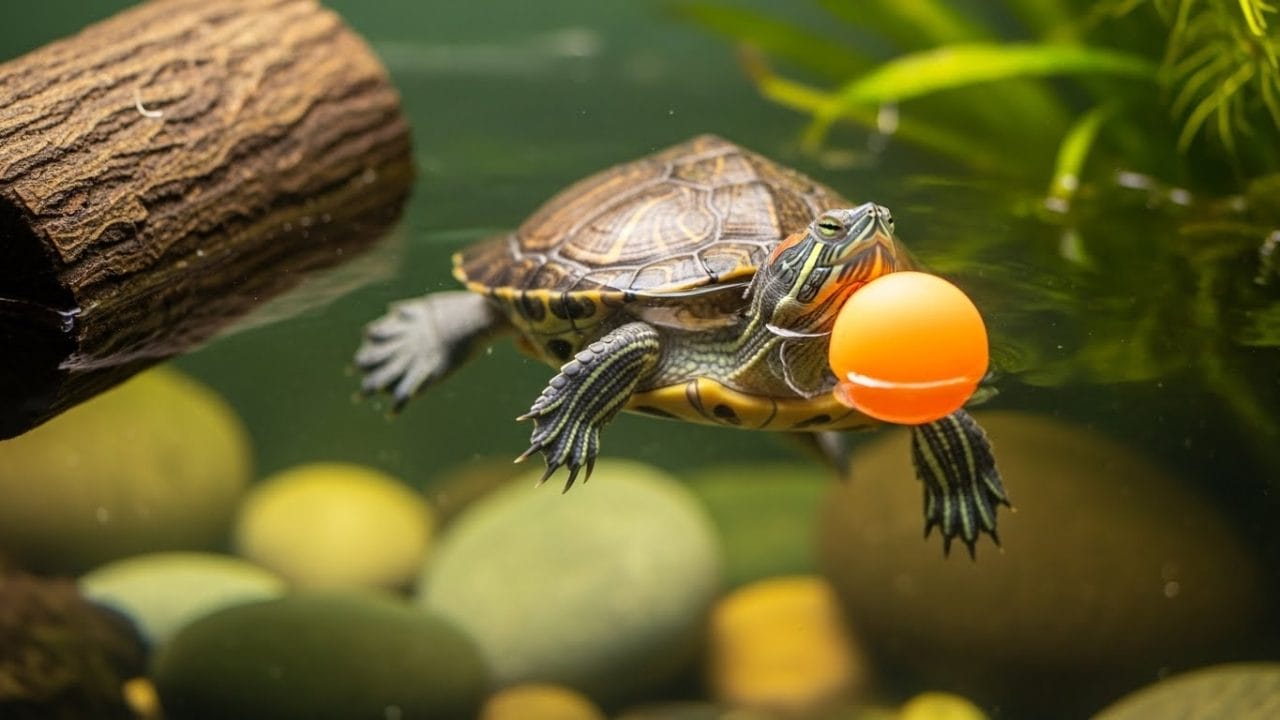
Drop a ping pong ball into your turtle’s tank and watch what happens. Most turtles will immediately swim over to investigate. They’ll push it around, chase it, and sometimes even try to bite it.
The floating action drives them crazy. It’s unpredictable. It moves when they touch it. It’s basically turtle entertainment gold.
Pro tip: Don’t leave plastic balls in the tank 24/7. They can develop mold and clog your filter. Toss them in during supervised play sessions.
Other floating toys that work:
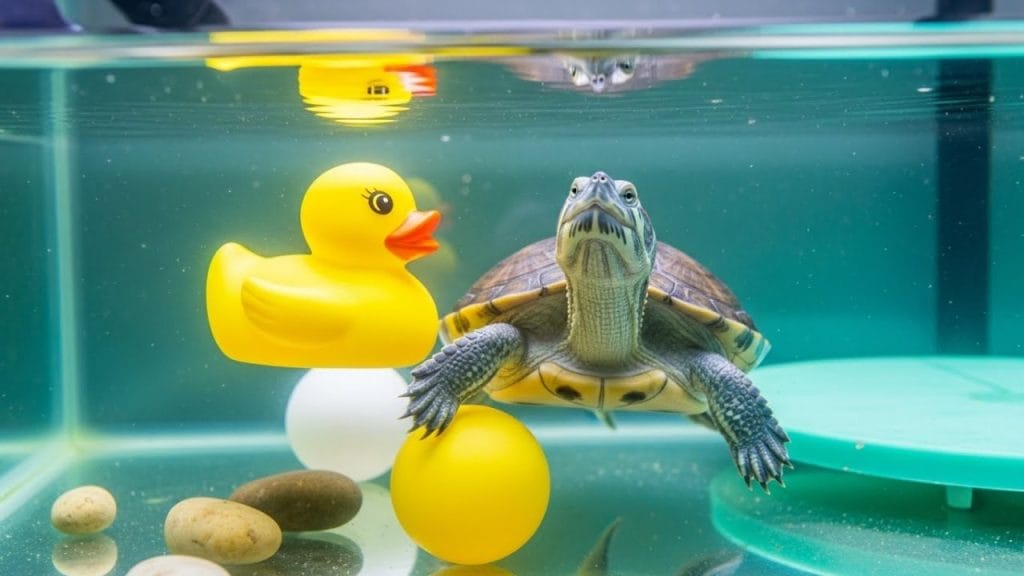
- Rubber ducks (a personal favorite among turtle owners)
- Small bath toys
- Floating boats
- Wiffle balls
Some turtles get so attached to their rubber ducks that they’ll drag them around the tank like a dog with a bone. I’m not making this up.
Puzzle Feeders
Now we’re talking.
Puzzle feeders combine two things turtles love: food and problem-solving. You stuff treats or pellets inside a ball with holes, and your turtle has to push it around to get the food out.
This mimics their natural foraging behavior. In the wild, turtles don’t just have food handed to them. They work for it. And that process of hunting and figuring things out keeps their brains sharp.
You can use:
- Cat lattice balls (the kind with holes)
- Dog treat dispensers (smaller sizes)
- Wiffle balls stuffed with treats
- Commercial turtle puzzle feeders (yes, these exist)
For land turtles and tortoises, you can even wrap their favorite fruits in large leaves like kale or banana leaves. They’ll have to eat through the greens or figure out how to unwrap the “burrito” to get to the good stuff inside.
Live Food (The Ultimate Enrichment)
Nothing gets a turtle more excited than the chase.
Introducing live feeder fish, ghost shrimp, crickets, or earthworms into the tank triggers your turtle’s natural hunting instincts. They’ll stalk, chase, and eventually catch their prey.
This isn’t just fun for them. It’s exercise and mental stimulation rolled into one.
Best live food options:
- Feeder fish (guppies, minnows)
- Ghost shrimp
- Crickets
- Earthworms
- Roaches (for the brave)
For aquatic turtles, you can put live insects on a floating log or basking platform. Your turtle will actually climb up to catch them, getting some serious exercise in the process.
One warning: Make sure any live food comes from a reputable source. Wild-caught insects or fish can carry parasites.
Empty Shells
Turtles go absolutely nuts for empty shells.
Place a few empty snail shells or clam shells in the tank, and your turtle will push them around, pile them up, and generally treat them like the world’s best toys.
Why? Nobody really knows. But turtles seem fascinated by shells. Maybe it’s the texture, maybe it’s the shape, maybe they recognize it as something turtle-related. Whatever the reason, it works.
Floating Logs
The Zoo Med floating log is basically the gold standard of turtle enrichment (recommended: aquatic turtle toy picks).
It floats on the surface, provides a hiding spot, doubles as a basking platform, and gives your turtle something to explore. They can swim through it, climb on it, hide inside it, and investigate every angle.
Unlike cheap floating objects, quality floating logs are weighted at the bottom so they don’t roll over when your turtle climbs on. That’s important for safety.
Rocks and Decorations
Turtles love rearranging their environment.
Put some smooth rocks, aquarium-safe decorations, or large glass marbles in the tank. Many turtles will spend hours pushing these around, stacking them, and generally redecorating.
It’s like they’re playing their own version of interior design. And watching them do it is honestly pretty entertaining.
Important: Make sure any rocks or decorations don’t have sharp edges, and they should be too large to swallow.
This Hilarious Turtle Book Might Know Your Pet Better Than You Do

Let’s be real—most turtle care guides feel like reading a textbook written by a sleep-deprived zookeeper.
This one’s not that.
Told from the snarky point of view of a grumpy, judgmental turtle, 21 Turtle Truths You’ll Never Read in a Care Guide is packed with sarcasm, sass, and surprisingly useful insights.
And hey—you don’t have to commit to the whole thing just yet.
Grab 2 free truths from the ebook and get a taste of what your turtle really thinks about your setup, your food choices, and that weird plastic palm tree.
It’s funny, it’s honest, and if you’ve ever owned a turtle who glares at you like you’re the problem—you’ll feel seen.
DIY Turtle Toys (Free or Cheap Options)
You don’t need to spend a fortune on turtle entertainment. Here are some household items that work great.
The Obstacle Maze
This is one of the most popular enrichment activities among turtle keepers.
Build a simple maze using:
- Smooth rocks
- Plastic containers
- PVC pipes cut in half
- Aquarium-safe plants
Place your turtle’s favorite treat at the end. Now they have to figure out how to navigate through the obstacles to get their reward.
Start simple and increase the difficulty over time. You’ll be shocked at how quickly turtles learn to solve these puzzles.
The Treasure Hunt
Instead of dumping all your turtle’s food in one spot, scatter it around the tank.
Hide pieces of food:
- Under decorations
- Behind plants
- In different corners
- At various water depths
This mimics natural foraging and keeps your turtle actively searching for their meals instead of just waiting for the food to appear.
The Dig Box
Most turtle species love to dig. It’s instinctive behavior that they don’t get to express in a bare-bottom tank.
Create a dig box by adding:
- Play sand (for aquatic turtles)
- Coconut coir (for terrestrial turtles)
- Organic topsoil (pesticide-free)
Bury some treats in there and let your turtle go to town. They’ll dig, forage, and generally have a blast.
For aquatic turtles, you can create a land section with sand that slopes into the water. They’ll dig, bask on it, and treat it like their own private beach.
Fun Activities Beyond Toys
Toys are great, but there’s more you can do.
Supervised Exploration Time
Most semi-aquatic turtles can handle some time outside their tank.
Find a safe area with:
- Hard floors (tile or wood, not carpet)
- No escape routes
- No other pets nearby
- A hide spot if they get nervous
Let your turtle roam and explore. New environments are incredibly stimulating for them.
Just make sure to supervise the entire time and return them to their tank if they show signs of stress, since new environments are one of the biggest stress triggers for turtles.
Heads up: Many turtles pee when nervous. Tile floors are your friend.
Outdoor Adventures
If weather permits and you have a secure outdoor space, supervised outdoor time is incredible enrichment.
Your turtle gets:
- Natural sunlight (way better than any UVB bulb (my pick: Zoo Med ReptiSun 10.0))
- Fresh air
- Natural scents and sounds
- Real grass and dirt to explore
You can even set up a shallow outdoor pool or pond for aquatic species. Just watch them like a hawk. Turtles are escape artists.
For extra safety, turtle harnesses exist. Yes, really. You can leash-walk your turtle. It’s as ridiculous and adorable as it sounds.
Turtle Racing (Seriously)
Got multiple turtles? Or a friend with a turtle?
Set up a simple race track in your backyard with boundaries on both sides. Place a treat at the finish line. Release the turtles and let the race begin.
Is it the fastest sport in the world? Absolutely not.
Is it hilarious and surprisingly exciting? You bet.
Turtle races are actually popular events in many communities, especially during summer. Some people take this very seriously. Championship brackets and everything.
For a home race, just make sure:
- The surface isn’t too hot or cold
- There’s shade available
- You don’t stress the turtles
- You wash your hands after (salmonella is real)
Hand Interaction
Some turtles enjoy interaction with their owners. Not all of them, but some.
You can:
- Gently scratch their shell with a soft toothbrush
- Let them chase your hand through the glass (keep fingers safe!)
- Hand-feed them treats
- Talk to them (they recognize voices)
Read your turtle. If they’re retreating into their shell, snapping, or hiding, they want to be left alone. Respect that. But if they’re swimming toward you when you approach and extending their neck, that’s a good sign they’re comfortable.
What NOT To Do
Real quick, let’s cover the things that will stress your turtle out rather than entertain them.
Never:
- Put them on their back (terrifying and dangerous for them)
- Pull their tail or limbs
- Force them out of their shell
- Introduce sharp objects
- Use toys small enough to swallow
- Leave unsuitable items in the tank 24/7
- Handle them excessively (they’re not cuddlers)
Also, don’t rearrange their entire habitat frequently. While turtles enjoy exploring new objects, completely changing their environment can stress them out. They like some familiarity.
Signs Your Turtle Needs More Enrichment
How do you know if your turtle is bored? Watch for:
- Swimming in repetitive patterns or circles
- Constantly trying to climb the glass walls
- Scratching at their own skin or shell
- Loss of appetite
- Lethargy and lack of interest in surroundings
- Aggression (including biting)
- Hiding more than usual
If you’re seeing these behaviors, it’s time to step up the enrichment game.
Many of these behaviors overlap with fear responses, so it’s worth understanding what commonly scares turtles to rule out environmental stressors before assuming boredom is the cause.
Creating the Ultimate Turtle Playground
Here’s how to set up a tank that keeps your turtle mentally stimulated long-term.
Layer your environment:
- Multiple levels (rocks to climb, platforms at different heights)
- Plants (live or artificial) for hiding and exploring
- Various substrate textures
- Caves and hiding spots
- Open swimming areas
Rotate enrichment:
- Don’t put everything in at once
- Swap toys every few weeks
- Introduce new objects periodically
- Change up feeding locations
Stimulate their senses:
- Different colors (turtles have excellent color vision)
- Various textures (smooth rocks, rough bark, soft plants)
- Movement (floating objects, bubbles from air stones)
- Live food for hunting stimulation
Wrapping Up
Here’s the bottom line: your turtle needs more than just food, water, and a basking spot.
These animals are smarter and more curious than most people give them credit for. They explore, they problem-solve, they play, and yes, they can get depressed when life gets too boring.
The good news? Keeping them entertained doesn’t have to be complicated or expensive. A ping pong ball, some live food, a puzzle feeder, and regular habitat changes go a long way.
Start simple. See what your turtle responds to. Every turtle has its own personality and preferences. Some go crazy for rubber ducks while others couldn’t care less. Some love to dig while others prefer to climb.
Pay attention, experiment, and have fun with it.
Your turtle will thank you. Well, they won’t actually thank you because they’re turtles. But they’ll be healthier, more active, and way more interesting to watch.
And isn’t that the whole point of having a pet turtle in the first place?

About Author
Muntaseer Rahman started keeping pet turtles back in 2013. He also owns the largest Turtle & Tortoise Facebook community in Bangladesh. These days he is mostly active on Facebook.