Can Two Tortoises Live Together? Why a Pair Is the Worst Setup

This post was created with help from AI tools and carefully reviewed by a human (Muntaseer Rahman). For more on how we use AI on this site, check out our Editorial Policy.
Here is the scene almost every keeper describes to me. Two tortoises in one pen, sitting right next to each other, sometimes stacked. It looks like friendship. It looks like the best decision you ever made.
It is almost never friendship.
Two tortoises can share an enclosure, but a pair is the single worst way to house them. Two males will fight. A male and female pair means constant mating pressure on her. Two females is the only pairing with a real chance, and even that fails often enough that most keepers end up with two separate setups. Groups of one male to several females work better than any pair, but they need serious space.
If you take nothing else from this post, take that. Tortoises are not lonely, and adding a friend is not a gift to them.
The Short Answer, By Pairing
| Pairing | Will it work? | What usually goes wrong |
|---|---|---|
| Two males | Almost never | Ramming, flipping, biting. Gets worse at sexual maturity, not better |
| Male + female | Rarely, long term | He mates her relentlessly. She stops eating, hides, gets injured |
| Two females | Sometimes | Usually the calmest option, but one still tends to dominate food and basking |
| Two babies | Short term only | Fine for a year or two, then one starts bullying and the other stops growing |
| Two different species | No | Different care needs plus a real risk of passing disease between them |
| One male + 4 to 7 females | Best odds | Needs a lot of space. This is the setup zoos and breeders use |
| Tortoise + any other pet | Supervised only | Covered further down, dogs especially |
Do Tortoises Actually Get Lonely?
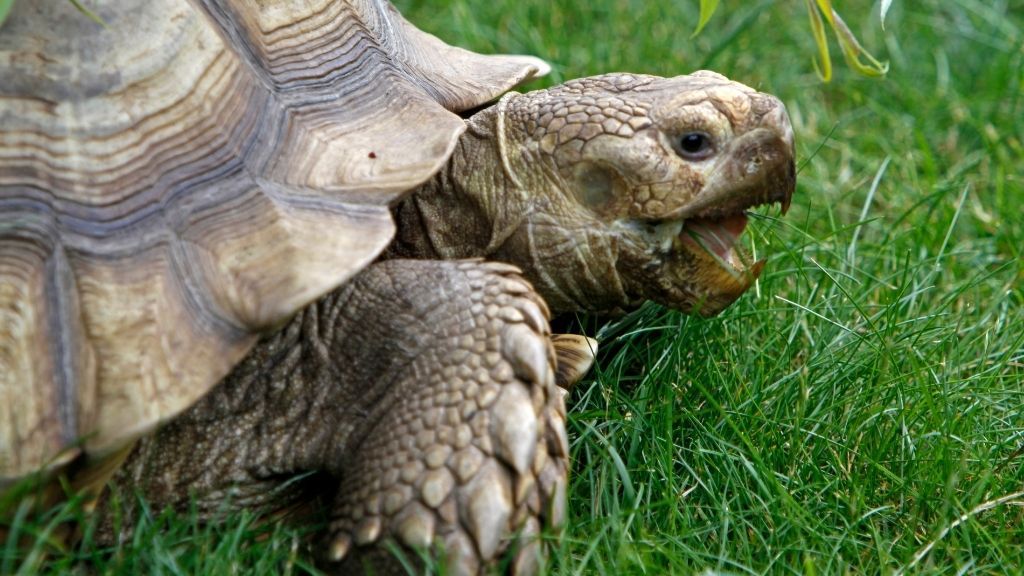
No. This is the belief that causes most of the damage.
In the wild, most tortoise species are solitary and only seek out another tortoise to mate. That is the whole social calendar. They are not sitting in a burrow wishing they had someone to talk to.
We project our own wiring onto them because that is what people do. You would go strange living alone in a room for forty years, so surely your tortoise would too.
A tortoise does not work that way. It has no social need to meet, so there is no loneliness to cure.
There are exceptions, and they matter. Redfoot, Burmese brown, pancake, Galapagos, and Aldabra tortoises are genuinely more tolerant of company and are found in loose groups in the wild. Most tortoises people keep at home, Russians, Hermann’s, Greek, sulcata, leopard, are not on that list.
So if your tortoise is alone and eating well, basking, and plodding around, it is not sad. It is a tortoise.
This Hilarious Turtle Book Might Know Your Pet Better Than You Do

Let’s be real—most turtle care guides feel like reading a textbook written by a sleep-deprived zookeeper.
This one’s not that.
Told from the snarky point of view of a grumpy, judgmental turtle, 21 Turtle Truths You’ll Never Read in a Care Guide is packed with sarcasm, sass, and surprisingly useful insights.
And hey—you don’t have to commit to the whole thing just yet.
Grab 2 free truths from the ebook and get a taste of what your turtle really thinks about your setup, your food choices, and that weird plastic palm tree.
It’s funny, it’s honest, and if you’ve ever owned a turtle who glares at you like you’re the problem—you’ll feel seen.
Why A Pair Is The Worst Possible Number
This is the part that surprises people. A group of eight can be calmer than a group of two.
In a pair, there is nowhere for aggression to go. One tortoise picks a target, and the target is the only other tortoise in the pen. There is no dilution.
Add more animals and the pressure spreads out. One male harassing seven females is annoying for each of them. One male harassing one female is a full time job for him and a nightmare for her.
Two is the number that concentrates the damage. Keep that in mind every time someone tells you their two tortoises are best friends.
About Those “Best Friends”
The behaviours that look sweet to us mean something else entirely.
One tortoise following the other around is not loyalty. It is a dominant animal keeping tabs on a subordinate one.
Sleeping stacked or piled together is not cuddling. It is usually one tortoise sitting on the other, and the one underneath does not have a say in it.
Mounting is dominance, not always mating. You will see it in babies far too young to breed, and between two females.
First, Are You Sure Of Their Sexes?
Every decision below depends on this, and a lot of keepers get it wrong. Pet shops guess, and sellers guess confidently.
Here is what you are actually looking at, once the tortoise is old enough to read.
| Tell | Male | Female |
|---|---|---|
| Tail | Long and thick, usually tucked to one side | Short and stubby |
| Plastron (belly shell) | Dips inward, concave | Flat |
| Anal scutes (rear notch) | Wider, more open V | Narrower, tighter |
| Cloaca position | Further down the tail, away from the body | Close to the body |
| Size, same age and species | Often the smaller one | Often the larger one |
None of this is readable in a hatchling. Depending on species, you are waiting until somewhere between two and five years old, or until the tortoise hits a certain size.
That is exactly why “we raised these two babies together and it was fine” turns into a problem later. You did not know what you had.
If you are unsure, a reptile vet can sex a tortoise in one appointment. Worth doing before you commit two animals to one pen, not after.
Can Two Male Tortoises Live Together?
No. This is the clearest no in the whole post.
Male tortoises are built to compete for territory and for females. Put two in a pen and you have not created a friendship, you have created a permanent border dispute with no border.
They ram each other. They bite legs and heads. They flip each other over, and a tortoise stuck upside down in the sun can die of overheating in a couple of hours if nobody spots it.
The cruel part is the timing. Two young males often get along fine for a year or more, which convinces the keeper that this pair is different.
Then sexual maturity arrives. With Testudo species especially, keepers describe it as not a question of whether the bullying starts, but when.
There is no training fix for this. The only reliable solution is two separate setups.

Can A Male And Female Live Together?
They can, but she pays for it.
A male with permanent access to a female does not mate occasionally. He mates constantly, and courtship in most species involves ramming her shell and biting her legs.
The result is a female who spends her day retreating. She eats less, hides more, and picks up shell chips and leg wounds from being rammed.
There is a second cost people forget. Constant mating means constant egg production, and a female laying clutch after clutch is at real risk of egg binding and calcium depletion.
If you want to breed, the standard approach is to keep them apart and introduce them deliberately for a short period. There is more on the process in our tortoise mating and breeding guide.
Housing them together permanently is not breeding. It is just wearing her down.
Can Two Female Tortoises Live Together?
This is the pairing with the best odds, and it still is not a safe bet.
Females are generally less territorial and less aggressive than males, so you skip the worst of the ramming and flipping. Plenty of keepers run two females for years without a serious incident.
What you get instead is quieter bullying. One female claims the best basking spot and the food bowl, and the other learns to wait.
That looks peaceful from across the room. It is not. The subordinate animal grows slower, eats less, and spends more time hidden.
So two females is worth trying if you have the space and you are willing to watch closely. Go in expecting to separate them, and treat it as a bonus if you never have to.
Can Baby Tortoises Live Together?
For a while. This is the most common trap in the hobby.
Hatchlings are cheap to house, they take up no room, and they genuinely do seem to get along. So people buy two or three and raise them in one tub.
Then it goes wrong quietly. Hatchling Hermann’s and Russians have been seen chasing and biting each other as young as six months, and mounting behaviour shows up in babies nowhere near sexually mature.
The damage in babies is not usually dramatic injuries. It is growth. One baby edges the other off the food and the warm spot, and within months you have one normal tortoise and one that is visibly behind.
A hatchling that falls behind on food and warmth does not always catch up. Some do not survive it.
Common guidance is that babies should not be housed together beyond the first year or two, and that you need at least 10 square feet per baby if you do it at all. Watch for one preventing another from eating or basking, and split them the day you see it.
If you are raising hatchlings, our baby tortoise diet guide covers what each one should actually be getting.
Can Different Tortoise Species Live Together?
No, and this one is not really about temperament.
The first problem is care. A sulcata from the African grasslands and a redfoot from humid forest do not want the same humidity, the same temperature, or the same diet. Whatever you set the pen to, one of them is living in the wrong climate.
The second problem is disease, and it is the serious one.
Tortoises carry pathogens like herpesvirus and Mycoplasma without showing any symptoms at all. A species that has lived with a bug for generations can shrug it off and still pass it to a species that has never met it.
Mycoplasma is the main cause of chronic runny nose in tortoises, it spreads through nasal discharge, and tortoises greet each other nose to nose. Infected animals often become lifelong carriers, so this is not something that clears up.
Cross species transmission of both herpesvirus and Mycoplasma has been documented, including into Hermann’s and spur-thighed tortoises. Mixing species is how a healthy collection becomes a sick one.
There is also the size mismatch. A 100 pound sulcata does not need to be aggressive to injure a Russian tortoise, it just needs to walk.
There is a lot more on tortoises sharing an enclosure with other reptile species if that is the direction you are weighing up.

When Group Housing Actually Works
Groups do work. They just need the conditions most homes cannot provide.
One male to roughly four to seven females is the ratio keepers and breeders use. The point is to spread his attention so no single female takes the full load.
All the animals should be the same species and roughly the same size. A big size gap turns ordinary shoving into injury.
You need real space, and more than you think. Rough guidance is at least 10 square feet of floor per adult tortoise, and 8 to 16 square feet as an absolute floor for two, with more added for every animal after that.
Outdoors is far easier than indoors here, because the space problem mostly solves itself. Our outdoor enclosure setup guide walks through building one properly, including keeping predators out.
And no all male groups. Ever. A group of males is just several border disputes running at once.
Species By Species
Temperament is not identical across the board, so here is where the common pet species land.
| Species | Two together? | Notes |
|---|---|---|
| Russian | Poor | Very territorial. Males fight hard, and even females squabble over food |
| Hermann’s | Poor | Classic Testudo pattern. Males bully once mature, reliably |
| Greek (spur-thighed) | Poor | Same as above. Males are relentless with females |
| Marginated | Poor | Territorial, and they get big enough to do damage |
| Sulcata | Poor, and risky | Sheer size makes any conflict serious. Needs enormous space for groups |
| Leopard | Fair | Calmer than Testudo species, but still needs real room |
| Redfoot | Good | One of the genuinely group tolerant species, from a forest social structure |
| Yellowfoot | Good | Similar to redfoot |
| Pancake | Good | Naturally found sharing rock crevices |
| Burmese brown | Good | Tolerant of company |
| Aldabra and Galapagos | Good | Group living in the wild, but nobody is housing these in a spare room |
| Indian star | Fair | Fairly placid, though males still spar |
Even in the good rows, that is permission to try with space and supervision. It is not a promise.
You can read up on the ones that stay manageable indoors in our guide to the smallest tortoise species.
How To Set Up A Pen For More Than One
If you are going to house tortoises together, the setup does most of the work.
Go rectangular, not square. A long pen lets two animals put real distance between themselves. A square pen means they are always within sight of each other.
Break the sight lines. Rocks, logs, planted clumps, and low walls let a tortoise get out of view. A tortoise that can see its rival at all times stays keyed up.
Duplicate everything, at opposite ends. Two feeding stations, two water dishes, two basking spots, and more hides than you have tortoises. Most bullying happens at the resource, so remove the bottleneck.
Feed them apart. Mealtime is when a dominant tortoise does its clearest damage, and it is the easiest moment to control.
Keep a spare setup ready. Not a plan for a spare setup, an actual one. When you need to split them you need to split them that day, not next weekend.
A divider down the middle of an existing pen is a fine emergency fix, as long as it is solid enough that they cannot see through it.
Signs One Tortoise Is Bullying The Other
The bully is easy to spot once you know what you are looking at. The victim is the one people miss, because a bullied tortoise gets quiet, and quiet reads as calm.
Watch for these in the aggressor:
- Head bobbing at the other tortoise
- Ramming the shell, especially from the front
- Biting at legs, neck, or the front of the shell
- Following the other one around the pen
- Blocking access to food, water, or the warm spot
- Mounting, at any age and in any sex combination
- Flipping the other tortoise onto its back
And these in the one being bullied:
- Hiding constantly, or wedging into a corner
- Eating noticeably less, or not eating when the other is nearby
- Falling behind in growth over weeks and months
- Fresh chips, cracks, or bite marks on the shell and legs
- Backing away or retracting whenever the other approaches
- Pacing the walls, which often means it wants out
That last one has other causes too, and we cover them in why is my tortoise pacing.
If you are unsure whether what you are seeing counts as stress, the checklist in signs a tortoise shows when it is stressed is a good second opinion.
Here is the rule I would give anyone. The moment you find yourself explaining away a behaviour, separate them. Explaining it away is the sound of a keeper who already knows.
What To Do When It Goes Wrong
Separate them first, diagnose second. Do not spend three days deciding whether it is really bullying while one animal is getting rammed.
Move them into different pens, or drop a solid divider into the pen you have. Same day.
Check the victim over properly. Look at the shell edges, the front legs, and the neck for bite wounds and cracks, and check for a runny nose or wheezing, which stress can bring on.
Any open wound or shell damage is a vet visit, not a wait and see. Wounds on a tortoise get infected easily and infections travel to bone. You can ask a vet online if you cannot get an appointment quickly.
Then leave them apart. Reintroducing after a fight almost never ends differently, because nothing about either animal has changed.
Quarantine: The Step Almost Everyone Skips
If you are adding a second tortoise, this part is not optional.
Quarantine the new arrival for a minimum of three months, and six is better. Separate room, separate equipment, and wash your hands between animals. Feed and clean the resident tortoise first, the new one last.
The reason is the carrier problem. A tortoise carrying herpesvirus or Mycoplasma can look completely healthy for months and still infect your existing animal on day one.
If you can, get the new tortoise screened by a reptile vet before they ever share air. That is the only way to actually know.
Skipping quarantine is how people lose a tortoise they had for fifteen years to a bug that came in with a new one.
Can Tortoises Spend Time Together Temporarily?
Yes, and this is the compromise I would point most people toward.
Supervised yard time in a neutral space is low risk. Nobody owns that ground, so there is much less to fight over.
Keep it short, stay present, and end it the moment you see head bobbing or ramming. Weekly is plenty.
Two things to know. Neutral ground helps, but it does not make two males safe together, and any shared space still means shared germs, so this only applies to tortoises you would house together anyway.
If they ignore each other completely, that is the result you want. Do not read boredom as a failed playdate.

Can You Keep Tortoises With Other Pets?
Different question, and the answer is more forgiving. Your dog is not competing with your tortoise for territory or mates, which removes the main driver of tortoise on tortoise aggression.
The risk here is simpler. One animal is fast, curious, and has teeth, and the other one cannot run.
The general rule holds for any pet. Tortoises get along with calm animals and get stressed by loud ones, and barking, meowing, or anything that moves suddenly can send a tortoise into hiding or into the walls of its pen looking for a way out.
Other reptiles are the exception to how forgiving this section is. A dog lives in your house while the tortoise lives in its pen, but a second reptile almost always ends up inside the pen itself, and that fails for completely different reasons. I went through them species by species in can tortoises live with other reptiles.
Dogs come up most, so they get the detail.
Can Dogs And Tortoises Live In The Same House?
Yes, with rules. It depends almost entirely on the housing.
If your tortoise lives in a closed pen the dog cannot get into, this is easy and thousands of homes do it without incident.
If your tortoise free roams or lives in an open outdoor pen, the two will meet, and eventually they will meet when you are not in the room.
Why They Are A Bad Natural Match
Nothing about these two animals lines up.
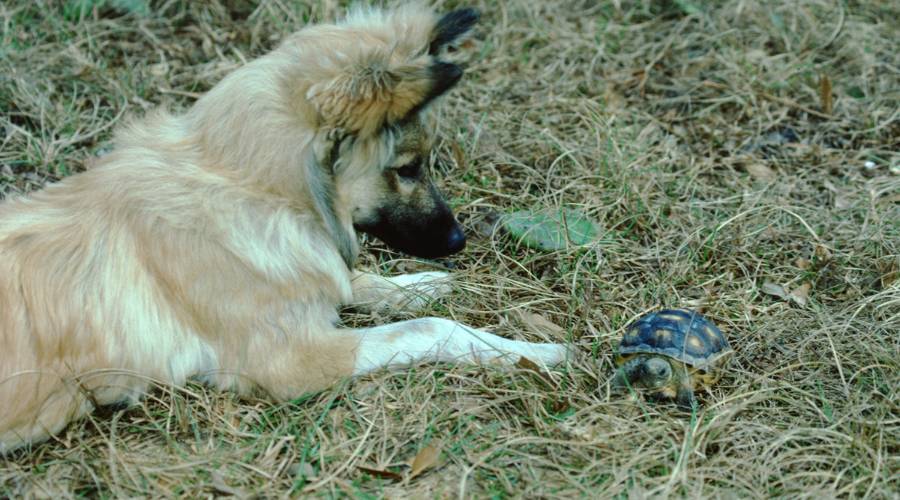
Dogs are hot, fast, and social. Tortoises are slow, shy, and want to be left alone. Dogs greet by getting in your face, which is exactly what a tortoise reads as a threat.
Tortoises treat anything larger than themselves as a predator, and they are not wrong to. In the wild, dogs and other canines raid tortoise nests and eat hatchlings.
When a tortoise sees a dog, it does what it always does. It pulls into its shell or digs itself out of sight.
Can A Dog Bite Kill A Tortoise?
Yes, and this is not a rare freak accident.
Dogs chew. A tortoise shell is a fascinating object to a bored dog, and while tortoise shells are strong, a determined dog can puncture the scutes or crack the shell edge.
Bites to the legs and neck are more common than shell damage and more dangerous. Open wounds get infected, infections reach bone and blood, and untreated cases go to necrosis.
A minor bite treated the same day is usually fine. That is the whole difference.
Which Dogs Are Safe Around A Tortoise?
Not all dogs are a threat and not all dogs are fine. Temperament matters more than breed, but breed is not nothing.
- Dogs already comfortable with people and other pets adapt fastest
- Rescue dogs with unknown history or trauma are a bigger gamble around a defenceless animal
- Puppies and young dogs generally accept a new housemate more easily than a set in its ways older dog
- High prey drive breeds are the ones I would simply keep away from the pen

How To Introduce A Dog And A Tortoise
Slowly, and with a stand in first.
- Start with a toy. Give the dog a tortoise sized plush and correct it every time it bites or shakes the toy. Do the reverse too, leaving a dog shaped toy near the tortoise so the shape stops being alarming.
- Meet through a barrier. Bring the dog to a secured pen and let them look at each other. You are watching the dog for fixation and the tortoise for whether it keeps walking or shuts down.
- Repeat it, short and often. A few minutes at a time over a couple of weeks tells you more than one long session.
- Feed both before any real meeting. A fed dog is a calmer dog, and a fed tortoise is less motivated to wander.
- First proper meeting, you do not leave the room. Not once, not for a minute.
- Know your red flags. Fixed staring, stalking, crouching, growling, or trying to mouth the shell means done for the day, and possibly done for good.
The Rules That Do Not Change
Even if they get along beautifully.
No unsupervised contact, ever. The reason is not that your dog is bad. It is that one bad second is enough.
The pen keeps its secure cover whether they are friends or not. Separate rooms is still the safest default.
And wash your hands. Tortoises carry salmonella, and it moves to dogs through shared surfaces, water, and food bowls just as it moves to people. There is more on that in can turtles transmit diseases to humans.
Cats are usually a smaller risk than dogs, mostly because a cat loses interest. Small pets like rabbits and guinea pigs should not share a pen at all, because they bring their own bacteria and they compete for the same food.
Common Myths, Cleared Up
“They cuddle at night, so they must like each other.” Stacking is dominance or heat seeking. The one on the bottom did not agree to it.
“They have been fine for two years.” Two years is roughly how long it takes a young male to grow up. Fine now is not the same as fine.
“My tortoise looks bored on its own.” Boredom in tortoises is solved with a bigger pen, varied terrain, and things to climb, not with another tortoise. Enrichment beats company every time.
“They only fight at feeding time, so it is not real aggression.” Feeding time aggression is the most common form there is, and it is the one that starves the loser.
“A bigger pen fixed it.” Space genuinely helps and is often the right first move, but it does not change what a mature male is trying to do.
Frequently Asked Questions
How many tortoises can I keep at home?
As many as you have square footage and separate setups for. Space and the ability to split them are the real limits, not a number.
Should tortoises be kept in pairs?
No. A pair is the worst configuration. Keep one, or keep a properly sized group with one male.
Can two tortoises share a water dish?
They can, but give them two. Shared dishes are both a bullying point and a disease route.
Will my tortoises breed if I house a male and female together?
Almost certainly, and more often than is good for her. If you are not set up to incubate eggs and manage a laying female, do not house them together.
Can I put a new tortoise straight in with my old one?
No. Quarantine for three to six months first, then introduce in a neutral space if at all.
Do tortoises recognise each other?
They recognise individuals well enough to maintain a pecking order, and they recognise their keepers too. That is not the same as friendship.
My two have lived together for years with no problems. Should I split them?
Not necessarily. If both are eating well, growing evenly, and neither is hiding, you may have got lucky. Keep the spare setup ready anyway.
The Bottom Line
Tortoises are not lonely, and a second tortoise is not a favour to the first one.
If you want more than one, skip the pair. Build the space for a proper group, keep it to one male, quarantine anything new for months, and set the pen up so nobody has to fight over food or heat.
And keep a second setup standing by. The keepers who never have a disaster are the ones who can separate two animals in ten minutes, not the ones who got the pairing right.
If you keep aquatic turtles as well, the same question has a slightly different answer over in can you house two turtles in a single tank.
And if the second animal you are weighing up is a lizard or a snake rather than another tortoise, the answer changes completely. Housing a tortoise with another reptile species is a harder no than any pairing on this page.

About Author
Muntaseer Rahman started keeping pet turtles back in 2013. He also owns the largest Turtle & Tortoise Facebook community in Bangladesh. These days he is mostly active on Facebook.