Box Turtle Breeding: A Complete Guide to Mating, Eggs & Hatchlings
This post was created with help from AI tools and carefully reviewed by a human (Muntaseer Rahman). For more on how we use AI on this site, check out our Editorial Policy.
So you want to breed box turtles. Maybe you have a healthy pair and you are dreaming of a clutch of tiny hatchlings. Maybe you just found two of them getting cozy and now you have questions.
Either way, here is the honest truth. Breeding box turtles in captivity is absolutely doable, but it is not as simple as putting a male and female in the same box and waiting.
There is a season for it. There is a cooling period that triggers it. There is a whole mating ritual, then egg laying, then incubation, then months of hatchling care.
I have kept box turtles for years, and I have walked this entire path more than once. In this guide I will take you through every stage, start to finish. Choosing the pair, conditioning them, the mating itself, collecting and incubating the eggs, and raising the babies that come out the other end.
Grab a coffee. This is the complete one. Already incubating a clutch? See when your turtle eggs will hatch.
Why Breed Box Turtles In Captivity At All?
Before we get into the how, let me make the case for the why. Because it matters.
Captive bred box turtles make better pets. They are used to human contact from day one, so they are calmer and adjust to a home enclosure without the stress a wild caught turtle goes through.
A wild box turtle has sharp wild instincts. It takes a long time to settle, and honestly some never fully do.
Captive breeding also takes pressure off wild populations. Box turtles are declining across much of their natural range, and every captive bred hatchling is one less reason to pull one from the wild.
So if you do this right, you are doing a good thing. Now let us get you set up for success.
Before You Start: Can Your Box Turtles Even Breed?
This is the part most beginners skip, and it is where most failed breeding attempts actually fail. Before you think about mating, three things have to be true.
- You have a confirmed male and a confirmed female
- Both are sexually mature
- Both are healthy and the right species match
Let us walk through each one.
Are You Sure You Have a Male and a Female?
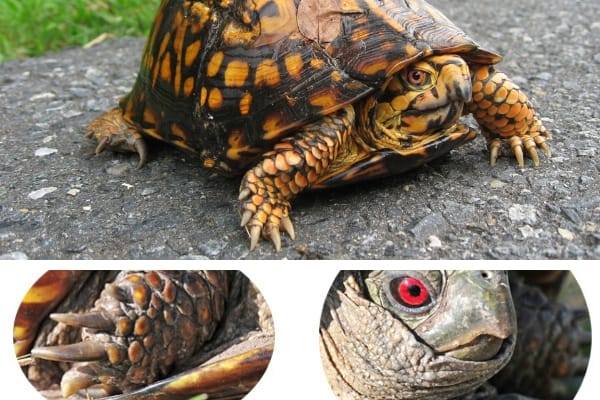
It sounds obvious, but you would be shocked how many people try to breed two turtles of the same sex and wonder why nothing happens.
You cannot reliably sex a young box turtle. Once they hit around 3 to 3.5 inches the differences start showing. Here is what to look for.
- Males are usually larger than females, though the ornate box turtle flips this and females run bigger
- Males tend to be more colorful overall
- Males often have red, pink, or orange eyes. Females usually have dark brown eyes
- Males have a thicker, longer tail. The female tail is shorter and thinner
- Males frequently have a slightly concave plastron (the bottom shell) which helps them mount during mating
These clues are strong but not perfect across every subspecies. If you want certainty, a quick vet visit settles it. For a full walkthrough, see our guide on how to tell the gender of a box turtle.
Are They Old Enough?
Box turtles cannot breed until they hit sexual maturity, and that takes a while.
Depending on the subspecies, maturity arrives somewhere between 5 and 10 years of age. By then a turtle should be roughly 4 to 6 inches long.
A baby box turtle will not breed no matter what you do. Trying to pair a juvenile is just stress with no payoff.
My advice goes one step further. Even if your turtle is technically mature, give it an extra year. A fully established adult breeds more successfully and the female handles egg production far better. Not sure how old yours is? Here is how to estimate a box turtle’s age.
Are They Healthy and a Good Match?
Mating is physically demanding. A turtle that is underweight, dehydrated, or fighting an infection should not be bred, full stop.
Make sure both turtles are the same species or a compatible subspecies. Crossing distant subspecies can produce weak or abnormal hatchlings.
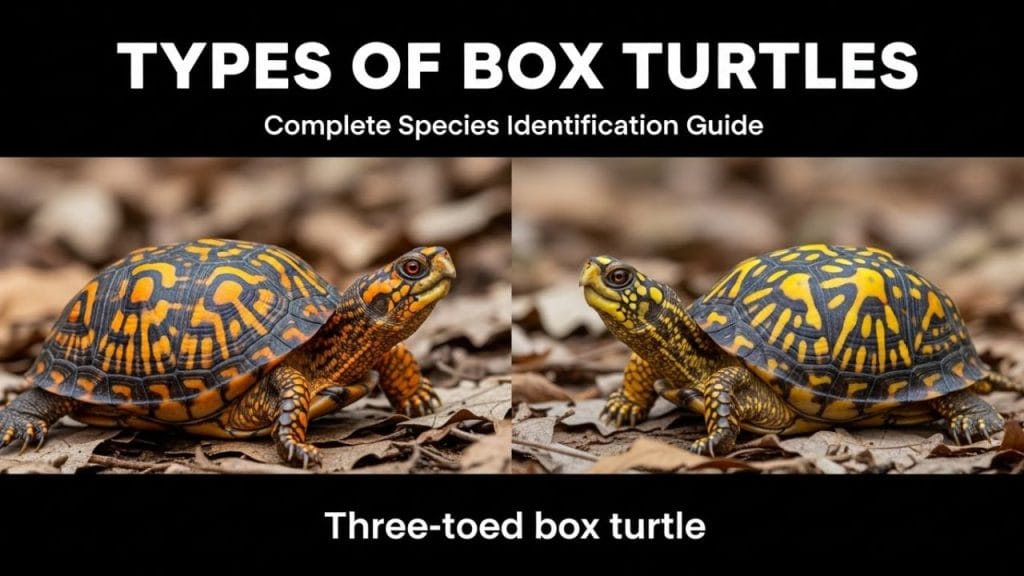
Some crosses are fine. An Eastern box turtle paired with a Three-toed box turtle, for example, usually produces healthy babies. But matching like with like is always the safer bet, and our types of box turtles guide helps you confirm what you actually have.
What About the Male to Female Ratio?
If you are breeding more than a single pair, the ratio matters a lot.
Keep more females than males. A commonly cited target is roughly 2 males to 5 females.
Here is why. During breeding season males get aggressive and relentless. With too few females, the males gang up on one female and harass her until she gets sick or injured.
Too few females also means the males start fighting each other over a single mate. A higher female ratio spreads the attention out and keeps the peace.
This Hilarious Turtle Book Might Know Your Pet Better Than You Do

Let’s be real—most turtle care guides feel like reading a textbook written by a sleep-deprived zookeeper.
This one’s not that.
Told from the snarky point of view of a grumpy, judgmental turtle, 21 Turtle Truths You’ll Never Read in a Care Guide is packed with sarcasm, sass, and surprisingly useful insights.
And hey—you don’t have to commit to the whole thing just yet.
Grab 2 free truths from the ebook and get a taste of what your turtle really thinks about your setup, your food choices, and that weird plastic palm tree.
It’s funny, it’s honest, and if you’ve ever owned a turtle who glares at you like you’re the problem—you’ll feel seen.
The Cooling Period: The Switch That Turns Breeding On

This is the single most important step, and the one beginners most often miss. In the wild, box turtles breed in spring, right after they come out of winter dormancy.
That cold spell is not just something they survive. It is the biological trigger that primes their bodies to reproduce.
So if your turtles never experience a cooling period, their reproductive systems may never fully switch on. You have to recreate winter.
How to Cool Your Box Turtles
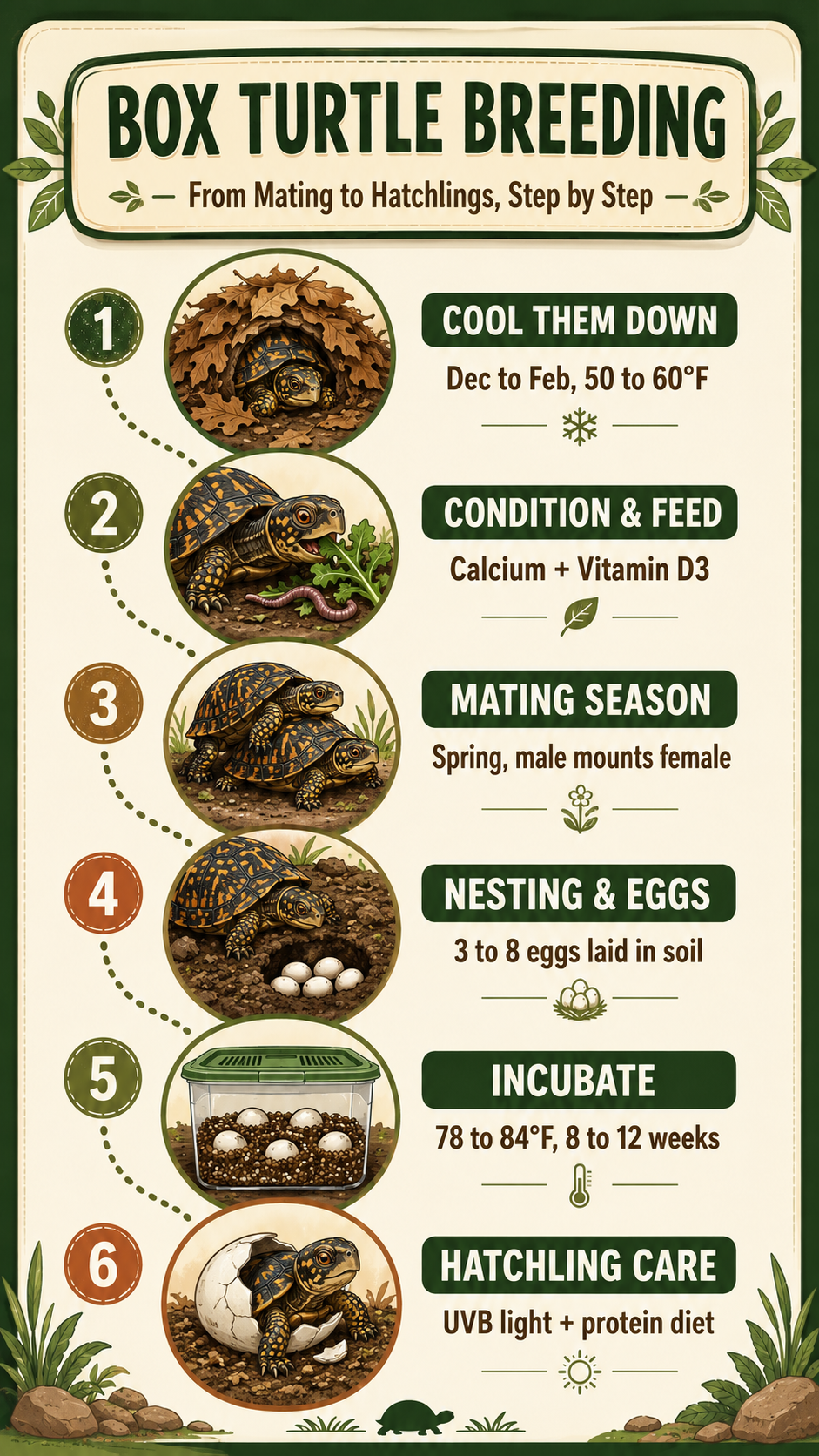
The cooling window runs roughly December through February, about 12 weeks. During this time you bring the enclosure temperature down to between 50 and 60 degrees Fahrenheit.
Leave them mostly alone. Keep offering food and water, but do not be surprised if your box turtle stops eating during this stretch. That is normal cooling behavior.
If your turtles live outdoors, nature often handles this for you. The dropping temperatures cool them naturally, and some will brumate on their own. Our box turtle hibernation guide covers how to do this safely.
Bringing Them Back Up
When February ends, the cooling period is over. Now you gradually return the enclosure to normal warmth.
Aim for a daytime temperature around 75 degrees, with a warmer basking spot. Here are target ranges by subspecies.
| Subspecies | Daytime (F) | Basking area (F) | Nighttime (F) |
|---|---|---|---|
| Eastern box turtle | 70 to 75 | 85 to 88 | 65 to 70 |
| Ornate box turtle | 70 to 90 | 85 to 88 | 65 to 70 |
| Florida box turtle | 70 to 90 | 85 to 88 | 65 to 70 |
| Three-toed box turtle | 70 to 75 | 85 to 88 | 65 to 70 |
As the warmth returns, your turtles wake up hungry and, soon after, interested in each other.
Conditioning: Feeding for Fertility
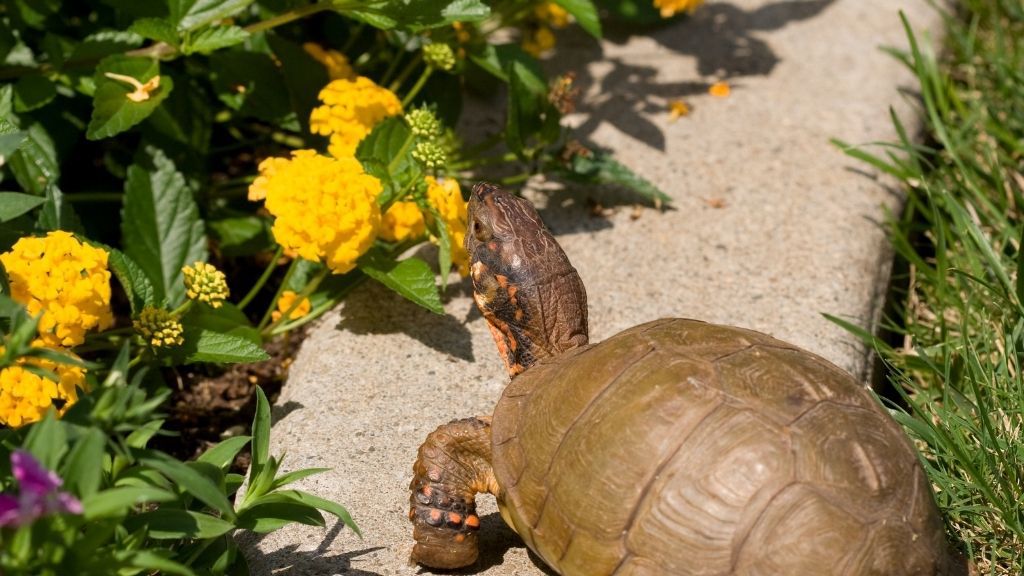
Coming out of cooling, both turtles need to rebuild condition fast. Mating burns energy, and the female has to produce eggs on top of that.
A varied, nutrient dense diet is how you get them there. Mix plant and animal foods.
| Plant based | Animal based |
|---|---|
| Butter lettuce, dandelion greens, mulberry leaves, steamed broccoli, sweet potato, peas, melon, strawberries, blueberries, tomato | Earthworms, snails, crickets, feeder fish, boiled egg |
The female needs extra calcium and vitamin D3 to form strong eggshells. This part is not optional.
Offer a cuttlebone (my pick: natural cuttlefish bone) in the enclosure or dust food with a calcium supplement (my pick: Rep-Cal Calcium with D3). For D3, outdoor turtles get it from natural sunlight, while indoor turtles need a full spectrum UVB (my pick: Zoo Med ReptiSun 10.0) lamp. Our full box turtle diet guide breaks down quantities and feeding schedules.
How Box Turtles Actually Mate

Alright. Conditioning is done, the weather is warm, and your turtles are ready. Here is what the mating process actually looks like, because knowing the signs helps you avoid interrupting it.
Mating Season and Courtship
Box turtle mating season is spring, peaking in March and April, though it can run the whole season. Pet turtles that skipped a real winter may be on a looser schedule.
A mature male goes looking for a female and begins courtship. He may show off his colorful neck and tickle her head with his front claws. An interested female returns the gesture.
If the female is not in the mood, things get pushy. The male will chase her, bump her shell, and may bite at her head, neck, or shell to wear her down.
Sometimes a male will even roll a female over and right her again. It looks rough, and it is, but it is normal box turtle behavior.
The Actual Mating
When the female is finally receptive, the male climbs onto her back. He hooks his hind toes onto the rear edge of her shell to lock himself in place.
Both turtles have a cloaca, the single opening near the base of the tail used for waste and for reproduction. During mating the male connects his cloaca to the female’s. His longer, thicker tail is what makes this possible.
Here is the wild part. The male often tilts almost vertical, sometimes leaning back toward the ground. In the wild, males that fall onto their backs and cannot flip over can actually die from it.
The whole thing can last up to 3 hours. Afterward the male may stay latched onto her shell for a while to keep other males away.
How to Tell If They Are Mating
You usually do not have to guess. The male will be mounted on the female, or positioned nearly upright behind her with his tail tucked under her shell.
You may hear clicking sounds as he bumps her shell. Some box turtles also hiss or make a screeching noise during the act.
When you see this, give them space. Turtles are shy and do not want an audience mid-mating.
Separate Them Afterward
This is important. Once mating is done, move the male away from the female.
Males will keep pestering a female long after the deed is done, and that constant harassment can make her sick or stop her from nesting properly. One successful mating is enough to fertilize a whole clutch, and a female can even store sperm to fertilize eggs in later seasons.
Setting Up the Breeding Enclosure
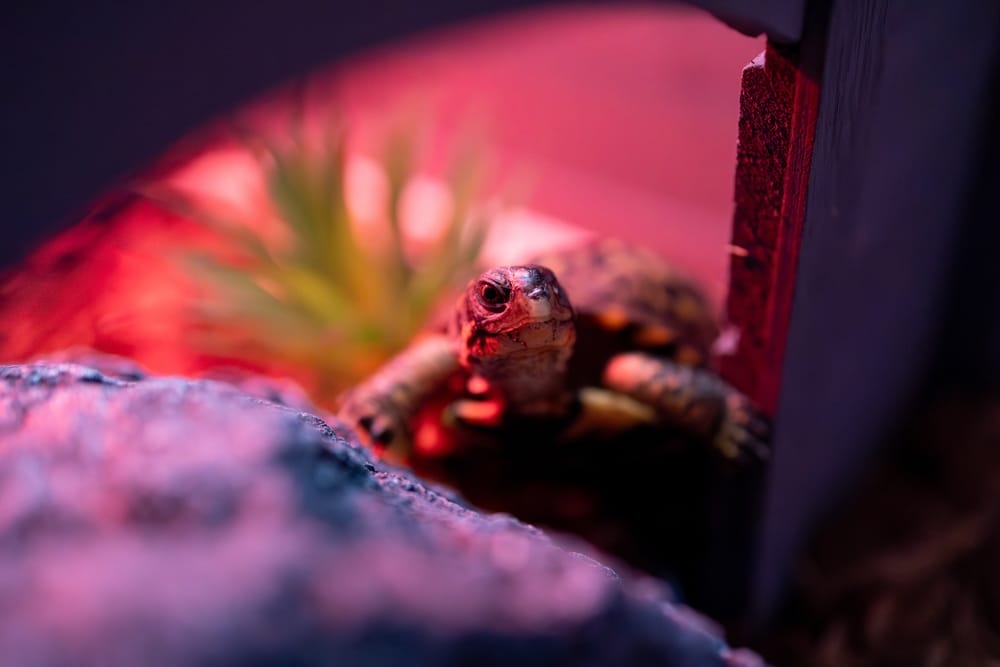
Whether you breed indoors or outdoors, the enclosure has to support the whole process. Here is what it needs.
- A large, shallow water dish big enough for a turtle to soak in and drink from
- A heat lamp (my pick: heat lamp) placed at one end only, so turtles can move toward or away from the warmth
- Logs, brush, and hiding spots so a female can escape an overeager male
- Opaque walls, or walls covered with paper or cardboard, since visible glass stresses turtles out
- Plenty of food spread around for everyone
If you are working indoors, our indoor box turtle habitat guide walks through the full setup, and the lighting guide covers UVB and heat placement.
Egg Laying and Nesting

A few weeks after a successful mating, your female gets ready to lay. This is where a lot of clutches are lost, so pay attention here.
Signs Your Female Is Gravid
A gravid (egg carrying) female often changes behavior. She may get restless, pace the enclosure, dig test holes, and lose interest in food.
She is hunting for the right nesting spot. If she cannot find one she is happy with, she may hold her eggs too long, which is dangerous and can become egg binding.
Give Her a Proper Nesting Box
In a captive enclosure the substrate is often too shallow for a turtle to dig a real nest. A dedicated nesting box solves this.
To build one you need high quality topsoil, a large deep container, a water sprayer, and a lid.
Fill the container with 6 to 8 inches of soft, diggable substrate. Mist it so it holds shape without being soggy, then connect it to the main enclosure. Our step by step on how to make a nesting box has the full build.
How She Lays
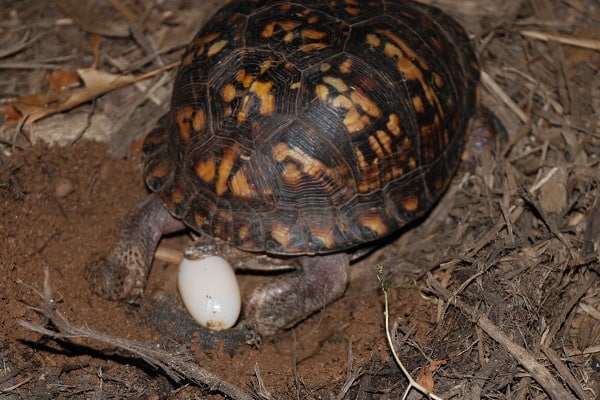
Box turtles do not lay on the surface. The female digs a deep chamber, usually near a rock or tree root, climbs in, deposits her eggs, then carefully covers the hole and walks away.
A typical clutch is 3 to 8 eggs, often around 3 to 4. The eggs are white, oval, thin shelled, and a little spongy.
Let her finish undisturbed. Interrupting a nesting female can make her abandon the nest or retain eggs.
Collecting and Handling the Eggs
In a stable outdoor nest the eggs may hatch on their own. But in captivity, conditions are rarely reliable enough, so most breeders incubate.
That means carefully digging the eggs back up, and this is the most delicate task in the entire process.
The eggs are fragile and buried deep, so go slow. Brush soil away with a soft paintbrush rather than your fingers.
Here is the rule you cannot break. Do not rotate or turn the eggs.
After the first day or two, the embryo attaches to the top inside of the shell. Flip the egg and you drown the embryo. Before you move each egg, mark a small dot on top with a pencil so it goes into the incubator in the exact same orientation.
Incubating Box Turtle Eggs

This is where patience pays off. A clean, stable incubator gives you far better hatch rates than leaving eggs to chance.
Prepping the Incubator
Start clean. Wipe the incubator down with a mild bleach solution or a commercial incubator disinfectant, then let it dry.
Add a substrate that holds moisture. Vermiculite (my pick: coarse horticultural vermiculite) or perlite mixed with water is the standard, and you half bury the eggs in it, marked dot facing up.
Run the empty incubator for a full 24 hours before the eggs go in. You want to confirm it holds temperature and humidity steadily before trusting it with a clutch.
Temperature, Humidity, and Sex
Keep the incubator around 78 to 84 degrees Fahrenheit with humidity in the 75 to 85 percent range. Steady is the goal. Big swings kill embryos.
Box turtles have temperature dependent sex determination, which is genuinely fascinating. Cooler incubation, around 72 to 78 degrees, tends to produce more males. Warmer incubation, around 82 to 85, tends to produce more females.
So you have some influence over the mix of your clutch just by adjusting the dial.
Are the Eggs Even Fertile?
Not every egg will be viable. Often one in four is infertile from the start.
After a couple of weeks you can candle the eggs by holding a small flashlight against the shell in a dark room. A fertile egg develops a chalky white band and later visible veins. An infertile egg stays translucent or yellowish and may go moldy.
Do not toss an egg just because it looks slow. Some lag behind and still hatch, so only remove eggs that clearly rot.
How Long Until They Hatch?
Box turtle eggs take roughly 8 to 12 weeks to hatch. The exact timing depends on subspecies, embryo development, and incubation temperature. For the bigger picture, see how long turtle eggs take to hatch across the common species.
Warmer eggs generally hatch sooner. Cooler eggs take their time. For a deeper dive into this stage, see our guide on hatching box turtles from eggs.
Hatching Day

When the time comes, the hatchling uses a tiny egg tooth to slice through the shell. This first crack is called pipping.
Do not help. It is tempting, but a hatchling often pips and then rests inside the shell for a day or more while it absorbs the last of its yolk sac.
Pulling it out early can cause fatal bleeding or infection. Let it emerge on its own schedule.
Expect some eggs not to hatch. Even with great conditions, a perfect hatch rate across a whole clutch is rare, so do not be discouraged by a few duds.
Caring for the Hatchlings

The eggs hatched. Congratulations, you are now running a tiny turtle nursery. Hatchlings are delicate, so their care is its own job.
Housing
Keep hatchlings indoors for their first year so you can watch them closely. A 10 gallon tank works as a starter enclosure for a small group.
Use terrarium moss and reptile bark as substrate, and mist it regularly to keep the bedding humid. Babies dehydrate fast.
Run a heat lamp about 12 hours a day, and add a UVB source. Without UVB, hatchlings develop shell and bone deformities.
Feeding
Hatchlings are heavy meat eaters early on, more so than adults. They crave protein because their shells and bones are growing fast.
Offer chopped earthworms and other small protein sources, dusted with a calcium and vitamin supplement. You do not need to feed every single day, but always keep fresh water available.
Skimp on protein at this stage and you risk permanent physical abnormalities. This is not where you cut corners.
Health and Monitoring
A baby box turtle has a weak immune system, and even a small change in conditions can make it sick. Stay on top of it.
- Check each hatchling regularly for swelling, soft shell, or sunken eyes
- Isolate any sick baby immediately so problems do not spread
- Keep the enclosure spotless, since dirty bedding breeds infection
- Feed a consistent, supplemented diet
Our guides on box turtle care and common box turtle health problems cover what to watch for as they grow.
Common Box Turtle Breeding Problems
A few issues come up often enough to flag.
No interest in mating usually means one of two things. The turtles are not fully mature, or they never got a proper cooling period. Fix the cooling and wait a season.
Egg binding happens when a gravid female cannot find a place to nest and retains her eggs. A proper nesting box usually prevents it. If she is straining, lethargic, or has gone weeks past due, see a vet right away.
Infertile clutches often trace back to a male that is too young, poor conditioning, or a mating that did not fully take. Healthy, well fed, mature adults solve most of this.
Final Thoughts
Breeding box turtles is a long game. It runs from a December cooling period all the way to hatchlings you are still raising the following winter.
But none of the individual steps are hard once you understand the sequence. Get the pair right, cool them properly, condition them, let nature take its course, then protect the eggs and babies.
Do that, and you get the genuine reward of watching a clutch of tiny box turtles take their first steps into the world. There are few things in this hobby that feel better.

About Author
Muntaseer Rahman started keeping pet turtles back in 2013. He also owns the largest Turtle & Tortoise Facebook community in Bangladesh. These days he is mostly active on Facebook.