6 Types Of Pet Mud Turtles [Species Guide + Care Basics]

This post was created with help from AI tools and carefully reviewed by a human (Muntaseer Rahman). For more on how we use AI on this site, check out our Editorial Policy.
If you’ve been down the “small pet turtle” rabbit hole long enough, you’ve probably stumbled across mud turtles. They stay small, they eat almost anything, and they don’t need a swimming pool — just a shallow tank and the right setup.
The tricky part is that “mud turtle” isn’t one species. It’s an entire genus (Kinosternon) with nearly 20 species, and about a half-dozen of them regularly show up in the pet trade.
Each one has its own personality, origin, and quirks. Here’s what you need to know about all six.
Quick Comparison: 6 Pet Mud Turtle Species
| Species | Adult Size | Origin | Lifespan | Temp/Personality |
|---|---|---|---|---|
| Eastern Mud Turtle | 3–4 inches | Eastern USA | Up to 50 years | Shy, burrowing |
| Mississippi Mud Turtle | 3–4.75 inches | South-central USA | 23–46 years | Active, social |
| Striped Mud Turtle | 4–5 inches | Southeastern USA | Up to 50 years | Hardy, adaptable |
| Yellow Mud Turtle | 4.5–6 inches | Central USA / N. Mexico | 10–40 years | Terrestrial explorer |
| Red-Cheeked Mud Turtle | Up to 7 inches | Mexico & Central America | 30–50 years | Bold, active |
| White-Lipped Mud Turtle | Up to 8 inches | Central & South America | 30–50 years | Experienced keeper only |
Most mud turtles you’ll find in pet stores are North American, but two popular species — the red-cheeked and white-lipped — come from Central and South America and have slightly different needs.
Warning: You Might Spend Hours Here
I’ve built the ultimate turtle and tortoise species database. This isn’t your average turtle list. Filter by genus, conservation status, and more. How many species? Which are endangered? What’s the tiniest one? It’s all there.
1. Eastern Mud Turtle (Kinosternon subrubrum)
| Scientific Name | Kinosternon subrubrum |
| Also Known As | Common Mud Turtle |
| Adult Size | 3–4 inches |
| Weight | 100–200 grams |
| Lifespan | Up to 50 years |
| Price | $40–$100 |
The eastern mud turtle is the one that started it all for most mud turtle keepers. It’s small, it’s hardy, and it’s been common in the US pet trade for decades.
You’ll find these guys naturally from southern New England down through Florida and west into eastern Texas. They love slow-moving, shallow water with soft bottoms — ponds, swamps, sluggish streams. Anywhere they can walk along the bottom without actually having to swim much.
Their shells run brown to olive to nearly black. No dramatic markings. The plastron (bottom shell) is yellow-brown with some darker blotching, and adult males have a noticeably longer, thicker tail.
One thing that surprises new keepers: eastern mud turtles aren’t great swimmers. They basically walk underwater. Keep your water depth low enough that they can touch the bottom and reach the surface without effort — 6 to 10 inches of water is the sweet spot for most adults.
Tank: 40-gallon minimum for one adult. Shallow water section with a solid basking platform (my pick: floating basking platform) they can haul out onto easily.
Temperature: Water at 74–78°F, basking spot at 88–92°F.
Diet: Primarily carnivorous — earthworms, feeder fish, snails, insects. Supplement with turtle pellets (my pick: Mazuri Aquatic Turtle Diet) 2–3 times a week. Add calcium powder (my pick: Rep-Cal Calcium with D3) to live prey items.
Fun fact: When winter arrives, eastern mud turtles dig themselves into the pond bottom or soft soil and brumate until spring. Pet ones kept indoors at stable temperatures usually skip this entirely, which is fine.

This Hilarious Turtle Book Might Know Your Pet Better Than You Do

Let’s be real—most turtle care guides feel like reading a textbook written by a sleep-deprived zookeeper.
This one’s not that.
Told from the snarky point of view of a grumpy, judgmental turtle, 21 Turtle Truths You’ll Never Read in a Care Guide is packed with sarcasm, sass, and surprisingly useful insights.
And hey—you don’t have to commit to the whole thing just yet.
Grab 2 free truths from the ebook and get a taste of what your turtle really thinks about your setup, your food choices, and that weird plastic palm tree.
It’s funny, it’s honest, and if you’ve ever owned a turtle who glares at you like you’re the problem—you’ll feel seen.
2. Mississippi Mud Turtle (Kinosternon subrubrum hippocrepis)
| Scientific Name | Kinosternon subrubrum hippocrepis |
| Adult Size | 2.75–4.75 inches |
| Weight | 88–263 grams |
| Diet | Omnivore |
| Lifespan | 23–46 years |
The Mississippi mud turtle is technically a subspecies of the eastern mud turtle — same genus, slight differences in coloring and range.
Their territory covers the central Mississippi Valley from southern Illinois south through Louisiana, and across to eastern Oklahoma and Texas. They like the same habitat as their eastern cousins: shallow ponds, bayous, ditches, and sluggish waterways with plenty of mud to dig into.
The easiest way to tell them apart from eastern mud turtles: two yellow or tan stripes running along the sides of the neck and head. The shell is dark brown to black with no significant pattern on top, and the plastron is yellowish with some brown mottling.
A note for new owners: juvenile Mississippi mud turtles are genuinely poor swimmers. More so than adults. Watch your water depth carefully with babies — they can tire and drown in water that’s too deep with no easy exit.
Tank: 40-gallon minimum. Same shallow-water approach as eastern mud turtles.
Temperature: Water 74–78°F, basking area 88–90°F.
Diet: Omnivore — aquatic insects, snails, earthworms, small fish, and aquatic plants. In captivity, turtle pellets plus live or frozen prey works well.
3. Striped Mud Turtle (Kinosternon baurii)
| Scientific Name | Kinosternon baurii |
| Also Known As | Three-Striped Mud Turtle |
| Adult Size | 4–5 inches |
| Weight | 11–12 ounces |
| Diet | Omnivorous |
| Lifespan | Up to 50 years |
The striped mud turtle is one of the most popular species in the pet trade, and it’s easy to see why: they’re pretty, adaptable, and a little more tolerant of imperfect conditions than some of their relatives.
Their range covers Florida, Georgia, and coastal areas up through South Carolina, North Carolina, and into Virginia. They’re one of the few mud turtle species comfortable in brackish water — you’ll find them in marshes, coastal wetlands, and cypress swamps with salinity up to 15 parts per thousand.
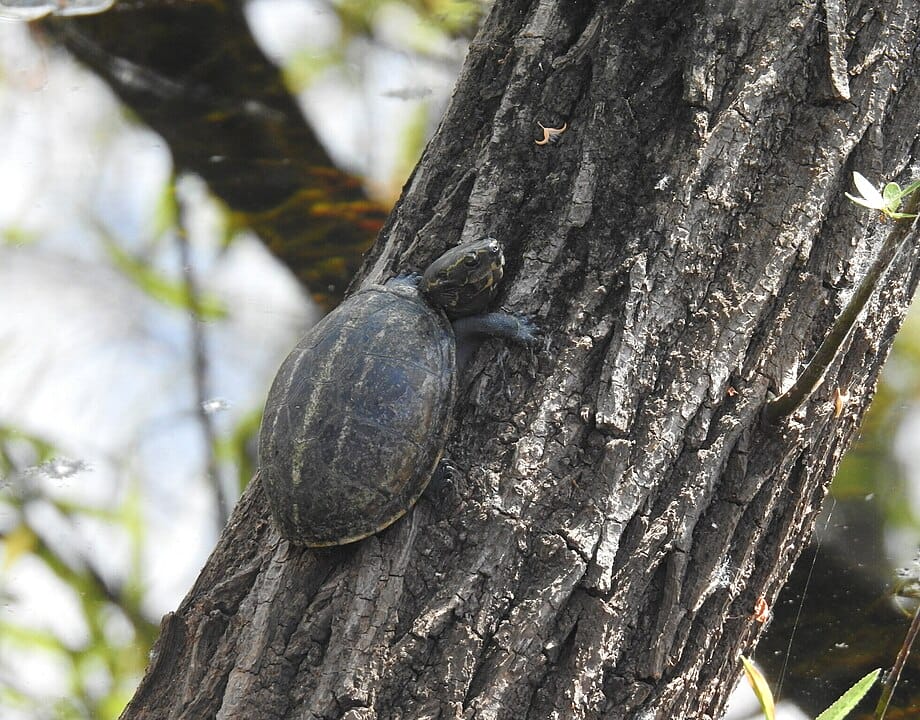
The field mark is right there in the name: three light tan or cream-colored stripes running lengthwise along the shell. Most also have a stripe between the eyes. The carapace is dark brown, and the plastron is typically rust-colored.
Why keepers like them: striped mud turtles are a bit more active and visible than eastern mud turtles. They’ll explore their tank instead of hiding all day.
Tank: 40-gallon minimum. They appreciate some cover like driftwood or aquatic plants to hide in when they want privacy.
Temperature: Water 74–78°F, basking spot 88–92°F. UVB (my pick: Zoo Med ReptiSun 10.0) lighting for 10–12 hours daily.
Diet: True omnivores — snails, earthworms, crustaceans, carrion, aquatic plants, algae, even palm seeds in the wild. In captivity, mix turtle pellets with live or frozen invertebrates and occasional greens.
4. Yellow Mud Turtle (Kinosternon flavescens)
| Scientific Name | Kinosternon flavescens |
| Also Known As | Yellow-Necked Mud Turtle |
| Adult Size | 4.5–6 inches |
| Weight | 11–12 ounces |
| Diet | Omnivorous |
| Lifespan | 10–40 years |
Yellow mud turtles are the landlubbers of this group. Compared to other mud turtles, they spend significantly more time on land and are surprisingly comfortable trekking overland between water sources when their ponds dry up.
They’re found across the central and southwestern US — Nebraska, Kansas, Oklahoma, Texas, New Mexico, Arizona — and down into northern Mexico. Dry grasslands, desert playas, temporary ponds that vanish in summer. They’ve evolved to handle conditions that would stress most aquatic turtles.
The giveaway: yellow coloring on the head, neck, and throat, sometimes extending along the sides of the shell. Their shell is more olive to brownish, often smoother than other species. Females lack the tail-tip spine that males have.
One distinctive feature: two hinges on the plastron instead of the usual one, letting them close up front and back independently. It’s like a turtle with two separate trapdoors.

Tank: They need more dry land than most mud turtles. Minimum 40-gallon tank but provide a larger terrestrial section — think 50/50 land to water or even more land. Some keepers go up to 40 gallons per turtle.
Temperature: Water 74–78°F, basking area at 88–92°F. UVB bulb running 10–12 hours a day.
Diet: Insects, small reptiles, amphibians, mollusks, snails, crayfish, fish, plus plant matter. In captivity, turtle pellets plus live invertebrates and occasional fruit and greens.
5. Red-Cheeked Mud Turtle (Kinosternon cruentatum)
| Scientific Name | Kinosternon scorpioides cruentatum |
| Adult Size | Up to 7 inches |
| Lifespan | 30–50 years |
| Diet | Carnivorous |
| Origin | Mexico, Belize, Guatemala, Honduras, Nicaragua |
Here’s where things get interesting. The red-cheeked mud turtle isn’t a North American species in the typical sense — it comes from southern Mexico and Central America, ranging through Belize, Guatemala, Honduras, and Nicaragua. It’s a subspecies of the scorpion mud turtle complex.
They’ve become popular in captivity because of their looks and bold personality. These guys aren’t shy.
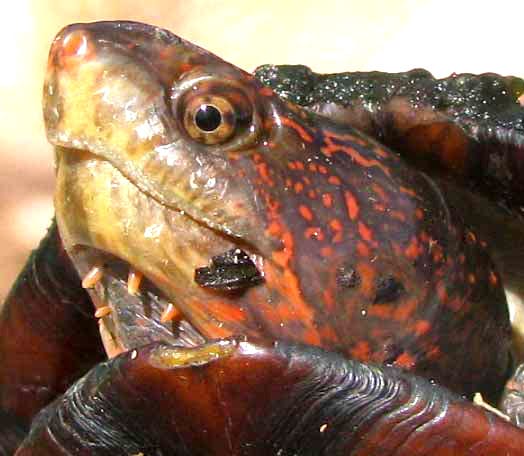
The appearance is genuinely striking: smooth, dark brown shell, bright orange to yellow plastron, and — most distinctively — red or orange patches on the face that look like flushed cheeks. Males are larger than females and have a longer, thicker tail ending in a small spine.
They like warm, slow-moving lakes and rivers with sandy or silty bottoms. Their native climate is tropical, which means they need slightly warmer conditions than North American mud turtles.
Tank: 40–50 gallons minimum for one adult. Keep water clean — a canister filter (my pick: Penn-Plax Cascade) is worth it for these guys as they can be messier feeders.
Temperature: Water 76–82°F (warmer than most North American species). Basking area at 90–95°F.
Diet: Strongly carnivorous — tiny freshwater fish, crabs, mollusks, amphibians, insects. They’ll also take carrion. In captivity: feeder fish, earthworms, snails, and turtle pellets as a supplement.
Note: They can be nippy when handled, especially younger animals. Handle carefully and let them acclimate on their own terms first.
6. White-Lipped Mud Turtle (Kinosternon leucostomum)
| Scientific Name | Kinosternon leucostomum |
| Adult Size | Up to 8 inches |
| Lifespan | 30–50 years |
| Diet | Omnivorous |
| Origin | Mexico, Central America, Colombia, Ecuador, Peru |
The white-lipped mud turtle is the largest on this list and arguably the most exotic. It’s native to Central and South America, ranging from southern Mexico through Colombia, Ecuador, Nicaragua, and into northwestern Peru. Entirely tropical.
Their distribution and care needs make them more of an experienced-keeper turtle than a beginner pick.
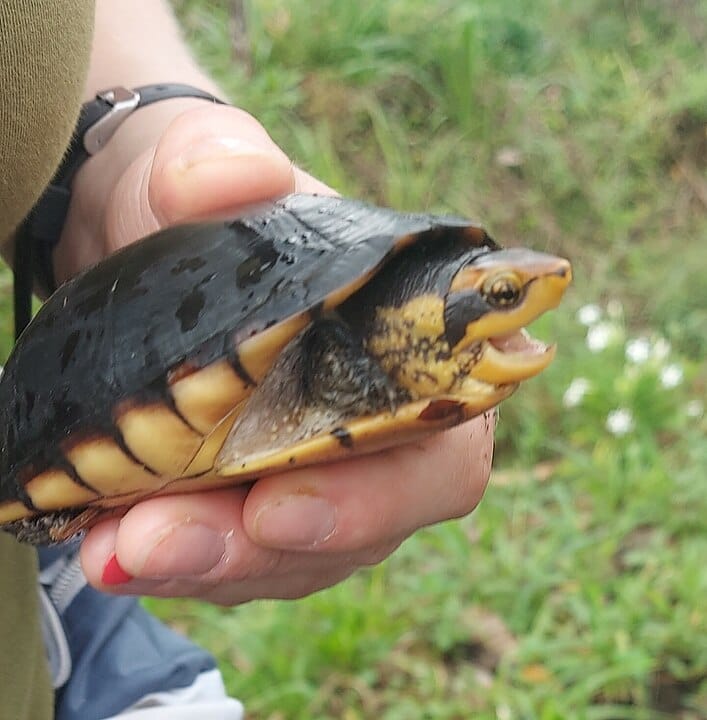
You can’t miss the ID: their lips and the skin around their mouth is distinctly white or cream-colored — hence the name. The shell is rounded and dark brown to black. Their plastron is yellow, and males have a horn-tipped tail.
Like the red-cheeked, they spend most of their time in water. Marshes, swamps, slow or stagnant water bodies are their preference. When water levels drop, they bury themselves in sandy, silty substrate and wait it out.
Tank: 50+ gallons for an adult. Robust filtration is non-negotiable — canister filter recommended. Provide plenty of aquatic cover like plants or driftwood.
Temperature: Water 76–82°F. Basking area 90–95°F. UVB lighting for 10–12 hours daily; calcium powder supplementation important for this species.
Diet: Broadly omnivorous — crabs, fish, crustaceans, mollusks, occasional plant matter. Active primarily at dawn and dusk in the wild. In captivity: feeder fish, shrimp, earthworms, snails, and turtle pellets.
Honest assessment: If this is your first turtle, start with a striped or eastern mud turtle. The white-lipped is rewarding but needs stable tropical conditions and an experienced eye.
General Mud Turtle Setup: The Basics
All six species share similar fundamentals. Here’s the short version:
Tank size:
Minimum 40 gallons for most species. More is always better.
Water depth:
Shallow. Adults should be able to reach the surface from the bottom. 6–10 inches is ideal for most mud turtles — deeper than that and poor swimmers can tire and drown.
Filtration:
Mud turtles are messy eaters. A canister filter rated for at least twice your tank volume keeps the water clean without constant partial changes.
Basking:
Every mud turtle needs a basking platform they can fully exit the water onto. UVB lighting above the basking area for 10–12 hours daily. The basking spot should hit 88–95°F depending on species.
UVB bulb:
Replace T8 bulbs every 6 months, T5 HO bulbs every 12 months. The bulb looks fine long before the UVB output degrades — set a calendar reminder.
Diet frequency:
Feed 2–3 times per week for adults. Juveniles need daily feeding. Dust food with calcium powder regularly.
For the full breakdown — water parameters, heating, substrate, tank mates, and feeding schedules — see the complete mud turtle care guide.
Which Mud Turtle Is Right for You?
Best for beginners: Eastern mud turtle or striped mud turtle. Hardy, forgiving of small mistakes, widely available, and stay compact.
Best if you want something active: Red-cheeked mud turtle. More personality, bolder behavior, genuinely interesting to watch.
Best if you have more space: Yellow mud turtle — they need more terrestrial area than the others.
For experienced keepers only: White-lipped mud turtle. Tropical needs, larger size, and less forgiving of setup errors.
All six make good long-term pets if you meet their basic requirements. The main mistake new keepers make is treating mud turtles like low-maintenance goldfish. They’re not. But compared to most turtle species, they’re about as manageable as aquatic turtles get.

About Author
Muntaseer Rahman started keeping pet turtles back in 2013. He also owns the largest Turtle & Tortoise Facebook community in Bangladesh. These days he is mostly active on Facebook.