How Much Should A Tortoise Weigh? [Weight Chart]

This post was created with help from AI tools and carefully reviewed by a human (Muntaseer Rahman). For more on how we use AI on this site, check out our Editorial Policy.
We obsess over how long our tortoise is getting. We measure the shell, brag about the growth, post the photos. And then we completely ignore the one number that actually flags trouble first: the weight.
Here is the thing. A tortoise that is quietly losing weight is often a tortoise that is quietly getting sick. By the time you notice it “looks a bit off,” you have missed weeks of warning.
So let’s fix that. How much should a tortoise actually weigh, and how do you know if yours is in the healthy zone?
A tortoise can weigh anywhere from about 150 grams to over 200 pounds depending on species and age. There is no single “correct” number. Instead, you check whether your specific tortoise is healthy using its length, with the Jackson ratio, the Donoghue ratio, or a simple tortoise BMI.
Below you get a full weight chart by species, weight-by-age tables for the popular pets, the exact formulas (done correctly, with worked examples), and how to fix an over or underweight tortoise. Grab a kitchen scale and let’s go.
How Much Does A Tortoise Weigh? (Weight Chart By Species)
Weight is tied to species first. A pancake tortoise and a Sulcata are both tortoises the way a chihuahua and a Great Dane are both dogs.
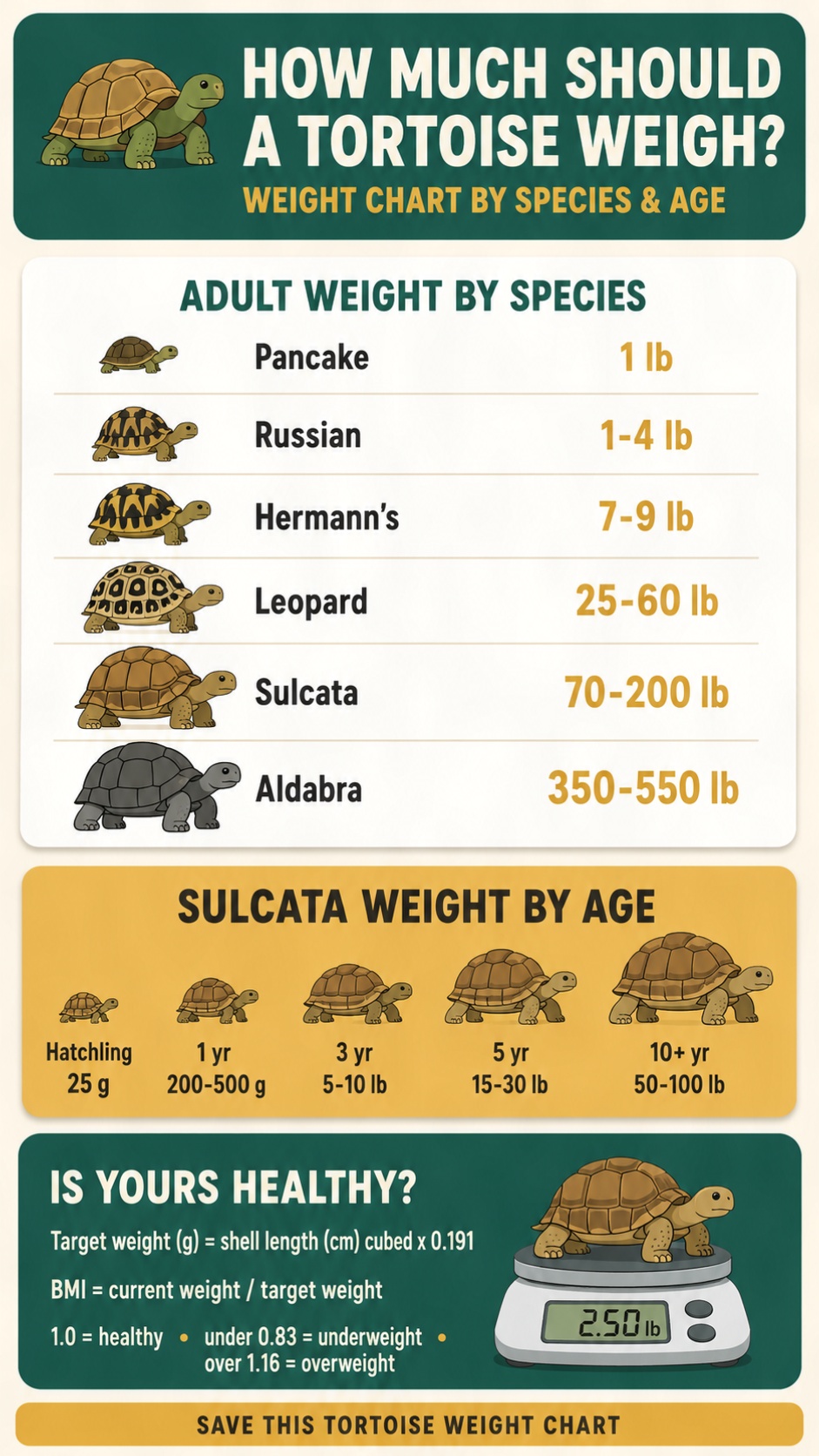
Here is what a healthy adult looks like on the scale, species by species.
| Tortoise Species | Adult Weight |
|---|---|
| Pancake Tortoise | ~1 pound (about 450 g) |
| Egyptian Tortoise | Up to 400 grams |
| Spider Tortoise | Up to 400 grams |
| Greek Tortoise | 2 – 3 pounds |
| Russian Tortoise | 1 – 4 pounds |
| Hermann’s Tortoise | 7 – 9 pounds |
| Indian Star Tortoise | 3 – 5.5 pounds |
| Elongated Tortoise | Up to 7 pounds |
| Marginated Tortoise | Up to 11 pounds |
| Red-Footed Tortoise | Up to 25 pounds |
| Yellow-Footed Tortoise | Up to 35 pounds |
| Radiated Tortoise | Up to 35 pounds |
| Leopard Tortoise | 25 – 60 pounds |
| Burmese Mountain Tortoise | 70 – 100 pounds |
| Sulcata Tortoise | 70 – 200 pounds |
| Aldabra Tortoise | 350 – 550 pounds |
Note: These are adult averages. A healthy tortoise can land a little above or below its species range based on genetics, sex, and locality. Females are often heavier than males in many species.

Tortoise Weight By Age (The Chart Everyone Actually Wants)
Adult numbers are great, but most people asking this question have a young tortoise and want to know if it is growing on track. So here are weight-by-age ranges for the most commonly kept species.
These are approximate. Captive tortoises fed well often run ahead of these numbers, and that is not always a good thing (fast growth can cause shell pyramiding). Use them as a guide, not a target to beat.
Sulcata (African Spurred) Tortoise Weight By Age
| Age | Approx. Weight |
|---|---|
| Hatchling | 25 – 30 grams |
| 1 year | 200 – 500 grams |
| 2 years | 1 – 2 pounds |
| 3 years | 5 – 10 pounds |
| 5 years | 15 – 30 pounds |
| 10+ years | 50 – 100+ pounds |
Russian Tortoise Weight By Age
| Age | Approx. Weight |
|---|---|
| Hatchling | 10 – 12 grams |
| 1 year | 30 – 60 grams |
| 3 years | 150 – 250 grams |
| 5 years | 300 – 500 grams |
| Adult | 1 – 4 pounds |
Hermann’s Tortoise Weight By Age
| Age | Approx. Weight |
|---|---|
| Hatchling | 10 – 12 grams |
| 1 year | 40 – 60 grams |
| 3 years | ~200 grams |
| 6 years | 400 – 600 grams |
| Adult | 7 – 9 pounds |
Leopard & Red-Footed Tortoise (Quick Reference)
| Species | Hatchling | Adult |
|---|---|---|
| Leopard | 25 – 30 grams | 25 – 60 pounds |
| Red-Footed | 20 – 30 grams | Up to 25 pounds |
If your tortoise is tracking near these numbers and staying active and alert, you are almost certainly fine. It is the sudden drops and the runaway gains that matter, which is what the next section is about.
This Hilarious Turtle Book Might Know Your Pet Better Than You Do

Let’s be real—most turtle care guides feel like reading a textbook written by a sleep-deprived zookeeper.
This one’s not that.
Told from the snarky point of view of a grumpy, judgmental turtle, 21 Turtle Truths You’ll Never Read in a Care Guide is packed with sarcasm, sass, and surprisingly useful insights.
And hey—you don’t have to commit to the whole thing just yet.
Grab 2 free truths from the ebook and get a taste of what your turtle really thinks about your setup, your food choices, and that weird plastic palm tree.
It’s funny, it’s honest, and if you’ve ever owned a turtle who glares at you like you’re the problem—you’ll feel seen.
What Is A Healthy Weight For A Tortoise?
Here is the important mindset shift. A tortoise is not “healthy” at a magic weight. It is healthy when its weight matches its length.
A long tortoise should weigh more than a short one. So the real question is whether your tortoise is dense enough for its size, and there are three tools for that.
Think of these like a BMI check for reptiles. Same idea, tortoise math.
1. The Jackson Ratio
The Jackson ratio checks weight against length, and it was designed mainly to answer one question: is this tortoise fit to hibernate?
Here is how you calculate it:
- Weigh the tortoise in grams.
- Measure the straight carapace length in centimeters.
- Divide the weight by the length cubed (length x length x length).
The formula is Weight (g) ÷ Length (cm)³. So a Hermann’s tortoise weighing 700 g with a 15 cm shell = 700 ÷ (15 x 15 x 15) = 700 ÷ 3,375 = 0.21, which reads as a healthy weight on the chart below.
| Jackson Ratio | Health Indication |
|---|---|
| 0.16 or under | Underweight |
| 0.17 – 0.18 | Underweight for hibernation |
| 0.19 – 0.20 | Normal weight |
| 0.21 – 0.22 | Healthy weight |
| 0.23 or above | Heavy, overweight, or carrying eggs |
Big catch: the Jackson ratio only works for Mediterranean tortoises, specifically Hermann’s tortoises and spur-thighed (Greek) tortoises. It was built from their body shape.
Do not use it on a Sulcata, leopard, Russian (Horsfield), marginated, hinge-back, or any tropical species. Their body shapes are different enough that a healthy tortoise can read as “underweight” and scare you for no reason.
2. The Donoghue Ratio (Works On More Species)
Susan Donoghue built a more flexible method after studying 76 tortoises and 11 box turtles across 11 species. It applies to almost all tortoise species, not just the Mediterranean ones.
Instead of scoring an existing tortoise, it tells you the target weight a tortoise of a given length should be.
Target weight in grams = Straight carapace length (cm)³ x 0.191
The length is cubed, and this is where most online guides (and the old version of this very post) get it wrong. You do not multiply the raw length by 0.191. You cube the length first.
Worked example: your tortoise has a 12 cm shell.
- Cube the length: 12 x 12 x 12 = 1,728
- Multiply by 0.191: 1,728 x 0.191 = 330 grams
So a healthy 12 cm tortoise should weigh around 330 grams, not 2.3 grams. If a formula ever hands you a target weight smaller than a grape, you forgot to cube.
For ounces, use SCL (inches)³ x 0.113 instead.
The Donoghue ratio still struggles with hatchlings and very odd-shaped species, so treat it as a strong estimate, not gospel.
3. Tortoise BMI
Once you have a target weight from the Donoghue ratio, the BMI tells you how your tortoise compares to it.
Tortoise BMI = Current weight ÷ Target weight
| BMI Ratio | Weight & Health Status |
|---|---|
| 0.66 or lower | Extremely underweight |
| 0.66 – 0.83 | Dehydrated or underfed |
| 0.83 – 0.99 | Slightly underweight |
| 1.00 | Healthy weight |
| 1.01 – 1.16 | Slightly overweight |
| 1.16 – 1.33 | Overweight |
| 1.33 or over | Extremely overweight |
Full worked example, start to finish:
- Measure the shell: 12 cm.
- Target weight (Donoghue): 12³ x 0.191 = 1,728 x 0.191 = 330 g.
- Weigh the tortoise: say it reads 300 g.
- BMI: 300 ÷ 330 = 0.91.
- Result: 0.91 falls in the “slightly underweight” band. Feed it up a little and recheck in a few weeks.
A BMI right around 1.0 is the goal. Any of these numbers is a range, not a verdict, so combine it with how the tortoise looks and acts.
How To Measure Your Tortoise’s Length And Weight Correctly
Every method above is only as good as your measurements. Garbage in, garbage out. Here is how to do it right.
Straight Carapace Length (SCL)
Do not use a soft tape that follows the curve of the dome. That inflates the number. You want the straight-line length.
- Put a sheet of paper on the floor against a wall.
- Place the tortoise on the paper, head toward the wall, front of the shell touching it.
- Mark the paper at the very back edge of the shell with a pencil.
- Lift the tortoise off and measure from the wall to the mark with a ruler.
Even easier: use a caliper or a straight ruler held flat above the shell, front edge to back edge.
Weight
- Give the tortoise a quick soak and pat it dry first, so a full bladder or dirt does not skew the reading.
- Set it directly on a digital kitchen scale (grams for accuracy).
- For a wriggly tortoise, weigh a bowl first, tare to zero, then put the tortoise in the bowl.
How Often Should You Weigh A Tortoise?
Weighing once is a snapshot. Weighing regularly is where the real value is, because the trend catches illness long before your eyes do.
- Hatchlings and young tortoises: weekly. They change fast, and a stall is an early red flag.
- Adults: monthly is plenty when everything is stable.
- Before and during hibernation: weigh going in, then roughly monthly, to track loss.
Jot the numbers down. A notebook works, or a tortoise care app that graphs it for you. A slow downward line over several weigh-ins is your cue to look closer, even if the tortoise seems normal.
Weight And Hibernation: Why It Matters Most Here
If your tortoise hibernates, weight stops being a nice-to-know and becomes a safety check.
A tortoise that is underweight going into hibernation may not have the reserves to survive months without food. An overweight one carries its own risks and may not settle properly.
This is exactly what the Jackson ratio was built for. For Hermann’s and spur-thighed tortoises, aim for a ratio in the 0.19 to 0.22 band before they go under. Below 0.18 or above 0.23, and most keepers delay hibernation and fix the weight first.
During hibernation, a healthy tortoise loses roughly 1% of its body weight per month. Losing much more than that means something is wrong, and it is time to wake the tortoise and check in with a vet.

Why You Need To Monitor Your Tortoise’s Weight
Beyond hibernation, weight is the cheapest health monitor you own. It tells you things the tortoise cannot.
A steady, unexplained drop is one of the earliest signs of illness, parasites, or poor husbandry. Weight loss shows up before sunken eyes, before lethargy, before the stuff you would actually notice.
A creeping gain flags overfeeding or too little space to move, both of which shorten a tortoise’s life.
And around breeding season, a jump in a female’s weight can simply mean she is carrying eggs. Context matters, which is why the trend beats any single number.
Why Is My Tortoise Overweight?
Yes, a fat tortoise looks cute. No, it is not healthy. Obesity in tortoises brings real problems: fatty limbs and neck that stop it retracting fully into the shell, trouble walking, and raised risk of liver, kidney, and heart disease.
Two things usually cause it.
Overfeeding
Tortoises are opportunists. They will keep eating as long as food keeps appearing, because in the wild food is never guaranteed. Feed too often or too much, especially protein-heavy or fruity food, and the weight piles on.
Too Little Exercise
A tortoise stuck in a cramped enclosure cannot graze and roam the way it needs to. No movement, no calorie burn. A bigger space and daily grazing time do a lot of the work for you. If your tortoise is already tipping overweight, our guide on whether tortoises can get overweight walks through slimming it down safely.
Why Is My Tortoise Underweight?
A skinny tortoise is almost always a sign that something in the care sheet is off. Here are the five usual suspects.
1. Dehydration
Lack of a water dish, an irregular soaking schedule, or low humidity causes weight loss fast, especially in hatchlings. A dehydrated tortoise needs soaking and moisture corrected before anything else.
2. Underfeeding
Too little food, or the wrong food, and the weight falls off. Filling a tortoise with watery lettuce or cucumber leaves it full but starved of real nutrition, so it stays thin even after eating.
3. Refusing Food
Sometimes tortoises go off their food entirely because of boredom, low temperatures, or stress. Less eating, less weight.
4. Illness Or Parasites
Weight loss is the most common symptom of almost any tortoise illness. Parasites are a big one: worms live off the tortoise and steal its nutrition, leaving it skinny, sunken-eyed, and often with diarrhea. Chronic weight loss with a soft or deformed shell can also point to metabolic bone disease.
5. Stress
A stressed tortoise eats less. Cramped space, too many tank mates, loud noise, wrong temperature, or low humidity can all do it. Fix the environment and the appetite usually returns.
How To Get Your Tortoise Back To A Healthy Weight
If the numbers say your tortoise is off target, here is how to steer it back.
1. Build a proper diet. Tortoises want high fiber, low protein. Too much protein packs fat onto the limbs and neck. Base meals on weeds, leafy greens, and species-appropriate food from a solid tortoise feeding guide.
2. Get the portion right. A common rule of thumb is a portion roughly the size of the tortoise’s shell, or about 5% of body weight for growing tortoises. Do not free-feed an adult.
3. Set a feeding schedule. Baby tortoises need feeding daily. Adults do well on about 5 days a week, and seniors often prefer 3, since their appetite drops.
4. Encourage movement. Give the tortoise room to walk and graze. Scatter food or place it a short walk away so eating doubles as exercise.
5. Fix the environment. Correct temperature, humidity, and space keep a tortoise relaxed and eating normally, which keeps weight stable.
6. Add variety. Same meal every day and tortoises lose interest, then lose weight. Rotate the menu to keep them keen.
7. See a vet when weight keeps sliding. Persistent loss despite good care means it is time for a reptile vet. Never medicate a tortoise on a guess.
Is Some Weight Change Normal?
Yes, and knowing the difference saves you a panic. Not every wobble on the scale is an emergency.
A tortoise weighs less right after emptying its bladder and more right after a big drink or meal. That is why you weigh under the same conditions each time, ideally after a soak.
Seasonal dips during cooler months or a light natural slowdown can be normal too. What is not normal is a steady, unexplained decline weigh-in after weigh-in. That trend is your signal to investigate.
Frequently Asked Questions
How much should a baby tortoise weigh?
Most hatchling tortoises weigh only 10 to 30 grams, depending on species. What matters more than the exact number is steady weekly gain. A hatchling that stops gaining or starts dropping needs attention quickly, since they dehydrate fast.
How do I know if my tortoise is a healthy weight?
Compare its weight to its length, not to a fixed number. Use the Jackson ratio (Hermann’s and spur-thighed only) or the Donoghue ratio and BMI for other species. A BMI near 1.0, plus an active, alert tortoise, means you are in good shape.
How often should I weigh my tortoise?
Weigh hatchlings weekly and adults monthly. Weigh more often before and during hibernation. The trend over time matters far more than any single reading.
Do tortoises lose weight during hibernation?
Yes. A healthy hibernating tortoise loses about 1% of its body weight per month. Significantly more than that is a warning sign, and the tortoise should be woken and checked.
Can a tortoise be too heavy?
Absolutely. Overweight tortoises can struggle to retract into the shell, have trouble walking, and face higher odds of liver, kidney, and heart disease. Fat is not the same as healthy weight.
Before You Go
Your tortoise cannot tell you when something feels wrong. The scale can. A cheap digital kitchen scale and a two-minute monthly habit is one of the best early-warning systems you have.
Learn your tortoise’s healthy number, write down the trend, and act on the direction it is heading. Catch the drift early and most problems are easy fixes. Ignore it, and small issues become vet emergencies.
Now go weigh your tortoise. Seriously, right now. You will sleep better knowing.

About Author
Muntaseer Rahman started keeping pet turtles back in 2013. He also owns the largest Turtle & Tortoise Facebook community in Bangladesh. These days he is mostly active on Facebook.